
Welcome to Luxarion: Readings and Spiritual Work, Room by Room
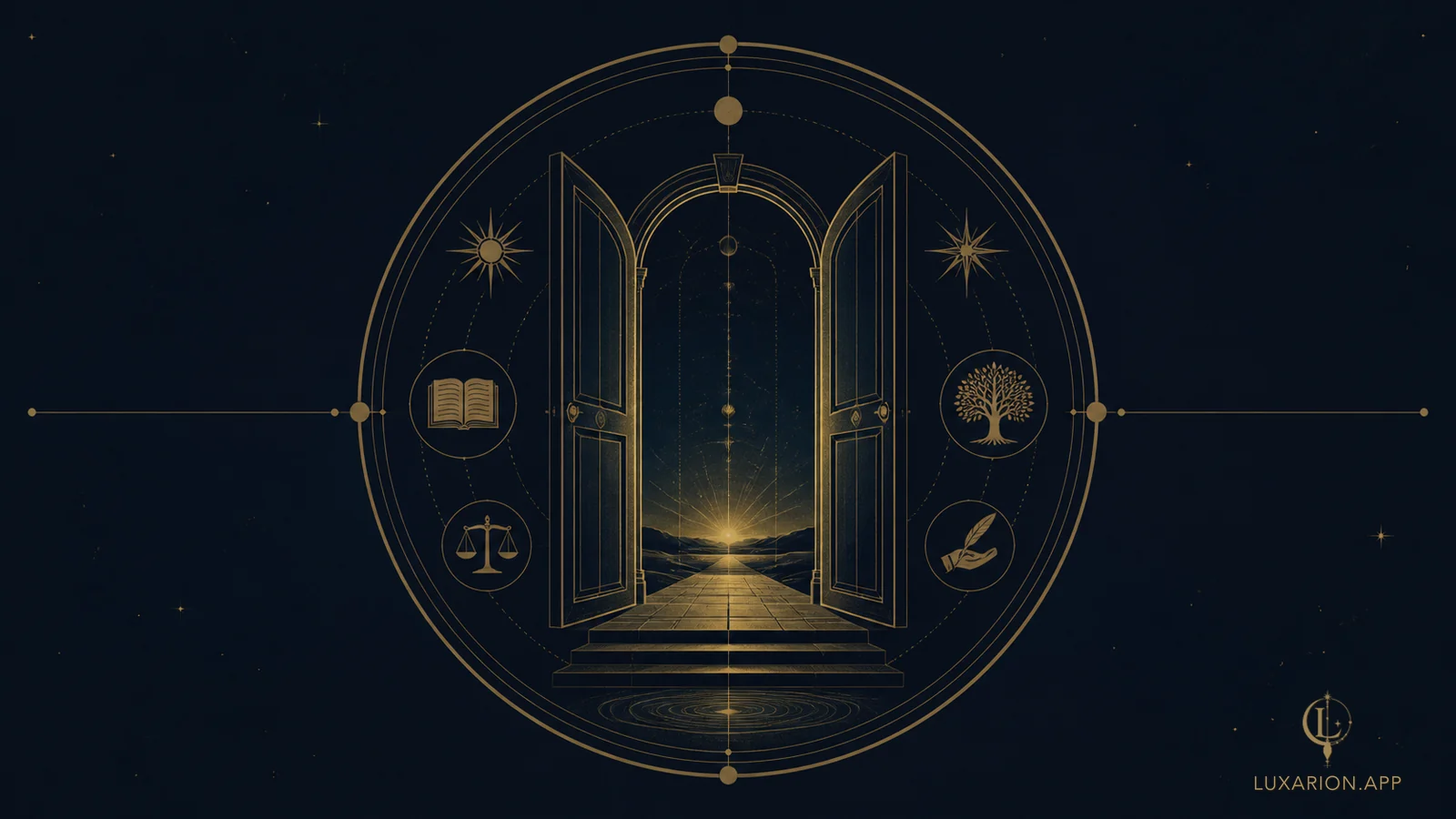
You arrive with a question; the house does the rest. A walk through every room of Luxarion — readings, spiritual work, the readers, the free doors, and Wren.
Almost nobody comes here first. You come from somewhere — from a dream that was still standing in the room when you woke, from a cup somebody turned over at the end of coffee, from one of those nights when a decision refuses to lie down and sleep, from a heaviness that arrived without a reason. You arrive carrying a question, precise or unnamed, and the first thing this house owes you is to say plainly what it is.
So, plainly: Luxarion works in the unseen. It reads — coffee cups and palms, tarot and dreams, birth charts and the bond between two people. It uncovers what is at work around a person: the evil eye, envy, sihr, a blockage in love or in rizq. It does the work that answers what the uncovering finds — undoing sihr, drawing a beloved's heart back, opening rizq — and it prepares spiritual pieces, rings and stones for the purpose each is made to carry. Its readers are verified practitioners and an AI reader grounded in the same traditions; everything is written natively in five languages, with a library, a handful of free tools, and a companion for the hours in between. The company behind it, Luxarion LLC, is a software and artificial-intelligence company registered in the State of Wyoming, and where most of its industry keeps a careful distance from this work, it was built around it.
That is the floor plan. But no house is its floor plan. Stay a few minutes and walk it room by room — the tour costs nothing, and by the last door you will know which one is yours.
The questions that bring people here
Every room in this house was built because somebody kept arriving with a particular kind of question. Six of them account for most of the footsteps.
There is the dream that does not end when it ends — the one still sitting at the foot of the bed at seven in the morning, asking to be read like a letter that arrived without a sender. What the classical interpreters read in a dream like that, and how a dream carries a message, glad tidings or a warning, is the subject of a dream is a letter.
There is the cup. Coffee finished, conversation gone quiet, and in the drying grounds a bird lifting off near the rim — news on its way, and close. What the cup keeps, and how it shows what is coming, is told in the cup remembers.
There is the question about another person — whether he will call, what she carries toward you, where the bond is heading. A reading answers it, and a question asked well is answered sharply: how to ask about love. And when a bond needs work rather than a reading — a heart to draw back, a harmony to restore — that work is done here too.
There is the chart — you know your sign, you have heard the words rising and moon, and somewhere in you is the suspicion that a twelfth of humanity does not share your interior weather. It doesn't. The birth chart calculator will show you what does, free, in about a minute.
There is the decision — job, city, marriage, silence — the kind you take for a long walk rather than to a stage. It asks for guidance, and one of the oldest ways of seeking it is described in istikhara, and making the decision.
And there is the heaviness that came from nowhere — love that will not settle, rizq that will not open, a weight nobody can name. That is what spiritual uncovering is for, and it has its own room below.
Different questions want different rooms. The house is arranged so that the question chooses.
The reading rooms
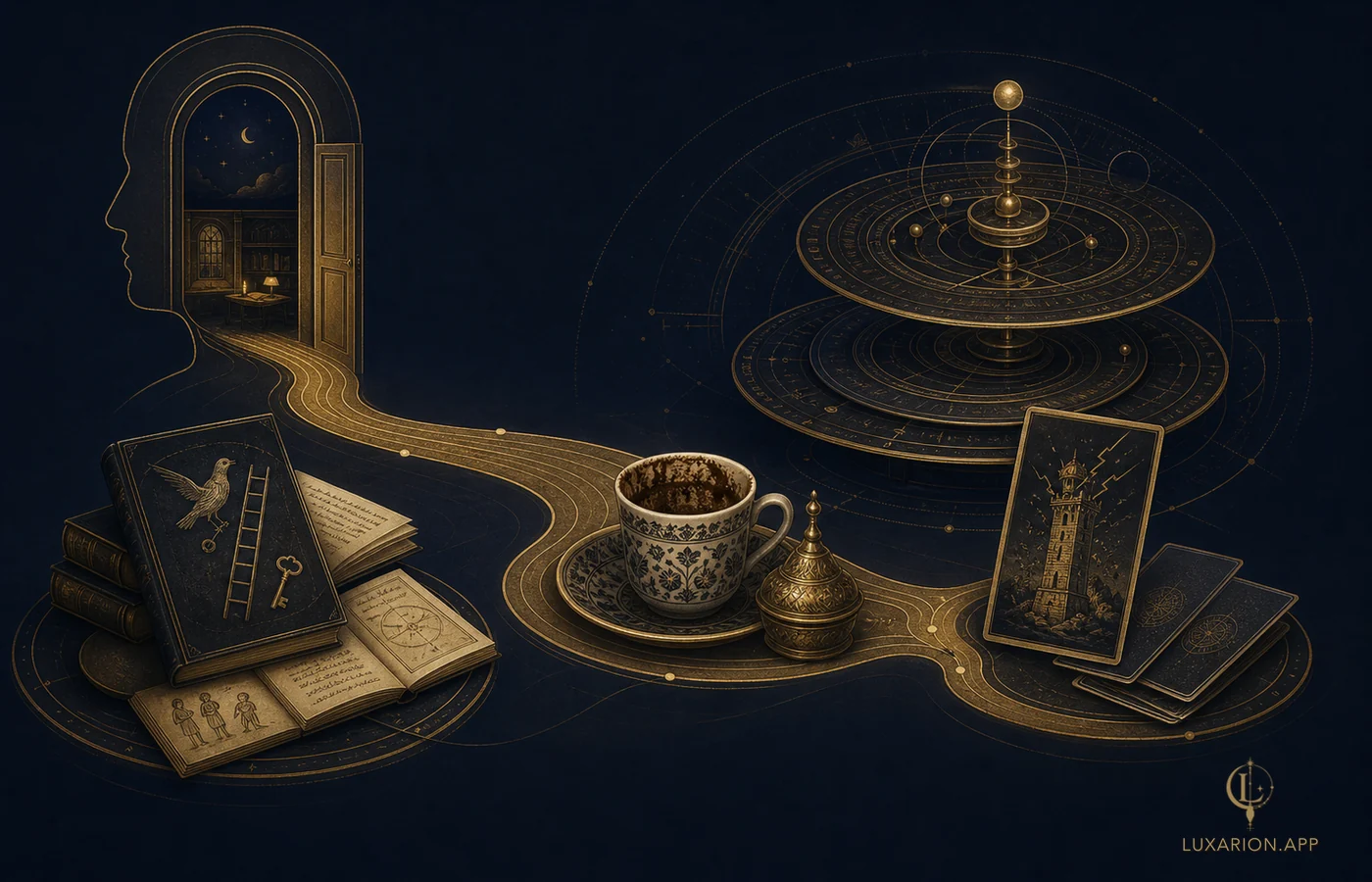
There is no generic mysticism on this floor. Each room descends from a documented tradition, works inside that tradition's own rules, and inherits its cautions along with its craft.
The night's room holds dream interpretation, in the lineage that runs from the method of Ibn Sīrīn — context before symbol, the dreamer before the dream — and from Artemidorus: a dream can carry a message, glad tidings or a warning, and the interpreter says which. Bring the dream while it is fresh: the dream interpretation room is open, and the bird, the ladder, the key will teach you to keep your own symbol alphabet between visits.
The table's rooms hold the crafts you meet with your hands. Coffee-cup reading, the Levantine and Anatolian art that reads what is approaching in the grounds, whose living context UNESCO recognised when it added Turkish coffee culture to the intangible cultural heritage of humanity. Tarot, read card by card for what is at work, what is hidden and where it leads — the form A. E. Waite and the artist Pamela Colman Smith shaped in 1909, whose most feared card turns out to be a mercy. And palm reading, among the oldest of the body's own texts, whose true premise — a hand records what has been lived and indicates what is forming — is restored in hands change.
The sky's rooms hold astrology in its full sense: the complete natal geometry, of which the sun-sign column is only the first page — you are not your sun sign sets out the rest. A natal chart reading starts from your own sky and its timing; a spiritual compatibility report reads two of them side by side, the weather between, and where the bond is heading.
The uncovering room. Some questions arrive without a method attached. A love consultation reads a bond itself — what moves between two people and where it is going. And the spiritual reading is where spiritual uncovering is done: a verified practitioner looks at what is at work around you — the eye, envy, sihr, a blockage in love or in rizq — what it is, and what will lift it. It is also the widest door in the house, the one to choose when you cannot name the room you need.
And the work room. When what is found needs work rather than a reading, the work is done here: sihr undone, a beloved's heart drawn back, rizq opened, a person protected from the eye and from sihr. It is asked for on the page to request your spiritual piece, where Luxarion prepares rings, necklaces, bracelets, pendants and talismans — stones chosen for their properties — each made for one person and the purpose it is to carry: protection and fortification, love and harmony, rizq and blessing, acceptance, presence, ease in one's affairs, or a purpose you name in your own words.
Two ways to be read
The reading rooms above can be entered in one of two ways — the uncovering and the work are a practitioner's alone — and the difference is not a pricing tier. It is a difference in who is reading.
An AI reading is a reader grounded in the documented rules of the tradition — the symbol families of the cup, the houses and aspects of a chart — and returns a full reading in about a minute: what is at work, what is hidden, what is approaching. The page where you buy it says plainly that it is an AI reader. Its strengths are real: it is fast, consistent, available at any hour in any of the five languages, and it never gets tired of a beginner's question.
An expert reading is written by a human practitioner — described in our terms, precisely rather than flatteringly, as independent or Luxarion-vetted. A person weighs your particular situation, notices what you did not ask, and answers what you ask next: an expert reading stays open for follow-up, so an answer can become a conversation. It is not instant, because a person is reading, and that is the point of it.
One is a craft, carefully encoded. The other is a craftsman, actually met. Neither pretends to be the other, and the difference is exactly why both exist.
Either way, what you write and what you upload stay between you and your reading — an expert sees only the consultation you bring them, and nothing you share is ever published. Live prices for both ways sit on the services page rather than in this article, because they are configured and change. Choose by what the question needs: structure and speed, or company and depth.
Wren, for the hours between
Formal readings are occasions. Most of a question's life is not an occasion — it is Tuesday, 3 a.m., and something is stirring that has not yet found its shape.
For those hours there is Wren. She is the knowledge behind Luxarion kept close and awake: bring her the card you drew this morning, a dream that lingered, tonight's sky, or a feeling you cannot name yet, and she answers in your language, gently and without spectacle. She is good at small — the half-formed question you would not book a reading for, asked anyway.
Two practical things about her. She is Luxarion's AI companion, the knowledge of the house between readings, and where a question needs a full reading or a practitioner's hand, she will tell you which room it belongs in. And past the first hello she keeps modest accounts: you can try her as a guest from the companion drawer on any page of the house, and with an account her conversation is metered in Lux like everything else here.
The doors that are open before you knock
A fair amount of this house asks nothing at all, and it is real work, not samples.
The birth chart calculator computes your Sun, Moon, rising sign and every planetary placement with a professional-grade ephemeris — the same astronomy an astrologer uses — free, no account. The compatibility checker takes two signs and returns a score and a short reading, also without an account — the first page of a bond, with the full map in the compatibility reading. The daily horoscope is freshly written every day and free for everyone.
The library — of which this article is the front door — is entirely free, and much of it teaches practices that cost nothing either: one card in the morning, a short return to the day at night, a page of ink as witness. If you cannot tell which room you need, a short quiz will make a suggestion.
Two more doors open with a free account, and it is fair to say so. Daily Cosmos gathers your day in one place — the sky, your card of the day, a whispered reading, a streak that notices you came back — and needs an account to know whose sky it is holding. And the pendulum takes one question, clearly held, and answers yes, no, or maybe, with a line on what it sees; sign in, hold the question, and watch the swing.
Five languages, five inheritances
Luxarion is written in Arabic, Persian, English, French and Turkish. Written in them — not translated into them, which is a different thing wearing the same flag.
A language is not a wrapper around meaning; it is a world with an inheritance. The Arabic pages draw on the ishāra of the Sufi tradition; the Persian ones grew up with Rumi and Hafez, in a culture where opening the Divan at random is a national instinct; the Turkish ones carry the hikmet of Yasawi and a coffee culture where a turned cup is ordinary hospitality; the French ones inherit that language's long argument with the soul. Each locale is authored by people from inside its culture, its experts come from that culture's own world, and an article can exist in one language before it exists in another — this one is written five separate times.
The intended effect is simple to state and rare to feel: you should feel addressed, not accommodated.
What the house declines
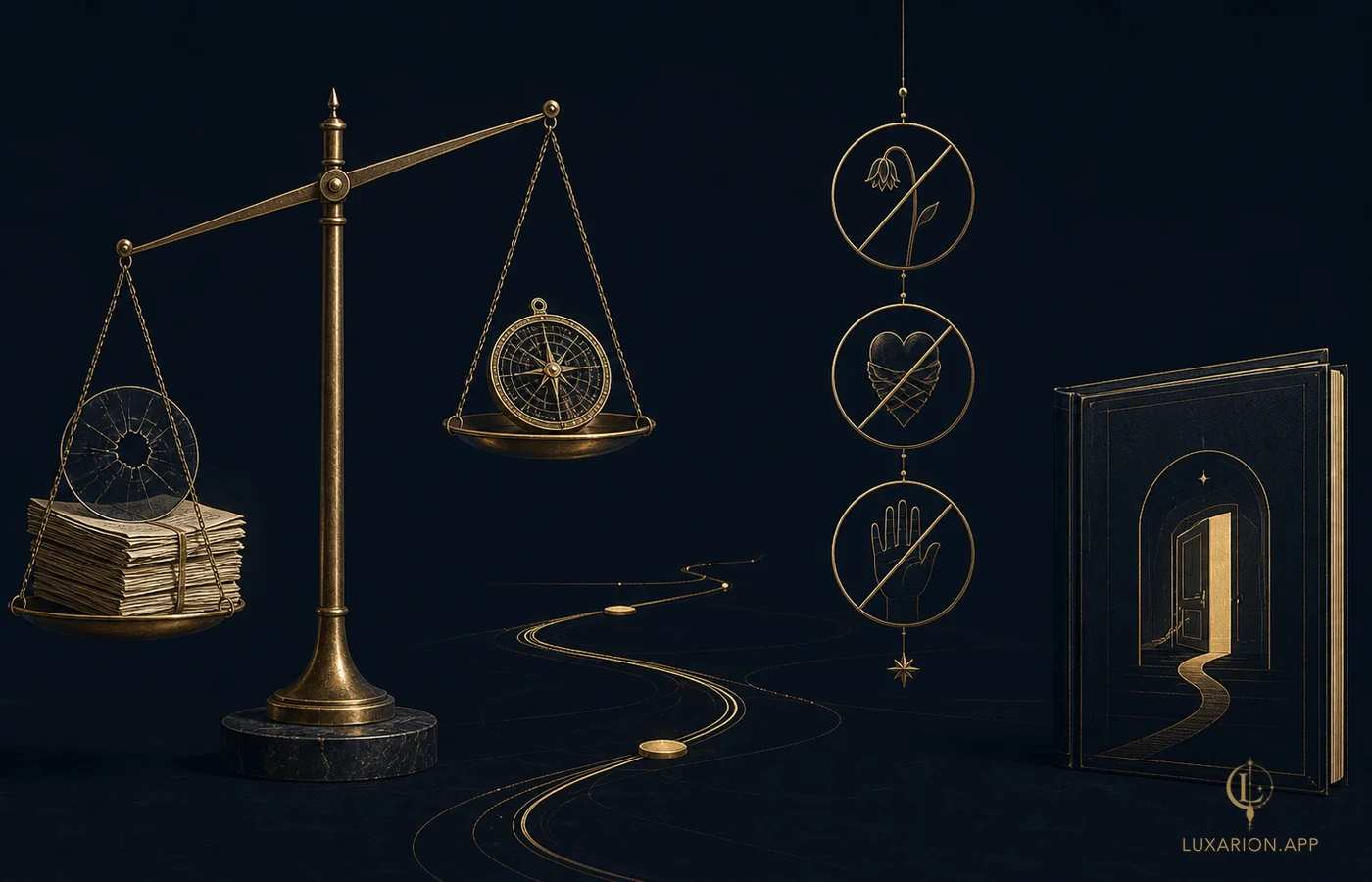
Every real tradition in this house survived by knowing its limits, and the house keeps them. The refusals are few, and they are load-bearing.
The house does no harm work: sihr is undone here and never cast, and no work is done to separate two people, to sicken anyone, or to ruin them. No reading pronounces on the body — illness belongs with a physician, and no reader dates a death. And no reading pronounces a fixed doom: the craft's own maxim — the stars incline, they do not compel — is older than this company and binding on it; a reader who declares a life finished has left the craft for theatre. When a reader declines, and how, has its own article: when the reading says no.
And the house is exact about its own tools. The life line marks the vitality and the turning points of a life, and it is never read as a count of years. The sun-sign column is the first page of astrology, and a compatibility reading here compares two whole charts — we set out how in compatibility is a verb. Exactness is how a craft keeps faith with the people who come to it.
The legal frame is written down where you can read it: the terms set out, as a matter of law, that a consultation is not medical, legal, psychological or financial advice, ask that you be eighteen — you confirm this before any reading begins — and carry the money-back guarantee on completed consultations. Stated once, in its own register, so the rest of the house can speak about the work in the work's own voice.
The practical house
A house this size needs a till, and Luxarion's is deliberately boring — in the best sense.
Readings are paid in Lux (Ł), the house's own unit: one currency through all five language doors, prepaid into your wallet once, deliberately, so that no checkout ever interrupts a held moment. The rate is fixed, published, and shown beside your balance — Lux is built to make costs clearer, not blurrier.
Around the wallet stand three quieter counters. Memberships — Lux Rise, Lux Flow, Lux Ascend and Lux Crown — bundle discounts, included sessions and perks for people who have made the house a habit. The store ships physical pieces worldwide — journals, incense, keepsakes — and keeps a small digital shelf for Crown members. And a reading can be given: a gift, sent to someone who is carrying a question of their own.
All of it runs in the browser today, on any device. The mobile applications are being prepared for the App Store and Google Play and are not yet released; when they arrive it will be the same account and the same wallet, and until then we would rather show working software than promise it.
Who stands behind it
Luxarion was founded by Eng. Ahmed Hassan, an engineer, who runs it as chief executive. He did not set out to add another app to the world's acceleration; he set out to build the opposite of one.
Luxarion isn't another app added to the rush. It's a refuge from it.
That sentence, from the founder's own note, is the closest thing the house has to a blueprint: a place that offers what the noise cannot — a moment of stillness, and the kind of clarity that gets harder to reach the more you need it. The company behind the refuge is Luxarion LLC, a limited liability company registered in the State of Wyoming; the formal record, registered office included, is stated in full on the about page, because a house that asks for your trust should be checkable down to its paperwork.
Choose your door
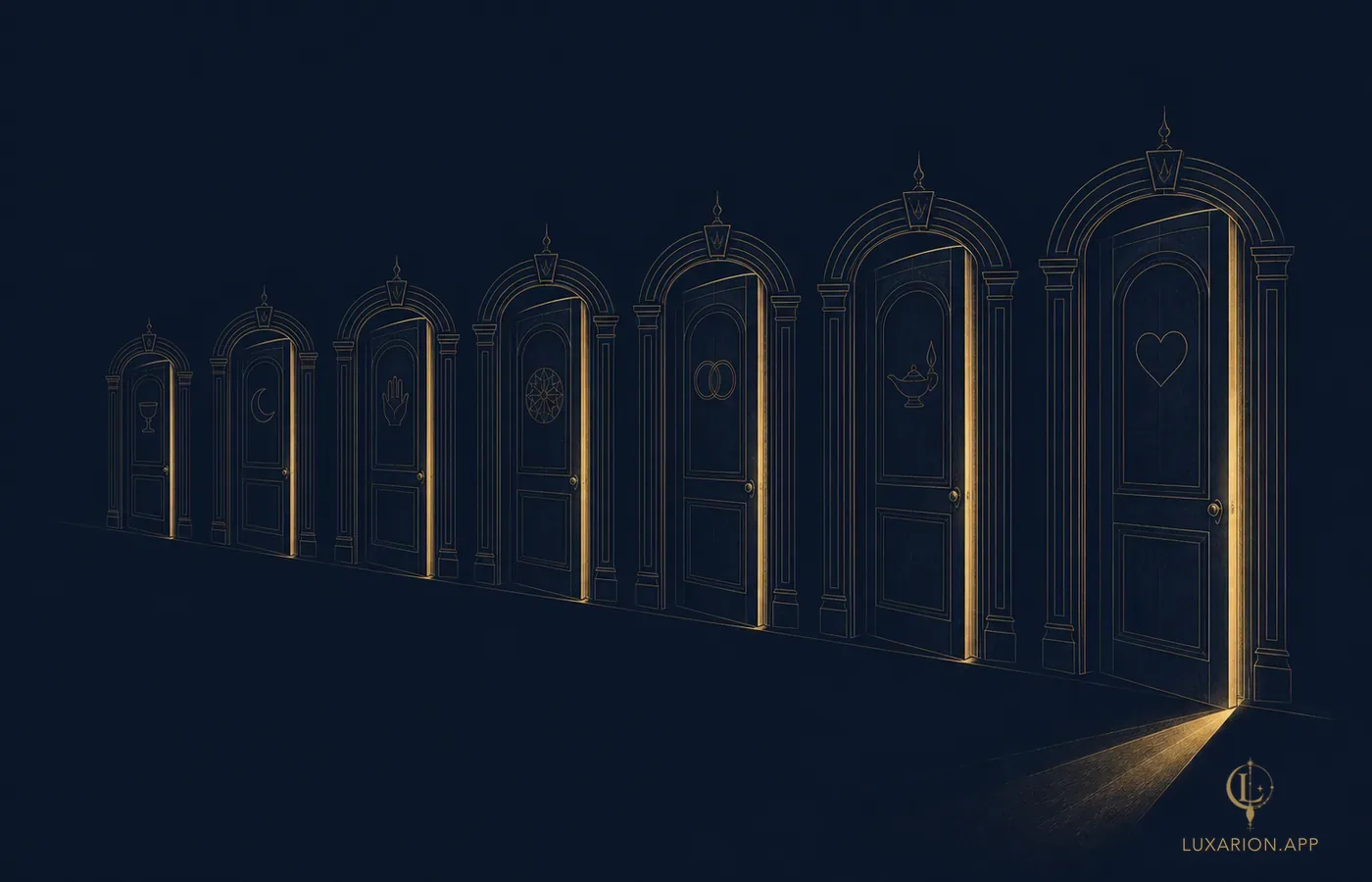
You arrived with a question. Here is the house, one last time, arranged around it:
- If it is about love — a person, a silence, a maybe — the love consultation holds it, and holds it better the better it is asked.
- If it is about who you are and when — start free at the calculator, then let a natal reading turn the geometry into sentences.
- If it is about the two of you — the free checker is the doorstep; the compatibility report is the room.
- If it is about tonight — the daily horoscope is already written, and Daily Cosmos will keep your sky for you.
- If it wants a person — the experts page shows who reads here and in what; reserve a chamber.
- If it is one sharp yes-or-no — take it to the pendulum and watch the swing.
- If something is blocked or heavy — love that will not settle, rizq that will not open, the mark of the eye or of sihr — the spiritual reading uncovers it, and the work that lifts it is asked for when you request your spiritual piece.
- If you cannot name it at all — the spiritual reading is the widest door, and the cup or last night's dream may know more than you have told them.
And if tonight you open none of them, that is a fine visit too. Read something in the library. Draw one card in the morning. Let the house be what it was built to be: a set of rooms where what is hidden is read, what is coming is named, and what weighs on a life is lifted.
What a reading here does is name what is moving around you and where it is heading — the influence you have felt without being able to place it, the season you are actually in, what is approaching, and the road that is open. The kettle is on. The cards are wrapped in their cloth. The sky is already turning. Welcome to Luxarion.
The library teaches the craft. A reading applies it to you.
Get your personal reading