

One Card a Day: How Tarot Readers Are Actually Made
The daily draw is tarot's oldest classroom: why teachers assign it, what Pamela Colman Smith changed in 1909, and lens versus forecast.
Ask working readers how they learned, and you will hear about books, teachers and one or two disastrous early readings for friends. And then, almost universally, the same quiet admission: what actually taught them was the year — or the five years — of drawing one card every morning.
The daily draw is the tradition's apprenticeship. It looks like the simplest thing in tarot, and it is the one practice every serious teacher assigns, in every school, regardless of what else they disagree about.
That is worth pausing on. Readers who use reversals and readers who refuse them, Marseille practitioners and Rider–Waite–Smith practitioners, people who read professionally and people who never read for anyone but themselves — all of them arrive at the same instruction for beginners. There is a precise pedagogy hiding inside the simplicity, and this article sets it out: why one card, why daily, what to write down, what the first month feels like, what the first year actually teaches, and the three ways the practice goes wrong.
Why one, and why daily
Seventy-eight cards are a language, and languages are not learned from dictionaries.
A ten-card spread read once a week gives each card a walk-on part. One card held all day gives it a full performance. By noon you have watched your card turn up in an argument with a colleague; by evening it has appeared in a small kindness you nearly failed to notice. The card stops being a definition and becomes an acquaintance.
This is also why teachers insist on one. Draw three and your attention splits into a committee; you spend the day adjudicating between them instead of living alongside any of them. The classical instruction is almost monastic: one card, drawn before the day begins, named aloud, and carried.
The daily part is doing something specific too. What makes the trumps and the suits stick is not intensity but return — the same principle behind spaced repetition and behind every craft that is learned by daily practice rather than by study. Seventy-eight cards, one a day, is roughly three months to meet the whole deck once. Most readers say the second pass is where it starts.
And there is a plainer reason, which practitioners mention more often than the pedagogical one: a daily card is a habit small enough to survive a bad week. Anything larger gets abandoned in February.
The deck that made it possible
The practice in its modern form owes almost everything to one artist, and her name is worth saying whenever the practice is taught.
Before 1909, most decks — the Marseille pattern above all — showed the minor arcana as pip cards: five cups, seven coins, arranged like playing cards, legible only to someone already trained. You could not hand a beginner the Five of Coins and expect a day's worth of thought from it.
Then Pamela Colman Smith, commissioned by A. E. Waite, painted a scene on all seventy-eight. The sleepless figure of the Nine of Swords, upright in bed with their face in their hands. The grey exile of the Five of Cups, mourning three spilled vessels and blind to the two still standing behind. Suddenly every card could speak to a beginner on sight, and the daily draw became possible for someone with no teacher at all.
Waite's own commentary is worth pairing with the images: brief, strange, and considerably more open-ended than the keyword lists that later hardened around his deck. Reading his sentences beside her pictures is one of the fastest ways to loosen a beginner's grip on fixed meanings.
Smith was paid a small flat fee and credited for decades in a footnote. Her illustrations are now among the most reproduced images in the world, and much of the deck's material has long since passed into the public domain. Say her name when you teach this. The classroom she painted is still open.
Lens, not forecast
Here is the discipline that makes the practice work, and experienced readers state it on day one: the morning card is a lens, not a forecast.
Draw the Tower and the assignment is not to brace for catastrophe. It is to spend one day noticing where structures creak — where a truth is louder than the container holding it. We wrote a whole essay on that card's mercy in the Tower is a mercy, and it is the single most useful card to meet early in a daily practice, precisely because it teaches the lens habit under pressure.
Draw the Empress and the assignment is to notice what is being nourished and what is being starved — in your work, your household, your body — for one day.
The difference is not cosmetic. A forecast asks the day to confirm the card, and a day can always be bent into confirming something. A lens asks the card to sharpen the day, which is a question the day can actually answer. One produces a private argument with reality; the other produces observations.
What you have primed yourself to notice you will notice more of; that is ordinary and it is also exactly the point. The card is not competing with your judgement. It is choosing, for one day, which of a thousand available things you will look at — and choosing it in a way you did not control, which is what makes it different from simply deciding to think about your marriage today.
How to actually do it
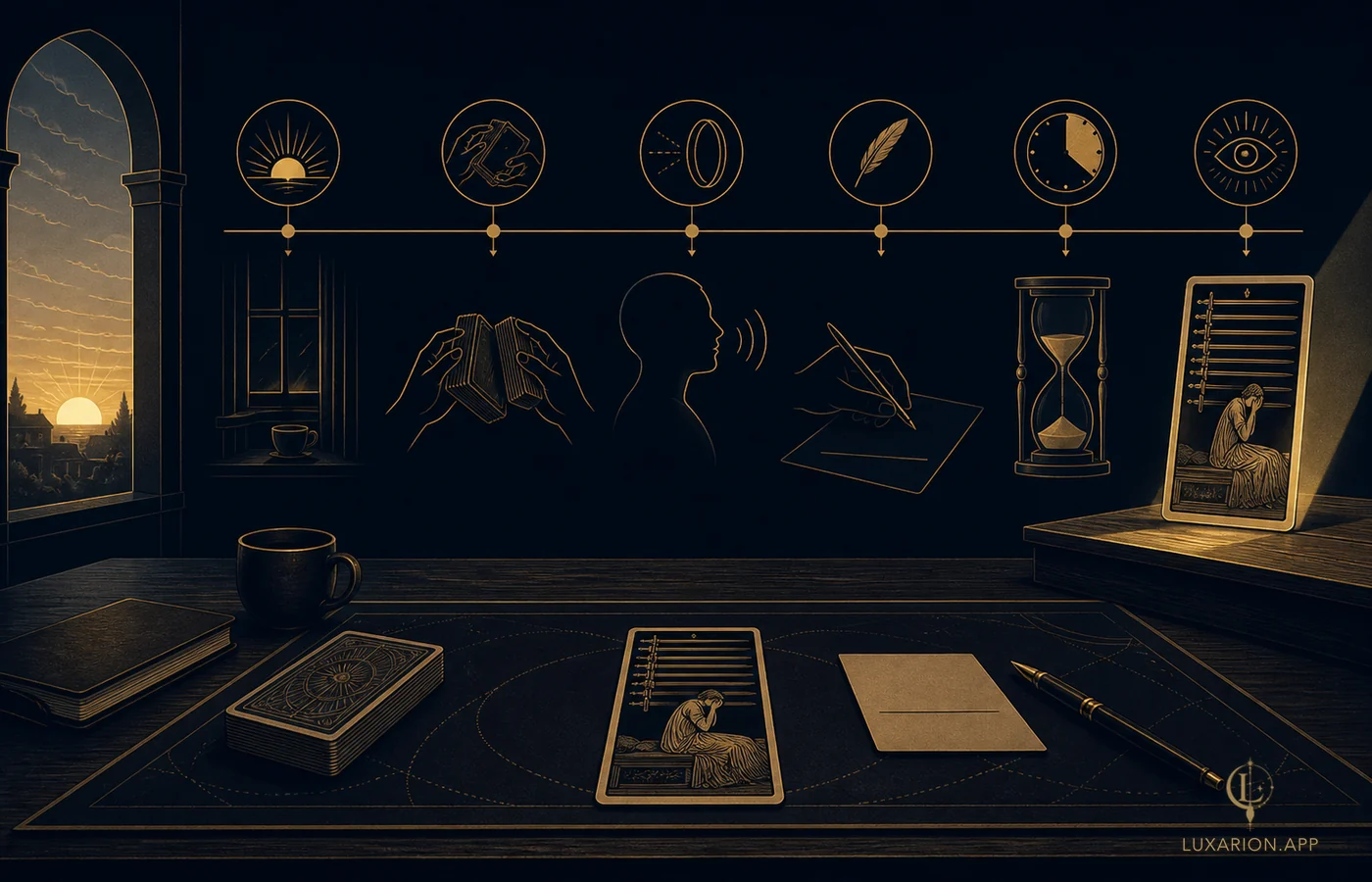
The mechanics are simple enough to describe in a paragraph and are worth doing exactly, because most of the ways this practice fails are mechanical.
Draw before the day starts. Before email, before the first conversation. A card drawn at noon is drawn into a day that already has a shape, and it will bend to fit that shape.
Shuffle without a question. Not "what do I need to know about the meeting" — that turns a lens into a forecast before you have begun. The daily draw is deliberately open: what am I looking through today?
Say the name out loud. Practitioners are unanimous about this and it sounds trivial. Naming it moves the card out of a vague morning feeling and into something you can recall at three in the afternoon.
Write one line, before interpreting. Description, not meaning: Nine of Swords, figure sitting up, hands on face. Two minutes.
Leave it where you will see it. Face up on the desk, or a photograph on your phone. The point is to encounter it again at midday.
Write two lines at night. What the day actually did. Not what it should have done.
Total cost: about five minutes. Anything more elaborate will not survive a busy month, and a practice that does not survive is not a practice.
A worked example of a single day
Abstract descriptions of the practice are less useful than one concrete day, so here is what an ordinary entry looks like from the inside.
The card is the Eight of Cups. Morning line, description only: figure walking away from eight standing cups, moon overhead, water and hills. No interpretation yet — this is deliberate, because writing "leaving something behind" at seven in the morning closes the day before it opens.
Named aloud, propped against the kettle. The lens for the day is roughly: where am I walking away from something, and where am I not?
By mid-morning it has already caught something small and unglamorous — a piece of work being kept alive out of sunk cost rather than usefulness. That is not a revelation; it is a noticing, and noticings are the unit this practice deals in.
By the evening, something else. A conversation avoided for a fortnight, which is also a walking-away, and one that had not been thought of in those terms. Evening line: the leaving I keep looking at is not the one that costs me.
That is a good day in this practice, and it is worth seeing how modest it is. Nothing was predicted. Nothing arrived. A card supplied an angle, the angle caught two ordinary things, and one of them was worth writing down. Multiply by three hundred and you have the year that makes readers.
It is also worth seeing what did not happen: the card was not consulted about a decision, no meaning was forced onto the parts of the day that did not fit, and the entry took under five minutes in total.
The journal is the practice
If you keep only one part of this, keep the writing, because the writing is where the learning lives.
The morning line and the evening line do different jobs. The morning line is a record of what you saw before you knew what the day held — which is the only version of that observation you will ever get, since by evening it is contaminated. The evening line is the check.
What makes this valuable is not any single entry. It is what happens when you read back three months. You will find the same two or three cards recurring around the same subject; you will find an interpretation you were certain of in March that reads as obviously forced in June; you will find a card you thought was minor showing up at every turning point in the year. None of that is visible from inside a single day.
This is reflective practice in the ordinary sense, and it is what separates a year of daily draws from a year of daily draws that taught you something. Readers who kept a journal and readers who did not describe their first year very differently.
Keep it plain. Date, card, one line of description, one line at night. Elaborate journals get abandoned; a notebook with three lines a day does not.
What the first month feels like

Beginners are often disheartened early, and it helps to know that the discouraging phase is standard.
Week one is mostly lookup. You draw a card, you look it up, you carry a keyword around. It feels mechanical because it is. Everyone starts here.
Week two is doubt. Half the days seem to have nothing to do with the card. This is the most common point of abandonment, and it is the wrong conclusion drawn from the right observation. The card is not supposed to match the day. It is supposed to be the angle you looked from.
Week three, something shifts. Usually it is small: you find yourself thinking of the card at an odd moment without having tried to. Practitioners describe this almost identically, and it marks the point where the card has stopped being homework.
Week four, the first repeat. A card you have already had comes back, and you notice you remember what you wrote last time. That memory is the whole practice announcing itself.
Nothing dramatic has happened in that month. What has happened is that four or five cards have moved from the book into your hands, which is the rate at which this actually goes.
What the first year teaches
The longer arc is where the practice earns its reputation, and what it teaches is not what beginners expect.
Cards stop having single meanings. After the third or fourth encounter with the same card in different weather, its keyword collapses and something more useful replaces it — a range, a temperament, a set of situations it likes to appear in.
You learn your own bias. Every reader over-reads certain suits and under-reads others. A journal makes this undeniable within about six months, and knowing it is worth more than any additional memorised meaning.
You learn to sit with an unclear card. Some days the card does not resolve. Learning to write "nothing today" without forcing an interpretation is a genuine skill, and it is the one that later prevents you from over-reading someone else's spread.
You learn what the deck is for. Most people begin the practice expecting information about the future and end it with something quieter: a daily habit of attending to one thing on purpose. That shift is the actual curriculum.
Ask any reader with years behind them what the daily card gave them and you will rarely hear a prediction story. You will hear that it taught them to read, and that reading turned out to be a form of attention.
The three ways it goes wrong
The practice is robust, but it fails in three recognisable ways, and all three are avoidable if you know their names.
Re-drawing. You get a card you do not like, and you draw again. This is the failure the tradition warns about most consistently, and the reason is not superstitious — it is that re-drawing teaches you to shop for a comfortable lens, which is the exact opposite of the skill you are building. If a card lands badly, that is the day's assignment. Write it down and go.
Forecast creep. Slowly, without deciding to, you start treating the card as a prediction. It usually begins with a striking coincidence — the card matched the day exactly once — and it hardens from there. The signal is that you have started feeling relief or dread at the draw. When you notice it, return to the question: what am I looking through today?
Meaning inflation. Every card becomes profound; the journal fills with paragraphs; a five-minute practice becomes a forty-minute one and then stops entirely. The tradition's answer is deliberate modesty. Most days are ordinary. A card that produced nothing is an honest entry, and a journal with a few of those in it is a journal you can trust.
Reversals, and other choices
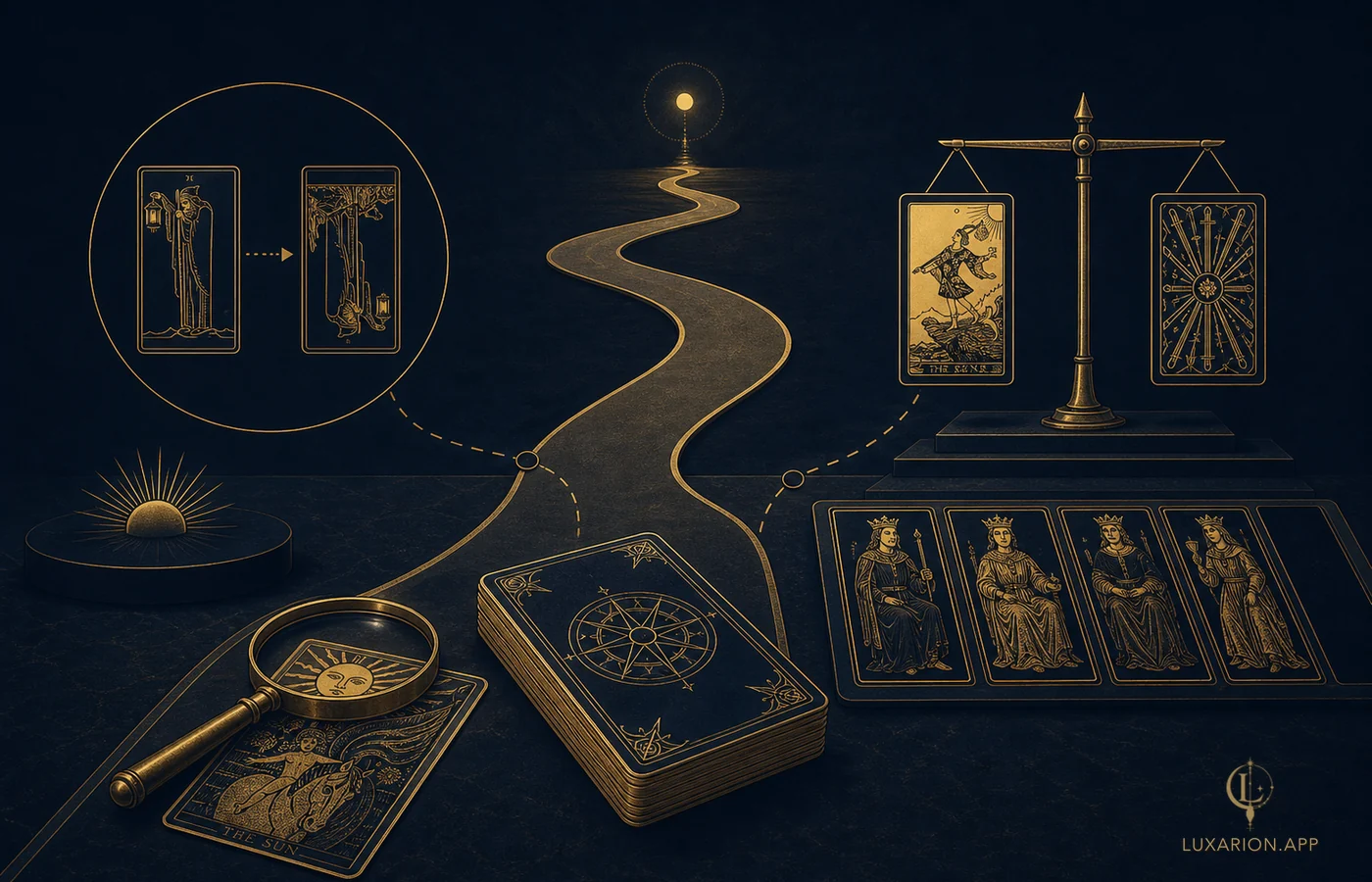
Beginners often ask which conventions to adopt, and for a daily practice the answers are usefully simple.
Reversals: not at first. Most teachers say to leave them out for the first pass through the deck. Seventy-eight lenses is already a lot, and doubling that before you know a single card well produces confusion rather than nuance. Add them on the second pass if you want them; many practitioners never do, and read the surrounding context instead.
Deck: whichever one you will actually look at. The Smith images are the standard starting point for exactly the reason described above — a beginner can enter every card by sight. A Marseille deck is a fine daily deck too, but it works differently: with pip cards you are learning number and suit as a grammar rather than reading a scene, which is a slower and, some argue, deeper start. It is a legitimate choice, not a purist affectation.
Court cards: do not skip them. Everyone wants to. They are the hardest cards to hold for a day because they describe people rather than situations, and holding one is the fastest way to stop treating them as a mystery.
Repeats: read them as emphasis. When the same card appears three times in two weeks — and it will — the tradition's reading is not that something dramatic is coming. It is that you have not yet finished the observation. Go back to what you wrote the first time.
Doing it with a partner
A variation worth knowing, because it doubles what the practice teaches and costs nothing extra.
Two people draw their own card each morning and send each other the name only — no interpretation. In the evening, each sends one line about what the card caught.
What this adds is the thing solitary practice cannot supply: you watch someone else hold a card you know well and use it in a way that had not occurred to you. Nothing loosens a fixed keyword faster. Beginners who do this for a season consistently describe their range of readings widening.
The rule that makes it work is that neither person interprets the other's card. The temptation to do so is strong and it converts the exercise into a reading, which is a different activity with a different purpose. Names in the morning, observations at night, no advice.
It also helps with the plain problem of continuity. A daily practice you have promised to one other person survives a bad fortnight considerably better than one you have promised only to yourself.
What it is not
It is worth being exact, because the daily draw attracts a few misunderstandings that get in the way of the practice.
It is not a horoscope for your day, and it is not a schedule. It does not tell you what will happen, and reading it that way strips out the part that actually teaches.
It is not a substitute for a reading. A single card is a lens for one person on one day; a reading is a structured conversation about a question. Different tools. If you want to know how a full reading is built, we set that out in how to read tarot, and what the craft can and cannot claim in is tarot accurate?.
It is not a test of belief. Plenty of long-standing practitioners describe the daily card primarily as a discipline of attention, and the tradition has never required anyone to hold a particular theory in order to do the work. The practice is the same either way.
And it is not something you can be bad at. There is no wrong entry in a journal that only you read. A month of "nothing today" is still a month of showing up, and showing up is the mechanism.
From daily draw to reading for others
Most people who read for others started here, and the transition is more gradual than beginners imagine.
What the daily draw builds is not a memorised deck. It is three specific capacities. Recognition: knowing a card by sight, with its range rather than its keyword. Restraint: the willingness to say a card is unclear rather than inventing. Register: a feel for what a card sounds like in a life rather than on a page.
Those three are exactly what a reading requires, and none of them can be got from books. It is why teachers assign the daily draw rather than more reading: the deck can be memorised in a fortnight, and the capacities take a year.
And if you would like to see what those capacities look like at a table, that is what our tarot reading is — the same practice, carried out for long enough that the cards have stopped being definitions.
The classroom is still open
There is something worth appreciating about a craft whose central teaching method costs nothing, requires no permission, and has not changed in over a century.
You need a deck, three lines a day, and the willingness to keep writing them when the days are ordinary. That is the whole curriculum. It was assembled by a painter who was paid a flat fee and credited in a footnote, and it has taught more readers than every tarot book ever written.
The instruction has not changed either. One card. Before the day starts. Named out loud. Carried.
Draw one tomorrow morning, write the line, and see where you are in three months. The practice does not ask you to believe anything in advance. It only asks you to keep the notebook honest — and the notebook, read back, is what does the teaching.
The library teaches the craft. A reading applies it to you.
Get your personal reading