Welcome to Luxarion: What This Place Is
The flagship volume of our library: what Luxarion is, the reading traditions we practice and how we practice them honestly, what we refuse to do, and where to begin.
You have probably arrived the way most people do: carrying a question. Perhaps a precise one — a dream that will not release you, a decision with two doors, a name you cannot stop turning over. Perhaps only the unnamed kind: the sense that your days are speaking and you have had no quiet place to listen. Either way, welcome. This is the flagship volume of our library — the book we would press into your hands at the door — and it will tell you, without hurry, what this house is, what we believe, what we will not do, and where to begin.
What Luxarion is
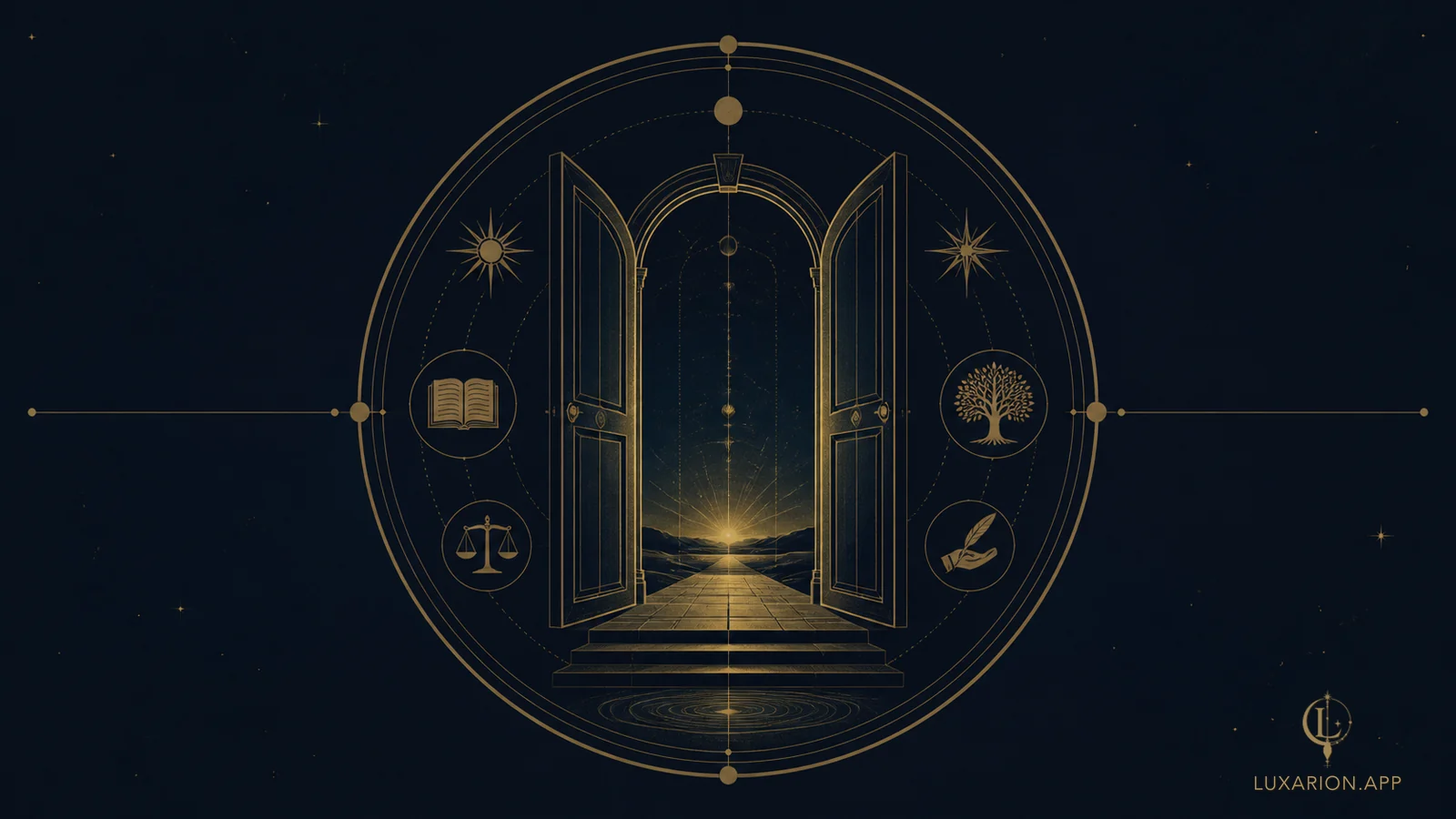
Luxarion is a house of readings. The name joins lux — light — with the old dream of an orrery: a machine built not to command the heavens but to contemplate them. We practice the listening arts that human beings have carried for millennia, and we practice them under one roof, so your question can find its right room. But a house is known by its principles before its rooms, so let us state ours first: every craft here is a technology of attention, not a machine of prophecy. The cup does not hold your future; it holds your attention, returned to you in symbols. The chart does not issue verdicts; it describes weather. The cards do not command; they mirror. Hold that one sentence and everything else in this library follows from it.
The rooms, and their real lineages
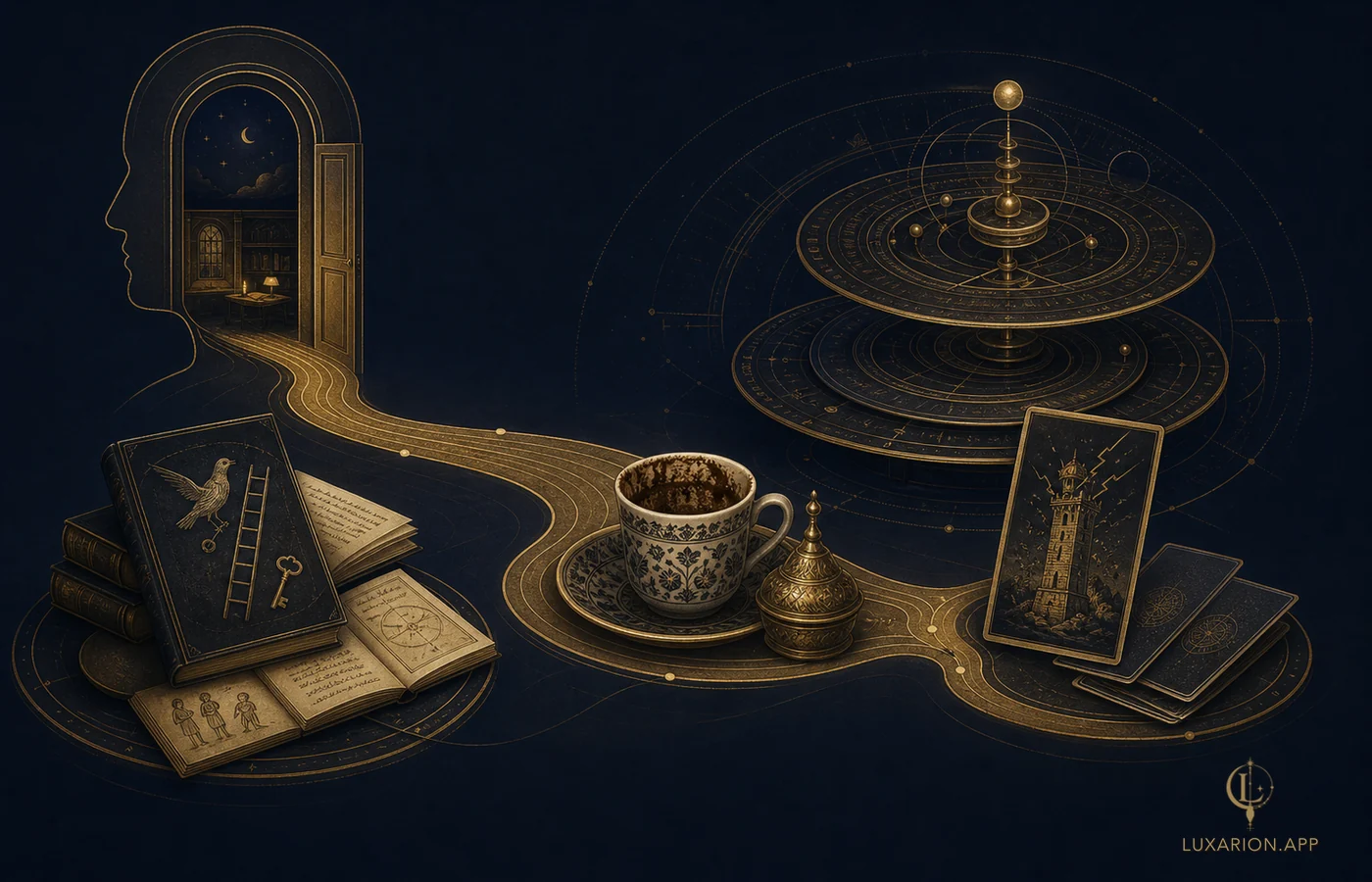
We do not offer generic mysticism. Each room descends from a documented tradition, and we practice each within that tradition's own rules and cautions.
Dream interpretation, in the lineage that runs from the method attributed to Muḥammad ibn Sīrīn — context before symbol, the dreamer before the dream — to the associative approach of modern psychology. We describe how the old interpreters actually worked in A Dream Is a Letter, and how you build your own symbol-alphabet in The Bird, the Ladder, the Key.
Coffee-cup reading, the Levantine and Anatolian craft whose living context UNESCO recognized when it inscribed Turkish coffee culture as intangible heritage. We open the craft from the inside in The Cup Remembers.
Tarot, the deck read card by card as mirror, never verdict — the tradition A.E. Waite and the artist Pamela Colman Smith shaped in 1909, and which we approach in The Tower Is a Mercy and practice daily in One Card a Day.
Palmistry, among the oldest of the body's own texts, whose real premise — that your hand is a diary, not a sentence — we restore in Hands Change.
Astrology, the full natal geometry of the sky you arrived under — not the newspaper column, which is a 1930 invention, as we explain in You Are Not Your Sun Sign. We meet its most feared season in Mercury Is Not Your Enemy and its oldest rhythm in Living by the Moon.
What we believe, and what we refuse
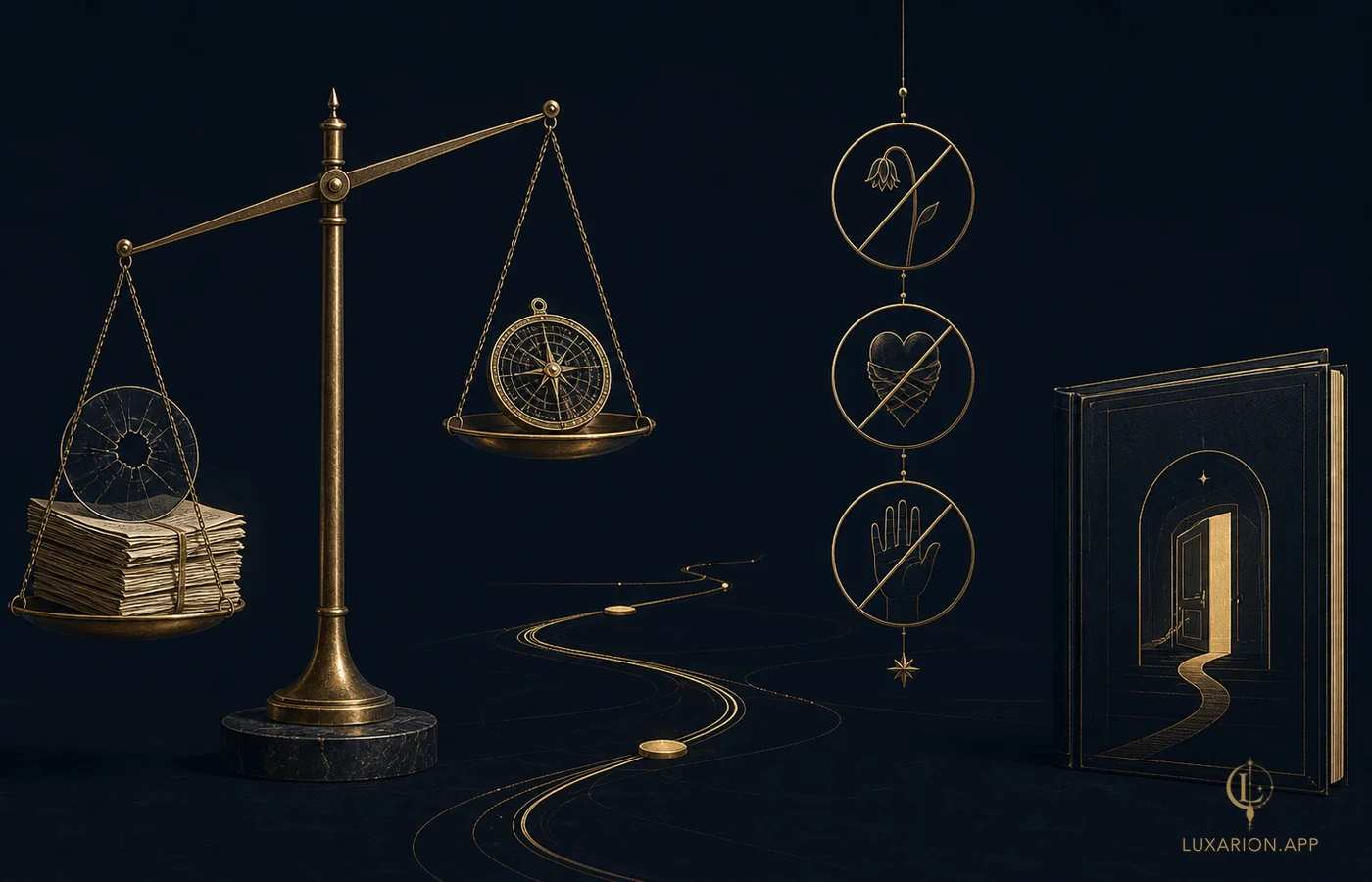
Our convictions are few and load-bearing. We believe the traditions are worth their full depth and their full honesty at once — which means we tell you, plainly, that the newspaper horoscope is young, that the life line does not measure lifespan, that sun-sign matching fails the largest studies ever run. A craft that cannot survive the truth about itself is not one we want to keep. And we hold, with every serious lineage, that the reader's oldest skill is refusal: we do not read for a person in fresh grief, we do not surveil a third person's private heart, we do not deliver a fixed doom. That ethic — the whole discipline of when a reading should say no — is important enough to have its own volume: When the Reading Says No.
The thread through every room
Different as the crafts look, they train one faculty from different sides — the ability to look at what is actually there before deciding what it means. Modern research on expert intuition names the conditions under which that trained noticing becomes trustworthy, and the contemplative traditions arrived at the same guardrails centuries earlier; we hold both in The Quiet Sense. That faculty is built by small, honest, repeated practice — the evening review the Stoics and Sufis both kept (The Evening Return), and the witnessing page every craft eventually needs (Ink as Witness).
Where to begin
Begin with your question, and let it choose the room. If it is about love, do not ask us whether he will return — learn instead How to Ask About Love, because in every tradition the question is half the reading. If it is about time and timing, the moon and the birth chart are your rooms. If it is only the unnamed pressure of a life that wants listening to, begin with a single card each morning or a single honest page each night, and let the library open one volume at a time. Nothing here will tell you your fate; everything here is built to help you meet your present with less fear and more clarity. That has always been the real work of the reading arts, and it is the whole of what we offer. Welcome to the house. Choose a room.
The library teaches the craft. A reading applies it to you.
Get your personal reading