
The Tower Is a Mercy: Reading Tarot's Most Feared Card
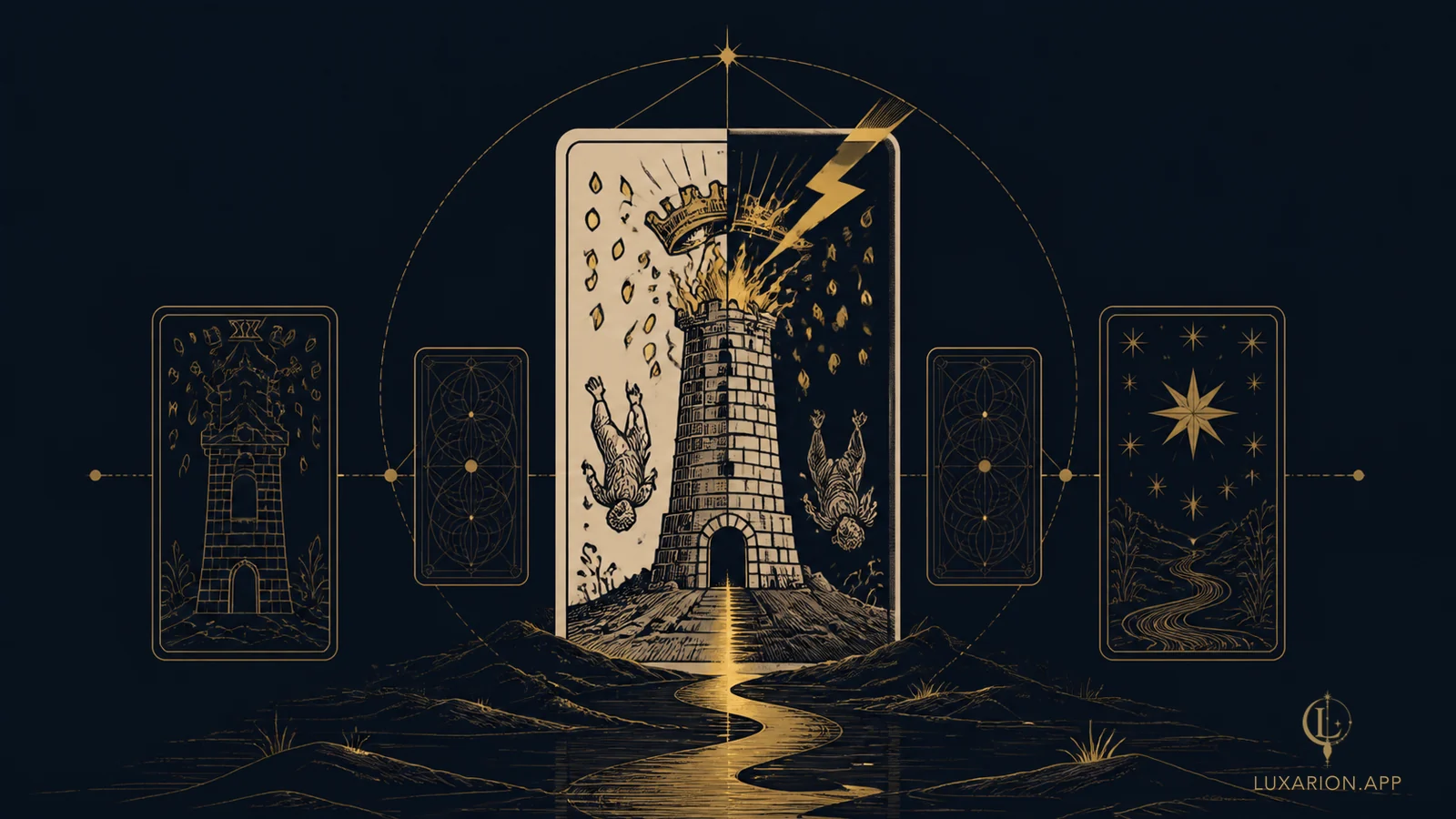
Card XVI from inside the craft: the Marseille Maison Dieu, Waite's lightning, why the Star follows it, and how seasoned readers handle it.
Ask any reader which card changes a face at the table, and the answer is the same in every country: the sixteenth trump. Lightning, a falling crown, two figures in midair. People who have never touched a deck know this one by sight.
And yet readers with decades in their hands treat the Tower with something close to tenderness. Not because they have talked themselves out of what it means, but because they have watched, hundreds of times, what it actually does in a life — and what it does is almost never what the frightened querent is bracing for.
This article is the card from inside the craft: where the two versions of the image come from and why they differ, what the picture is actually depicting, the question a reader asks when it appears, why the sequence of the trumps answers it, how position and neighbours change it, the ethics of delivering it, and what to do in the days after you have drawn it.
Two towers, two lineages
There are really two Towers, and most of the confusion around the card comes from not knowing which one you are looking at.
In the Tarot de Marseille — the pattern French and Swiss cardmakers standardised in the seventeenth century and printed from woodblocks and stencils for two hundred years — the card is called La Maison Dieu, the House of God. Its tower loses its crown to a burst of coloured fire, and the old readers did not all see that fire as destruction. Some read it as a plume: a breath leaving a place that had been sealed. The figures beside it are not always falling; in several early printings they look more like people getting out.
In 1909, Pamela Colman Smith painted the version most of the world now knows, for A. E. Waite. Black sky, jagged bolt, the crown knocked clean off, two bodies clearly in the air. It is a more cinematic card, and that is part of why it travelled — but it also narrowed the reading, because a picture that dramatic is hard to hear quietly.
Waite's own commentary is startlingly precise, and worth knowing if you use the Rider–Waite–Smith deck. He reads the card as the ruin of a house of falsehood — a structure of belief that could not survive contact with what is true. Not punishment. Correction. That single word is most of the craft's position on this card, and it was written by the man who commissioned the scariest version of it.
If you read Marseille, you inherit a card about a sealed thing opening. If you read Rider–Waite–Smith, you inherit a card about a false structure coming down. These are the same reading told at different volumes.
Where the card came from
The trumps were not designed as a system of divination. They began in fifteenth-century Italy as trionfi — trump cards for a game played in courts like Milan, where the hand-painted Visconti–Sforza decks were made. The images came out of the visual vocabulary of the Renaissance: allegorical figures, virtues, wheels, the memento mori tradition, the kind of picture that appears in an emblem book with a motto under it.
That origin matters for the Tower specifically, because in the earliest surviving decks the card is sometimes missing altogether — and where it appears, it belongs to a run of images about fortune and reversal that any educated person of the period could read at a glance. A struck tower was not a horror image. It was a standard emblem for the collapse of what pride had built, cousin to the Tower of Babel and to every sermon about hubris preached in that century.
Divinatory use came later, through cartomancy in the eighteenth century and then through Éliphas Lévi and the occult revival of the nineteenth. Each layer added meaning without erasing the one underneath. So when a reader today says the Tower is about a structure rather than an accident, that is not a modern softening. It is the oldest layer of the card, still legible under the lightning.
What the picture is actually doing
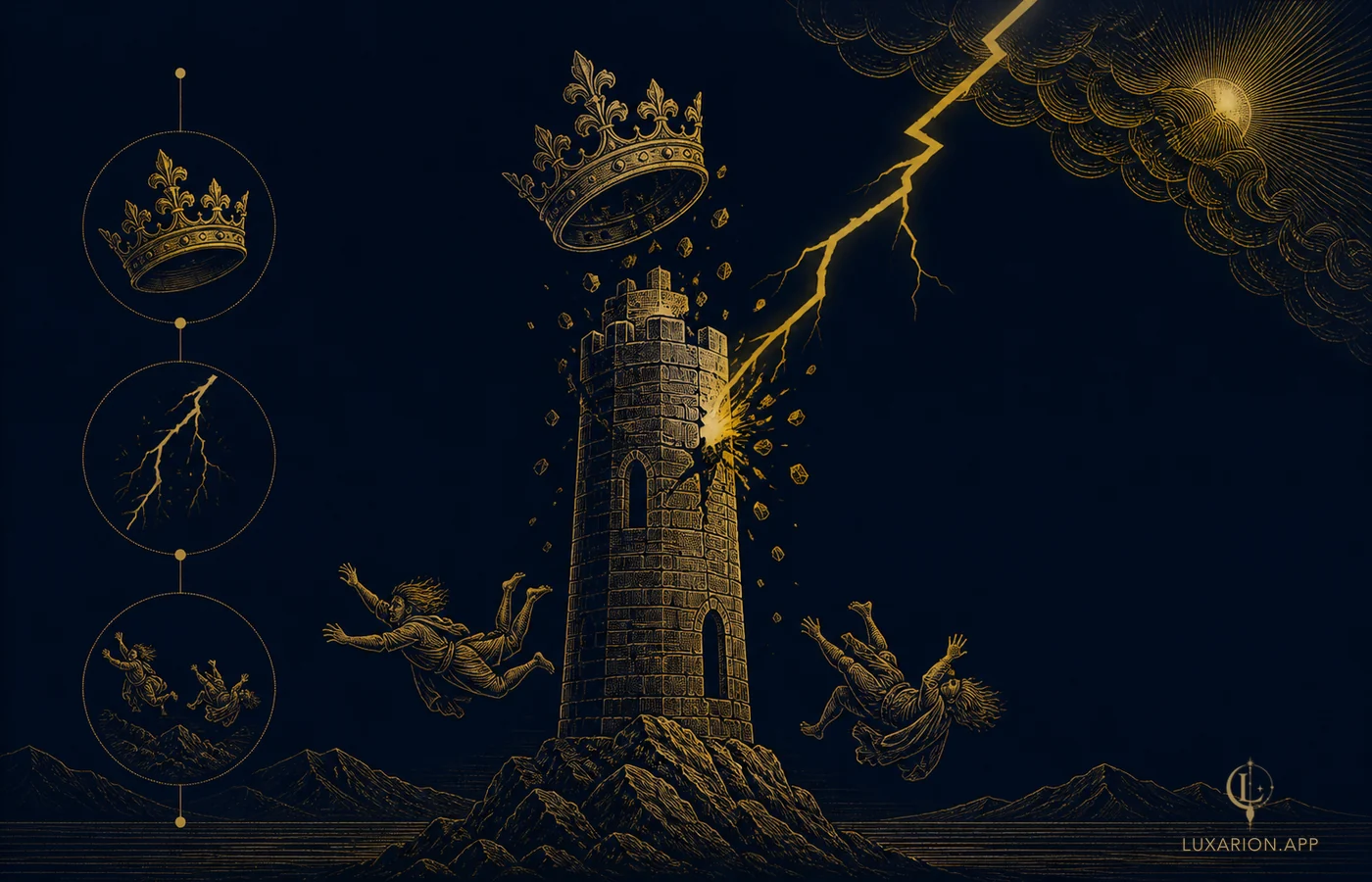
Look at the image as iconography rather than as a photograph of a disaster, and three details do the work.
The crown comes off first. It is not the walls that go, and not the foundation — it is the ornamental top, the part that was placed highest. This is the deck's oldest joke about pride, and it is a mercy in itself: the card removes the decoration, not the building.
The lightning comes from outside. Nothing in the tower generates it. That detail is why the card is so often about something arriving — a piece of information, a sentence someone finally says — rather than about something you did.
The figures are out of the building. Whatever else is happening, they are no longer inside a structure that has just been opened to the sky. Readers who have sat with this card for years point at that constantly. Being outside is uncomfortable. It is also survivable, and being inside would not have been.
Read that way, the picture is not a prophecy of ruin. It is a picture of the exact moment a concealment ends — which is why it so often turns up for people who already know, somewhere, what is about to stop being hidden.
Structure, not event
Here is the sentence that separates a reading from a fright: the Tower almost never announces an event. It names a structure.
A job built on a fiction. A silence a marriage depends on. An identity outgrown years ago and maintained out of habit. A family arrangement everyone can see and no one will say. A story about yourself that stopped being true and kept being told.
And the thing about a structure is that it was going to come down anyway. That is what makes the card a mercy rather than a threat. The lightning does not choose at random; it finds the thing that was already false. Sooner is kinder than later, because a false structure gets more expensive to maintain every year, and more people build their lives on top of it while you keep it standing.
The discomfort of holding two incompatible things at once is not a small tax. Neither is denial, which is not stupidity but one of the ordinary ways a mind protects itself until it is ready. The Tower, read well, is the card that says: you are ready, and it costs more now to keep it up than to let it go.
The question a reader actually asks
Beginners and practitioners ask different questions of this card, and the difference is most of the skill.
The beginner asks: what disaster is coming? That question has no good answer, because the card does not carry one. It produces guessing, and guessing is what makes readings feel cheap.
The reader asks: which structure in this person's life is already false? That question always has an answer, and usually the querent supplies it within a minute of being asked — often with a laugh, because they knew. That laugh is one of the most common sounds in a room where the Tower has landed. It is the sound of something being said out loud for the first time.
From there the reading has somewhere to go. What is holding it up. What it would cost to take it down deliberately. Who else is standing on it. What you would need in place first. None of that is available to a reading that has decided the card means catastrophe.
We have written more about how a reader builds a question into a reading in how to read tarot, and about what the craft can and cannot claim in is tarot accurate?.
The deck's own answer
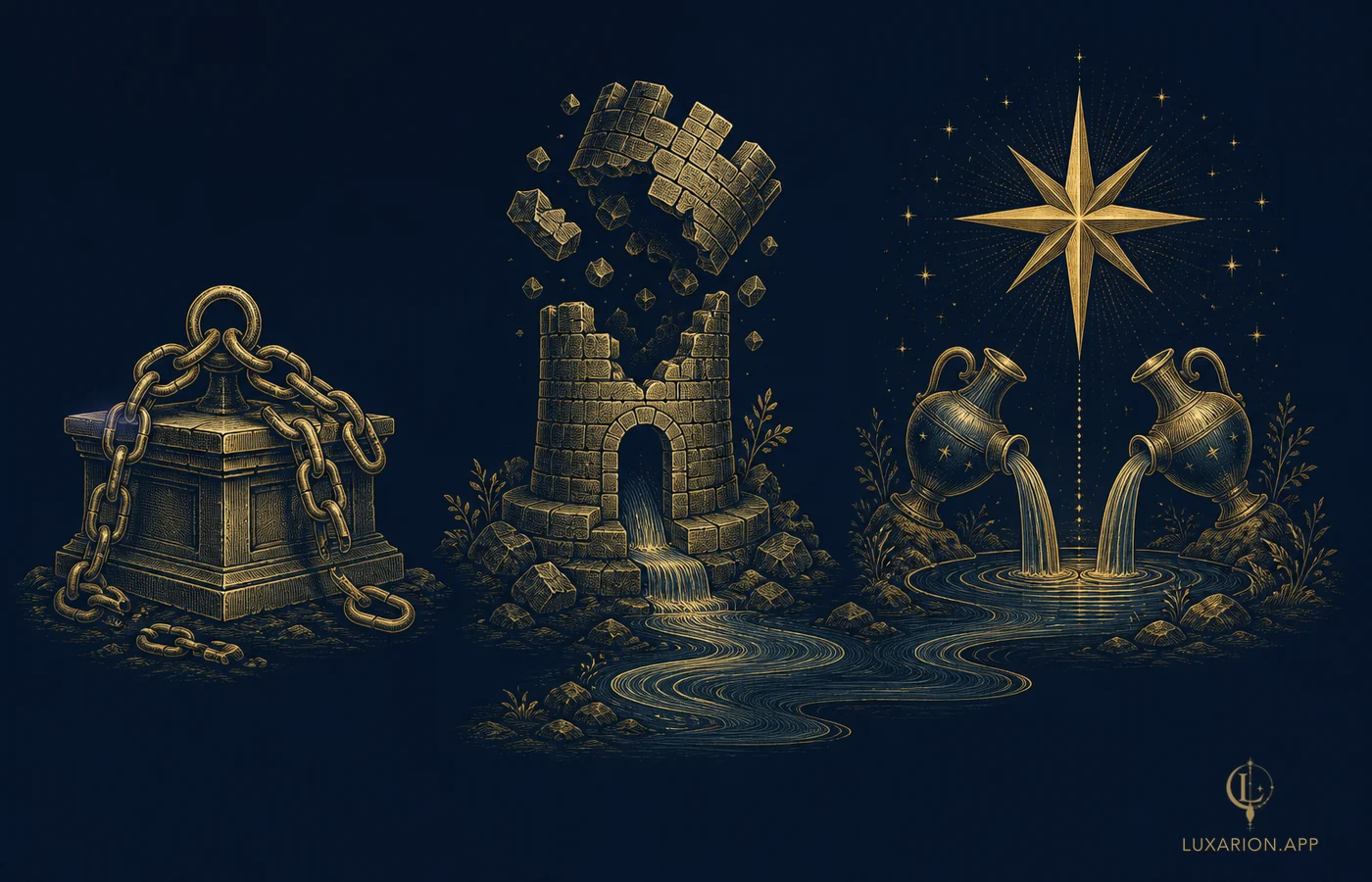
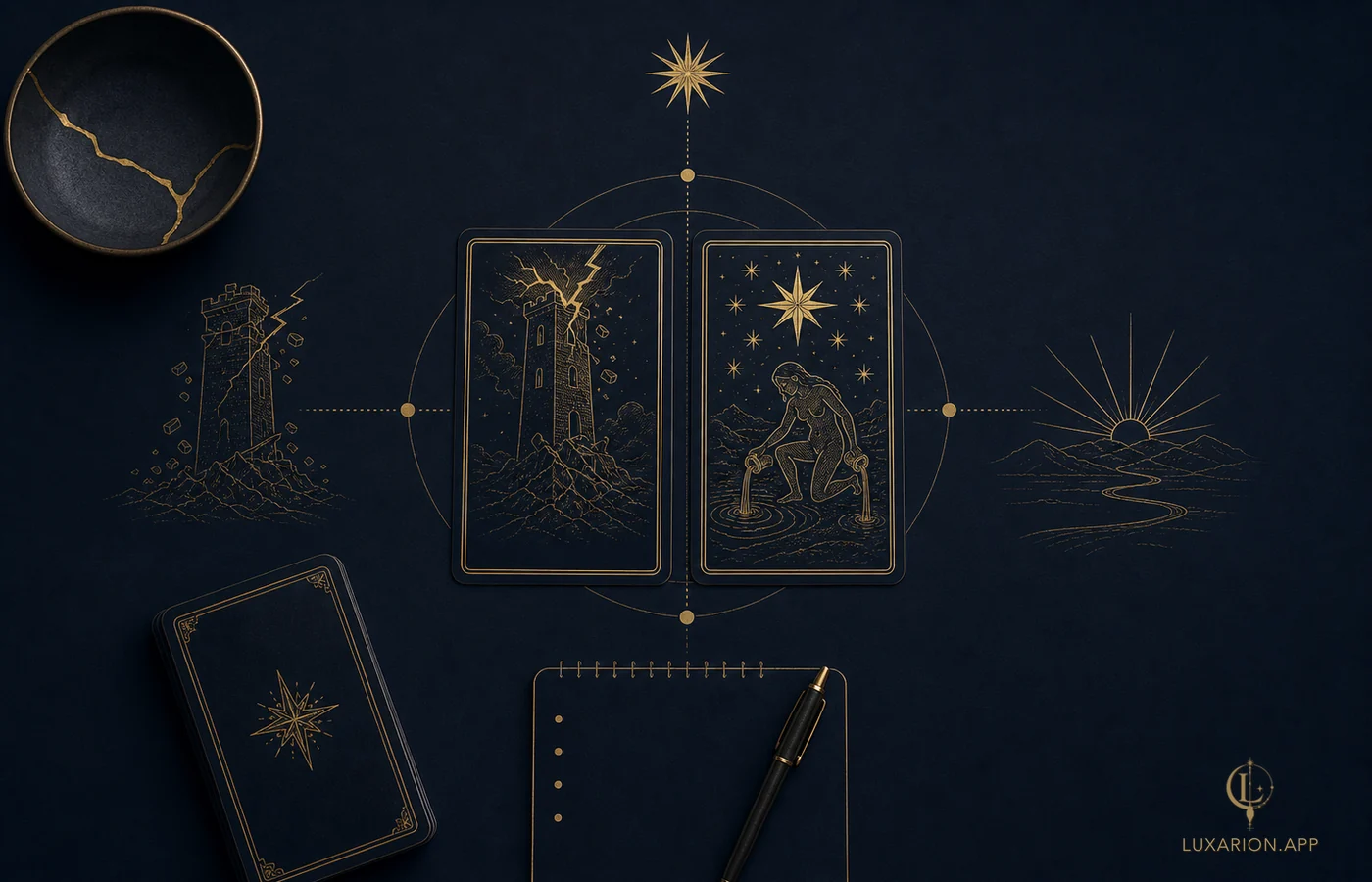
Here is the detail beginners miss and old readers lean on: the trumps are a sequence, and the card after the Tower is the Star.
A woman kneeling at water. Bare, unhurried, pouring. One foot on land and one in the pool. It is the quietest card in the deck, and it is placed immediately after the loudest, in that order and not the reverse.
That ordering is a statement, and it was made by whoever fixed the sequence centuries ago. Rupture is followed by replenishment. The house of falsehood comes down and then there is water, and the water is not dramatic — it is just there, and it keeps being poured.
A reader who delivers the Tower without the Star behind it has read half a sentence aloud and stopped. This sequential way of reading — each trump answered by its neighbours — is old Marseille craft, and it turns the card from a shriek into a hinge.
The card before matters too. Fifteen is the Devil: the picture of a thing you are attached to on a chain loose enough to lift off. Read the three in order and the story is complete and unmistakable — attachment, the sudden end of the attachment, and then the long quiet refilling. That is not a horror sequence. That is a description of how people actually get free of things.
Position and neighbours change it
The same card in a different seat is a different sentence, and this is where readings go wrong most often.
In a past position the Tower is usually the most reassuring card on the table. It means the collapse already happened, the querent survived it, and everything else in the spread is being read by someone who has been through it. Readers often say the past-position Tower explains the rest of the cards better than any of them explain themselves.
In a present position it is a description, not a warning. Something is already coming apart, and the querent generally knows it. The work is naming which structure, not predicting a date.
In a near-future position it is a question about agency: what would you rather take down yourself, gently, before it falls? That question is the single most useful thing the card produces.
In an advice position — and this surprises people — it is often an instruction to stop propping something up. Not a catastrophe at all. A permission.
Neighbours matter as much as seats. The Tower beside the Wheel reads as a turn of circumstance. Beside the Death card it reads as the ending of a chapter that was ending regardless. Beside the Fool it reads as a departure — someone leaving a building rather than being thrown from it. A card read alone is a card read badly.
When it is softened
Traditions differ on reversals, and this is one of the cards where the difference actually matters.
Readers who use reversals often take a reversed Tower as a collapse that is being delayed, resisted, or absorbed internally — the structure is still standing, and holding it up is taking everything the querent has. Read that way, it is not a lighter card. It is sometimes a heavier one, because it describes exhaustion rather than release.
Readers who do not use reversals — a large share of Marseille practitioners — get the same information from the surrounding cards instead. Both approaches work. What does not work is treating the reversal as a cancellation, as though the card had been drawn and then unsaid.
There is also the question of the small Tower: the reading where the structure that falls is genuinely minor. A plan, an assumption, a piece of scheduling. Not every Tower is a marriage. Experienced readers calibrate scale from the rest of the spread and from what the querent came in holding, and they say so plainly rather than inflating a small card into a large one.
What the Tower is not
It is worth being exact about the boundaries, because the card attracts more projection than any other.
It is not a death card, and neither is Death. It is not a prediction of accident or illness; the tradition does not read cards for those and a careful reader will say so. It is not a verdict on your character, and the falling crown is not a punishment for pride so much as an observation about where the weight was.
It is also not a card that requires an intervention to be purchased. That is worth stating flatly, because the Tower is the card most often used to frighten people into paying for a remedy, and every honest practitioner names that for what it is. The tradition's own answer to the Tower is not a remedy. It is the Star — which nobody sells you.
And it is not a card that overrides what you know about your own life. If it lands and nothing in you recognises it, that is information too. A reading that does not connect is a reading that has not connected; the craft has always allowed for that, and when the reading says no covers the whole discipline of stopping.
Handling it at the table
The ethics matter more here than anywhere else in the deck, because a frightened querent hands a reader enormous power, and the tradition's answer to that power is restraint.
You place it in time. One card among seventy-eight, drawn today, about this question. That framing is not a hedge; it is accurate, and it is what keeps a card from becoming a life sentence.
You name the structure, not the disaster. If you cannot name one, you ask. The querent almost always can.
You do not dramatise. The card is dramatic enough on its own. A reader who leans into it is borrowing fear to make a session feel weighty, and that is the oldest bad habit in the trade.
You read the Star. Out loud, in the same breath. The sequence is part of the card's meaning, not a consolation prize added afterwards.
You hand back agency. The useful closing question after a Tower is not when but what would you rather take down yourself? That returns the reading to the one person who can act on it.
If you would like a card like this read by someone who has sat with it for years, that is what our tarot reading is — the same discipline, at a table where the Tower is not treated as a spectacle.
What people report afterwards
Ask readers what querents say when they come back after a Tower reading, and the answers are remarkably consistent.
Very few describe a bolt from the sky. Most describe a conversation they finally had, a resignation letter that had been written for months, a lease not renewed, a sentence spoken at a kitchen table that everyone had been avoiding for a year. The collapse, in retrospect, looks less like an explosion and more like a decision that had been waiting for permission.
And nearly all of them describe the period afterwards as flat rather than dramatic. Not a crisis — a quiet. Things to be sorted out, a lot of admin, a strange amount of sleep. This is the Star, in practice: not a reward, just water, poured steadily, for longer than you expected.
The research literature on growth after upheaval and on resilience describes something adjacent — that people rebuild along different lines than they expect, and that the rebuilding is slow and unglamorous. The card said the same thing five centuries earlier with a picture.
Living with a Tower reading
If the card has landed for you, a few practical things follow from the craft rather than from advice-giving.
Write down what you thought of first. When the Tower appears, something surfaces before you have decided what it means. That first thing is the reading. Write it before you talk yourself into a safer version.
Ask what it is holding up. Structures are load-bearing. Who else is standing on this one? What would need to exist before it could come down without hurting them? That is the most useful hour of thinking the card produces.
Do not act at speed. The card does not ask for a dramatic gesture. Dismantling deliberately is slower than collapse and much less costly, and the whole point of drawing it early is that you have time.
Do not re-draw. Pulling again in the hope of a kinder card is the impulse the tradition warns against most consistently, and it teaches you nothing. If you work with a single card daily, one card a day is the practice that builds the tolerance for this.
Give it a season. Note the date. Look at it in three months. What the Tower named is almost never resolved in a week, and almost always legible by the following season.
Why the craft calls it a mercy
The word is not sentimental, and it is not a way of taking the sting out of a hard card. It is a technical description of what the card does.
A false structure is not stable. It is a thing you pay for continuously — in attention, in silence, in the small daily work of not looking at it directly. The bill comes either way. The only question the Tower raises is when, and whether you are the one holding the hammer.
The crown falls first because the crown was the part that was never load-bearing. The lightning comes from outside because the truth usually does. The figures are in the air because they are out, and out is where you have to be before anything else can start.
And then, immediately, there is a woman kneeling at water with a jug in each hand, pouring into the pool and onto the ground, taking her time. The deck put her there on purpose. Five hundred years of readers have kept her there.
That is why the sixteenth trump, the card that changes faces at the table, is the one experienced readers reach for with something close to relief. It does not bring the collapse. It arrives at the moment the collapse becomes survivable — early enough to be chosen, and with the Star already turned face up behind it.
The library teaches the craft. A reading applies it to you.
Get your personal reading