

How to Decide When You Cannot Know: The Practice of Istikhara

The oldest working method for making a hard decision without certainty — what istikhara actually asks for, and how to use it on a real choice.
There is a particular kind of night that most people recognise. The decision is real, the deadline is close, and the information has run out. You have made the list. You have asked the people worth asking. And the two columns still look roughly even, or the better-looking column is the one that frightens you. What you want at that hour is certainty, and certainty is precisely what is not available.
Every serious tradition has had to build something for that night, because it arrives for everyone. The one built in the Islamic world is called istikhara, and it is worth knowing about for a reason that surprises people who meet it for the first time: it is not a technique for obtaining certainty. It is a technique for acting well without it. That is a much rarer and more useful thing.
This piece is about how the practice actually works — the text, the sequence, the commentary that clarifies it, and the very common misunderstanding that stops people using it properly — and about what the same structure looks like when you strip it back to its bones and apply it to any hard choice at all.
What istikhara literally asks for
The word comes from the Arabic root kh-y-r, meaning good or better. Istikhāra is the tenth verbal form: to seek the good, to ask for what is best. Not to ask what will happen. To ask for what is good to be brought about.
The practice is transmitted in a well-known report from Jabir ibn Abd Allah, recorded in Sahih al-Bukhari, in which the Prophet is described as teaching istikhara for all matters with the same care he taught passages of scripture. The framing is the first thing worth noticing. Not a rare rite for extraordinary crises — an ordinary tool, taught for ordinary use, in all matters.
The prayer itself is two units of voluntary prayer followed by a supplication. And the supplication's structure is the whole lesson. It opens by acknowledging an asymmetry — I ask You by Your knowledge, for I do not know; by Your power, for I have none — and then it makes a conditional request in two branches:
If You know this matter to be good for me in my religion, my livelihood and the outcome of my affair — then decree it for me, make it easy for me, and bless it for me. And if You know it to be bad for me in those same things — then turn it away from me, and turn me away from it, and decree for me the good wherever it may be, and make me content with it.
Read that last clause slowly, because it is the part people skip and it is the part that does the work. Make me content with it. The prayer's final request is not for information. It is for reconciliation with an outcome not yet known. The supplicant is asking to be changed, not merely to be informed.
There is a second detail with real practical weight. The three criteria named — religion, livelihood, and ʿāqibat al-amr, the end or consequence of the matter — deliberately include the long horizon. Most bad decisions are not bad on the day. They are bad in the third year. The prayer builds that horizon into the question by grammar, which is more than most decision frameworks manage.
The misunderstanding that stops people using it
Ask around and you will hear, very commonly, that after istikhara you wait for a dream, and that the dream's colour tells you the answer — green for yes, red or black for no. Many sincere people have waited weeks for that dream, concluded that they were not answered, and quietly given up on the practice.
The classical commentators are notably relaxed about this. Ibn Hajar al-Asqalani, in his great commentary on Bukhari, discusses the question of what follows the prayer and does not make a dream a condition of it; nor does al-Nawawi in his widely used collections. The colour scheme is folk elaboration, not part of the transmitted text. Nothing in the supplication requests a vision. What it requests is that the matter be made easy or be turned away, and that the heart be settled.
Understanding this changes the practice from something passive into something usable. You are not waiting for a message. You are asking for the road to open or close, and then you are going to walk toward one of them and watch what happens. A dream, if it comes, can carry a sign; it is not the condition — and dreams have their own long and serious interpretive tradition, which we treat separately in how the dream interpreters work.
What people do commonly report is subtler and, in our experience of hearing about it, more reliable: a loosening. The option that was unbearable to consider becomes considerable. Or the option you were leaning toward starts to feel oddly heavy, and the heaviness does not lift over several days. The classical vocabulary for the good version of this is inshirāh al-ṣadr — an expansion of the chest, a widening where there had been tightness. It is how the heart receives the answer, felt in the body, and anyone who has made a decision that turned out right will recognise it.
The sequence nobody teaches, and it is the important part
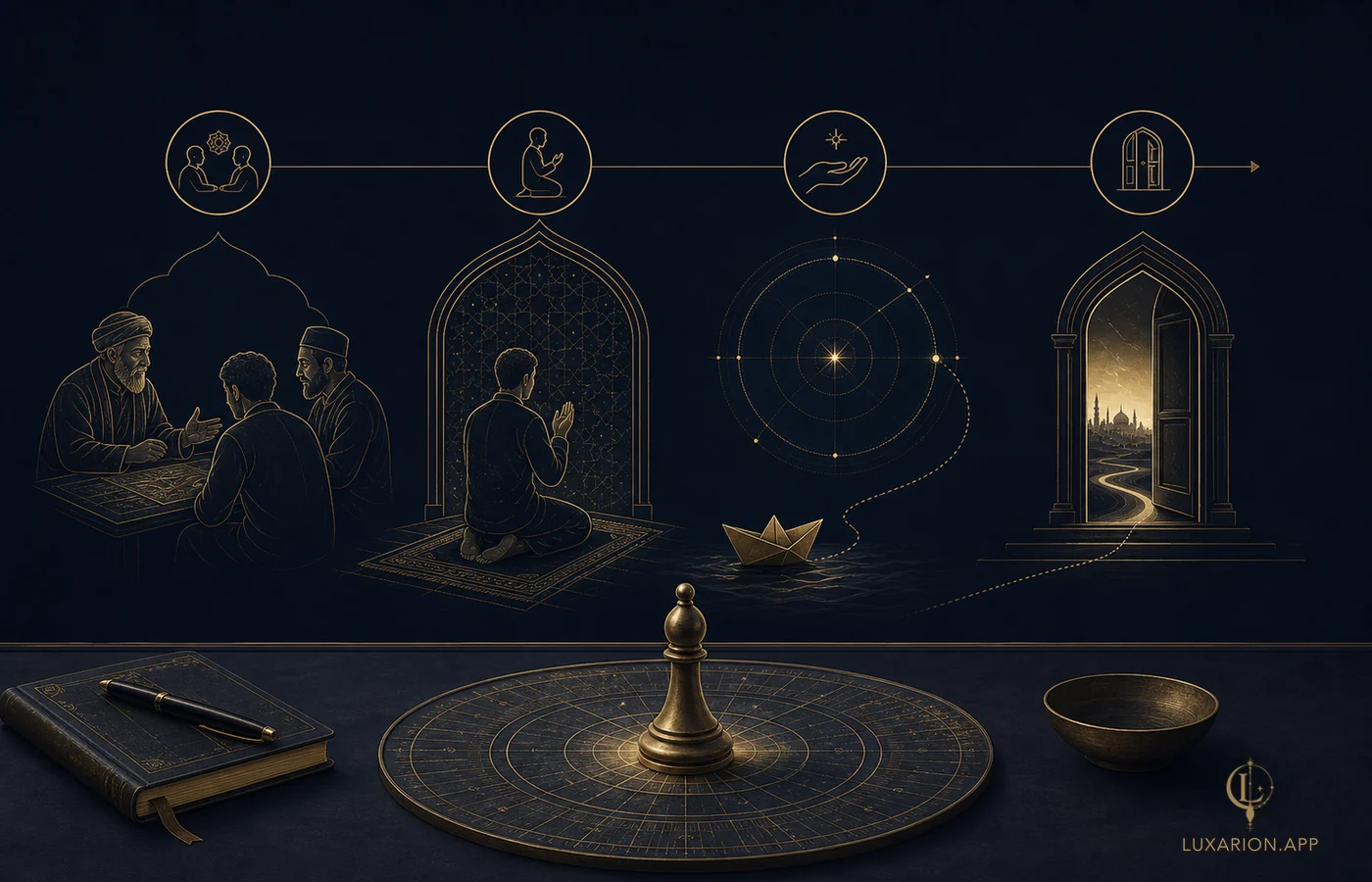
Istikhara almost never stands alone in the classical presentation. It sits third in a sequence of four, and the sequence is the actual method.
First: istishāra — consultation. Before the prayer comes the obligation to ask people who know. This is not incidental piety; it is scriptural instruction, and the Quran twice makes mutual consultation — shūrā — a defining practice, describing a community whose affairs are conducted by consultation among themselves. The order is deliberate. You do your homework first. Istikhara is not a substitute for research; it is what you do when the research is done and still underdetermines the answer.
Second: the prayer itself. Two units, the supplication, the matter named specifically in your own words at the point where the text says this matter. Name it concretely — not "my career" but "accepting the job in Ankara starting in March". Vague questions get vague experiences.
Third: ʿazm — resolve. Here is the step that most modern accounts drop, and dropping it is why the practice so often stalls. You are expected to decide. The prayer does not replace the decision; it precedes it. Having consulted and prayed, you choose the option that seems best to you and you commit to it.
Fourth: tawakkul — reliance. And only now. The Quranic phrasing is unusually precise about the order: when you have resolved, then rely upon God. Resolve first. Reliance second. Not reliance instead of resolve.
That ordering is the whole teaching in one line, and it inverts what most people assume the practice is for. Istikhara hands the outcome to the One who knows it: the road opens or closes by His decree, and the one who prayed is released — free to make a real choice with incomplete information and then to stop re-litigating it at three in the morning.
What reliance actually means, since it is constantly misread
There is a famous exchange in the hadith literature in which a man leaves his camel untied, explaining that he is relying on God, and is corrected: tie her, and rely. The correction is the entire doctrine in five words. Reliance operates on the part of the outcome you do not control, and only on that part. It is not a substitute for tying the camel.
Al-Ghazali works this out at length in the Ihyāʾ ʿulūm al-dīn, treating reliance as a station with degrees rather than a single switch, and insisting that it coexists with — rather than replaces — the ordinary use of means. The person of genuine reliance is not the one who does nothing. It is the one who does everything available and is then genuinely unbothered by the residue of uncertainty, because they were never relying on their own calculations to be complete in the first place.
This matters practically because the failure mode of anxious decision-making is not insufficient effort. It is the belief that if you think hard enough, the uncertainty will go away. It will not. Some part of every significant decision is opaque to you at the time you must make it. Reliance is the name for the relationship you have with that opaque part, and having a good relationship with it is the difference between deciding and endlessly deferring.
The same shape, seen from decision research
Decision researchers, working without the theology, arrived at a shape that sits close beside this one.
Herbert Simon won a Nobel Prize partly for the observation that real decision-makers do not optimise, because optimising requires information and computation nobody has. They practise what he called satisficing: they establish what would be good enough, search until they find it, and take it. His broader framework, bounded rationality, is the formal claim that this is not laziness but the only available strategy for creatures with limited time and limited knowledge.
Read the istikhara sequence beside that and the parallel is close. Consult — gather what is gatherable. Pray — acknowledge explicitly and out loud that the remaining gap cannot be closed by more thinking. Resolve — choose without having closed it. Rely — decline to re-open it.
The medieval logicians had a picture for what happens when you refuse that structure: Buridan's ass, the donkey placed exactly between two identical bales of hay, which starves because it has no sufficient reason to prefer either. The joke has teeth. When two options are genuinely close, the cost of continuing to deliberate exceeds the difference between them. At that point the rational move is to choose — and the tradition's teaching is that a person cannot choose in peace until what they are giving up has been handed to God. That is what the fourth step is for.
Kierkegaard named the same gap from the other side: at some point the evidence stops and you must move anyway, and no amount of further reflection converts the leap into a step. William James, in The Will to Believe, added the useful distinction that some options are forced — where declining to choose is itself a choice, and usually the worse one. The job you do not take is a decision. The relationship you do not end is a decision. The tradition's insistence on ʿazm is the same recognition, arrived at seven centuries earlier.
Which decisions this is actually for
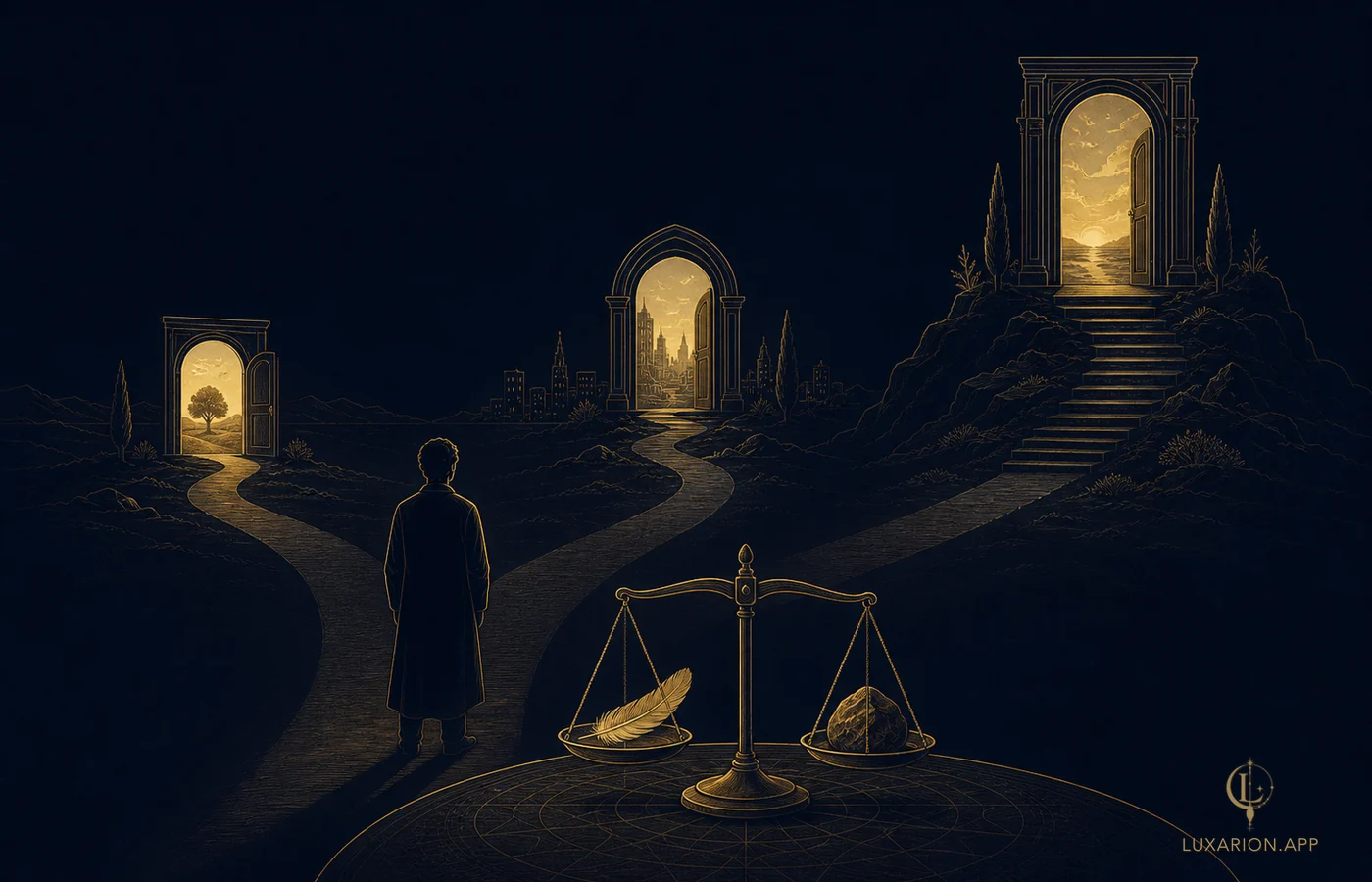
Not all decisions deserve this apparatus, and treating small choices as large ones is its own affliction. A rough sorting that we have found holds up:
Reversible and cheap. Most decisions. Try it, and if it is wrong, undo it. The cost of deliberation exceeds the cost of a mistake. Decide quickly and stop thinking about it.
Reversible and expensive. Moving cities, changing fields. Painful to undo but not impossible. Worth real deliberation, worth consultation, worth the prayer — and worth remembering that the exit exists, because people routinely treat these as irreversible and become paralysed accordingly.
Irreversible. Marriage, children, some surgeries, some public acts. These deserve the full sequence, slowly, and they deserve the long-horizon clause — the outcome of the affair — taken seriously rather than skimmed. Ask what this looks like in year five, not year one.
Not actually yours. A category people miss. Some of what keeps you awake is another person's decision that you are trying to make on their behalf. No practice will resolve it, because it is not yours to resolve. Recognising this is often the whole answer.
There is a fifth case worth naming: when both options are genuinely good. People find this state more distressing than a clear good-versus-bad choice, and they should not. If both roads are good, the decision matters less than you think, and the opportunity cost you are grieving is the price of living in time rather than a mistake you are about to make. The prayer's request to be made content with the good "wherever it may be" is addressed exactly to this.
A practice you can actually run this week
The following is a faithful and usable version of the sequence. It takes about a week.
Days one and two — write the thing down. One sentence, concrete, with a date. "Do I accept the offer in Ankara, starting in March?" Not "what should I do about work". If you cannot write the sentence, you do not yet have a decision — you have an anxiety, and it needs a different treatment.
Day two — consult, properly. Two or three people, chosen for a specific reason: one who has actually done the thing you are considering, one who knows you well enough to name your pattern, one who has no stake in the outcome. Ask them the written sentence, not a vague version of it. Notice that the tradition puts this before the prayer, and do not skip it because it is the uncomfortable part.
Day three — pray it. If the prayer is yours, pray it as transmitted, naming the matter in your own words. If it is not your prayer, turn to God in your own words and your own way, and keep the supplication's shape: that you have gathered what can be gathered, that the knowledge of the outcome is with Him, that you ask for the good to be made easy and the harm turned away, and that you ask to be content with what follows. Say it out loud, unhurried. The formality is not decoration; it marks the moment the matter passes from your deliberating into His keeping.
Days four to seven — walk toward one door. Choose the option that seems best and begin acting as if it is settled. Not committing publicly, not burning the other bridge — acting. Draft the acceptance. Look at flights. Then watch two things: whether the road opens or keeps closing, and whether the tightness in your chest loosens or grows. The classical language for the good sign is expansion of the chest: the road eases, sleep returns, and the arguments stop rehearsing themselves.
Day seven — decide, and stop. Then the fourth step, which is the discipline of not re-opening it. This is where most people fail, and it is worth knowing in advance that you will want to re-litigate. Reliance is precisely the refusal to do so.
If you want a reader beside you through a week like this, that is what our spiritual reading is for: a practitioner looks at what is at work around the matter — what is easing it, what is blocking it, and where it is heading — while the prayer itself stays yours.
Three cases, worked through
A marriage question. A proposal has been made. The person is decent by every visible measure, the family approves, and there is a tightness in your chest you cannot account for. The mistake is to pray before asking. The sequence says consult first — and consult specifically: someone who knows the person closely rather than by reputation, and someone who knows you well enough to say whether this is discernment or simply fear of change. Only when the reporting is done and the ambiguity survives does the prayer have work to do. Then take one concrete step — a second meeting — and watch whether the chest opens or closes. And do not try to settle an irreversible matter inside a single week; the timetable above is for ordinary decisions, not for this one.
A question about moving. Work is offered in another city. The money is better; the people you love are here. This belongs to the reversible-but-expensive category, and the characteristic error is to treat it as permanent and therefore become paralysed. The useful move is to bound it: what will I know in a year that I do not know now? If there is real information coming, then the decision in front of you is a one-year decision, not a lifetime one, and it should be prayed over at that size rather than inflated to the size of your whole future.
A question that is not yours. A father lies awake over his adult son's engagement. He prays, repeats, prays again, and nothing clarifies — because the matter is not his to decide. What is his is a real question with a real answer: do I say the thing I think, or hold it? Do I offer help, or withhold it? That can be prayed over. His son's will cannot. When a question refuses for weeks to resolve, it is worth checking whether you have been asking on someone else's behalf, because a badly-formed question does not become answerable through repetition.
Where this sits among the other ways of seeing
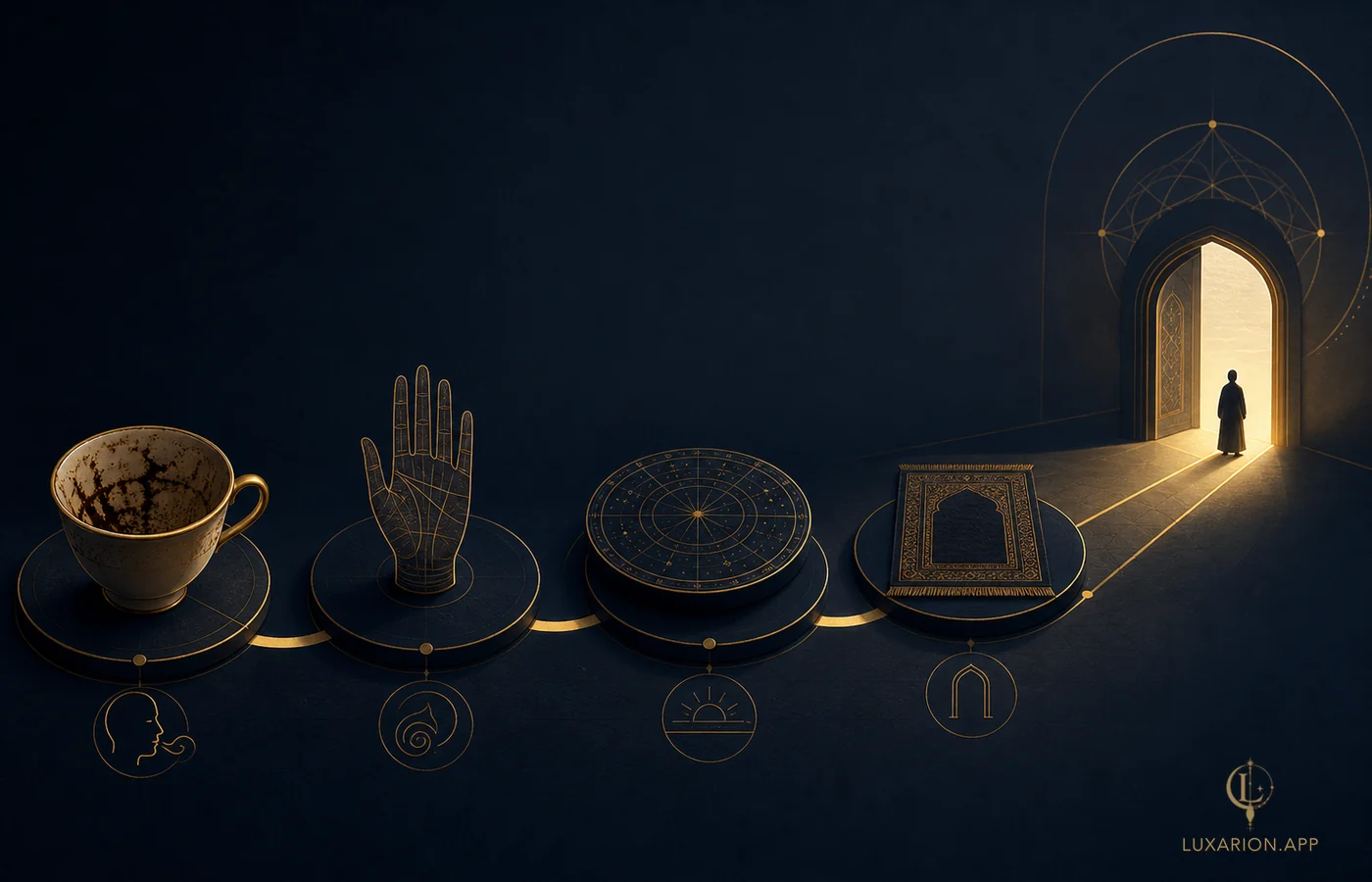
People reasonably ask how this relates to the other things one might consult — a cup, a chart, a dream. They are not competitors, and they are not doing the same job.
Istikhara's subject is action: do I move, or not? It is alone among these in being a petition rather than a reading. What is read — a cup, a hand, a chart — has a different subject: what is at work, and what is coming. Where you stand now, what is moving around you, and where the road is heading. We describe in how the cup shows what is coming how a reading names what approaches — and that is knowledge brought to a decision, not a substitute for making it.
Ordered properly, they compose. Read what is at work and what is coming. Consult expertise to complete the information. Pray the direction to close the matter. Rely, once it is closed. The confusion only arises when someone asks one of them for what another was built to give.
When nothing seems to come
Sometimes you run the sequence and the week ends exactly as ambiguous as it began. This is common enough that it deserves its own answer rather than being treated as failure.
Four things are usually true when this happens. The question was too large — "should I change my life" cannot be answered; "should I hand in notice this month" can. The question was not really yours, as above. The information genuinely has not arrived yet, and the answer is that the decision is not ripe, which is a real answer and not an evasion — we have written about that season at length in the waiting season. Or you have already decided and are seeking permission rather than guidance, which is worth noticing gently, because the heart usually knows first and the mind spends weeks catching up.
That last one is more common than people admit. If you notice relief when one option is blocked by circumstance, you have your answer and have had it for some time. The practice did not fail. It worked, and you did not like the speed.
Where this sits among the other questions
Deciding is one of a small family of problems that keep returning across a life, and they inform each other. Underneath every decision is a question about how much of your life is yours to steer at all — the argument between what is written and what is chosen, which we take up in what is written and what is yours. Alongside it sits the discipline of the interval when nothing can be decided yet. When the decision is specifically about work and provision, the particular knots are different enough to deserve their own treatment in work, provision and the honest exit. And when it is about a person — whether to stay or to go — the calculus changes again, because another will is involved; that is knowing when to hold on and when to let go.
Two further pieces are directly useful here. The question of how far to trust the feeling in your chest is treated in the quiet sense, which is careful about the difference between an intuition and an anxiety — a distinction this whole practice depends on. And the ethics of asking any question at all, including which questions a serious practitioner will decline, is in when the reading says no.
If your question has a timing component — whether now is the season for this move — the chart is a genuinely useful instrument, and the cycle most often involved in the big structural decisions of the late twenties and late fifties is described in the Saturn return. You can cast the chart itself free with our birth chart calculator; if the decision involves another person, the compatibility tool covers the same ground for two charts at once.
What the practice is really teaching
There is a reason this particular structure has survived fourteen centuries of use, and it is not that it delivers certainty. It does not, and it never claimed to.
What it delivers is a way of holding the gap in God's hands. It says, in effect: you are a creature who must act on partial information, permanently and without exception, and the knowledge you lack is with the One you are asking. Here is what to do with it — gather, ask, choose, release. Then live in the decision rather than beside it.
The one who prays it has asked for the good wherever it lies, and the old saying holds that whoever seeks God's choice is not disappointed, and whoever consults does not come to regret. They also decide better in a sense that counts over a lifetime: they stop bleeding energy into decisions already made, and they arrive at the next choice with something left. That is what the request to be made content is asking for — peace with an answer whose rightness shows itself in time.
Most of the difficulty in a hard decision is not the choosing. It is the wanting to be certain first. The old practice knew that, and built its whole shape around it.
The library teaches the craft. A reading applies it to you.
Get your personal reading