

A Dream Is a Letter: How the Old Interpreters Worked
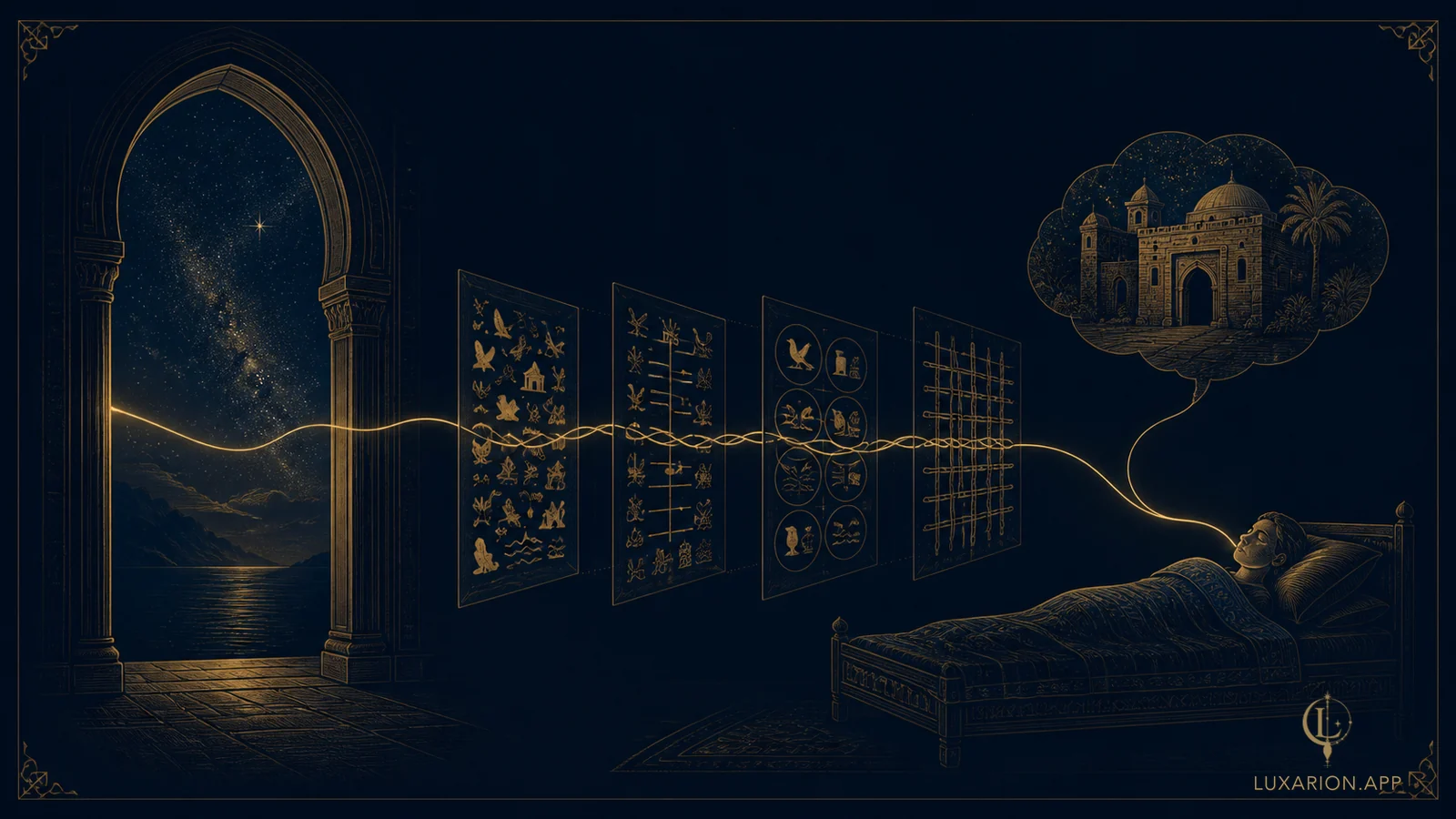
The craft behind dream interpretation: how the traditions sorted dreams, why a dictionary is the wrong instrument, and the method you can actually use.
Some dreams evaporate with the warmth of the pillow. A few arrive like mail — sealed, addressed, oddly formal — and stay with you for years. Every serious tradition of dream interpretation begins in the same place: learning to tell those two apart, and refusing to treat every night's static as a message.
That refusal is the whole craft. It is also the thing almost entirely missing from how dreams are discussed now, where a symbol is looked up and a meaning is returned. The old interpreters would have found that procedure not merely wrong but backwards — and this piece is about what they did instead.
What follows is the method: how the traditions sorted dreams before interpreting any of them, the questions that came before the symbol, why the dreamer is half the text, and a practice you can run yourself.
First, the sorting
The Arabic interpreters divided dreams into three registers, and the sorting is most of the wisdom. Nothing else in the craft works until this is done.
The true dream. Rare, quiet, unusually clear. It tends to arrive near dawn, to survive waking intact, and to stay legible years later — and it carries something: glad tidings, a warning, a matter shown before it arrives. The tradition treats these as few, and much of the interpretive discipline consists of recognising them without inflating the ordinary into their company.
The frightening dream. Nightmare material that feeds on fear. The tradition names its source — in the Islamic reading it comes from Satan, sent to grieve — and its counsel, recorded in the hadith collections of al-Bukhari and Muslim, is strikingly practical: seek refuge in God from its harm, do not narrate it, turn over and let it pass, and it will not harm you.
Ḥadīth al-nafs — the self talking to itself. The vast middle category, and where most dreams live. Yesterday's residue rearranged: what you carried through the day, taking a shape at night. Not meaningless — but its meaning points inward at your current preoccupation rather than outward at events.
Why this matters practically: the reading you give depends entirely on which register a dream belongs to. A snake in a frightening dream is met with refuge and set aside. The same snake in a true dream is read by the tradition's keys — often an enemy, with the details saying which — and in the self's own talk it is yesterday's worry replayed. Skipping the sort and going straight to the symbol is how people end up frightened by the wrong dream, and deaf to the right one.
Artemidorus makes a parallel division in Greek, separating dreams that reflect present preoccupation from those the tradition treated as significant. Two traditions, no contact, same first move.
One further point about the sorting, because it is the step people most want to skip. The traditions did not treat the three registers as a hierarchy of value so much as a division of method. A dream in the third register is not a lesser dream; it is a dream that answers a different question. Asking a preoccupation-dream to predict events is like asking a shopping list to tell you the weather — the fault is in the question, not the document.
Why a dictionary is the wrong instrument
Here is the claim the manuals make most insistently and that modern practice most ignores: the same image means different things to different people, and any list that says otherwise is selling convenience.
Artemidorus organises whole sections of the Oneirocritica by the dreamer's trade, status, wealth, health and habits — because he had collected thousands of cases and found the readings would not hold still across them. A dream of losing cargo means one thing to a merchant and another to a man who has never owned any. The Arabic compendia do the same by circumstance: married or not, in debt or not, travelling or settled, in good health or ill.
This is why Ibn Sirin, whose name attaches to the greatest of these compendia, is remembered for a method rather than a lookup table — the principle that a figure in a dream commonly stands for a quality, a period, or a matter associated with it rather than for itself. Which means the symbol never resolves alone. It resolves against a life.
The practical consequence is uncomfortable for anyone who wants a fast answer: a dream cannot be interpreted from the dream alone. Half the text is the dreamer, and any reading offered without knowing who is dreaming is a guess wearing a costume.
The questions that come before the symbol
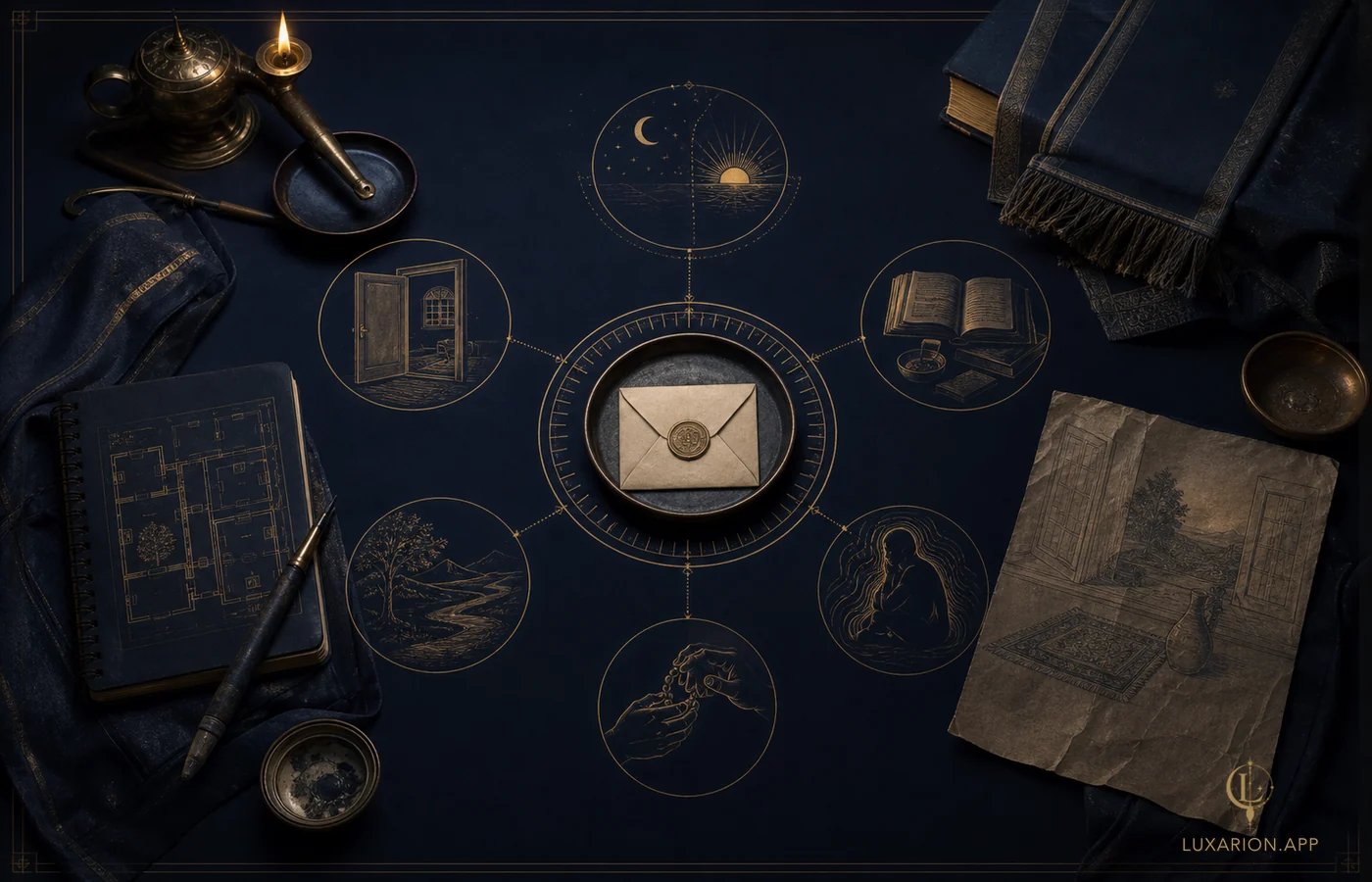
A good session in this craft is mostly interrogation. These are the questions the classical material implies, and you can put every one of them to yourself.
When did it arrive? Early night or near dawn — the traditions distinguish, and generally treat the pre-dawn dream as clearer and more weighted. Modern sleep research is not in conflict here: REM periods lengthen through the night, so the longest and most narratively coherent dreams do cluster before waking.
What occupied you the day before? If a preoccupation was live, the dream most likely belongs to the third register and should be read against that rather than as a message about events.
Where were you in the dream? Your own house, a stranger's, open country, a place from your childhood. The setting frequently carries the subject while the action carries only the drama.
What was your state? Calm, terrified, curious, resigned. The tradition weights the dreamer's own condition above the imagery — the same scene dreamt calmly and dreamt in horror are two different dreams.
Was there speech? What is said in a dream receives special attention across traditions. Where a figure speaks, the sentence is often the whole content.
Has it recurred? A single dream and a returning one are different phenomena, and the second is read as insistence — something sent and not yet read. We treat that specifically in why the same letter keeps arriving.
An interpreter who delivers a verdict before asking these is not practising the craft, whatever they happen to get right. Accuracy without method is luck, and the manuals say so plainly.
The ethics, which are not decoration
The interpretive traditions carry a code, and it is load-bearing rather than ornamental. Four rules recur across languages.
A dream falls as it is interpreted. This is the most striking of the classical positions. In the Islamic tradition a dream is said to rest on the leg of a bird until it is interpreted, and to fall as it is read — which is why a reading is an act, not a neutral observation. Hence the counsel to tell a dream only to someone learned or someone who loves you, and the corresponding duty on the interpreter to read it for the good.
Where readings are equally available, offer the better one. Not concealment of the difficult, but a refusal to select the frightening reading when the material does not compel it. This follows directly from the rule above.
Do not interpret into fresh fear. Someone in the first week of a bereavement or a rupture is heard first, and read when they can carry it — the discipline we set out in when the reading says no.
Do not turn a dream against anyone, and do not pronounce on a body from it. A dream can concern another person — a true dream may carry news of a relative or a warning about a companion — and the tradition reads it with care and for the good. What it never does is make a dream into an accusation, or into a diagnosis; the body goes to a physician.
What the modern study of sleep contributes
The contemporary picture complements the craft rather than competing with it, and it is worth having because it explains the raw material.
Dreaming clusters in REM sleep, during which the emotional centres of the brain are highly active while the regions governing self-monitoring are quieter. That is the physiological picture of a night that speaks in images rather than propositions — the language the interpretive traditions have always read.
Sleep is also when memory consolidation occurs, integrating recent experience with older stored material by association rather than chronology. This is why a feeling from Tuesday can summon a scene from a decade ago: the filing system works by resemblance. The traditions' third register — the self talking to itself — is a remarkably good description of that process observed from the inside.
Calvin Hall assembled the first large empirical corpus of dream reports and found the same image clusters the old manuals had catalogued by hand across centuries — a laboratory arriving, by its own road, at a map the interpreters had long been using.
Antti Revonsuo proposed a rehearsal function for threatening dream content, which sits comfortably beside the traditions' own attention to fear-driven dreams as a distinct category requiring different handling.
None of this replaces interpretation. It describes what the sleeping body is doing; the craft reads what the dream carries — and a true dream is not written by the body at all. The traditions were never troubled by physical causes: they placed each cause in its own register, and gave the true dream its own.
Jung, and the shared images
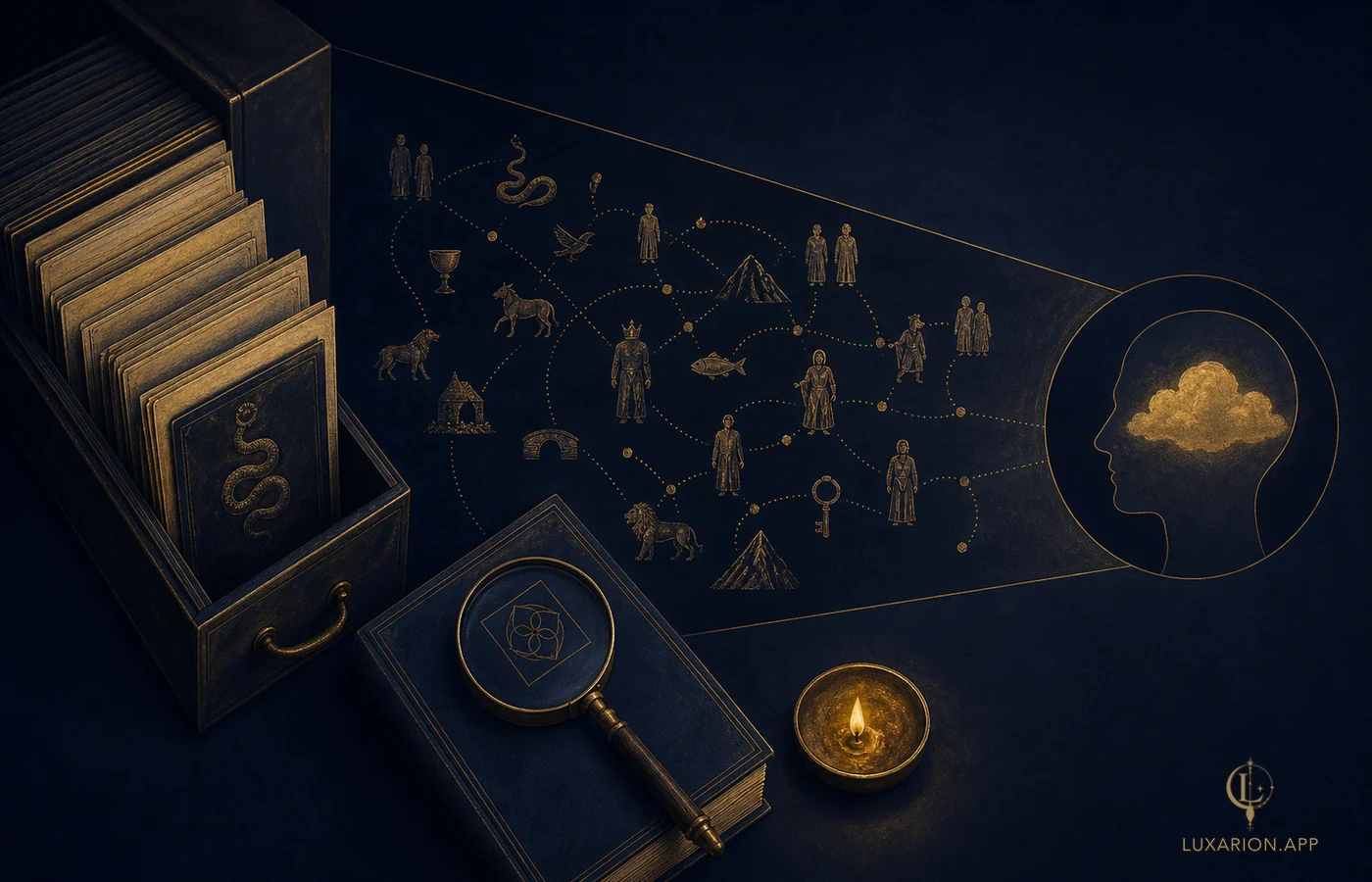
Carl Jung gave modern language to something the old interpreters worked with practically: that certain images recur across people who could not have learned them from each other. His account of the collective unconscious is one framework for that observation; the traditional catalogues are another, arrived at empirically by interpreters comparing thousands of cases.
What is useful in Jung for a dreamer is the emphasis on dreams as compensatory — showing what waking attention has been leaving out. That sits beside the tradition's questions rather than replacing them: a dream can show what you have not been looking at, and a true dream can also show what is on its way.
How the tradition was actually transmitted
It is worth knowing how this body of knowledge was built, because the manner of its assembly is the best argument for taking it seriously.
Artemidorus is explicit about his method: he travelled, he attended festivals, he sought out practising diviners, and above all he collected outcomes. He was not theorising about what dreams ought to mean; he was recording what interpreters had said and what had followed, across thousands of cases, and adjusting. That is a practitioner's record rather than a theory, and it is why his distinctions are so stubbornly specific.
The Arabic tradition compiled on an even larger scale, and the compendia that carry Ibn Sirin's name are the accumulated work of many hands over generations rather than one man's inventory. What survives is therefore a filtered record: readings that were used, tested against lives, and either kept or dropped over centuries of practice.
This matters for how you should hold the material. These catalogues are the accumulated reading of interpreters who stood in a line reaching back to Joseph's reading of the king's dream, and who saw a great many dreamers and kept what held. The right posture toward them is the one you would take toward any living craft: serious attention, and the expectation that a key must be applied to a life rather than merely consulted.
Four common errors
Most bad interpretation comes from one of four moves, and naming them prevents most of the damage.
Interpreting before sorting. Going straight to the image without asking which register the dream belongs to. This single error produces most of the unnecessary fear in the whole field, because anxiety dreams get read as prophecy.
Treating intensity as significance. A dream that shook you may be the frightening kind the tradition tells you to set aside with refuge, not a message. The true dream is more often quiet and clear — and the quiet dreams are the ones people forget by breakfast, which is the real argument for writing everything down.
Reading a symbol without the dreamer. Covered above, but it bears repeating because it is the error the internet has industrialised. The symbol is half the text at most.
Repeating the dream until it hardens. Each retelling smooths the account toward narrative coherence. After a dozen tellings you are interpreting a story you constructed, not the dream you had. This is why the discipline says write it once, early, and then stop handling it.
The practice: seven minutes a morning
Translated into something you can actually do, the classical discipline takes about seven minutes.
Write before you speak. Before the phone, before telling anyone. Dreams degrade fast and in a specific direction — toward a tidier, more meaningful-sounding story. Record the parts that do not fit; that is usually where the information is.
Sort it first. Which of the three registers? Was there a live preoccupation yesterday? Was it fear-driven? Is it unusually clear and pre-dawn? Do this before you interpret anything, because it determines how you read everything after.
Name the feeling in one word. Before analysis. Dread, embarrassment, grief, relief, curiosity, indifference. People routinely misremember this within an hour, and it carries more interpretive weight than the imagery.
Note the setting and the witnesses. Where, and who saw. Both are systematically under-recorded and frequently turn out to be the subject.
Write any dialogue verbatim. Then ask who that sentence is actually for.
Ask what changed in the last fortnight. Something begun, ended, decided or revealed. Transitions are the reliable occasion for significant dreams.
Close the notebook. Recording is half the interpretation; rumination is its enemy. Telling yourself the same dream ten times in a day produces anxiety, not understanding.
Keep this for a month and something usually becomes visible that no single dream shows: your dreams cluster. They arrive in particular weeks, and looking at what those weeks contained answers the question before you have to ask it. This is also the practice that lets the inherited keys speak to your own life — the subject of your own dream alphabet.
Reading a dream in practice
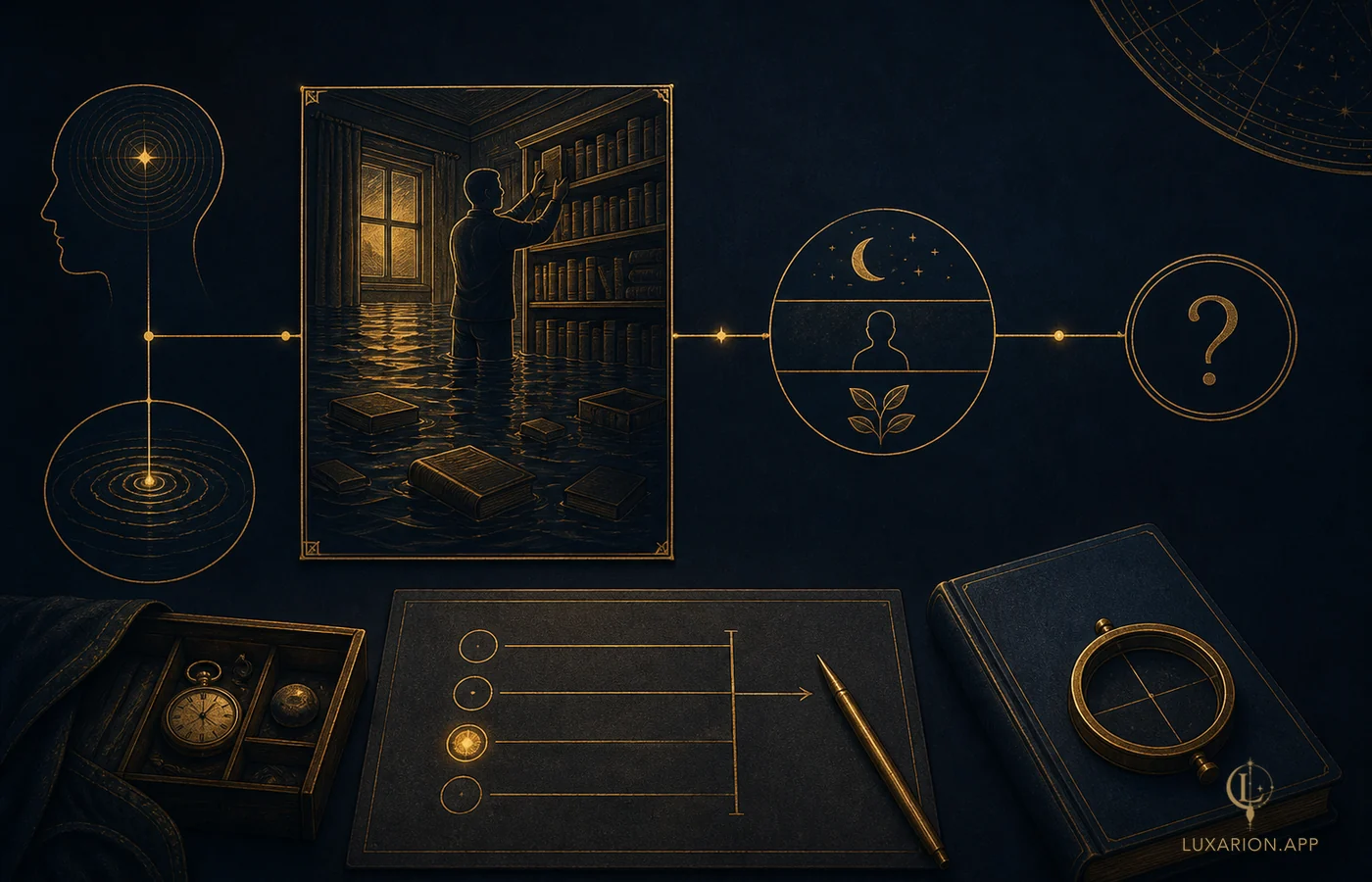
An example, to show the method rather than describe it. Someone brings this: they are in their childhood house, water is rising through the floor, and they are calmly moving books to a higher shelf. No fear.
The dictionary approach reaches for water — emotion, the unconscious — and stops. The method does something else.
Sort first: no live crisis yesterday, not fear-driven, and it came near dawn and stayed clear on waking. So it is weighed as more than the self's talk.
Then the questions and the keys together. The setting is the childhood house, not the current one — so the matter belongs to the dreamer's roots. In the classical keys, clear water entering a house without harm is commonly read as good entering it — provision, or knowledge — and books are knowledge and what is kept of learning. The state is calm, which is the most informative detail here: rising water that brings no fear is not a flood of trouble. The action is preservation.
Now the reading: something old and rooted is being brought into this season — learning, or what the family kept — and the dreamer is carrying the best of it upward. What from your roots is returning to you now, and what are you being asked to keep?
That is a reading a person can do something with. It came from the sort, the setting, the emotional state and the keys together — not from a single symbol looked up alone.
What this method refuses to do
Worth stating plainly, because these are the requests practitioners receive most often.
It does not pin dates. A true dream shows what is coming — glad tidings, a warning, a matter before it arrives — and the classical interpreters gave its timing with care, as a season or a sign rather than a calendar day.
It does not turn a dream into an accusation. A person who appears may stand for a quality or a matter, or a true dream may concern them; the interpreter reads which, and reads it for the good.
It does not deliver fixed verdicts about death or ruin. No serious lineage does this, and the refusal is principled: such a reading harms the person receiving it.
What it does is read the letter: what the dream carries, what it asks of you, and — when it is a true dream — what it announces. That is what the traditions were built to do.
Where to go from here
This method applies to every dream, and the recurring images have their own treatments. The snake is the most reported of all: one animal, a dozen traditions. Teeth are the other near-universal: what the traditions say about teeth. Pursuit is in who is really doing the running, dreams of a former partner in what the dream is really about, and dreams in which the dead appear — handled with particular care — in what the traditions read in a death dream.
The related contemplative practices sit close by: the discipline of reviewing the day before sleep, in a practice two thousand years old, and the question of how far to trust an inner signal at all, in the quiet sense.
And if you would rather work a dream through with someone who knows the tradition, that is what our dream interpretation is for — the session is built on the questions above rather than on a lookup table, which is the difference between the craft and its imitation.
What the metaphor is actually claiming
Calling a dream a letter is more precise than it first appears, and every part of the comparison carries weight.
A letter is addressed — to one person, in terms that person can read. It arrives at a time not of your choosing. It uses a shorthand that assumes shared knowledge between sender and recipient, which is why another person's dream is opaque and your own is oddly legible once you stop trying to decode it. And crucially, most post is not important. The traditions' first move — the sorting — is simply the recognition that a household receives a great deal of mail and only some of it needs answering.
Which leaves the one instruction that survives every tradition and every century of this craft. Do not look the dream up. Read it — slowly, in your own circumstances, with attention to how it made you feel and what you were carrying that week.
The letter was written to you, in a language you already know.
The library teaches the craft. A reading applies it to you.
Get your personal reading