

The Weight on the Chest: Sleep Paralysis and the Night Visitor
Awake, unable to move, certain someone is in the room. Every culture named this — and every one of them put it in a category of its own.
It goes like this. You come awake — properly awake, aware of the room, of the light under the door, of where your arm is lying — and you cannot move it. Not stiffness. Absence. The command goes out and nothing answers.
Then, in a large fraction of cases, there is the other thing. A weight settling across the chest. A conviction, complete and immediate, that someone is here. Often at the foot of the bed or just past the edge of what you can see. Sometimes a sound: breathing, a footstep, a voice saying something you cannot afterwards recall.
It lasts seconds to a couple of minutes. Then it releases, and you lie there with your heart going, trying to work out what to call what just happened.
Here is the first useful thing: every culture that has left a record has a name for it, and the names describe the same figure. That is not a small fact, and this article is about what follows from it — including a finding from inside the interpretive traditions themselves that almost nobody mentions, and that changes how the experience feels to carry.
The names, and what they agree on
Start with the vocabulary, because it is the evidence.
In Arabic it is al-jāthūm, from a root meaning to crouch or squat on something — a name that is a description of posture. In Persian it is bakhtak. In Turkish it is karabasan, built from the words for black and pressing. In English folklore it was the night hag or the old hag, who rides the sleeper. In Newfoundland the same visitor is still called the Old Hag and the verb is hagged. In Japanese it is kanashibari, bound in metal.
And in French, the word did not stay in folklore at all. Cauchemar is built on the Old French caucher, to press or trample, plus mare — the same night creature that sits inside the English word nightmare. Both languages carry the folklore inside the ordinary word for a bad dream, and both have forgotten it.
Look at what these names have in common, because it is unusual. They are not names for fear. They are names for weight, pressure, restraint and a specific location — on the chest, on top, sitting. Cultures with no contact between them independently produced not a general word for a frightening dream but a precise one for a thing that sits on you and holds you down.
Anything reported that consistently, in that much detail, across that many unrelated languages, is describing something real that happens to human beings. The question is what.
The three shapes an episode takes
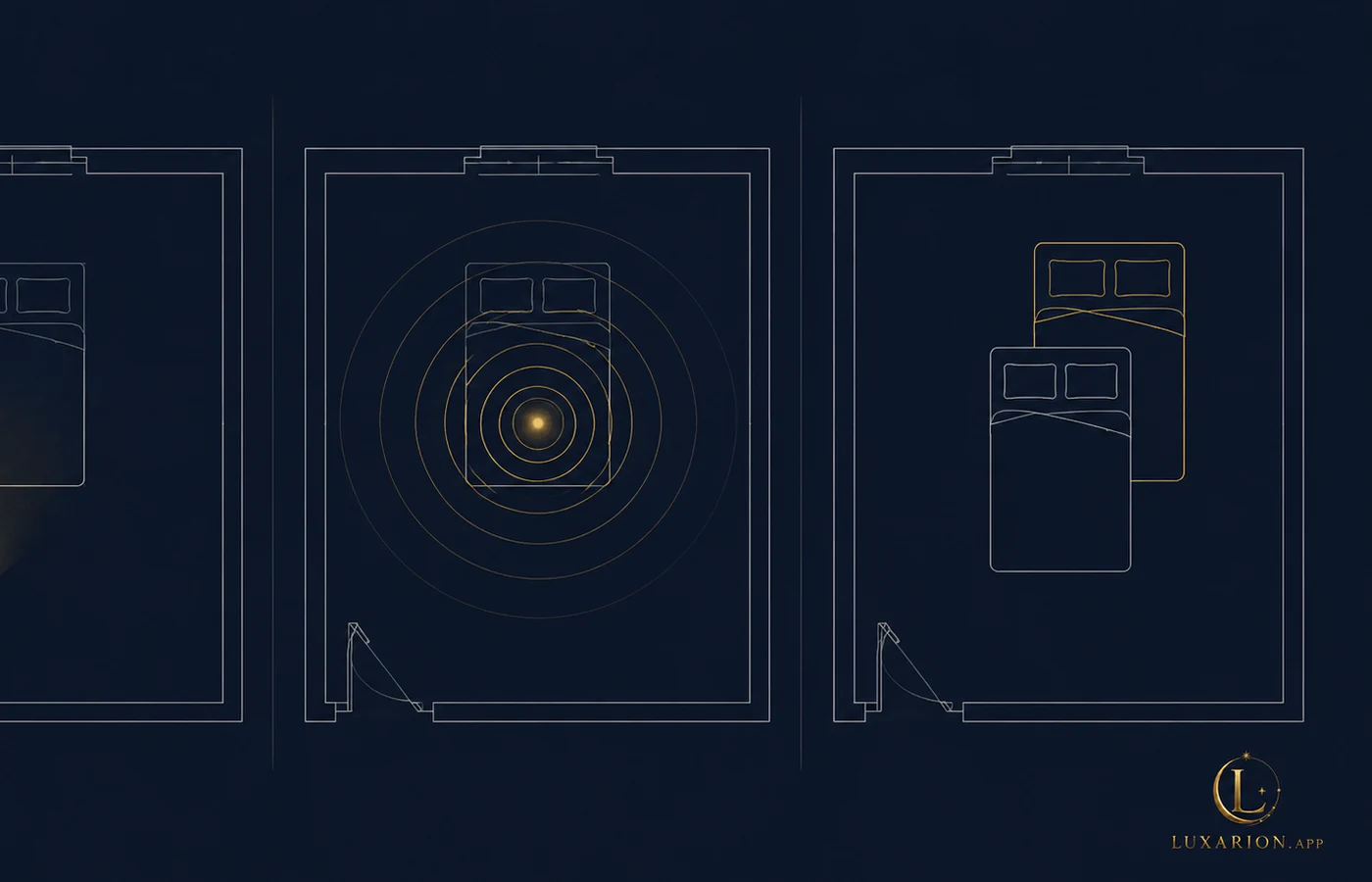
Reports sort into three recognisable kinds, and knowing which one you get is more useful than any general account, because they respond to different things.
The intruder. Someone is in the room. This is the most-reported kind and the one that generates the folklore: a figure at the door, at the foot of the bed, moving closer. It is the version most responsive to the practical advice about where you direct your attention, because the figure gains detail from being looked for.
The weight. Pressure on the chest, sometimes on the throat, occasionally the sensation of being sat on or held down. This is the version the names describe — jāthūm, karabasan, cauchemar all point here — and it is the one that responds to breathing out rather than in.
The floating. Less discussed and often not frightening at all: a sense of rising, tilting, being drawn upward or out of the bed. A minority of people find this one pleasant. It shares a boundary with the experiences people describe as leaving the body, and the overlap is worth knowing about, because it explains why two people can describe the same physiological state in completely different registers — one as an assault and one as a lift.
Most people get one kind consistently. A few get all three, sometimes in the same episode, and the sequence is usually weight first and figure second — which is a small clue about how the imagery assembles: the sensation arrives, and the mind supplies a cause.
What the body is doing
The mechanism is worth knowing, and knowing it makes the experience easier rather than smaller.
During REM sleep — the phase in which most vivid dreaming happens — the body holds the voluntary muscles in a state of temporary paralysis. This is protective and it is standard equipment: it is the reason you do not physically act out a dream in which you are running. Breathing and eye movement continue; nearly everything else is held.
Sleep paralysis is what happens when consciousness returns before the paralysis lifts. The mind is awake, the room is real, and the body has not yet been released. Around a fifth of people experience it at least once, which makes it common rather than rare — commoner than most people think, because almost nobody mentions it.
The presence in the room belongs to the same overlap. The state at the boundary of sleep — hypnagogia at the entry, its mirror at the exit — generates imagery that arrives with the full authority of perception rather than the lower authority of imagination. You are not imagining a figure; you are seeing one, in the sense that seeing is a thing your brain does. The chest pressure has an equally direct source: in REM, breathing is shallow and rib-cage movement is reduced, and a mind that is awake and cannot move interprets a restricted breath exactly as it would while awake.
None of this makes the folklore wrong. It makes it accurate from the outside. A tradition that says "something sits on the chest and holds you down" is describing what happens with considerable precision; it named the experience from where a person actually stands, which is inside it.
The finding nobody mentions
Now the part that changes how this feels to carry, and it comes from inside the interpretive traditions rather than from outside them.
Every serious dream tradition sorts dreams before it reads them. It does not interpret everything it is handed. The Islamic classification is the best known of these and distinguishes the true vision from the dream that is the soul talking to itself and from the troubling dream that is not to be acted on — with the explicit instruction that the third kind should not be recounted or interpreted, only put down. Artemidorus, writing in Greek in the second century with no connection to that tradition, made the same primary cut: he separated the enhypnion, which arises from the body and its appetites and reports the present state, from the oneiros, which is significant and may be read.
Now put the pressing-dream against those categories. Sudden onset at the boundary of sleep. Bodily, unmistakably — pressure, restraint, breath. Reported nearly identically by people whose lives have nothing else in common. It falls, in both systems, on the side that is not to be interpreted as a message.
That is not a dismissal. Read it the other way round and it is one of the kinder things a tradition has ever said to a frightened person: you have not been sent something you are obliged to decode. There is no hidden instruction in it, no verdict about your life, nothing to work out before it happens again. The traditions that took dreams most seriously are precisely the ones that drew this line, and they drew it to protect people from exactly the reading a modern search result will hand you at three in the morning.
This is worth saying plainly because the alternative is expensive. A person who believes their sleep paralysis is a message will spend months looking for what it means, and will find nothing, because there is nothing of that kind in it to find.
Why the figure looks the same everywhere
If the traditions decline to read it as a message, an obvious question follows: why is the imagery so consistent?
Because it is built from the same three ingredients everywhere. There is weight on the chest, which needs a source. There is an awake mind in a dark room, which will locate a source. And there is complete immobility, which makes any source threatening. Given those three, a large heavy thing sitting on you and watching is nearly the only description available.
What varies is the costume, and the costume is cultural. A society that speaks of jinn will meet one. A medieval European village met an incubus. A twenty-first-century city meets a shadow figure, a hooded outline, sometimes something with the shape of technology about it. The grammar is fixed and the vocabulary is local, which is exactly the pattern you would expect if the experience is human and the interpretation is inherited.
There is a practical use in that. Because the costume is local, it can be changed by what you have recently read and watched. People who consume a lot of material about night visitations report more elaborate figures. This is not a reason for shame; it is a reason to be a little careful about what you read in the fortnight after an episode, and about reading it at midnight.
What helps while it is happening
Practical, and it works. Almost everyone who has learned these reports that episodes stop being frightening long before they stop happening.
Name it, in words, immediately. "This is the pressing. It lasts a minute." The naming is not a formality. It replaces the interpretation your fear is building with one that has an end time in it, and that alone shortens the experience for most people.
Do not fight the whole body. Large-muscle effort against atonia produces nothing but panic. Go small instead: a fingertip, a toe, the tongue, the eyes. The smallest muscles release first, and one moved finger is usually enough to break the whole state.
Breathe out rather than in. The chest feeling comes from restricted expansion, so trying to take a big breath fights the exact thing that is stuck. A slow, long exhale is available and it settles the alarm.
Do not look for the figure. Searching the dark for it makes it more detailed, because you are supplying attention to a process that is assembling an image. Looking at a known object — the window, the edge of the door — gives the process something already solved to work with.
Let it end. It ends. Every single one has ended. The person who is frightened is frightened of a state that has a hard time limit and no exceptions.
What helps between episodes
Frequency is much more responsive to ordinary conditions than most people expect, and this is the part worth acting on.
Three factors turn up again and again in people's own records. Sleeping on the back is associated with episodes in a large majority of reports, and changing position is the single most effective adjustment available; people who have been supine sleepers all their lives can usually retrain in a fortnight with a pillow behind them. Irregular timing — shift work, a broken week, catching up at the weekend — raises frequency reliably. And the state you fall asleep in matters more than the total hours: episodes cluster on nights that began at high alertness, which in practice usually means a screen.
Keep a short record, because the pattern is nearly always legible. Date, position, what time you went down, what the previous day was like. Three or four entries is usually enough to see it. This is the same discipline the dream traditions applied to everything else, and it works here for the ordinary reason that a series shows what a single night cannot.
And if the episodes are frequent, if daytime sleepiness is heavy, or if they arrive with anything else that worries you, this is a good thing to mention to a doctor. It is a recognised and well-described sleep phenomenon and it is not an odd thing to raise.
What is worth reading: the series

Everything above says the individual episode is not a message. That leaves a genuine question: is anything here worth interpreting at all?
Yes, and it is the pattern rather than the night.
Ask a practitioner who has heard many of these and they will tell you the same thing: the episodes cluster. They arrive in the month someone moves house, in the weeks after a bereavement, during the third trimester, in the run-up to a decision that has been avoided, in the fortnight after starting a job that is going badly. Not because the pressing carries a message about those things, but because the conditions that produce it — broken sleep, alertness at bedtime, a mind that will not put the day down — are the conditions those situations create.
So the reading is at the level of the season, not the night. What was happening in your life the last three times? That question has an answer, it is usually available immediately, and it is usually the same answer. What that surfaces is the thing worth attending to, and it is generally not the figure in the room.
This is precisely the move the interpretive traditions make everywhere else, and it is set out at length in the article on recurring dreams: when the same image keeps arriving, the message is in the arrival rather than in the image.
The painting that outlived the belief
A short digression that is worth the space, because the picture is probably in your head already.
In 1781 Henry Fuseli exhibited The Nightmare at the Royal Academy: a woman thrown back across a bed, and squatting on her chest a small, dense, malevolent figure. The painting made him famous, was reproduced endlessly as a print, and has never gone out of circulation.
What is remarkable is the accuracy. Fuseli was not illustrating a theory; he was painting a report. The posture is right, the location is right, the weight is right, the watching is right. Two hundred and forty years later, people describing their own episodes to a doctor produce, in words, that painting.
Its survival is the point. Long after educated Europe stopped attributing the experience to a creature, the image stayed, because the image was never really about the creature. It was about the pressure and the immobility, which have not changed.
Telling someone about it
A short section on the social part, which is the part that most often goes badly and is almost never covered.
People who have had these episodes tend not to mention them. The reason is easy to see: the account contains a sentence — there was someone in the room — that sounds, to a listener who has never had one, like a claim about the world rather than a description of an experience. The teller knows this and edits, and ends up either saying nothing or saying it as a joke.
Two things make the telling work. First, lead with the immobility rather than the figure. "I woke up and couldn't move for a minute" is a sentence anyone can receive, and it carries the essential fact. Second, name it. The phrase "sleep paralysis" does real work in a conversation, and so does the older name in your own language; both signal that this is a known thing with a name rather than something that happened only to you.
And if you are on the listening end: the single most helpful reply is not reassurance about the figure. It is that happens to me too, or, failing that, I know what that is. Almost everyone who has carried one of these for years reports that the relief came from learning it had a name and was common — not from being told what it was not.
Common questions
Is it dangerous? The episode itself is a temporary state of the sleep cycle and it resolves on its own. Frequent episodes, heavy daytime sleepiness or anything else that concerns you is worth raising with a doctor — sleep phenomena are well described and easy to talk about.
Why does it happen more when I am stressed? Because the reliable triggers are disrupted timing and high alertness at bedtime, and difficult periods produce both.
Is the presence in the room real? The perception is real — you are genuinely seeing and feeling, not imagining. What every tradition and every practitioner will tell you in the same breath is that this particular experience is not the kind that is read for a message, which is why nobody should be sending you off to decode it.
Can I make it stop? Frequency responds well to position, regular timing and how you fall asleep. Complete elimination is not always possible, but going from monthly to a couple of times a year is common with those three changes.
Should I record it in my dream journal? Record the date, the position and the previous day — not the content. The content is not the material here; the pattern is.
Is it the same as a night terror? No. A night terror occurs in deep non-REM sleep, involves movement and shouting, and is typically not remembered. This is the opposite: no movement, and remembered vividly.
Does lucid dreaming help or make it worse? Reports go both ways. Some people who practise lucid dreaming find the state becomes navigable rather than frightening; others find deliberate work at the sleep boundary increases how often it happens. If you already have frequent episodes, that is a reason to be cautious with techniques that involve waking yourself in the night.
If you are carrying one of these
Start with the three practical adjustments — position, regular timing, and how you go down — and keep four lines of record. For most people that is the whole intervention.
If the episodes are clustering around something in your life, that clustering is the thing worth talking about, and a conversation does more with it than any symbol list can. A dream interpretation with Luxarion starts from your account and your own season rather than a lookup, and it will do here what the traditions do: separate what is worth reading from what is not, and spend the time on the first.
If what you actually want is to be able to read your own dreams — the ones that are the readable kind — the article on how the old interpreters worked sets out the sorting this piece leans on, and the piece on building your own dream alphabet is where to go next.
And if you take nothing else from this: the thing that sat on your chest has been sitting on people's chests, under different names, for as long as there have been names. You are in extremely large company, and none of them were being told anything.
The library teaches the craft. A reading applies it to you.
Get your personal reading