
Teeth Falling Out in Dreams: What the Traditions Say
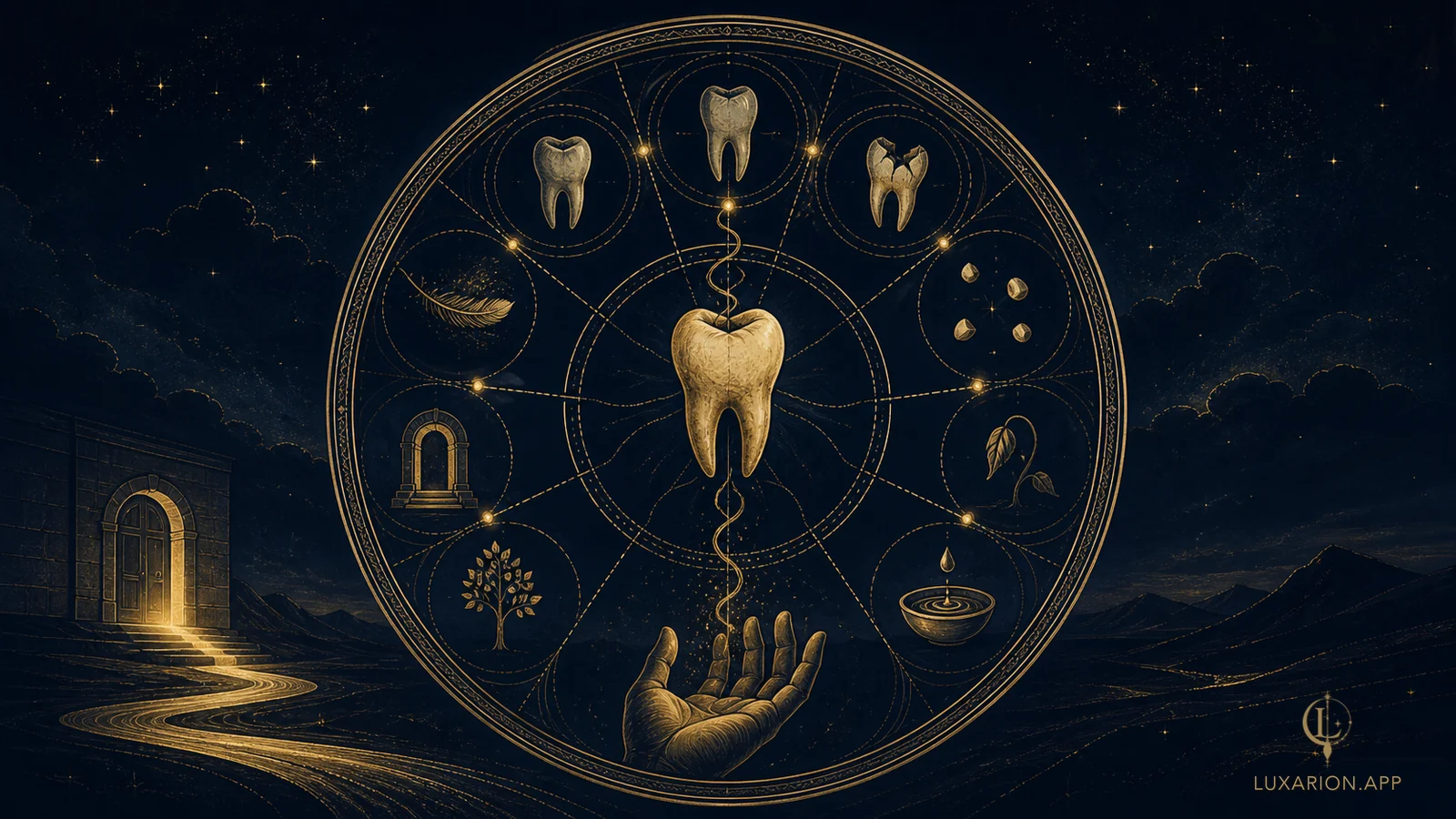
The most physically vivid dream most people ever have. What Ibn Sirin and Artemidorus actually read in it, every variant, and how to read your own.
You are talking to someone, and a tooth shifts. You touch it and it comes away in your hand. Then another. You are holding them, trying to put them back, aware that this is catastrophic and somehow also that you must keep the conversation going.
Almost everyone has had some version of this, and it is unlike other dreams in one specific respect: it is physical. People wake from it running their tongue along their teeth to check. That tactile quality is why it lodges in memory for years, and why it has been recorded and interpreted continuously for at least two thousand years.
What follows is what the traditions actually say — the Arabic material, which is the most systematic body of interpretation ever assembled on this image; the Greek, which is older in writing; the modern findings that explain why the dream feels so bodily; and a method for reading your own rather than looking it up.
Why teeth, and why everywhere
Before the readings, the fact underneath them. Dreams of tooth loss appear across cultures with no contact and across every century for which we have dream records. That kind of persistence usually means the image is doing several jobs at once.
Teeth are unusual among body parts in a way that shapes every interpretation they receive. They are the only visible part of the skeleton — bone, exposed, in the front of the face. They are how you eat, so they are survival. They are how you speak clearly, so they are communication. They are the most conspicuous element of a face in conversation, so they are how you are seen. And, uniquely, they are lost twice: once in childhood as an ordinary passage, and once in age as decline.
That last property matters more than any other. No other body part carries both a normal childhood transition and an image of ageing. A dream reaching for a symbol of change that costs something, and is visible to others, and connects childhood to old age, has exactly one option.
One further note on the childhood layer, because it is the part people most often overlook. Every adult who has this dream has already lived the experience once, at six or seven, as something entirely ordinary and even rewarded. That memory is still filed. It is one reason the dream can carry a strange undertone of the mundane alongside the horror — and it is why several traditions read the painless version as passage rather than loss. The body has done this before, and it did not mean disaster then.
The Arabic tradition: the household
In the Arabic dream literature — the largest and most detailed corpus on this image anywhere — the governing reading is that teeth stand for the people of your house.
Ibn Sirin, whose name attaches to the great compendia of this tradition, is associated with a scheme of remarkable precision: the upper teeth for the men of the family and the lower for the women, the incisors for the closest relatives, the molars for the more distant, the canines for particular figures of standing. On this reading a tooth falling is read as a separation — a departure, a rupture, a distance opening between you and a specific person, the person indicated by which tooth.
Two refinements matter more than the headline scheme, and both are constantly dropped in modern summaries.
The first is that a tooth falling into your hand was read very differently from a tooth falling to the ground and being lost. Caught and held, the tradition tends toward continuation — the matter is grave but the relation is retained, sometimes read as a birth in the family or an inheritance of position. Fallen and gone, the reading is closer to a genuine parting.
The second is that pain changes everything. A tooth that comes out painlessly and cleanly was read far more favourably than one wrenched out or bleeding. The interpreters treated the dreamer's sensation as part of the text, not as decoration around it.
There is also a second interpretive line, less known and worth having: teeth as debts and obligations. On this reading the falling tooth is a burden discharged — a debt paid, a duty completed, something you had been carrying that has been set down. Where a dreamer had no family concern but was under obligation, the interpreters reached for this line instead. Which is a useful demonstration of the tradition's actual method: the same image, read against a different life, produces a different meaning.
The Greek tradition: the household again, and the creditors
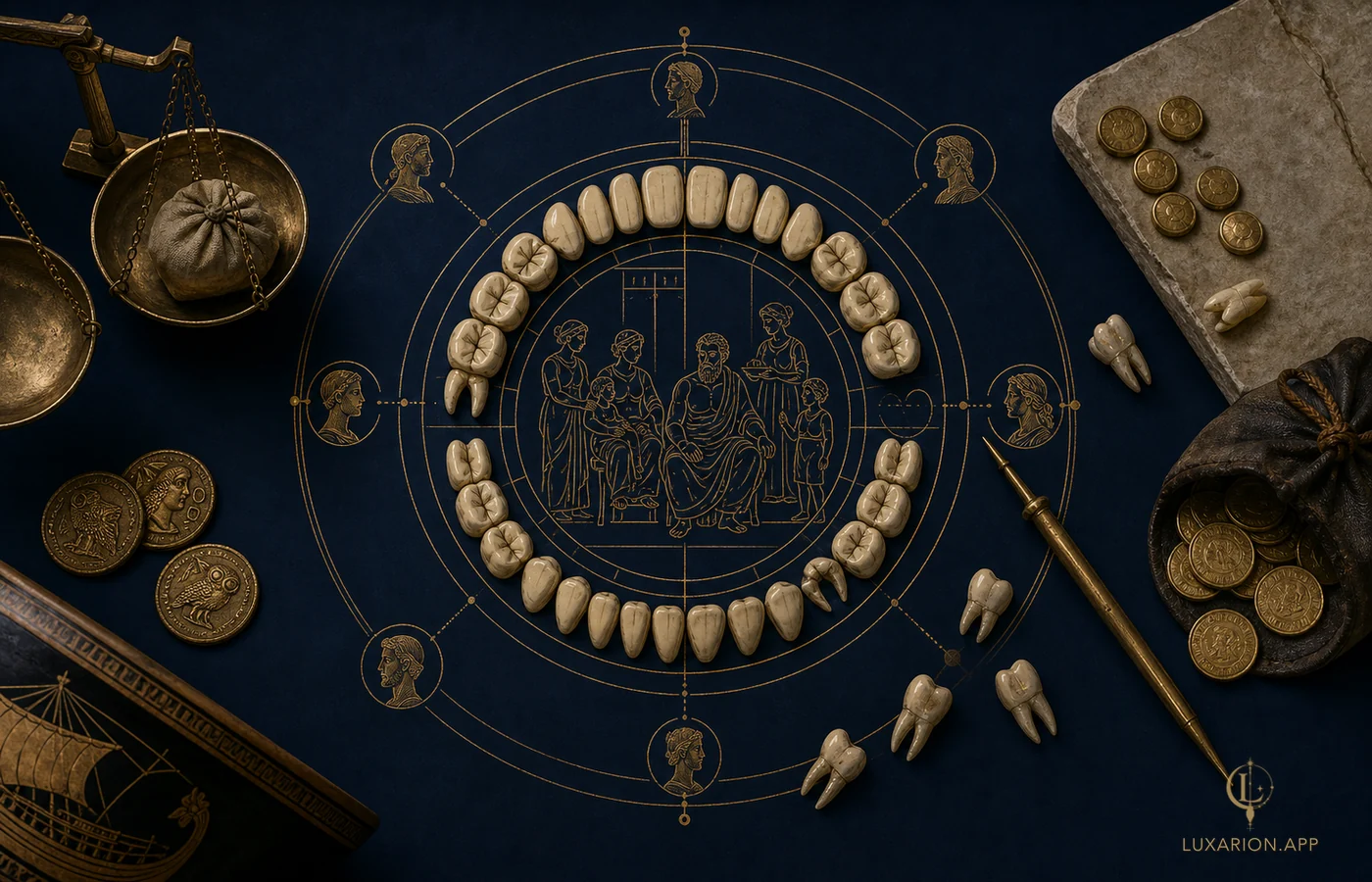
Artemidorus of Daldis, writing the Oneirocritica in the second century, arrived at something strikingly close without any contact with the later Arabic material.
He also reads teeth as the members of a household — and he too distinguishes upper from lower, and front from back, mapping them onto relatives by closeness and standing. Independent convergence on that specific structure, across languages and centuries, is one of the more remarkable facts in the history of dream interpretation.
Artemidorus adds a commercial dimension that the Arabic material also touches: teeth as possessions, and as creditors and debtors. Losing them can be read as losing property, or as the settling of accounts. And he is characteristically insistent that the reading depends on who is dreaming — a merchant's tooth dream and a farmer's are not the same dream, a principle we set out at length in how the old interpreters worked.
The counting tradition, and long life
A third line runs through several traditions and is worth knowing because it inverts the expected mood: teeth as a count of years.
Where a dreamer counts the teeth, or notices a specific number, some interpreters read that number as a span of time — a reading that turns an alarming image into a neutral or even favourable one. This is less a distinct doctrine than a demonstration of a principle the manuals repeat constantly: an image that frightens on waking is not therefore a frightening omen, and the interpreter's job includes not amplifying the fear the dream arrived with.
That principle is the ethical core of the craft rather than a nicety. The old interpreters knew that a person tends to live toward what they are told, which is why the tradition holds that where readings are equally available, the better one is offered — the discipline we set out in when the reading says no.
The reading modern dreamers recognise fastest
Alongside the classical material sits a reading that emerged from the large modern collections and that people tend to confirm immediately: teeth as how you are seen and heard.
Because teeth are the most visible thing in a speaking face, losing them in a dream is losing composure in public. This is why the dream so reliably places you mid-conversation, mid-presentation, mid-interview — and why the dominant emotion is usually not pain but embarrassment, which is an odd thing to feel about a medical catastrophe and a very natural thing to feel about being exposed.
Calvin Hall, assembling the first large empirical corpus of dream reports, found this image clustering around periods of self-consciousness and evaluation. And the timing people report bears it out: these dreams arrive before the presentation, during the probation period, in the month of the divorce, at the start of the new job. They cluster where you are being assessed.
This does not displace the classical reading so much as sit beside it. The tradition said separation and obligation; the modern collections say exposure and evaluation. Both are about a situation in which your standing is at stake — which may be why one image serves both.
What the body is doing
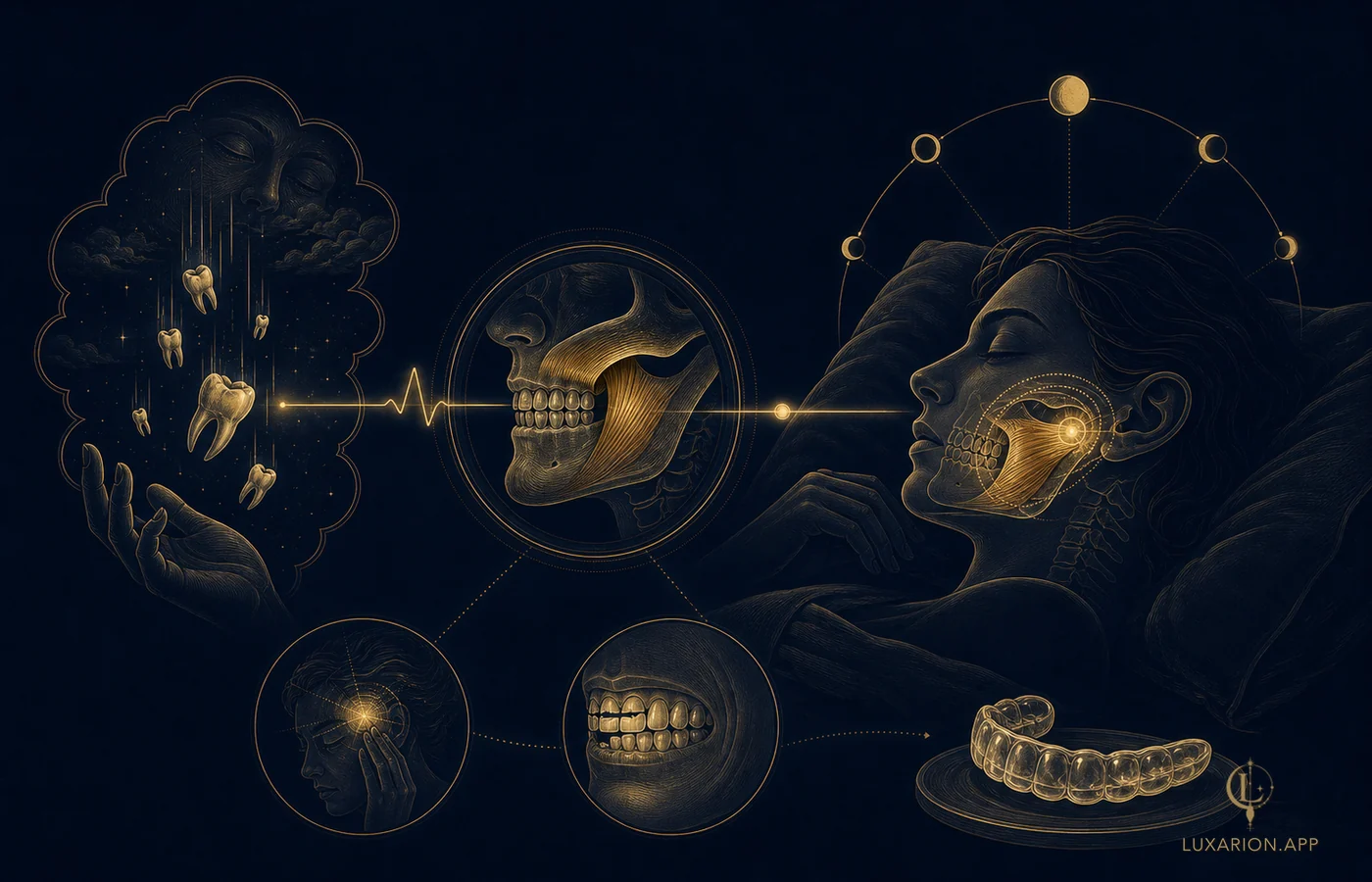
There is a physiological contribution here that is genuinely useful, and it explains the dream's unusual tactile vividness.
Many people clench or grind their teeth during sleep. Where that happens, there is real pressure and real sensation in the jaw, and the sleeping mind — which builds scenes around whatever input it receives — has an obvious image to reach for. This is not a competing explanation to the interpretive traditions; it is an account of the raw material. The traditions have always held that a dream is written in the language of the body, and this is a precise instance of it.
The practical consequence is worth acting on. If these dreams are frequent and you wake with jaw tightness, a headache at the temples, or worn edges on your teeth, that is worth mentioning to a dentist. Jaw clenching in sleep is itself strongly associated with waking stress — so the dream and the tension and the pressure in your life are very likely the same story told in three registers, and the traditions would have no difficulty with that. They would simply say the letter arrived by more than one route.
Beyond that, the REM phase in which most vivid narrative dreaming occurs shows heightened activity in emotional centres with quieter self-monitoring — which is a fair account of why an image this alarming can pass, in the dream, as something to be managed politely rather than screamed about.
The variants, and what each was read for
One tooth, cleanly, into your hand. The mildest version. In the household reading, a specific relation under strain rather than lost; the catching is significant, and several lines read it as continuation rather than severance.
All of them at once. Rarely read as many separations. More often a general reading: a wholesale change of situation, or — in the exposure register — a period in which you feel your entire standing is in question rather than one relationship.
Crumbling to powder or fragments. The most distressing variant and, notably, one of the most modern in its reporting frequency. Where classical readings emphasise loss, this variant's texture points at gradual deterioration rather than an event: something being worn down over time rather than taken.
With blood. The traditions treat blood as raising the weight of the reading considerably. It was rarely read as favourable and it moves the matter from the ordinary to the serious.
Without pain and without blood. Read comparatively lightly — often as an ordinary passage rather than a loss. This is the variant closest to the childhood shedding, and several interpreters read it as a change already underway and not to be resisted.
Spitting them out, or trying to hide them. The exposure reading in its clearest form. The concealment in the dream is the content: something you are managing so that others do not see.
Someone else losing teeth. Read as concerning that person or your relation to them, and notably, the interpretive traditions were cautious here — a dream about another person is still your dream, and does not report on their circumstances, a limit we take up in when the dream is about a person.
Teeth growing back, or growing in wrong. Uncommon and generally favourable in the classical material: renewal, or a situation reconstituting itself in an unfamiliar shape.
Three cases, worked through
The recurring version in a stable life. Nothing is wrong. No bereavement, no crisis, a good relationship, work that is fine — and the dream comes every few weeks. This is the case where the physical route deserves checking first, because a stable life with a recurring tooth dream is disproportionately likely to be a clenching jaw rather than an unread message. Ask a dentist before asking an interpreter; if the jaw is clear, then read it, and read it as evaluation rather than loss — a person can be under quiet, continuous assessment without anything being wrong.
The version that arrives during a family illness. Here the household reading is doing obvious work, and the useful refinement is the one the classical material insists on: catching versus losing. People in this situation almost always remember whether they held the tooth. That detail is not decorative, and the tradition would ask for it before saying anything else. What the dream is generally indexing is the anticipation of loss rather than a prediction of it — which is a distinction worth holding onto at three in the morning.
The version before something public. A wedding speech, a court date, a viva, a first day. This is the exposure reading in its purest form, and it is so common in these circumstances as to be almost unremarkable. Interpreters would not treat it as an omen about the event; they would treat it as an accurate description of how much you have riding on being seen well, which is information you can act on — by preparing differently, or by lowering the stakes you have privately attached to it.
What the classical interpreter would ask you
A good session in this craft is mostly questions. These are the ones the material implies, and you can put them to yourself.
Which teeth, and did you know whose they were? The household scheme requires specificity, and dreamers often have an unaccountable sense of a particular tooth mattering.
Did you catch them? The single most weighted detail in the Arabic material.
Was there pain? Painless was read lightly, painful heavily. This is treated as part of the dream, not a side effect of it.
Who saw? Audience, and its identity.
What were you doing when it started? These dreams almost always interrupt an activity, and the activity is frequently the subject.
And what is unsettled at home? Asked last, and gently, because the household reading is the one most likely to frighten and least likely to be improved by speculation.
An interpreter who delivered a verdict before asking these would not be practising the craft, whatever they happened to get right — accuracy arrived at without method is luck, and the manuals say so plainly.
How to read your own
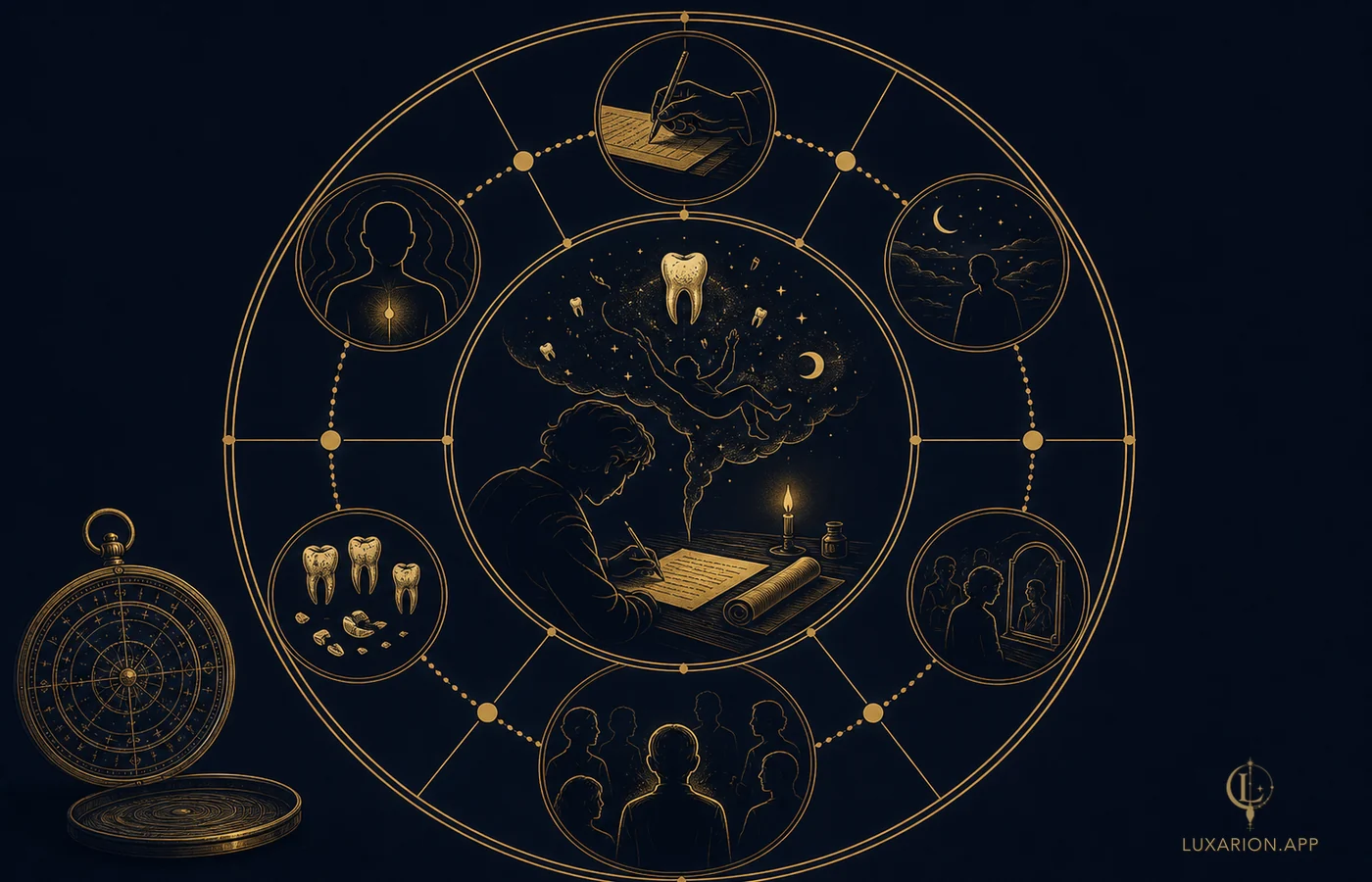
The traditions are unanimous that a symbol list is the wrong instrument. This is the method they actually used.
Write it before you speak it. Within minutes, including the parts that make no sense. Dreams degrade toward tidier stories, and the untidy details are usually where the information is.
Record the feeling first. Was it horror, embarrassment, mild interest, resignation? This single item does more interpretive work than the imagery. Embarrassment points toward the exposure reading; grief points toward the household reading; oddly, calm points toward passage.
Note the physical particulars. Which tooth, how many, pain or none, blood or none, caught or lost. Every classical distinction turns on these, and they are the first details to evaporate.
Note who was watching. This dream almost always has an audience, and who it is matters more than people expect. A stranger, a parent, a colleague, your partner — the witness is frequently the subject.
Ask what is being assessed this month. A review, an interview, a family judgement, a health question, a relationship being weighed. The dream clusters around evaluation, and there is usually a candidate.
Check the jaw. The unglamorous step, and the one that resolves a proportion of recurring cases outright.
If you would rather work it through with someone who knows the tradition, that is what our dream interpretation is for — built on the questions above rather than a lookup table. And if the dream keeps returning, recurrence is its own subject, treated in why the same letter keeps arriving.
What not to do with it
Do not read it as a death omen. This is the single most common fear attached to this dream and the classical material does not support it. The serious traditions consistently refuse fixed verdicts about death — not from squeamishness but because such a reading harms the person receiving it and cannot be justified from the image.
Do not go looking for which relative. The household scheme is a framework, not an accusation. Waking and scanning your family for who is about to leave produces anxiety and occasionally damages relationships that were fine.
Do not treat frequency as severity. A dream that recurs is insistent, not urgent. The traditions read repetition as something unread rather than something imminent.
And a note on frequency worth stating plainly: this is among the two or three most commonly reported dreams in every collection ever assembled. If you have had it, you are not marked out. The interpreters saw it constantly, which is precisely why they built such a detailed apparatus around it — not because it was rare and grave, but because it was universal and needed handling well.
Where this sits among the common dreams
Teeth belong to the small family of images that recur across the entire human record, and one method covers them all. The snake is the most reported of any: one animal, a dozen traditions. Pursuit has its own long literature in who is really doing the running. Dreams in which the dead appear are handled with particular care in transformation, not omen. And the practice the serious interpreters ultimately recommend over any inherited list — building your own vocabulary — is in your own dream alphabet.
What to take from it
Teeth are the part of the body that is bone and yet visible, that feeds you and lets you speak, that you lose once as a child in the ordinary way and once in age. An image carrying all of that will serve for separation, for obligation, for exposure, and for passage — and the traditions used it for all four, choosing between them by asking about the dreamer rather than consulting a list.
That is the whole method, and it is why the manuals are so insistent that a dictionary cannot do this work. The dream is addressed to one person. The interpreter's first question was never "what does a tooth mean" but "what is happening to you" — and the answer to the second usually settles the first inside a minute.
If you woke this morning checking your teeth with your tongue, the useful question is not what is about to be taken from you. It is: where am I currently being looked at, and what am I holding together while everyone watches?
The library teaches the craft. A reading applies it to you.
Get your personal reading