
Snake Dreams: One Animal, a Dozen Traditions
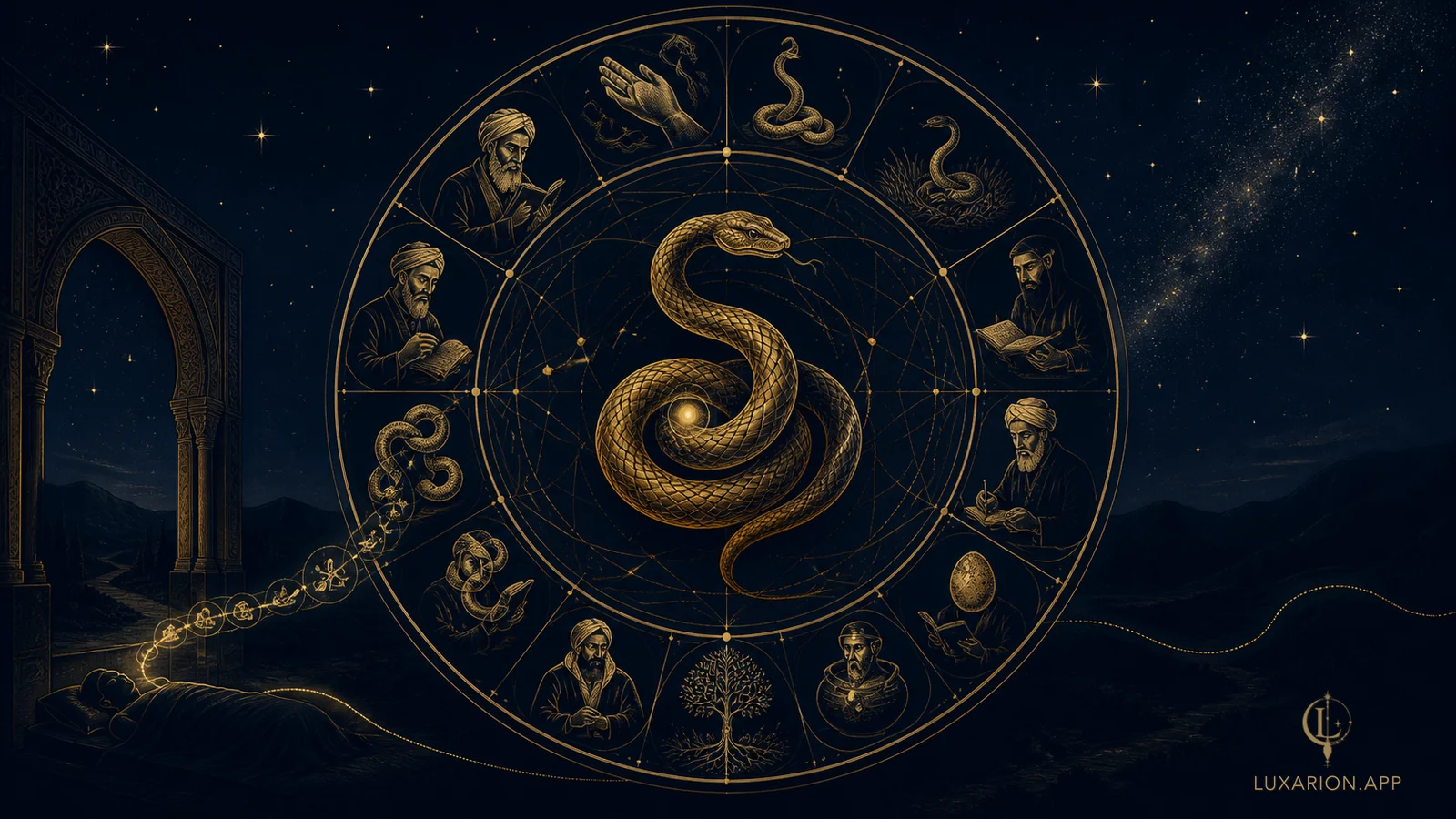
The most reported animal in the world's dream records. What the great interpreters actually said, what each variant means, and how to read your own.
Of all the animals that walk through human sleep, one appears more often than any other, in more places, across more centuries. Not the wolf, not the horse, not the bird. The snake.
This is not a modern observation. It is visible in the oldest dream manuals we possess, in Greek and Arabic and Sanskrit alike, and the interpreters who compiled those manuals all noticed the same thing: people bring them snake dreams more than anything else, and the dreams have a particular quality — vivid, physical, remembered for years, and almost never neutral.
What follows is what the tradition actually says. Not a dictionary — the old interpreters were explicit that a dictionary is the wrong instrument, a point we make at length in how the old interpreters worked — but the families of meaning the snake has carried, the specific variants and what each was read for, and a method for reading your own.
Why this animal, and why so consistently
Before the interpretations, the fact underneath them is worth sitting with, because it explains why the readings converge as they do.
Snakes are among the few creatures that appear in the dreams of people who have never seen one. Children in cities with no wild snakes dream of them. This is old and it is well attested, and the traditions drew a straightforward conclusion: an image that arrives unlearned is carrying something other than memory.
The animal itself is genuinely unusual in ways that shape every reading it receives. It moves without limbs, which makes its motion look intentional in a way an animal's motion usually does not. It sheds its entire skin and emerges intact, which is the most literal image of renewal available in nature. It carries lethal power in a small body. It goes into the ground and comes out again. Every one of those properties turns up in the interpretive tradition, and they turn up independently in cultures with no contact.
That convergence is the reason a snake dream feels significant when you wake. It is not that you have been told snakes are meaningful; it is that the image is doing several kinds of work at once, and the mind registers density.
The Arabic tradition: the enemy, and the treasure
In the Arabic dream literature — the largest and most systematic body of interpretation ever assembled — the snake carries two readings that appear contradictory and are not.
The first and most cited is the concealed adversary. Ibn Sirin, whose name attaches to the great compendia of this tradition, is associated with reading the serpent as an enemy whose enmity is hidden — someone close, someone whose hostility has not yet declared itself. The logic is legible: the snake is the animal that is present before it is noticed.
The refinements matter more than the headline. A snake inside the house was read as an adversary within the household or the trusted circle, not a stranger. A snake in open country was read as a rival in the wider world, less intimate and less dangerous. A snake that you see and that does not see you was read differently from one that turns toward you. And a snake killed in the dream was consistently read as the difficulty overcome — one of the few unambiguous readings in the whole literature.
The second reading is stranger and less known: the serpent as guardian of buried wealth. In this line the snake sits over what is hidden and valuable, and to dream of one is to dream of something concealed that has worth — money, yes, but also knowledge, or a capacity in yourself you have not drawn on.
The two readings are not in conflict once you see what they share. Both make the snake the keeper of what is not yet visible. Whether that hidden thing is a threat or a treasure depends on the dreamer's circumstances — which is exactly why the tradition insisted the same image means different things to different people, and why a competent interpreter asks about your life before offering a reading.
The Greek tradition: healing, and the household
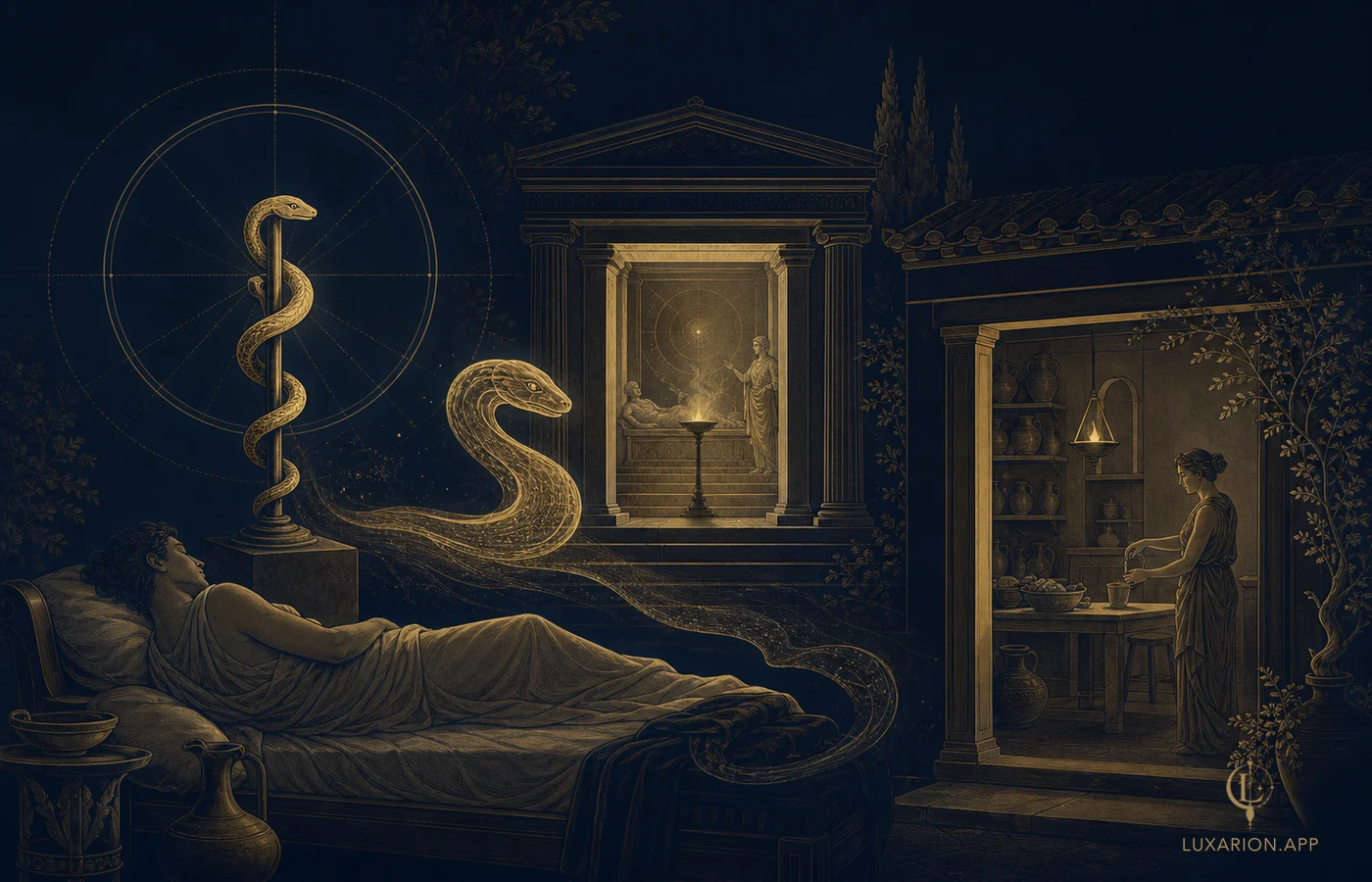
Artemidorus of Daldis, writing the Oneirocritica in the second century, compiled what is effectively a field manual from thousands of collected cases — and he is emphatic that the dreamer's occupation, status, health and habits change the reading entirely.
His snake readings run toward time, illness and authority. The serpent's association with sickness is not incidental: Greek medicine's own emblem was a snake coiled on a staff, the rod of Asclepius, and the healing sanctuaries of Asclepius practised incubation — sleeping in the temple precisely in order to dream, with the snake as the expected form of the god's arrival. In that world a snake dream was not a warning. It was a consultation.
This is worth holding onto, because it is the clearest counter-example to the assumption that a snake in a dream is bad news. For a thousand years, across the Greek world, it was the specific image people travelled to receive.
The related emblem, the caduceus with its two entwined serpents, belonged to Hermes and to commerce and messages rather than to medicine — the two are constantly confused in modern use. The distinction matters for reading: one snake on a staff is healing; two snakes entwined is exchange, negotiation, the passage between parties.
Older still: Mesopotamia, and the theft of renewal
The oldest snake story we have is also the one that explains the animal's association with immortality.
At the end of the Epic of Gilgamesh, the hero finally obtains the plant that restores youth — and while he bathes, a serpent takes it and slips away, shedding its skin as it goes. The snake gets the renewal that the man was seeking. That single scene, written down more than three thousand years ago, encodes the entire later tradition: the snake is the creature that renews itself, and it does so at humanity's expense.
The ouroboros — the serpent that consumes its own tail — is the same observation turned into a figure of cycles, and it appears in Egyptian, Greek and later alchemical material as an image of the year, of eternity, of a process that ends where it starts.
And in South Asian tradition the serpent-beings are neither adversaries nor omens but a class of powerful, ambivalent beings associated with water, fertility, treasure and threshold places. They can bless and they can withhold. That ambivalence — power that is not aligned for or against you by default — is the most accurate single description of what the snake means across all of these traditions at once.
What Jung added
Carl Jung gave the modern era a vocabulary for what the older interpreters had been describing practically. Reading the snake as an archetypal image arising from the collective unconscious, he treated it as belonging to the deepest and least civilised layer of the psyche — instinctual, pre-verbal, and therefore both frightening and generative.
His crucial contribution for a dreamer is the linking of the snake to transformation that has already begun. Because the animal sheds, it tends to arrive in dreams during periods when something is being outgrown — and the fear the dream produces is, on this reading, less about the snake than about the shedding. People commonly report snake dreams during a change they have not yet consciously admitted they are in.
That observation is testable against your own life, which is why it is worth more than a symbol table. If you dreamt of a snake recently, the question worth asking is not "what does the snake mean" but "what am I currently outgrowing" — and the frequency with which people can immediately answer that is the reason the reading has lasted.
The dream as a letter, not a code
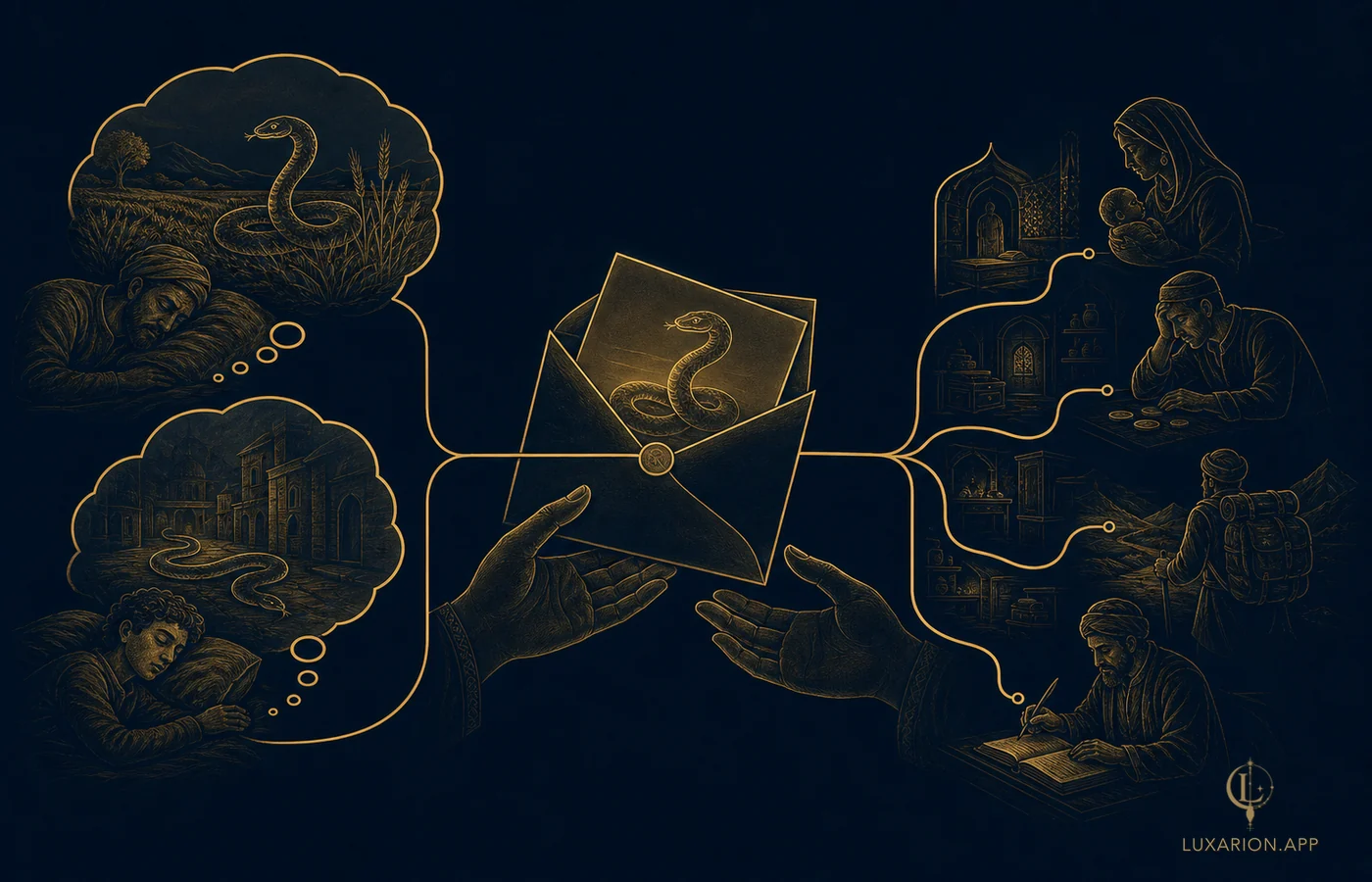
Before the variants are useful, the interpretive frame has to be right, and the old manuals are unanimous about what it is.
A dream is addressed to one person. This sounds obvious and it is constantly violated: the same snake, dreamt by a farmer who handles them and by someone who has never seen one, is not the same image and was never read the same way. Artemidorus organises entire sections by the dreamer's trade for exactly this reason. The Arabic compendia do the same by circumstance — married or not, in debt or not, travelling or settled.
This is why the lists that circulate online do more harm than good. They give the symbol and withhold the reader, which is like translating a word without the sentence. The interpreters who lasted were the ones who asked questions first and consulted the tradition second.
The practical consequence: everything in the section below is a range, not a verdict. When two readings both fit, the tradition's own instruction is to prefer the one that makes a demand on you rather than the one that flatters or frightens. A reading that leaves you with something to do is almost always the better reading, and it is the one a serious practitioner will offer.
When the snake is not about a person at all
The most common misreading in modern use is to take the "concealed enemy" line and go looking for a villain. The classical material is more careful, and the distinction it draws is worth having.
An enemy, in this literature, is not necessarily a person. The word covers anything that opposes your interest while remaining out of view — a habit, a debt accumulating quietly, an illness not yet diagnosed, an arrangement that has been costing you without your noticing. Interpreters routinely read the serpent as a situation rather than an adversary, particularly when the dreamer could not name anyone hostile.
This matters because the villain-hunting version of the reading does real damage. People wake from a snake dream and begin scanning their friendships for betrayal, which strains relationships that were fine. The tradition's own emphasis is quieter and more useful: something is working against you that you have not yet looked at directly. That is a prompt to examine your circumstances, not to suspect your family.
And in a substantial share of cases the thing not yet looked at is internal — the appetite you are not admitting to, the resentment you have not named, the fear you have been calling practicality. The snake as an image of one's own instinctual life is not a modern importation; the older material is comfortable reading it that way, and Jung simply gave the reading a vocabulary.
The variants, and what each was read for
The specific form matters more than the animal. These are the distinctions the traditions actually drew.
Bitten by a snake. The most common variant and the most consistently read: an injury from a quarter you had not defended. Where the bite lands was held to matter — the hand for work and dealings, the foot for the path or the journey, the neck or throat for speech and what has not been said.
A snake in the house. Read across several traditions as a matter inside the intimate circle rather than the outer world. Family, household, the person who has keys. Notably, the same dream in a stranger's house was read as a matter that is not yours to solve.
Killing the snake. Unusually unambiguous: the difficulty faced and ended. The tradition treats this as among the most favourable dream outcomes available, and it is one of the few places where the manuals do not hedge.
A snake that flees from you. A threat that dissolves on approach — read as a fear larger in anticipation than in fact.
Many snakes. Generally read not as many enemies but as a diffuse, unlocated anxiety: pressure without a single source. Interpreters often took this as a sign the dreamer was overwhelmed rather than opposed.
A white snake. Consistently the most favourable colouring across Arabic and East Asian material alike — associated with hidden good, or with a warning delivered kindly.
A black or very large snake. Magnitude was read as magnitude: a matter of proportionate weight, not necessarily proportionate malice.
A snake in water. Water is the emotional register in nearly every tradition, so a snake in it was read as something concealed inside a feeling — an ambivalence not yet acknowledged.
Carrying or holding a snake calmly. Read as power assumed rather than power threatening: a capacity being taken up. This is the variant closest to the Asclepian reading, and the one people most often misfile as frightening when it is not.
What the sleeping mind is doing
The traditions are not the only source of insight here, and the modern picture complements rather than displaces them.
Vivid narrative dreaming clusters in REM sleep, and the emotional centres of the brain are highly active during it while the regions governing self-censorship are quieter. That is a fair physiological description of why dreams speak in images rather than sentences — which is precisely the claim the interpretive traditions have always made about them.
Antti Revonsuo proposed that dreaming has a rehearsal function, with threatening images recurring because rehearsing them had survival value; snakes, one of the oldest dangers to our lineage, sit near the centre of that account. And Calvin Hall, who assembled tens of thousands of dream reports into the first large empirical corpus, found the same imagery clustering that the old manuals had catalogued by hand — an independent confirmation, from an entirely different method, that these images are shared rather than personal.
None of this competes with the interpretive craft. It describes the mechanism by which the letter is written; the tradition is concerned with reading it. Both are needed, and the interpreters who work best are comfortable with both.
How to read your own
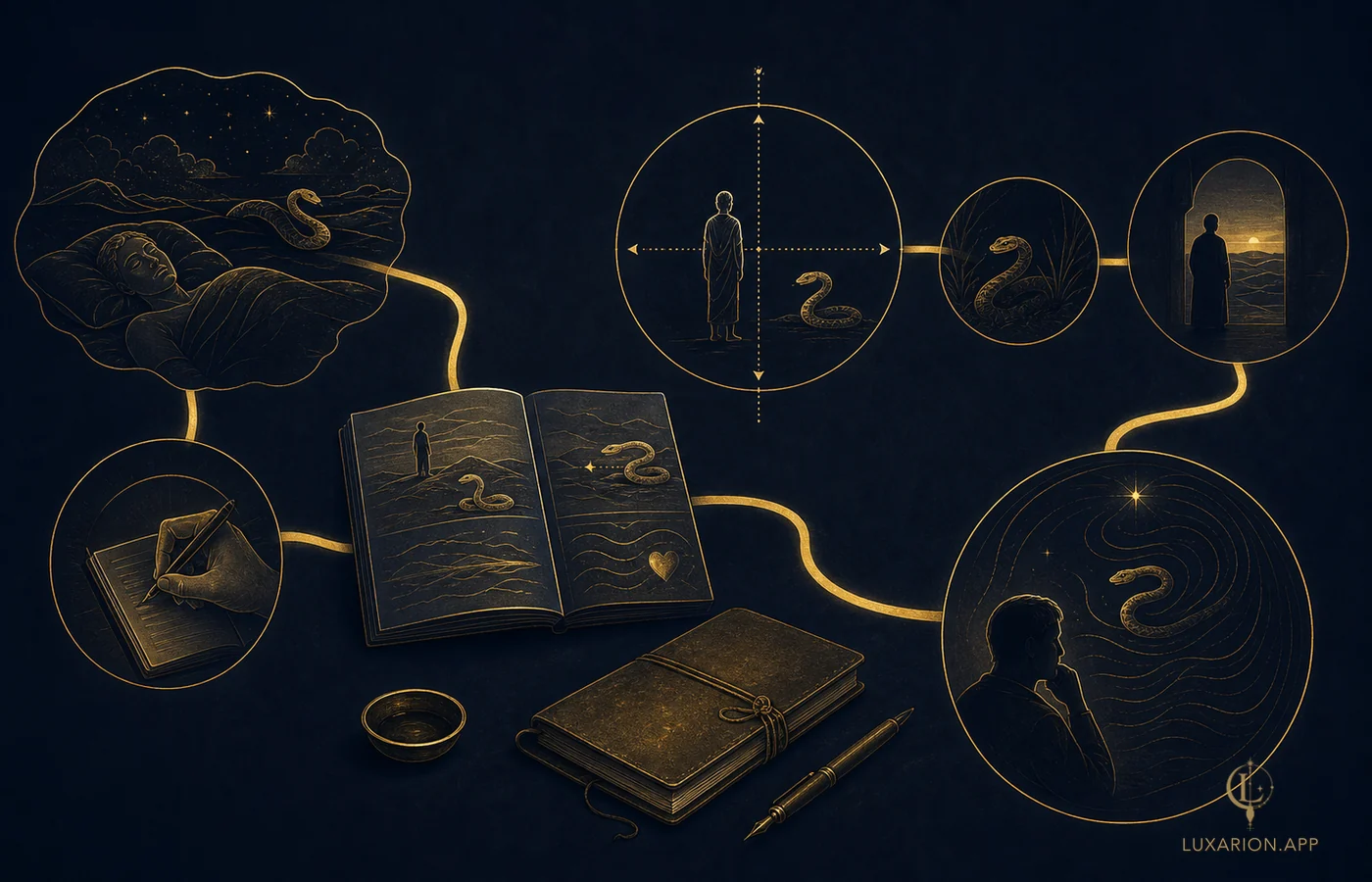
The old manuals are unanimous that a symbol list is not how this is done. Here is the method they actually used.
Write it before you speak it. Dreams degrade fast and they degrade in a particular direction — toward a tidier story. Get it down within minutes, including the parts that do not fit.
Record the feeling, not just the events. This is the single most important step and the one most often skipped. A snake dream in which you were calm and a snake dream in which you were terrified are different dreams with different readings, even if the images are identical. The tradition weights the dreamer's state above the content.
Note the position. Where were you, where was the snake, was it approaching or leaving, were you above it or below it, was it seen or only known to be there? Almost all the interpretive distinctions above turn on these relations.
Ask what has changed in the last month. Both the classical and the modern reading agree that this image arrives during transition. Something recently begun, ended, or been revealed is usually findable, and it is usually the subject.
Check the recurrence. A single snake dream and a snake dream that keeps returning are different phenomena — the second is treated as insistence, and we deal with that specifically in why the same letter keeps arriving.
If you would rather work through it with someone who knows the tradition, that is what our dream interpretation is for; the reading is built on the questions above rather than on a lookup table.
Snakes in the waking traditions this site works with
One last context, because it explains why the snake turns up in more than dreams.
In coffee-cup reading the serpentine shape is among the oldest recorded forms, and the readers who worked seriously with it read it the way the dream interpreters did — as something present and not yet named, its meaning taking colour from where it sits in the cup and what the person came in carrying. We describe the underlying method in how coffee reading actually works, and the symbol families in families, not a dictionary.
The consistency across crafts is the point. A tradition that reads a snake in a cup, a snake in a dream and a snake in a story the same way is not repeating itself out of laziness; it is applying one interpretive principle to several surfaces. The principle is that ambiguous power, arriving unbidden, asks to be identified before it is judged.
Where this sits with the other common dreams
The snake belongs to a small family of images that recur across the whole human record, and the same interpretive method applies to all of them. Teeth falling out is the other great near-universal, and its readings are set out in what the traditions say about teeth. The dream of being pursued has its own long literature, treated in who is really doing the running. Dreams in which the dead appear are handled with particular care in transformation, not omen. And the practice of building your own symbol vocabulary — which is what the serious interpreters ultimately recommend over any inherited list — is in your own dream alphabet.
What to take from it
The snake is the most reported animal in the world's dream records because it is the most useful one. It can carry threat, renewal, healing, hidden worth and instinct, and it can carry several at once — which is why it survives in traditions that agree on almost nothing else.
What the interpreters ask of you is not belief in a code. It is attention to a particular kind of arrival: an image that came unbidden, that stayed vivid past waking, and that turned up during a season when something in your life was changing shape. The traditions have found that image worth taking seriously for four thousand years, and the reason is simple enough — people who attend to their dreams generally turn out to be attending to something they already half-knew.
The snake, in every one of these traditions, is the animal that is present before it is noticed. That is the whole reading, and everything above is a refinement of it.
The library teaches the craft. A reading applies it to you.
Get your personal reading