

Water in Dreams: Why Every Dictionary Gives You a Different Answer
Clear or dark, still or rising, held in a cup or filling the room — water is not one symbol. It is five questions, and they decide the reading.
You woke with the image still on you — the sea coming up the stairs, or a glass of water so clear it seemed lit from inside — and you did what everyone does. You looked it up.
And the answers disagreed. One page said water means provision and long life. The next said it warns of grief. A third said it depends on whether the water was clean, which sounded reasonable until you remembered that yours was neither clean nor dirty; it was simply deep.
The contradiction is not carelessness on the part of the people writing those pages. It is a category error built into the format. Water is not an entry in a dictionary. It is the one image the tradition uses for everything a person cannot hold in their hands — provision, knowledge, feeling, time, life itself — and which of those it means in your dream is decided by five details you already remember.
This article is those five details, what the classical interpreters actually wrote, and six dreams read end to end so you can see the method work.
Why a lookup table fails on this one image
Start with the observation that makes the rest of it obvious. In the older interpretive literature, water appears more often than any other element, and it appears on both sides of nearly every reading. The same substance signifies knowledge and signifies confusion; it signifies mercy and signifies grief; it signifies life and, in a different arrangement, its ending.
A modern reader takes that as evidence the tradition is vague. It is the opposite. The old interpreters were not offering water as a symbol with one meaning; they were treating it as a medium whose meaning is set by its behaviour. The question was never "what does water mean". It was: what was this water doing, and where were you standing.
You already know the answer to both. That is the useful part. Almost nobody remembers a dream well enough to reconstruct its narrative, and almost everybody remembers whether the water was moving.
The five coordinates
Answer these five before you look anything up. In practice they decide most of the reading between them.
1. Was it bounded or unbounded? A cup, a well, a bath, a cistern, a fountain — bounded. A sea, a flood, a river in spate, rain that will not stop — unbounded. This single distinction does more work than any other, and the reason is human rather than mystical: bounded water is water you can use, and unbounded water is water that uses you.
2. Was it still or moving? Still water reads as a state — something settled, held, waiting. Moving water reads as time: a process already underway, with a direction. A river always has a direction, and the direction is part of the dream.
3. Was it clear or turbid? Clarity is the classical marker of whether the thing in question can be seen into. It is not simply good against bad, as the dictionaries render it; clear water shows you the bottom, and there are dreams in which seeing the bottom is the frightening part.
4. Where were you in relation to it? Watching, standing in it, submerged, crossing it, carrying it, thirsty for it. This is the coordinate people most often leave out of the telling and the one an interpreter asks for first.
5. What was the water's temperature and weight? Cold, warm, heavy, thin. The body notices this even when the dream does not narrate it, and it is often the last detail to fade.
Notice what these five have in common: none of them asks what the water symbolised. They ask what it did. That is the whole method, and it is the method the tradition itself used before the dictionaries flattened it.
Bounded water: the cup, the well, the bath
Water you can contain is water in the register of provision and use, and this is the most consistently favourable family in the whole literature.
A well is the archetype, and its reading turns on depth and reach. A well you draw from easily is a resource you have access to. A well you can see water in but cannot reach reads as something available in principle and not in practice — a skill you have not trained, money that is tied up, a person who is fond of you and unreachable this year.
A cup or a glass narrows the same idea to a single portion: this specific thing, offered to you or by you. Who hands it over matters more than the water. In the older sources, giving someone a drink is among the most favourable images in the entire vocabulary, and it is read as generosity that returns.
A bath or bathhouse adds an idea the other containers do not carry: water for a purpose, water that changes your state rather than sustains it. The bath is the classic image of a boundary between before and after. Dreams of washing tend to cluster around actual thresholds — the week before a wedding, the month after a resignation, the season somebody is deciding to forgive.
The exception worth knowing: bounded water that is overflowing switches families. A bath running over, a cup that will not stop filling, a cistern spilling into the street — these read with the unbounded images below, because what defines them is that containment has failed.
Unbounded water: the sea, the flood, the tide
Here the readings change register entirely, and here the dictionaries do most of their damage, because they file the sea under "good" or "bad" when the tradition files it under scale.
The sea is the image for something larger than the dreamer, and its reading depends almost entirely on the dreamer's relation to it. On a boat: you are managing something vast with the correct instrument. On the shore: you are looking at something you have not entered. In the water far out: you are in something whose edges you cannot see. Artemidorus, writing in the second century, was explicit that a sea dream read one way for a merchant whose living was on ships and another way for a farmer — the same image, different lives, different meaning. That principle has never been improved on.
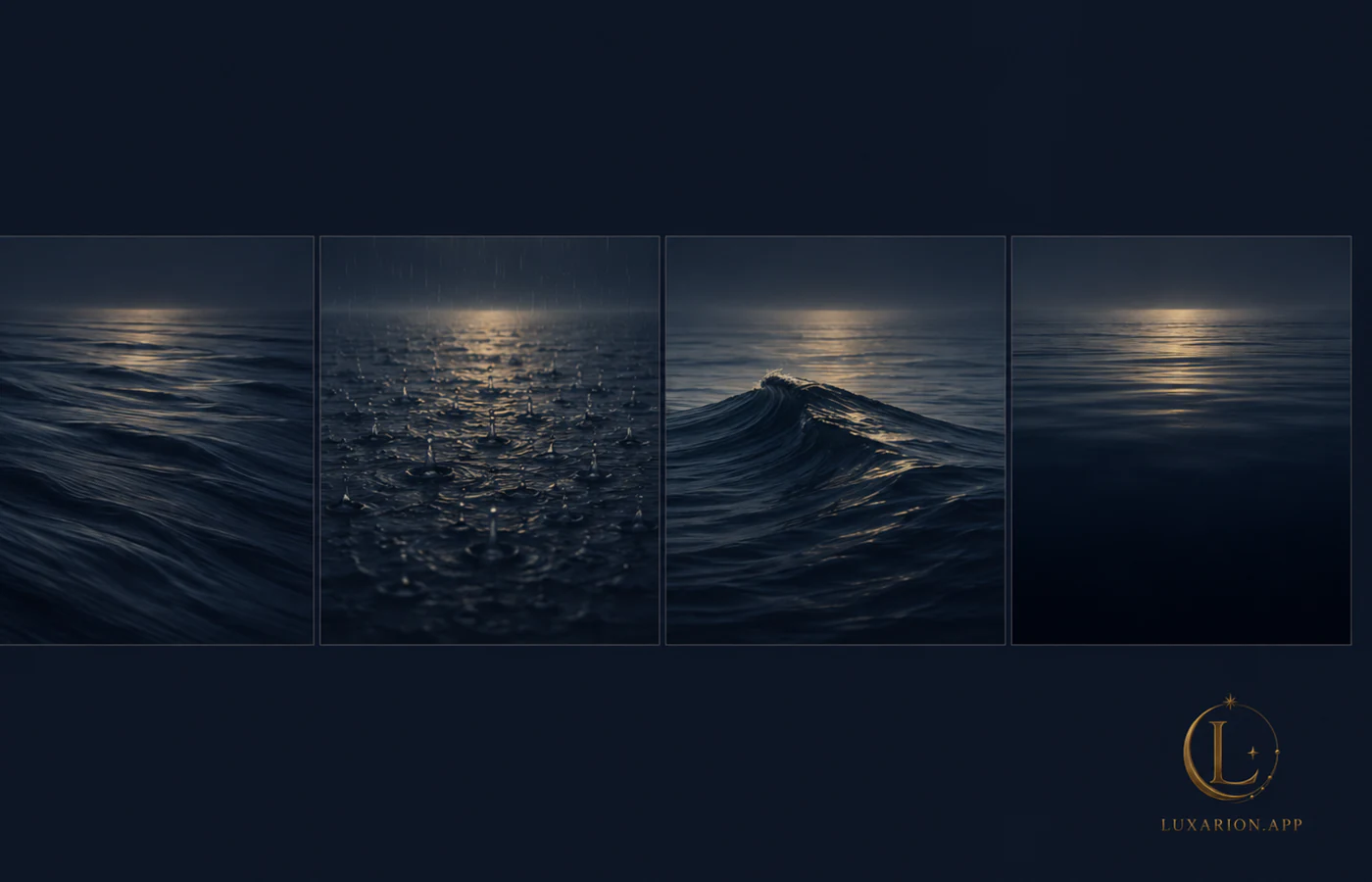
A flood is the sea's urgent cousin, and it is among the most commonly reported dreams anywhere on earth. Its signature detail is the one to attend to: where was the water coming from, and how fast was it rising? Water rising slowly in a house you know is the classic image of an accumulating situation you have been watching and not acting on. Water arriving suddenly reads as something that will not consult you. Water rising in a house you do not recognise usually returns the dream to something other than your literal home.
Almost every literate culture has a flood story at the foundation of its memory, which is worth knowing for one practical reason. The image arrives already loaded. If your flood dream carried a note of judgement or of a world ending, some of that came from the culture and not from your situation, and separating the two is useful.
Rain, and the dream nobody asks about
Rain gets left out of the guides, which is odd, because it is among the most frequently reported water images and it behaves unlike any of the others.
Rain is unbounded, moving and arriving from above — which places it, in nearly every interpretive tradition, in the register of things that are given rather than taken. That is why the readings recorded for gentle rain are so consistently favourable across sources that share no ancestry: it is water nobody had to fetch.
The variables that change the reading are volume and shelter. Rain you are standing out in reads differently from rain you are watching through glass, and both differ from rain you are sheltering from badly. Ask where you were when it started, whether you got wet, and whether you minded.
Rain that will not stop moves into the flood family, and rain in a season or place where it does not rain is usually the dream flagging that something has arrived out of its expected order — which is a note about timing rather than about weather.
Being in it: swimming, wading, crossing, going under
The single most useful sorting question in this whole family: were you in control of your relation to the water?
Swimming — moving deliberately through something deep — is read favourably almost everywhere, and the reading is closer to competence than to luck. Swimming easily in deep water is one of the more encouraging images a person can bring to a reading.
Wading is the ambivalent one and it is very common. You are in, but not committed; you can feel the bottom; the water is at your knees, then your waist. Wading dreams often accompany a decision that has been half-made for months.
Crossing introduces a far shore, which changes the dream from a situation into a passage. Bridges, fords, boats and stepping stones are all versions of the same question: by what means are you getting to the other side, and is it holding?
Going under deserves care, because it is frightening and because it is over-read. Drowning dreams are common, they are more often about volume than about death, and the detail that carries the meaning is usually the surface: whether you could see it, whether you were rising toward it. In the classical sources, coming up out of water is one of the strongest images of relief in the vocabulary — the same reading is recorded in traditions with no contact between them.
Drinking, and being thirsty
Give this its own place, because it is the family that has been read most consistently across the longest span of time.
To drink clear water in a dream is, in almost every interpretive tradition that has left a record, favourable — associated with knowledge, with relief, with provision arriving. Ibn Sirin is quoted for the reading that water in a vision indicates knowledge and life; the same association appears far from him, which is the kind of convergence worth noticing.
Thirst without water is the inverse and it is one of the most physically legible dream states there is. Before reading it as a symbol, check the ordinary explanation: a dry room, a late salty meal, a fever coming. That is not scepticism about the dream. The tradition itself sorted dreams by cause before it interpreted them, and a body's signal was always the first thing eliminated — see the article on how the old interpreters actually worked, where this sorting is set out in full.
When the physical cause is ruled out, thirst reads as wanting something you have decided you are not allowed to want. It is a dream that arrives during long periods of self-denial, and it is worth taking gently rather than dramatically.
Dark water, and the reading everyone gets wrong

Every dictionary says dirty water is a bad sign. This is the single most misleading line in the popular literature, and correcting it changes a great many readings.
The classical texts distinguish carefully between water that is turbid, water that is brackish, and water that is dark, and they are three different images.
Turbid — muddy, stirred up, cloudy — is disturbance. Something has been agitated recently. It reads as a situation in motion whose outcome cannot yet be seen, and it very often clears in a later dream, which is itself part of the reading.
Brackish or bitter — undrinkable water — is the one the sources treat least favourably, and specifically in matters of provision and of what a person takes in. The distinction between sweet water and bitter is old, explicit and repeated.
Dark is not dirty at all. Deep water is dark because of depth. A dream of dark, clean, cold water is one of the most commonly misread images there is: it is not a warning, it is depth, and it usually arrives when a person is approaching something in themselves they have not looked at directly.
Ask which of the three yours was. Most people know immediately, and most people find they had filed a depth dream as a warning dream for years.
What the sleeping mind may be doing with it
A short section, because it sits alongside the tradition rather than replacing it.
Water is the most-reported element in dream collections, and there are unremarkable reasons for part of that: it is the substance we are made mostly of, the one we cannot go three days without, and the one whose absence the body monitors continuously. Some water dreams are the body's own accounting.
Beyond that, Jung read water as the standing image for the parts of a mind not currently in the light — a reading that gained its authority not from argument but from how consistently people recognise it when they hear it. Whether or not you find that framework congenial, it names something real about the experience: water dreams tend to arrive in seasons when something is changing under the surface of a life, and they tend to stop when the change has finished.
The tradition and this description are not in competition. Both say the same practical thing, which is that a water dream is worth writing down and worth watching across weeks, because the series says more than any single night.
What to ask before you look anything up
If you take one habit from this article, take this one. Before opening any list, write these seven lines. They take two minutes and they change what a dictionary can even do for you.
- The five coordinates. Bounded or not; still or moving; clear, turbid, bitter or dark; where you were; how it felt on the skin.
- Whose water was it? Yours, someone else's, nobody's, a public source. Ownership changes the reading more than most people expect.
- Who else was there? And crucially — were they in the water or out of it?
- What was the ground? A house, a street you know, a landscape you have never seen. A dream set in a real address is usually about that part of your life.
- What time of day was it in the dream? Night water and daylight water are read differently everywhere.
- What was the feeling on waking? Not during — on waking. This is the single most reliable line in the whole record, and it fades within about ninety seconds.
- What happened yesterday? The tradition sorted by cause first, and the cause is often twelve hours old.
Seven lines. A month of them is a body of evidence about your own imagery, and it is the thing that turns a reader from someone consulting a list into someone who can read.
Six dreams, read

The method is easier to see working than to describe.
A clear glass of water on a table, untouched. Bounded, still, clear, and you are watching rather than drinking. Something is available and you have not taken it. The reading nearly always lands on a specific offer the dreamer has been leaving on the table for weeks.
The sea coming up the stairs of your childhood home. Unbounded, moving, in a house that belongs to your history rather than your present. Read as scale arriving in an old context: an old arrangement being reached by something much larger than itself.
Swimming easily at night in dark, calm water. Unbounded, still, dark, and you are competent in it. Among the more encouraging images in the vocabulary — depth that is not threatening you.
A tap you cannot turn off. Bounded water that has stopped being bounded. Containment failing rather than water arriving; almost always about a situation the dreamer feels responsible for and cannot stop.
Wading across a river toward someone on the far bank. Crossing, in control, with a destination. The dream's real content is nearly always in the detail of the far bank — who was there, and whether they were waiting or leaving.
Drinking and staying thirsty. Bounded, clear, and it does not work. The rare configuration in which the classical sources and the modern reading agree exactly: something is being consumed that is not the thing actually wanted.
Common questions
Is dreaming of water good or bad? Neither by itself. Bounded, clear and usable water is favourable across nearly every tradition; unbounded water is read by scale rather than by fortune. The five coordinates decide it.
What does it mean to dream of a flood? Something larger than the dreamer arriving in a space they hold. The rate of rise and the point of origin carry most of the meaning; slow water in a familiar house is the accumulating-situation reading.
I dream about the sea constantly. Why? Recurrence is its own signal and is worth reading as a series rather than as individual nights. The piece on recurring dreams takes up why the same letter keeps arriving.
Does dirty water always mean trouble? No — and the three-way distinction above is the reason. Turbid is disturbance, bitter is the unfavourable one, dark is usually depth.
What if I was drowning? Frightening and common, and more often about volume than about ending. Note whether you could see the surface, and note whether you woke before or after you reached it.
Does the kind of water matter — rain, sea, river, tap? Yes, and mostly through the coordinates: rain is unbounded and arriving, a river is moving and directional, a tap is bounded and controlled by someone. Ask what the source was and who controlled it.
Should I write these down? Yes, and specifically the five coordinates rather than the story. A month of coordinates is far more legible than a month of narrative, and the pattern usually shows itself by the fourth or fifth entry.
Reading yours properly
Start tonight with the five questions, written on the same page as the dream. Bounded or not, still or moving, clear or turbid, where you were, and how it felt. Four weeks of that is a genuine skill, and it costs nothing.
If the dream is one you have been carrying — the one that comes back, or the one you can still feel a week later — that is the kind a conversation actually helps. A dream interpretation with Luxarion works from your own account and your own life rather than from a symbol list, which is the only way this particular image can be read at all: the sea means one thing to someone who sails and another to someone who has never left an inland city.
And if you would rather build the skill yourself, the article on making your own dream alphabet is the natural next step, and the piece on how the old interpreters worked is the method underneath everything above.
The library teaches the craft. A reading applies it to you.
Get your personal reading