


Recurring Dreams: Why the Same Letter Keeps Arriving

A dream that returns is not a glitch. Every tradition reads repetition as non-receipt — and that changes entirely what you do about it.
There is a particular kind of tiredness that belongs to the recurring dream. Not the tiredness of a bad night — the tiredness of recognition. You are in the corridor again. The exam hall again. The house with the room you had forgotten. And somewhere underneath the dream, a small voice that says: this again.
Most people treat the returning dream as a malfunction — a stuck record, a groove worn into the night. Almost no serious tradition of dream interpretation reads it that way. Across Arabic, Greek, Persian and Turkish material, and in the modern research literature too, repetition is read as one thing, and the word is worth stating precisely because everything practical follows from it: repetition is not emphasis. It is non-receipt.
A dream repeats the way a letter is redelivered — not because the sender wants to shout, but because the letter has not been opened. That single reframing is what makes recurring dreams tractable. It tells you what to look for, it tells you what will make them stop, and it tells you why analysis alone almost never ends them.
What follows is the whole subject worked properly: what the traditions actually say about repetition, the six kinds of recurring dream and how each is read, what changes when the dream changes, what the sleep researchers found, why insight fails and what works instead, and a four-week practice you can start tonight.
Emphasis or non-receipt: why the difference decides everything
Start with the two available readings, because most bad advice about recurring dreams comes from picking the wrong one.
The emphasis reading says: the dream repeats because it is important. It is underlining itself. The implication is that you should treat repetition as urgency — the more it comes, the more alarmed you should be.
The non-receipt reading says: the dream repeats because its errand is unfinished. It is not shouting; it is redelivering. The implication is entirely different — repetition tells you nothing about how bad the situation is, only that something has not yet been received.
Every serious tradition takes the second. And you can see why by looking at what actually stops recurring dreams, which we will come to: they stop when something is answered, not when something is feared. A dream that repeats because it is urgent should intensify as the situation worsens. What recurring dreams actually do is stop when a conversation is had — even a conversation that makes the situation harder.
This is the practical core of the whole article. If you take repetition as alarm, you get frightened and you wait. If you take it as non-receipt, you go looking for the unopened letter. Only one of those postures ends the dream.
What the traditions say about the returning dream
The classical material treats the once-seen dream and the returning dream as genuinely different objects, and it treats the second with more weight.
In the Arabic collections, the first move with any dream is to sort it — the true dream, the frightening disturbance, and the wide middle category of the mind speaking to itself about what it carried during the day. Repetition sits oddly across these categories, and the interpreters noticed. A frightening image that returns is not automatically promoted to significance; the instruction there is famously the opposite, since attention is what keeps that category alive. But a dream that returns calmly, holding its shape, keeping its details across months — that one the tradition takes seriously, and the method attached to Ibn Sirin applies in full: the figures stand for attributes, and the reading depends on who is dreaming.
Artemidorus, in the Greek, is explicit that the dreams worth the most attention are the ones that persist — that stay legible after waking and keep returning to the mind. He built the Oneirocritica out of thousands of collected cases and their outcomes, and persistence is one of his working filters for which dreams merit interpretation at all.
The Persian and Turkish commentaries add a note that is easy to miss and genuinely useful: a returning dream is read against the dreamer's season, not just their circumstances. The same dream at twenty-five and at forty-five is two dreams. Recurring dreams cluster around transitions — and a dream that returns during a transition is usually about the transition, not about its content.
Six kinds of recurring dream

"Recurring dream" covers at least six different things, and they are read differently.
1. The identical dream. Same setting, same sequence, same ending, sometimes for years. Rare, and treated as the strongest case of an unopened letter. The identical dream is usually attached to a single specific unresolved matter, and it is unusually responsive: when the matter moves, this dream tends to stop outright rather than fade.
2. The same setting, different events. Far more common. The house, the school, the old workplace — but the story is new each time. Here the reading goes to the setting, not the plot. The place is the subject. What that place holds for you is the question, and the varying events are the mind trying different doors into the same room.
3. The same feeling, different everything. No shared images at all, but you wake with an identical sensation — the same specific dread, the same specific shame, the same specific relief. This is the hardest to notice and one of the most informative, because it is entirely invisible to a symbol list. Only a written record catches it.
4. The chase or exam type. The great structural recurrences — being pursued, being late, being unprepared, being unable to speak. These follow their own rules, and being chased is common enough to have its own treatment in who is really doing the running. They cluster around evaluation and obligation rather than around a specific event.
5. The seasonal return. A dream that comes back every year at roughly the same time. Almost always anchored to an anniversary the dreamer has stopped consciously marking. The body keeps a calendar the mind has retired, and this is one of the most reliably decodable of all recurring dreams.
6. The trauma replay. A dream that reproduces a real event with little or no transformation. This is categorically different from the others and should be treated as such. It does not respond to interpretation in the same way and belongs with a clinician; the classical traditions also handled this case by referral rather than by reading.
The three settings that repeat most
Three locations dominate the recurring-dream literature across every language that has kept collections, and each has a reasonably stable reading. Not a symbol-list reading — a structural one, about what kind of question the setting is posing.
The house with the forgotten room. You are in a home — sometimes yours, sometimes not — and you discover a room, or a wing, or a whole floor you had not known was there. The feeling is almost never fear; it is usually a strange, quiet astonishment. This dream is read across traditions as a dream of capacity: something in you that is real, present and unentered. It shows up disproportionately in people who have narrowed their lives for good reasons and stayed narrowed after the reasons expired.
The examination. The hall, the paper, the subject you never studied, the year you have already left school by decades. It is worth knowing how universal this is — it recurs in people who have not sat an exam in forty years, which tells you immediately that it is not about exams. It is the dream of being measured by a standard you did not set and cannot see. It clusters around evaluation: a new role, a probation period, a relationship where you feel assessed rather than known.
The journey that will not complete. The train missed, the road that loops, the luggage that will not close, the terminal you cannot find. This is the dream of a transition that has been declared but not made. Very common in the months after a decision is announced and before it is enacted — and it usually stops the week the first irreversible step is taken, which is a useful thing to know in advance.
Notice what these three have in common: none of them is about an event. Each is about a position — under-lived, under-judgement, mid-transit. Recurring dreams are far more often positional than eventual, and reading them as predictions of events is the single most common error people make with them.
Two things a recurring dream is not
Both of these come up constantly, and getting them wrong causes real distress.
It is not a countdown. A dream that has come back forty times is not forty times more urgent than one that came back once. Frequency tracks how unmoved the situation is, not how close anything is to happening. People sometimes arrive at a reading badly frightened by the sheer number of repetitions, and the number is genuinely not the alarming part.
It is not a report about someone else. If your recurring dream features a specific person, the tradition's line here is firm and it is worth restating because this is where people hurt each other: your dream is made of your material. It tells you about your relationship to what that person carries for you. It does not carry news about their intentions, their health, or their future. Every serious interpretive tradition draws this boundary, and it is drawn for the dreamer's protection as much as the third party's.
The most useful question: has it changed?
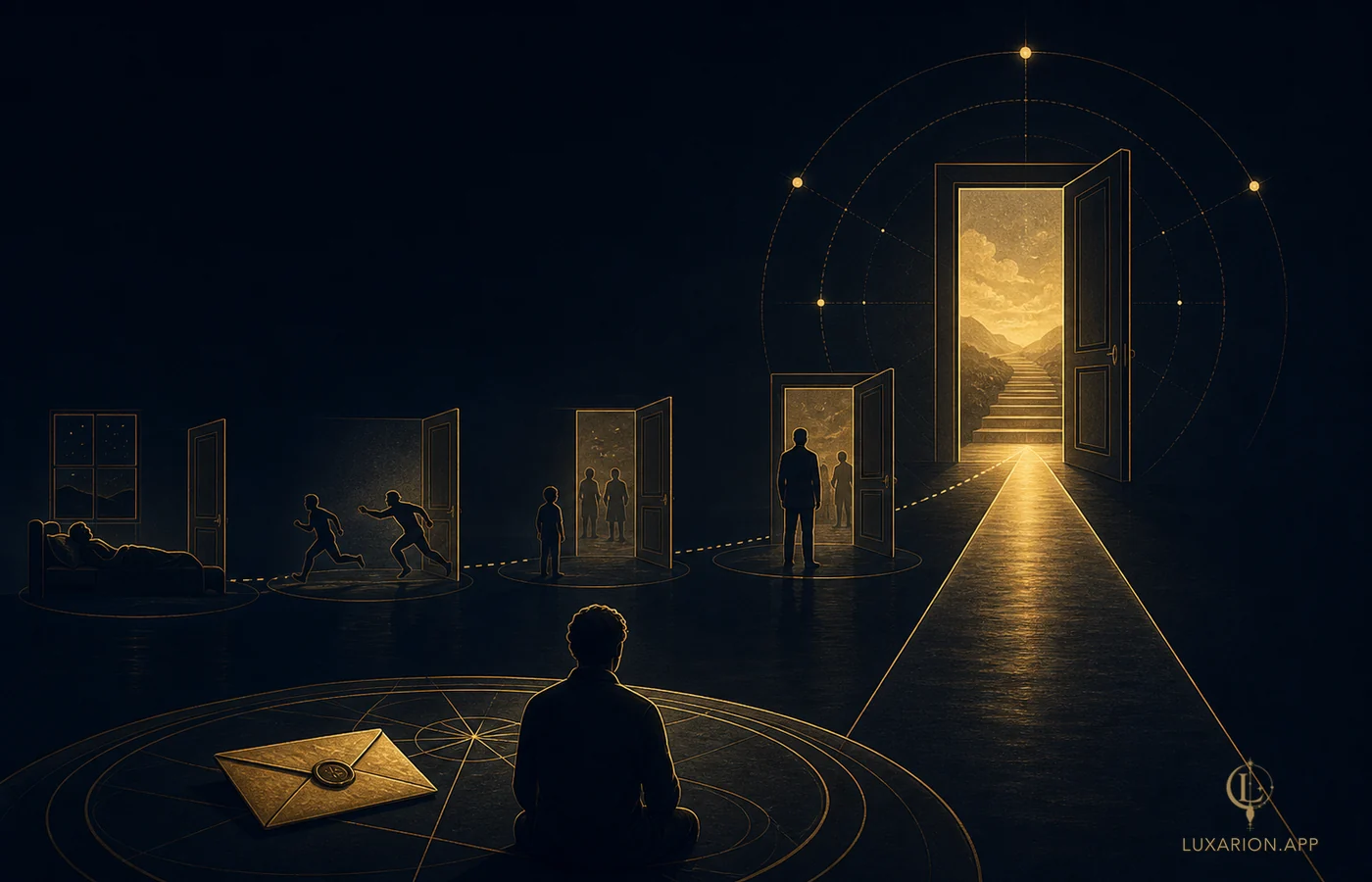
Here is the single most informative question about a recurring dream, and it is one that almost nobody asks: is it exactly the same?
Because recurring dreams do change, and the change is the message. In practice the variations carry more information than the content ever does.
The ending changes. You used to always wake before the door opened; last month you opened it. This is the most significant change there is, and in the classical framing it marks that the matter has moved — often before the dreamer has consciously registered any movement at all.
Your role changes. You were being chased; now you are watching someone else be chased. You were the child; now you are the adult in the room. This shift shows up very often around the end of a long-running situation.
The frequency changes. Getting more frequent is not "getting worse" — it usually tracks proximity to a decision. Getting less frequent, without anything having been resolved, often tracks avoidance deepening rather than the matter easing.
The feeling changes while the images stay. Same corridor, but you are no longer afraid in it. Read across all traditions as the clearest sign that the dream's errand is nearly complete.
This is exactly why a written record beats memory. You cannot detect these changes by recall — the mind smooths recurring dreams into a single remembered version and quietly discards the variations. Four lines in a notebook per occurrence is enough.
What the sleep researchers found
The modern literature on recurring dreams is unusually helpful, and it converges with the classical account rather than replacing it.
The content-analysis tradition begun by Calvin Hall — tens of thousands of coded dream reports rather than theory — established that recurring dreams are extremely common, that they skew negative in tone, and, most usefully, that their onset and offset track life circumstances rather than personality. They begin around a stressor and end around its resolution. That is a measured finding, and it is the same claim the traditions were making in a different vocabulary.
Research on memory consolidation during sleep supplies a plausible mechanism: sleep is when the brain replays and files recent experience, and material that has not been successfully integrated is exactly the material that gets replayed. On this account a recurring dream is a filing operation that keeps failing — and that is a remarkably close technical restatement of "the letter has not been received."
The threat-simulation account associated with Antti Revonsuo adds why the recurring material skews toward danger and inadequacy: the rehearsal system prioritises scenarios it treats as unresolved threats. And REM architecture explains the timing — cycles lengthen through the night, so the longest and most narratively coherent dreams cluster before waking, which is why recurring dreams are so often the ones you remember.
Worth stating plainly: none of this tells you what your dream means. Mechanism and meaning are different questions, and the researchers are careful about the distinction. Knowing that a letter was redelivered by the postal system tells you nothing about what is inside it.
Why insight alone does not stop them
Here is the most common frustration people bring: I know exactly what it is about, and it still comes.
This is not a failure of interpretation. It is the most important observation in the subject, and both the classical and clinical accounts agree on it.
The dream is not asking to be understood. It is asking to be answered. Understanding is cheap for the mind — you can hold an accurate account of an avoided situation indefinitely while changing nothing about it, and the dream is entirely unimpressed by that. What the record shows, over and over, is that recurring dreams end around action, and often quite small action.
al-Ghazali makes the general form of this point throughout the Revival of the Religious Sciences: knowing a thing and being changed by it are separate events, and the soul is skilled at the first as a substitute for the second. He is not writing about dreams, but the observation transfers exactly.
The clinical literature converges. For recurring nightmares, the interventions with the best evidence are the ones that involve doing something — rehearsing a changed version while awake, writing the dream out, deliberately imagining a different ending — rather than achieving insight into it. Doing beats knowing. That is the finding.
Which means the question "what does my recurring dream mean?" is slightly the wrong question. The better one is: what is this dream asking me to do that I have not done?
Finding the unopened letter

Practically, then: how do you locate the thing that has not been received?
Date the onset. When did this dream start? Not roughly — as precisely as you can manage. Recurring dreams almost always begin within a few weeks of something, and people can usually name that something once they are asked to be exact about the date. This one question resolves more recurring dreams than any amount of symbol work.
Look at the setting, not the plot. If the place repeats, the place is the subject. Ask what that specific location holds — not what houses mean in general, but what that house means to you.
Ask what ends the dream. The moment you wake is rarely arbitrary. Most recurring dreams stop at the same point, and that point is usually the threshold of the thing being avoided.
Ask who is absent. Recurring dreams are often characterised by a specific missing person — someone who ought to be in that setting and never is. This is one of the strongest signals in the whole set and one of the least noticed.
Ask what you keep meaning to do. Not what you fear; what you keep intending. The unopened letter is usually an intention, not a dread — the call not made, the sentence not said, the appointment not booked, the decision deferred by another month.
Check the calendar. If the dream is seasonal, this takes about two minutes and answers everything.
Working with a dream that returns: four weeks
This is a practice, not a theory, and four weeks is genuinely enough to see the shape of it.
Week one — record. Every occurrence: date, setting, ending, feeling, and one line on the day before. Four lines. Do not interpret yet; interpretation this early biases the record and you will start recording the version you expect.
Week two — date the onset and name the candidate. When did this start? What was happening then? Write one sentence naming what you think has not been answered. Let it be wrong; you can revise it. A wrong sentence you can test beats a vague feeling you cannot.
Week three — do the small piece. Not the whole thing. The dream responds to movement, so make one real movement in the direction of the named thing: send the message, book the appointment, say the first sentence to one person. This is the week that actually changes things.
Week four — check for variation. Read the record end to end. Did the ending change? The role? The feeling? The frequency? A variation after a real-world action is a strong confirmation that you named the right thing.
If four weeks produces nothing — no onset date, no candidate, no variation — that is itself informative, and it is the point at which a session with an interpreter earns its keep, because a second person asking the questions catches what self-questioning routinely misses.
When it stops
Recurring dreams do stop. That is worth saying clearly, because people in the middle of one often assume they are permanent.
They typically stop in one of three ways. Abruptly, after a real change — the conversation happens, the decision is made, and the dream simply does not come again. By transformation — the dream keeps its setting but the ending changes, and then it fades over a few months. Or by fading, with no clear cause, which usually means the underlying situation resolved without the dreamer noticing.
The one thing that does not stop them is waiting. In the accumulated experience of interpreters, and in the clinical record, the recurring dream is the single most responsive kind of dream there is — and the single least responsive to being ignored.
And a threshold to name plainly: dreams that replay a real traumatic event, or that come several times a week with real daytime cost, sit closer to chronic nightmare disorder and night terror patterns than to the interpretive question. Those are worth raising with a doctor. Reading and care are not alternatives — the classical traditions sent people to physicians constantly, and there is no tension in doing both.
The letter is addressed to you
The image in the title is not decorative. It is the most accurate model anyone has produced for what a recurring dream is.
A letter arrives. You do not open it. It arrives again. You do not open it. It keeps arriving, at intervals, for as long as it takes — not because the sender is angry, but because the sender has no other way to reach you and no way of knowing you have not read it. The system is patient and it is not punitive. It is just persistent.
And the sender, of course, is you. Which is why the letter can be answered, and why answering it works. Something in you has noticed a thing that the daylight part of you keeps putting down, and it has been raising it in the one room where you are not busy, in the only language available there — images, and the feelings that go with them.
If you have a dream that has been coming back for months or years and you want it read properly — the onset dated, the variations traced, the questions asked in the right order — that is exactly the work our interpreters do. You can bring it to a dream interpretation session, and you will be asked about the first time you had it, and what was happening that month, before anyone offers you a reading. Bring the record if you have kept one; it makes the session twice as useful. And if you want the underlying method first, it is set out in how the old interpreters actually worked.
The library teaches the craft. A reading applies it to you.
Get your personal reading