What Is Written and What Is Yours: Destiny and Choice
The oldest argument in the world, settled as well as it can be: how much of a life is fixed, how much is chosen, and why the answer changes how you act.
Every question brought to a chart, a cup or a hand asks what will happen, and the work answers it. Underneath it sits an older question that decides what the answer is for: how much of this is mine to move?
It matters practically, not just philosophically. If everything is fixed, deliberation is theatre and effort is decoration. If nothing is fixed, then every misfortune is a failure of will, which is a crueller doctrine than fatalism and does more damage. Most people live somewhere between these, without having examined the middle they are standing on.
That middle has been mapped, carefully, by several traditions that did not consult one another and arrived at strikingly similar conclusions. This piece walks that map — the Islamic debate on qadar, the Greek and Latin answers, the Persian poets, and what modern philosophy found when it reached the same ground — and ends where it should: with what changes on Monday morning.
The two answers that fail
Start with the two positions that feel obvious and that every serious tradition rejected.
The first is total determination: everything is written, nothing you do alters it. This is emotionally tempting because it dissolves responsibility, and it collapses immediately on contact with how anyone actually lives. Nobody believes it at the moment of choosing. The person who says the outcome is fixed still looks both ways before crossing.
The second is total self-authorship: you are the sole cause of your life, and outcomes are the exact wage of effort. This is the ambient religion of a great deal of modern advice, and it is a harsher creed than it sounds. It requires that the child born into war deserved it, that illness is a spiritual failing, that the person who worked and lost simply did not want it enough. Taken seriously, it is cruelty with a motivational vocabulary.
Both answers are attempts to escape the same discomfort — that a life is both decreed and chosen, and the two do not arrive labelled. The traditions worth reading are the ones that stayed inside that truth instead of fleeing it.
The Islamic settlement: neither compulsion nor delegation
Islamic theology argued this out with unusual rigour, because the stakes were explicit: divine power on one side, human responsibility on the other, and no willingness to abandon either.
The two extreme parties are useful precisely because both were rejected. The Jabriyya held that human acts are compelled — the human being is like a feather in the wind. The Qadariyya, and later much of the Mu'tazila, held that humans create their own acts outright, so that divine power does not reach into them. The first destroys responsibility; the second, in the eyes of its critics, fenced off a region of reality from God.
The mainstream settlement came through al-Ashʿari and the school that followed him, and it is subtle enough to be worth stating carefully. On this view God creates the act, and the human being acquires it — the technical term is kasb. You are not the originator of the raw power by which you act; you are genuinely the owner of the act, and therefore genuinely answerable for it. al-Maturidi and his school pressed harder on the reality of human choice within that frame, giving the human will more definite work to do.
There is a formulation that circulates widely and captures the settlement better than any technical summary: neither compulsion nor delegation, but a matter between the two. That sentence is doing real philosophical work. It refuses both escapes and insists the truth lives in the uncomfortable middle.
When the Companions asked the Prophet whether they should rely on what had been written for them and leave off acting, he answered: act, for each is eased toward what he was created for — and recited the verses on the one who gives, guards himself and affirms the good, who is eased toward ease. The writing was never a reason to stop. It is the ground the acting stands on.
What about the Preserved Tablet — the teaching that all things are written? The careful reading in the tradition is that it describes God's knowledge, not a mechanism of coercion: something being known in advance does not make it forced. And the writing makes room for the means. God erases what He wills and confirms, and with Him is the Mother of the Book, says the Qur'an, and the scholars read in it a decree that is settled and a decree that turns on its conditions; the Prophet said that nothing turns back the decree but supplication. Asked whether the ruqya people recite and the remedies they take turn back anything of God's decree, he answered: they are of God's decree. The remedy is written with the affliction. The first half of this — that knowing is not forcing — was argued with unusual precision by a Roman senator in a prison cell.
Boethius, and the best argument anyone has made
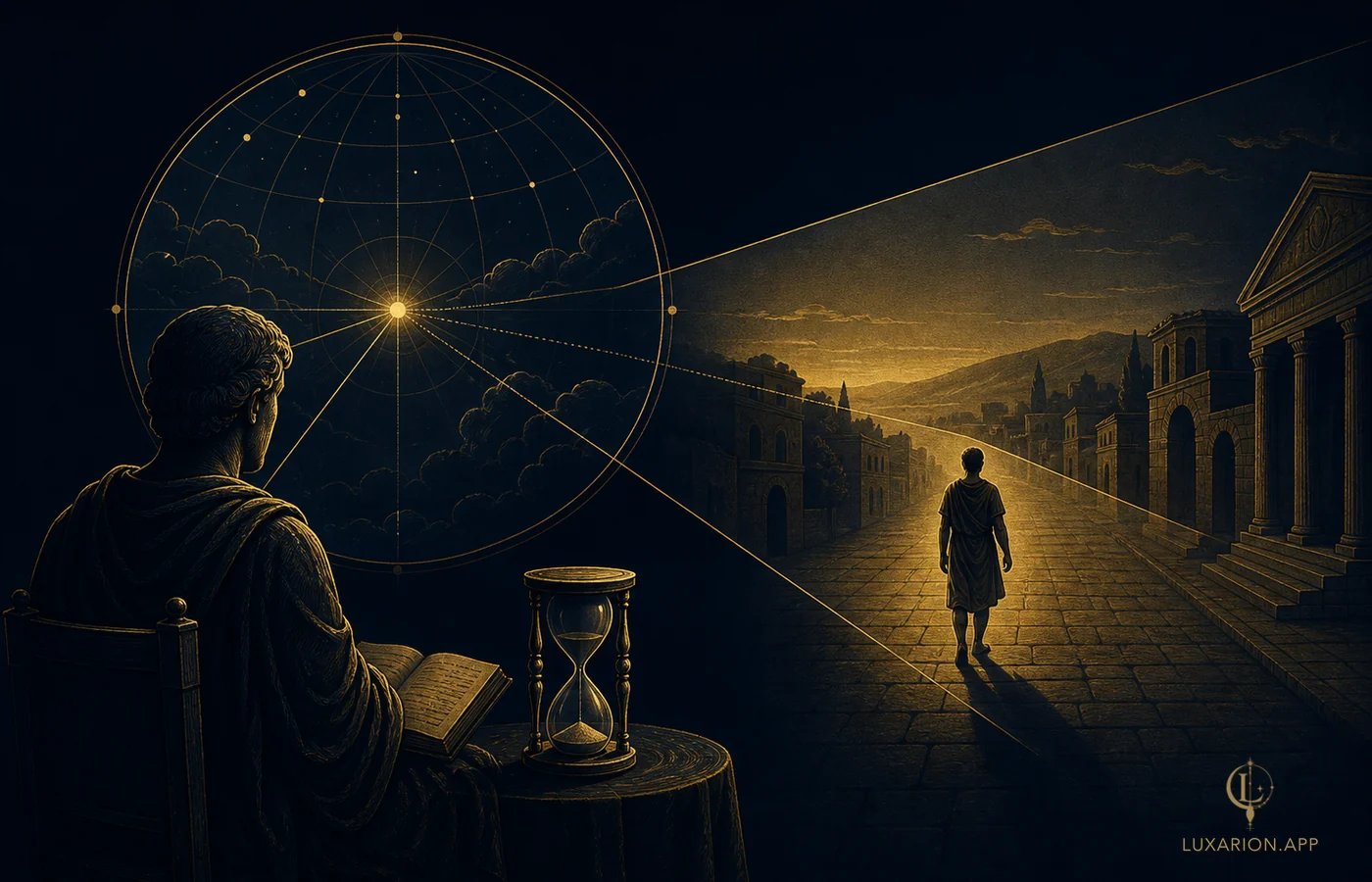
Boethius wrote The Consolation of Philosophy while awaiting execution around 524, and it contains what remains the most elegant resolution of the problem in any language.
The objection he faces is this: if the future is known, it must be fixed; if it is fixed, my choice is an illusion. His answer turns on the nature of knowing rather than the nature of the future. Knowledge, he argues, conforms to the knower rather than to the thing known. A being outside time does not foresee your choice the way you foresee tomorrow's weather — sequentially, from before. Such a being sees it the way you see what is in front of you now: present, actual, and entirely unforced by your seeing it.
Watch how the trick works, because it is genuinely clean. You are watching a man walk down a street. Your seeing him walk does not make him walk. Your knowledge is certain and his act is free, simultaneously, without contradiction. Boethius's claim is that all of time stands in that relation to eternity — not earlier and later, but a single present. Foreknowledge and freedom stop competing the moment you stop imagining the knower as sitting in the past.
He also rehabilitates Fortune, and this part is practically useful. Fortune, in his account, is not malicious; she is simply not yours. The famous image of her wheel makes the point: what rises must come down, and the error is not being on the wheel — everyone is — but mistaking the wheel for the ground. Grief comes from having believed that what was lent was owned.
The Greek version, and the trap inside it
The Greeks put fate before the gods themselves: the Moirai spun, measured and cut, and even Zeus negotiated rather than commanded.
But the story usually cited for fatalism argues the opposite of what people think. Oedipus is not doomed because the oracle was accurate. He is doomed by what he does with the oracle. His parents try to kill the infant; he flees the people he believes are his parents; every catastrophic step is taken in the attempt to escape. Remove the frantic evasion and the tragedy has no engine.
Read that way, the play is not a lesson that prophecy fails: the oracle was true to the letter. It is a lesson in how a true reading is received. Oedipus took what he was told as a sentence and fled it in terror, and the flight was the road. The tradition's counsel for a hard reading runs the other way — turn toward it with the means: refuge, supplication, charity, and the remedy the reading itself points to. That is why a practitioner who sees hardship coming names it together with what meets it, and why no reader of this house ever dates a death; we set out how a hard answer is given in when the reading says no.
The Stoics took the same universe and drew a workable discipline from it. Epictetus opens his handbook with the only division that matters: some things are up to us — judgement, intention, response — and some are not, and misery is the confusion of the two. He was born enslaved and lame, and had earned the right to say it.
Marcus Aurelius, writing privately in the Meditations while running an empire, applies it constantly to the small case: you cannot govern the man who is rude to you, only what you make of it. Later, amor fati — the love of one's fate — names the far end of the same practice: not resignation, which is passive, but the harder achievement of wanting what actually happened, on the grounds that resenting the past is a war you have already lost.
What the Persian poets did with it
Persian literature holds the tension better than almost any other body of writing, largely by refusing to resolve it.
Omar Khayyam sounds the fatalist note most famously: the moving finger writes, and having written, moves on. Read the Rubaiyat whole, though, and the conclusion is not paralysis but presence — since the past is closed, attend to the cup in front of you. The fatalism is a lever for attention, not an excuse for absence.
Ferdowsi in the Shahnameh is grimmer and more interesting. His heroes are told their fates and act anyway, and their nobility consists precisely in how they carry what they cannot change. Rostam's tragedy is not that destiny defeated him; it is that he behaved as a man rather than as a puppet, and the cost was his.
Rumi, in the Masnavi, gives the argument its best images, and puts them in the mouth of a lion answering beasts who would rather only trust. The Prophet said it aloud, the lion reminds them: trust in God, and tie your camel's knee. A ladder has been set before our feet, and the roof is reached rung by rung; to play the fatalist here is a raw hope. You have feet — why make yourself lame?
Saadi in the Gulistan puts the practical rule into a couplet: provision will surely come, and still reason's condition is to seek it at the doors; no one dies before the appointed hour, and still you do not walk into the dragon's mouth. The order is the same as everywhere else in this argument — the decree above, the means in your hands, and neither ever a substitute for the other.
What astrology actually claims, correctly stated

This is where people ask whether a chart is a script, and the tradition answered that question precisely.
The maxim carried through medieval Latin astrology is astra inclinant, sed non obligant — the stars incline, they do not compel. That is not a modern softening added to make the craft palatable; it is the practitioners' own position, and it follows from the theology above. A chart shows what is coming — events and seasons, openings and trials, and when each arrives. What it shows is real, and it inclines: it makes some things easy and some costly on a given day, and the person who knows the weather meets it prepared. It does not walk you out of the house.
Abu Maʿshar, in his Great Introduction, argued that the motions of the heavens signify what comes to pass in the world below and set out how those significations are read, and Al-Biruni taught the elements of the art in his Book of Instruction with the same exactness he gave to astronomy. Ptolemy opens the Tetrabiblos by defending prognostication as a real knowledge of what is coming and a useful one: what is foreseen can be prepared for, and much of it can be met and turned in time, as a physician meets an illness he sees approaching.
This is why a reading gives you more freedom rather than less. A reading that sees a hard month for a particular kind of launch tells you so — the cost is higher this month than next, the obstacle stands here, the opening comes there — and that is precisely the knowledge a free person acts on. We make the same argument about the most misunderstood transit in Mercury retrograde without the panic, and about the cycle that most reliably marks structural change in the Saturn return.
The natural companion to this is knowing how much of a chart is actually yours rather than generic — the sun sign is one placement among dozens, as we set out in what a birth chart really contains. You can cast the whole thing free with our birth chart calculator.
What modern thought reached
Two modern contributions are worth having, and both arrive close to ground the traditions already held.
The first is the separation of what is determined from what can be computed. Laplace's demon was the classic image of a mind that, knowing every particle's position and velocity, could compute the entire future. Chaos theory closed that road: even in fully law-governed systems, differences too small to measure grow until they decide the outcome — the butterfly effect. Notice which road it closed. The traditions never sought what is coming by counting particles. They read it in signs — the heavens, the true dream, the cup, the hand — which carry what is approaching whole rather than assembling it piece by piece, and that is the ground a reading has always stood on.
The second is compatibilism, the position most working philosophers hold: freedom is not the absence of causes but the absence of the wrong kind of cause. An act is free when it flows from your own deliberation and character rather than from coercion or compulsion. On this account, that your choice has causes — your history, your temperament, the chart you were born under — does not make it less yours. It is what makes it yours rather than random.
Notice that this lands in almost exactly the same place as kasb, arrived at from a completely different direction and a thousand years later. When two traditions with nothing in common converge on the same structure, it is usually because the structure is tracking something real.
What is given and what is yours
Here is the formulation we find most useful, and it is not a compromise so much as a clarification.
What is given is the constraint. What is yours is the response. A life comes with a great deal already fixed: the century, the country, the family, the body, the temperament, the language you first heard. Nobody chose any of that, and pretending otherwise is the cruelty described earlier. Within those constraints there is a real and surprisingly wide field of action, and it is wider than effort alone: supplication, which the Prophet said turns back the decree; charity; the istikhara that asks for the better of two roads; and the work that lifts what was done against a person and opens what was closed. All of it is yours to take up.
The useful analogy is not a script but a form. A sonnet is fixed at fourteen lines with a set rhyme scheme. It is also the case that no two sonnets are alike, and that the constraint is what makes the achievement legible. Nobody thinks the form wrote the poem.
Applied, this generates a question worth asking of any situation that is troubling you: which part of this is the constraint, and which part is the response? Most distress comes from working the wrong half — raging at a constraint that will not move, or passively accepting something that was always yours to change. The whole practical value of this ancient argument is the ability to tell them apart.
The discipline of acting on that distinction is treated in how to decide when you cannot know, which is the practical companion to this piece; and the discipline of the interval when the constraint has not yet lifted is the waiting season.
Three places this bites
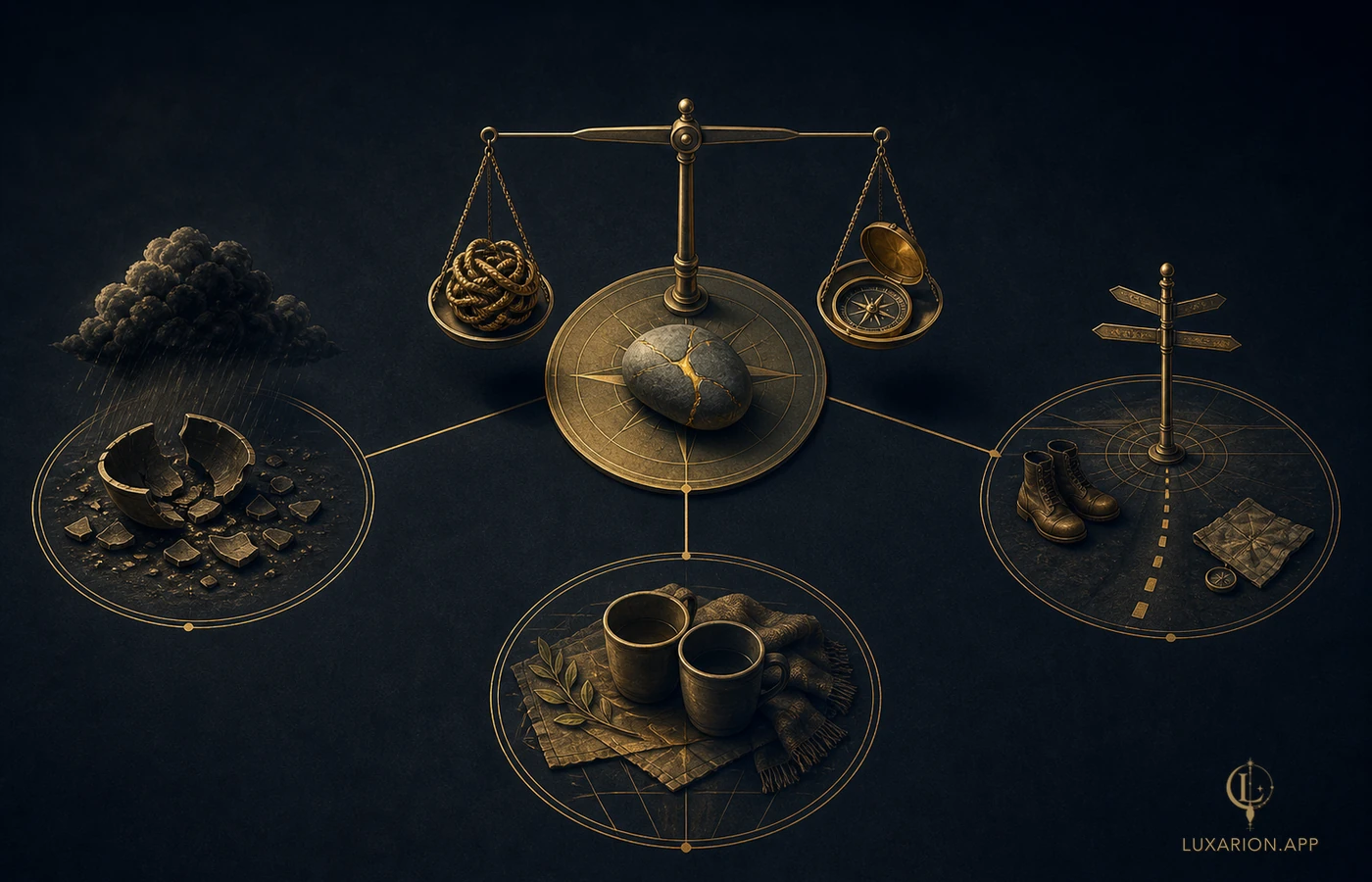
When something has gone badly wrong. The two failed answers reappear as two forms of suffering: "it was meant to be", which forecloses grief, and "I should have prevented it", which manufactures guilt from what was decreed. Both are attempts to make the event make sense. The middle position permits something harder and truer — that it was not your fault and your response is now yours. Those can both hold.
When you are considering a risk. Fatalism says the outcome is fixed, so why try. Total self-authorship says any failure is your fault, so the stakes become unbearable and you freeze. The middle says: the outcome is not fully in your hands, the effort is, and a good decision is judged by the quality of the deliberation and not only by how it turned out. That last clause is the one that lets people take reasonable risks at all.
When it concerns another person. The clearest case. Another person's heart is not moved by pressure, pleading or more effort from your side, and a great deal of suffering comes from trying. Hearts are between the fingers of the Merciful, who turns them as He wills, which is why the tradition asks rather than pushes: supplication, and the work of drawing a heart back — jalb al-habib — done by God's leave. Knowing whether the door is still open is a reading; opening it is that work. We take up the choice in knowing when to hold on and when to let go, and in a work context, where provision is drawn the same way, in work, provision and the honest exit.
"Everything happens for a reason" — and what to say at the hour of loss
This sentence deserves its own section, because it is the most common thing said to a suffering person, and because it is true and so often misused.
It is true the way the tradition means it: nothing befalls a person outside God's knowledge and wisdom, and the Prophet said the believer's affair is all good — gratitude in ease is good for him, and patience in hardship is good for him. What goes wrong is the hour and the use. Said to a bereaved parent in the first hour, as an explanation of why their child was taken, it becomes a way of closing their mouth, and the tradition never used it so.
The traditions surveyed here hold the wisdom and the grief together, and that is worth having ready, because you will need it. Boethius has Philosophy teach him, in the prison, that every fortune is good — rewarding, correcting or strengthening — while granting that the order is seen whole only from providence's height, not from inside the cell. The Stoic holds that his response to the storm is his own. And the Prophet, at the death of his infant son Ibrahim, wept, and said: the eye weeps and the heart grieves, and we say only what pleases our Lord; and at your parting, Ibrahim, we are grieved. The wisdom is God's to know, and the tears were not forbidden to the one who knew it best.
That gives you the words to use instead, and they are older than any of us: to God we belong, and to Him we return. Said with the grieving rather than at them, they hold the decree without explaining the loss away. Then stay with them. What the loss was for, and the good in it, is not theirs to settle in the first week.
It also protects a thing worth protecting: the right to grieve. The tradition names a loss an affliction — a musiba — and asks for patience, not for pretending it did not hurt. Contentment with the decree is a high station the tradition praises; it has never meant a face without tears.
An exercise, because this is meant to be used
The abstract argument becomes useful the moment it is written in two columns. Take whatever is currently occupying you and draw the line.
Left column — the constraint. What is genuinely fixed, at least on the timescale of this decision. What has already happened. Your history. The market. The diagnosis. The year you were born. Be honest and be generous with this column; the temptation is to under-fill it out of pride.
Right column — the response. What is actually yours: what you say next, what you stop doing, what you ask for — of people and of God — what you are willing to accept, the means you take up, and the timing of your own move. This column is always less empty than it feels at three in the morning.
Two rules make the exercise work. First, no item goes in both columns; force yourself to choose, because the ambiguity is where the paralysis lives. Second, put a date on the left column — "fixed this year" is different from "fixed forever", and a surprising number of things move to the right column when you extend the horizon.
Then spend your effort on the right, and hand the left over in supplication, the one act the tradition says reaches it. Effort spent pushing on the left column is the specific activity that exhausts people without changing anything; most of what we call worry is labour performed on the wrong column.
When you want to know what is actually moving in the situation — what is coming toward you, what holds it back, what can be moved and by which means — that is what our spiritual reading reads. A chart shows which season you are in and when it turns: you can cast yours free with the calculator, or compare two with the compatibility tool when the question involves someone else.
Why the answer has to stay uncomfortable
Every attempt to settle this question cleanly has failed, and the failure is instructive rather than embarrassing. Push all the way to determinism and you lose the ability to describe your own life; you cannot even deliberate without presupposing that deliberation matters. Push all the way to self-authorship and you produce a world where the unlucky are guilty.
The traditions that lasted are the ones that held both and refused to release the tension: neither compulsion nor delegation; trust, and tie the camel; some things are up to us and some are not; the constraint given, the response owned. Four traditions, one shape.
What this asks of you is the tradition's own habit: at each point, to see which half you are in, to take the means with your whole effort, and to leave the outcome with the One who decrees it. That is a lifetime's discipline and it is never finished. But it turns the oldest question in the world into something you can use before lunch, which is more than most philosophy manages.
And it leaves you with the piece of the argument that was never really in doubt. Whatever is written, its means are written with it — and the means are in your hands.
The library teaches the craft. A reading applies it to you.
Get your personal reading