

Opening a Book for an Answer: The Fal of Hafez and Its Family
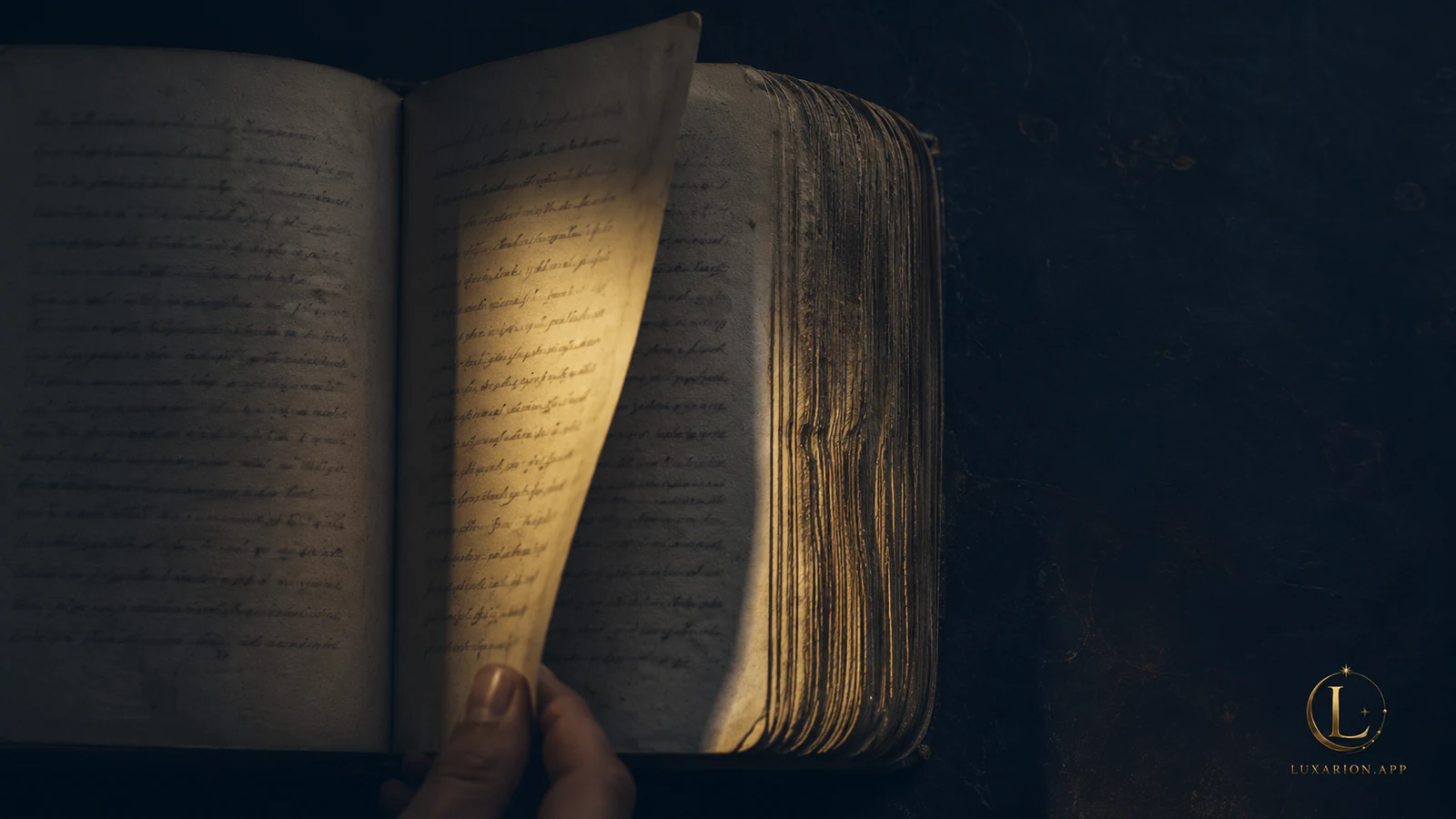
Make an intention, open a book of poems at random, read what is there. The practice is ancient, worldwide, and better designed than it looks.
In the summer of 386, in a garden in Milan, a man in his early thirties was crying under a fig tree because he could not make a decision he had been circling for years. He heard a child's voice from a neighbouring house repeating a phrase over and over: take up and read. He went inside, opened the book on the table at random, read the first passage his eye fell on, and did not need to read further.
Augustine tells that story himself in the Confessions, and it is arguably the single most consequential book-opening in European history. What is less often noticed is that he was not improvising. He was doing something that already had a name, a method and a wide currency — and that is still done, tonight, in Iranian sitting rooms, by people opening a book of fourteenth-century poems.
This article is about that practice: what it is, why it works better than it has any right to, how to do it properly, and what to do when the page seems to say nothing at all.
The family, and its shape

The general name is bibliomancy — putting a question to a book and taking the passage that arrives as the answer — and it turns up wherever there are both books and decisions.
Romans consulted Virgil. The sortes Vergilianae involved opening the Aeneid at random for guidance, a practice attested from imperial times onward and recorded of emperors. Christian Europe developed the sortes sanctorum, using scripture the same way, and we know how popular it was chiefly because church councils kept condemning it — a prohibition repeated over several centuries is a reliable sign of something that would not stop.
And in the Persian-speaking world the practice found its permanent book. The Divan of Hafez of Shiraz — a fourteenth-century poet whose collected ghazals run to a few hundred poems — became, and has remained for six centuries, the book you open. It sits in a very large number of Iranian homes for exactly this purpose, and it is opened at Yalda, on Nowruz, and on any evening when someone cannot decide something.
Look at what these have in common. In every case: a person with a question, a book chosen in advance and not chosen for the occasion, a passage arrived at without control, and an agreed rule that what turns up is to be read as addressed to the asker. That last clause is the whole mechanism, and it is the same one at work in every drawing of lots — the answer must be beyond your reach for it to be able to tell you anything.
Why a poem answers better than a sentence
Now the part that is usually left as mystery and is in fact quite explicable — and the explanation makes the practice more interesting rather than less.
Suppose you tried this with a technical manual. You would get a paragraph about torque settings, and nothing would happen. Try it with a novel and you would get a piece of narrative that belongs to someone else's story. The practice barely works with either, and everyone who has tried it knows this.
It works with poetry, and it works best with a particular kind of poetry: dense, figurative, and deliberately underdetermined. A ghazal is a sequence of couplets, each self-contained, held together by rhyme and mood rather than by argument. Its recurring figures — the beloved, the wine, the tavern, the rose, the nightingale, the door — are famously unfixed. Six centuries of readers have argued about whether Hafez's beloved is a person, a patron, or the divine, and the argument has never been settled because the poems are built so that it cannot be.
That is not a flaw. It is a design property, and it is precisely what makes the Divan a good instrument. A text with one clear referent gives you one meaning, which is either about your situation or it is not. A text with many possible referents gives you a structure that your own situation can enter — and what you find in it is your situation, articulated in language you would not have reached alone.
Which is the honest description of what the practice does. The book does not know about you. What it offers is an unusually good set of images, arriving without your control, at a moment when you are paying attention for a specific reason. And attention of that quality, applied to material of that quality, produces things you did not have five minutes earlier. That is a real event, and it is why the practice has outlasted a great many things with more elaborate claims.
Why Hafez, and not someone else
Persia has an unusually deep bench of poets, and the question of why this particular Divan became the national oracle is worth answering, because the answer is not sentiment.
Three properties made it the book. The form. A ghazal's couplets are self-standing, so any place the book falls open gives a complete unit rather than a fragment. Open a long narrative poem and you land in the middle of a story; open the Divan and you land in a whole thought.
The ambiguity. Hafez's characteristic move is to hold two registers in the same line — the tavern and the mosque, the human beloved and the divine one, the reproach and the compliment — and to refuse to resolve them. That refusal is the technical property discussed above, and no Persian poet does it more consistently.
The tone. The Divan is a book that repeatedly declines to condemn. Its speaker is forgiving of human weakness, suspicious of piety worn for show, and consistently on the side of the person who has made a mess of something. That matters enormously in a practice people turn to when they are worried, and it is probably the deepest reason the book stayed in the house: it is very hard to open Hafez and be told that you are worthless.
His tomb in Shiraz — the Hafezieh — is one of the most visited places in the country, and people read fal there. The practice and the poet are not separable, and the reason is that the poems were, in a sense nobody planned, extremely well built for the job.
The method, properly
There is a way this is done, and the steps are not decoration — each removes a specific way the practice degrades.
One book, chosen once. Pick the book before you need it and do not change it. Changing books between questions is the equivalent of asking a pendulum the same question until it agrees, and it destroys the practice for the same reason.
Form the intention silently and specifically. The Persian term is niyyat, and it is not a formality. Hold the actual question — not "what should I do about everything" but the real one. Practitioners will tell you the quality of a fal correlates with the honesty of the intention far more than with anything else.
Open once. Not until you like it. Once.
Read the whole poem, aloud if you can. This is the step most people skip and it is the one that matters most. The custom of reading the ghazal aloud is not ceremonial; the poems were written for the ear, their argument moves through sound, and reading only the first couplet loses most of what is there.
Notice what snags. Somewhere in the poem a line will catch — you will feel it before you can say why. That line, not the first line, is your fal. Mark it.
Read the last couplet as counsel. A ghazal traditionally closes with the poet's own pen-name — the takhallus — as Hafez addressing himself. Custom treats that closing couplet as the advice, and it is a genuinely useful convention: it turns the reading from a description into a suggestion.
Write down all of it. The date, the question, the poem, the line that snagged, and one sentence on what you took from it. A year of these is a document about your own preoccupations that nothing else will give you.
A worked example of the reading
Because "read the poem" is advice everyone gives and nobody demonstrates, here is the shape of the work — using a hypothetical fal, since the point is the method rather than the poem.
Someone asks whether to accept a position in another city. The ghazal that opens is, on its surface, about a lover complaining that the beloved has gone travelling and the wine tastes of nothing without them.
The first move is not to say "travel — so yes, go". That is reading a poem as a horoscope, and it produces the shallow readings that give the practice its reputation. The second move is to read the whole thing and notice what actually snags — which, for this asker, turns out to be a middle couplet that has nothing to do with journeys: a line about how the rose is not diminished by being praised in its absence.
Sit with that and the reading assembles itself. The question was framed as a departure. The line that caught is about whether something survives distance. What the asker has actually been worrying about is not the job. It is one relationship, and whether it holds if they leave.
That is the characteristic result of a well-conducted fal, and it is worth naming: the answer very often reframes the question rather than answering it. A practitioner would say the book did not tell them anything; it gave them a set of images clear enough that they could finally see what they were asking.
The etiquette, and why each rule exists
Every version of this practice has developed the same small set of customs, which is itself a piece of evidence.
Do not open for a question that is not yours. The custom is firm and the reason is practical: you cannot form an intention on someone else's behalf, so what you get back is your own reading of their situation, which is a different and much less reliable thing.
Do not open twice for the same question. The second reading is not more accurate. It is the first reading plus your dissatisfaction with it, which is the same failure mode as re-asking a pendulum or re-drawing a card.
Do not open lightly at another person's expense. Reading someone's fal aloud and interpreting it unkindly, for entertainment, is the single most common way this practice does harm — and it does, because people remember.
Treat the book well. Iranians keep the Divan somewhere particular, and many kiss it before opening. Whatever you believe about that gesture, it does something useful: it marks the boundary between ordinary reading and the deliberate kind, and the boundary is doing real work.
Do not use it to make a decision you are unwilling to think about. The practice is at its best on questions you have already worked and cannot resolve, and at its worst as a substitute for working them. That is the same boundary that the article on deciding when you cannot know sets out at length, from a different tradition, and it is not a coincidence that both arrive at it.
When the page seems to say nothing
It happens, and it happens most to people who have just started, so it deserves a straight answer rather than a mystical one.
Three ordinary causes cover nearly all of it. The question was too large. "What should I do with my life" has no fal, because there is no image specific enough to catch on it. Narrow it and try again another day.
You read only the first line. This is by far the most common. Go back and read the whole poem, out loud. The snag is usually in the middle.
The answer is not the one you wanted, and you are declining to see it. This is worth sitting with rather than solving. A fal that seems blank while a specific couplet keeps returning to you an hour later has not been blank.
And there is a fourth possibility that the tradition is entirely comfortable with: sometimes the reading is genuinely not for today. The custom of leaving a question and returning to it in a week is old and sensible, and considerably wiser than opening the book eleven times in one evening.
How the Divan reached Europe
A short passage of history that explains why a European reader may already half-know these poems without knowing where from.
Hafez arrived in European letters through a translation into German at the very start of the nineteenth century, and it landed on Goethe, who was then in his sixties. The effect was extraordinary: he wrote an entire book of poems in response — the West-östlicher Divan — addressed to Hafez as a colleague across four centuries and a continent, and declaring, in the most public way available to him, that this poet was his equal.
That book did something durable. It made Persian lyric a live presence in European Romanticism rather than an exotic curiosity, and the line of influence runs from it through a great deal of nineteenth-century writing. Readers who have never opened the Divan have often met its temperature secondhand.
It is worth knowing for a practical reason as well as a historical one. If you intend to use a translation, you are choosing which Hafez you get, and the translations differ enormously in whether they preserve the ambiguity or resolve it. A version that decides for you whether the beloved is human or divine has removed the property the practice runs on. Prefer a translator who leaves the question open — the poems are less comfortable that way, and considerably more useful.
Which books work
If you are not going to use the Divan — and there is no requirement that you should — the choice is worth making carefully, because it decides how well the practice will work for you.
What is needed is a book whose language is dense, whose images are multiple, and whose passages can stand alone. In practice that means poetry, and usually poetry with a long tradition of being read aloud.
In the Persian tradition the alternatives to Hafez are themselves canonical: Rumi's Masnavi, Saadi's work, Omar Khayyam's quatrains, Attar's Conference of the Birds. Elsewhere the same properties appear in the classical lyric traditions of many languages.
What does not work, and it is worth knowing why: prose fiction, because passages carry the momentum of a plot that is not yours; anything written to be unambiguous, because the practice needs room; and, notably, anything you have not read enough of to have a relationship with. The Divan works partly because its users know it — they recognise the poem, they have heard the couplet before, and the recognition is part of the reading.
One more consideration that is rarely mentioned. The book should be one you would be content to have shaped your thinking. You will remember what it said to you at difficult moments, and those lines will stay. Choose accordingly.
Common questions
Do I need the book in the original language? No, but the poem should be one you can hear. If you read a translation, choose one that reads as poetry rather than as a gloss, because the practice depends on the language doing work.
Is a digital version acceptable? Practitioners differ and both positions are held sincerely. What a physical book gives you is the pause — finding it, holding it, opening it — and that pause is not nothing. If you use a screen, build in a substitute for it.
How often can I do this? Once for a question, and let a question rest before reopening it. Many people keep it for genuine junctions rather than making it daily, and report that the readings are better for the rarity.
What if I get the same poem twice? Take it seriously rather than reopening. In every practice of this family, repetition is treated as emphasis.
Can I do this for a yes-or-no question? You can, but you are using a wide instrument for a narrow job. A poem answers in images; if what you need is one bit, the pendulum is the instrument built for that, and the piece on binary tarot questions works the same problem from the cards' side.
Is this the same as the I Ching? Related but distinct. The I Ching generates a figure by a randomising procedure and then sends you to a fixed text; bibliomancy skips the figure and goes straight to the text. Both belong to the older family of casting lots.
Does it matter whether I believe anything about it? Less than people expect. The practice is a structured way of putting good language in front of a real question at a moment of attention, and that works whatever account you give of it. Several of the most careful practitioners describe what they are doing in exactly those terms.
If you want to try it tonight
You need one book you like, one real question, and ten minutes without interruption. Form the intention, open once, read the whole poem aloud, mark what snags, read the closing couplet as counsel, and write it down. That is the entire practice, and it costs nothing.
What it does not give you is a second voice. A fal is a conversation with a book, and books do not ask follow-up questions — which is exactly what a question that has been circling for months tends to need. A spiritual reading with Luxarion is built for that: a conversation that finds the question under the question, in your own language, and stays with it long enough to be useful.
And if what you are actually holding is a decision rather than a curiosity, the article on how to decide when you cannot know takes the same problem up from an older direction, and the piece on intuition is the natural companion to everything above about the line that snags before you can say why.
The library teaches the craft. A reading applies it to you.
Get your personal reading