

Knowing When to Hold On and When to Let Go

Three situations feel identical at 3am and need opposite answers. How to tell them apart, what the traditions say about love and attachment, and how to release.
The question arrives at three in the morning and it is always the same shape. Do I keep trying, or is this over? And the reason it keeps you awake is not that you lack information. It is that both answers are available, both have evidence, and choosing either one costs something you are not ready to pay.
What makes this harder than any other decision is that it involves another heart. You are not choosing between two roads; you are choosing about a person who is also choosing, and whose heart is not moved by effort from your side alone. Every framework that treats this as an optimisation problem fails for that reason — and it is why the tradition, when a heart has to turn, asks the One who turns hearts rather than pushing.
What follows is what actually helps: a way to tell apart three situations that feel identical, what the older traditions understood about the difference between love and attachment, and a practical account of how release is done — because "let go" is advice, not instruction, and nobody ever became free by being told to be.
Three situations, opposite answers
A hard season in a sound relationship. Illness, grief, a job loss, small children, a stretch where one person has nothing to give. Every long bond has these, and the modern instinct to read discomfort as incompatibility ends a great many things that were merely tired. The mark is that you can name the pressure, that it is external or temporary, and that underneath it the other person is still reaching toward you, however clumsily.
A structural mismatch. Not a bad person, not a bad season — a real and durable difference about what a life is for. Children, place, faith, money, honesty, how conflict is handled. These do not resolve by patience, and the cruel thing is that they are usually visible early and mistaken for something that will change. The mark is that the same conversation has recurred, unchanged, for years.
A relationship that has already ended. One person has left, in fact if not in language, and the other is still working. This is the most painful because effort feels like loyalty. The mark is asymmetry: you can list what you have done this month; you cannot list what they have.
These require opposite responses — endure, decide, and grieve, respectively. Almost everyone lying awake has one of the three, and almost everyone is applying the wrong one's medicine.
Love and attachment are not the same thing
Here the older vocabulary is genuinely sharper than the modern one, which collapses several distinct states into a single word.
The Persian and Arabic tradition uses ʿishq for love in its consuming form — and, notably, is not simply approving of it. The poets treat it as a fire: real, transforming, and dangerous, something that burns away what is false but can also burn the house down. The distinction that matters is between love, which wants the good of the other, and attachment, which wants the continuation of the state that the other produces in you. They feel identical from inside. They are not identical, and the test is uncomfortable: if the person you love became genuinely happier without you, would that be bearable?
Modern psychology drew the same fault line from outside. John Bowlby and Mary Ainsworth, developing attachment theory, described patterns formed early that shape adult bonds, and one of their descriptions matters here: an anxious attachment produces an intensity of feeling that is easily mistaken for the depth of the love.
This is not a reason to distrust your feelings. It is a reason to ask a better question than "how strongly do I feel" — and the distinction between an intuition and an anxiety, which we treat in the quiet sense, is exactly the skill required here. The house adds a question the laboratories do not ask. When the pull toward someone is out of all proportion and will not loosen, or when a love that was sound turned cold overnight and without cause, the tradition looks for what has been done: a binding, the eye, envy set between two people, or the sihr the Qur'an names as that by which they separate a man from his wife. That is uncovered, and it is undone.
Layla, Majnun, and the mirror
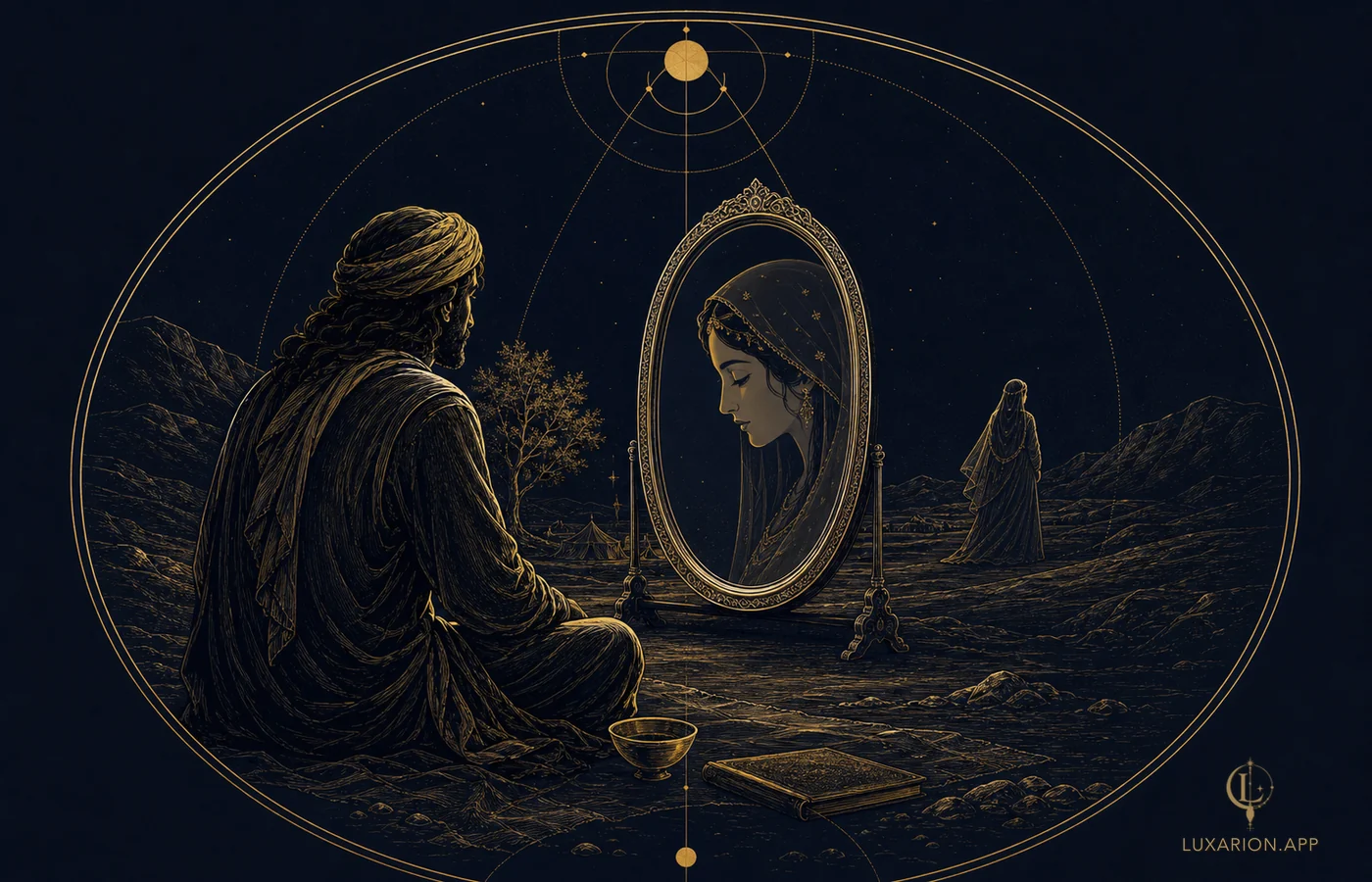
The great Persian love story is instructive precisely because it refuses the ending everyone wants. In Nizami's telling of Layla and Majnun, Qays loves Layla past the point of madness — majnun means possessed — and the two never unite. What is remarkable is that when he is finally offered the chance to see her, something has shifted: the beloved has become an image he carries, and the woman herself has almost become an interruption.
The tradition reads this in two directions and both are useful. Read spiritually, human love is a training ground for a larger one; the mystics called this ʿishq-e majāzi, metaphorical love, a bridge rather than a destination. Read plainly, it is a warning: it is entirely possible to be devoted to your own image of a person and to mistake the intensity of that devotion for a relationship with them.
That second reading is worth sitting with if you are grieving someone who has left. The question is not only "do I miss them" but "which them" — the person as they actually were, including the parts that made you unhappy, or the compiled best version you have been carrying? Grief for the second is real grief, but it is grief for something that did not exist, and it resolves differently.
Rumi opens the Masnavi with the reed cut from the reed bed, crying from separation — and the crucial move is that the cry is the music. The separation is not the obstacle to the song; it is the condition of it. Anyone who has been changed by a loss they did not choose knows this is true and also knows it is no comfort at the time.
Why leaving is so hard even when you know
Three mechanisms keep people in finished things, and naming them helps.
The first is sunk cost. Seven years invested makes leaving feel like wasting seven years — but the seven years are gone either way, and the only real question is about the years ahead. Everyone knows this abstractly; almost nobody applies it to their own relationship, because the years feel like an asset rather than a payment already made.
The second is ambiguous loss — the term for grief without closure, where the person is gone but not gone, still present in some form, still possibly returning. Research on this consistently finds it harder to resolve than a clean bereavement, precisely because the mind cannot begin the work while the door remains ajar. This is why "staying friends" immediately, or leaving one thread of contact open, so often prolongs the pain rather than easing it: the ambiguity is the injury.
The third is that hope is a habit. After long enough, the hoping becomes a familiar internal activity — a way of relating to the world that has its own comfort. People do not only miss the person; they miss the version of themselves who was waiting, because at least that person had a project.
What the traditions say release actually is
Every contemplative tradition has a technical vocabulary for release, and none of them means "stop caring".
The Sufi pair is fanāʾ and baqāʾ — annihilation and subsistence. What is dissolved is not the love but the self's claim on it: the demand that the beloved supply your existence. What remains — baqāʾ — is the capacity to love without requiring. This is a high station and nobody arrives at it by deciding to, but the direction it points is the correct one, and it is very different from indifference.
The Buddhist term upādāna is usually translated as clinging or grasping, and the distinction it makes is the same: the problem named is not the caring but the gripping. Detachment in the philosophical sense has always had to defend itself against the misreading that it means coldness; the tradition is consistent that it means the opposite — you can only be fully present to something you are not clutching.
Yunus Emre makes the same point in Anatolian Turkish with a directness the philosophers cannot match, turning the love of the created toward the Creator without ever suggesting the first love was worthless. And Hafez, throughout the Divan, holds separation and devotion together without resolving either — which is, in the end, what this feels like.
Four questions that actually decide it
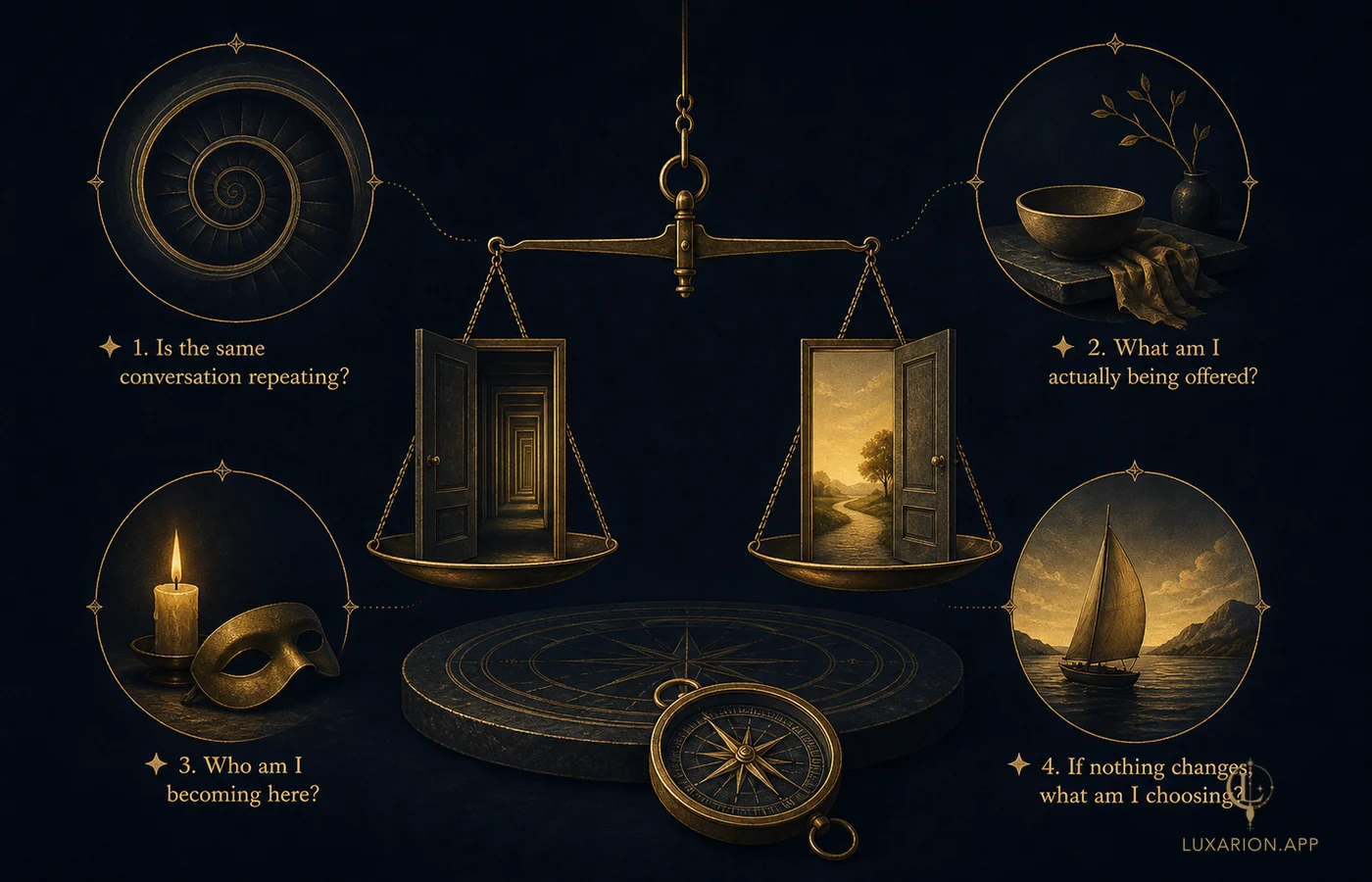
Run these in order, in writing. The writing matters; these questions are evasive when kept in your head.
One: is the same conversation repeating? Not the same fight — the same underlying conversation. If you can find the identical exchange three years back, unchanged, you are not in a difficulty being worked through. You are in a structural fact being re-encountered.
Two: what am I actually being offered? Not what was promised, not what is possible, not what happened in the good year. What is on the table this month, from the person as they are today. People routinely make decisions based on a version of the other that has not been available for a long time.
Three: who am I becoming here? This is the question with the most predictive power and the one people most avoid. Over the last two years, in this bond, have you become more yourself or less? More generous or more watchful? The answer to this is usually known immediately and resisted for months.
Four: what would I advise someone I loved? The oldest trick and still the most effective, because it removes the distortion of being the one who has to pay. If the advice you would give a friend in this exact situation is clearer than the advice you are giving yourself, you have your answer and are negotiating with it.
If the decision hinges on someone else's chart as much as your own, the compatibility tool covers both, and what synastry shows about a bond is set out in compatibility is a verb. A love consultation reads the bond itself — what the other person carries toward you, what holds them back, and where it is heading — and the discipline of asking a good question about love in the first place is in how to ask about love.
What a reading shows here
This deserves saying plainly, because it is the question under the question at three in the morning.
A reading reads the bond from your side of it: what the other person carries toward you, what holds them back, whether the door is still open, what is working against the two of you, and where it is heading. It reads you as well — what you are carrying, what you already know and have not said, what season you are in. That is what a love reading is for, and it answers the question you are lying awake with.
A reading that sees the door closed says so, and says it with care, as we set out in when the reading says no. And when it shows that something has been done — a binding, the eye, a hand set between you — that is uncovered and lifted, and a heart that should turn back can be drawn back by the house's work, by God's leave. Knowing whether they will come back is a reading; bringing them back is that work.
Three cases, worked through
The one who keeps almost-ending it. Four break-ups in two years, each followed by reconciliation within a fortnight. The pattern itself is the information: a bond that cannot survive a month apart and cannot survive together is usually two people who cannot stay away from each other and cannot build anything when they are close. The useful step is not another conversation — it is a genuinely bounded separation, long enough for the heart to settle and the matter to show itself, because nothing can be judged in week one. Three months, agreed in advance, with a date to talk after; and it is the right interval in which to pray istikhara or ask for a reading, once the pull has quietened.
The one waiting for someone unavailable. Married, emotionally absent, in another country, or simply not choosing you. The trap here is the occasional warm message: it keeps hope firing far longer than steady warmth would, and the laboratories have a name for it, intermittent reward. Recognising this is not cynicism about their feelings, which may be entirely real; it is accuracy about why you cannot stop. What is on offer, this month, from the person as they actually are, is the question such arrangements are designed to keep you from asking.
The one who was left without explanation. The absence of a reason is its own injury, because the mind will manufacture one and will usually manufacture something about your worth. Two things help. First, accept that the explanation may never come and that waiting for it hands the ending to someone who has already left. Second, notice that a person who could not explain themselves has told you something real about their capacity — which is information about them, not a verdict on you.
What to say to someone in it
You will more often be beside this than inside it, and most instinctive responses make it worse.
Do not say the relationship was obviously bad. Even if true, it makes the person defend it, and it insults the years they spent. What helps is naming both halves: it was real and it is over. Almost nobody offers both, and holding them together is what the person cannot yet do alone.
Do not push toward the next person. It implies the loss is replaceable, which is the thing they most fear and most need contradicted.
Do not ask for the story repeatedly. Retelling has a use early and becomes rumination later; the good friend is the one who, around month three, gently changes the subject.
Do offer specifics. "Let me know if you need anything" transfers the work to the person with the least capacity. "I am coming Thursday at seven" is the sentence people actually remember years later.
How release is actually done

"Let go" is a description of a destination, not a route. The route, assembled from what the traditions prescribe and what people who have done it report, looks like this.
Close the door properly. Ambiguity is the wound. One clear conversation, or one clear message, and then contact ends for a defined period — three months is the usual minimum. This is not punishment; it is the condition under which grief can begin at all.
Grieve on purpose, in a bounded way. Elisabeth Kübler-Ross gave us the five stages, and the correction is important: she never intended them as a sequence to be completed in order, and grief does not proceed tidily. What helps is a container — a set time, a walk, a written page, a prayer — rather than either the endless loop or suppression. Pray for them and for yourself: supplication is the one act that reaches what is no longer in your hands.
Reclaim the calendar. Whatever hours belonged to that bond are now empty, and emptiness at the same time each week is where the ache concentrates. Fill those specific hours deliberately. This is the most mechanical piece of advice here and the one people report as most effective.
Expect it to be non-linear, and do not treat relapse as failure. Month four is frequently worse than month two. This is documented and normal, and people who do not expect it conclude they are not healing and go back.
Let the interval be long. The releasing is not a decision made once; it is a season, with its own disciplines — which we set out in full in the waiting season.
What the ending does not cancel
One belief does more damage in the aftermath than any other, and it is worth dismantling directly: the idea that if a relationship ended, it must not have been real — that you were deceived, or foolish, or that the good years were a performance.
This is almost never true and it is enormously destructive, because it asks you to grieve twice: once for the person, and once for your own judgement. People who fall into it stop trusting their perception, which is a far longer injury than the loss itself.
The more accurate account is that two things can be simultaneously true. It was real, and it ended. Most endings are not the exposure of a fraud; they are two people changing at different rates, or a difference that was survivable at twenty-five and is not at thirty-five, or simply the ordinary fact that not everything that begins well continues. The traditions are comfortable with this in a way modern romantic expectation is not: a thing can be genuine and finite, and finitude is not a verdict on genuineness.
Practically, this matters because the story you tell yourself determines what you carry forward. "I was a fool" produces guardedness. "It was real and it ended" produces grief — which is more painful in the short run and far cheaper over a life, because grief resolves and guardedness does not.
When the answer is hold on
The literature tilts heavily toward leaving, and that is a distortion. Holding on is often right.
Hold on when the difficulty is external and shared — illness, grief, money, a hard year — and the other person is still turning toward you. Nearly every long relationship contains a stretch that, judged by feeling alone, would have justified ending it.
Hold on when what you want is available but slower than you would like, and the impatience is yours rather than a fact about them.
Hold on when you notice you are looking for a reason. Wanting an exit and hunting for its justification is its own state, and it is worth telling yourself the truth about which one you are in.
And do not hold on out of fear of the interval that follows, or out of a belief that this is your only chance. Those are the two motives that keep people longest in things that ended years ago — and the second is, more often than not, simply untrue.
The thing underneath
Every version of this question is finally a question about how much of your life is yours to steer, which is the argument we take up in what is written and what is yours. Another person's heart is not moved by pressure, pleading or trying harder, and a great deal of suffering comes from trying. Hearts are between the fingers of the Merciful, who turns them as He wills, so the tradition asks rather than pushes: supplication, and the work that draws a heart back, by God's leave.
What is yours is the response: what you offer, what you ask for — of them and of God — what you accept, what you are willing to keep paying, and when you decide. That is a smaller field than you want and a real one. And the discipline of choosing inside it, without the certainty you would prefer, is the same discipline set out in how to decide when you cannot know.
The traditions are unanimous on one point, and it is the one worth carrying. Love that requires the other person to stay in order to have been real was never quite love; and love that was real is not cancelled by having ended. Both halves of that are hard to believe at three in the morning. Both are true by daylight, and they are what makes it possible to let go of someone without having to decide that loving them was a mistake.
The library teaches the craft. A reading applies it to you.
Get your personal reading