

The Waiting Season: When You Have Done Everything and Nothing Moves

How to tell a real waiting season from avoidance, what the traditions say patience actually is, and the four disciplines that make an interval count.
There is a particular exhaustion that does not come from working too hard. It comes from having worked, correctly, and watching nothing happen. The applications are sent. The conversation was had. The treatment is underway. And the world, which was supposed to respond, simply has not.
This is one of the least-discussed conditions in the whole vocabulary of advice, because advice is built for people who need to act, and here the acting is already done. What remains is an interval — and the interval has its own skills, which almost nobody teaches.
Every contemplative tradition worked on this, because every contemplative tradition was built by people who spent long periods in it. What follows is what they found: what patience actually is (it is not what most people think), how to tell a genuine waiting season from avoidance wearing its clothes, and four things that turn an interval from lost time into the part of the story that later turns out to have mattered.
First, the distinction that decides everything
Four states look identical from outside and require opposite responses. Getting this wrong is the single most expensive mistake available here.
Waiting is when the action is complete and the outcome is not yours to accelerate. The seed is in the ground. The letter is sent. More effort now would not help, and might do harm.
Being stuck is when there is an available action you have not identified. It feels like waiting, which is why it is dangerous. The test is simple and slightly brutal: if a competent friend looked at this, would they see a move I am not making? If yes, this is not a waiting season. It is a problem wearing a waiting season's clothes.
Avoiding is when there is an available action you have identified and are declining to take, usually because it is frightening. This is the one that most often disguises itself as patience, and the disguise is convincing because avoidance and patience produce identical calendars. The distinguishing mark is bodily: genuine waiting is heavy but calm; avoidance has an edge of relief in it, and the relief is the tell.
Being held back is the one practitioners add, and it looks like waiting from every side. The doors that should open close one after another at the same step — the offer withdrawn at the last stage, the match that falls apart at the engagement, the money that comes and leaves — often with a heaviness, broken sleep, or a sudden dislike of the very thing you wanted. The tradition knows this as a blockage: the eye, envy, or a work done against someone's affairs. It is not answered by waiting harder. It is uncovered, and then lifted — which is what our spiritual reading is for.
Before anything else in this article applies, run those four. Much of what people call a waiting season is one of the other three, and the answer for those is: find the move, take the frightening one, or have the blockage uncovered and lifted.
What patience actually is
The English word suggests waiting quietly, which is why it sounds so passive and so unappealing. The Arabic term the tradition uses, ṣabr, comes from a root that means to bind, to restrain, to hold something firmly in place. It is closer to a tourniquet than to a shrug.
That etymology matters because it reframes the whole activity. Patience in this sense is not the absence of effort; it is effort applied inward rather than outward. You are not doing nothing. You are holding something — usually yourself — that would otherwise scatter.
The classical treatments divide it into three, and the division is genuinely useful because most people are only fluent in one:
Patience in doing what is hard. The steadiness that gets you through the fourth year of the training, the tenth month of the illness, the unglamorous middle of anything worth finishing.
Patience in not doing what is easy. The restraint that does not send the message, does not check the profile, does not take the mediocre offer just to end the discomfort of not having decided. This is the kind most relevant to a waiting season, and the kind fewest people have trained.
Patience under what has happened. Bearing an affliction without collapsing and without becoming bitter, which are two different failures.
Notice that only the third involves anything like resignation. The other two are strenuous. Anyone who has held a difficult position — kept a promise through a bad month, declined an easy exit — knows this is work, and that it is tiring in a way that looks like nothing from outside.
The two words the Greeks had for time

Greek distinguishes chronos — sequential, measurable clock time — from kairos, the right or opportune moment, the instant at which an action becomes possible that was not possible before.
This is not a poetic distinction; it is a practical one, and it names exactly why waiting seasons are so disorienting. You are living in chronos, where days pass and nothing is different, while the thing you need belongs to kairos, which does not arrive on a schedule. The mismatch is the suffering. You are measuring with the wrong instrument and concluding, wrongly, that nothing is happening.
The sailing metaphor underneath the word is the useful one. There is a moment when the tide turns, and the sailor who leaves before it fights the water the whole way. The waiting is not wasted; it is the price of a passage that will later look effortless. Anyone who has watched someone's career or marriage seem to "suddenly" work knows there was a preceding interval that looked, at the time, like failure.
This is also where a chart earns its place: it reads the timing — when the season turns, which months open a door and which close one — and what the turn will bring. Being told that a season is not favourable for a particular kind of launch, and when it becomes favourable, is being told something a free person can act on — wait a month, spend the interval differently, stop reading the flatness as personal failure. We treat the most misread of these transits in Mercury retrograde without the panic, and the long structural one in the Saturn return. You can cast your own with the birth chart calculator.
The threshold, and why it feels like nothing
Anthropology gave this state a precise name. Arnold van Gennep, studying rites of passage, found the same three-part structure everywhere: separation from the old state, a middle phase, and reincorporation into the new one. Victor Turner developed the middle phase and called it liminality — from the Latin for threshold.
Turner's findings about the liminal phase describe a waiting season with uncomfortable accuracy. The person in it is structurally ambiguous: no longer what they were, not yet what they will be. Ordinary status markers stop applying. Time feels suspended. And — this is the part worth knowing — traditional societies did not treat this as a malfunction. They ritualised it, gave it a duration, and assigned it meaning. The initiate in the forest was not failing; they were in the middle, and the middle was understood to be necessary.
Modern life has kept the transitions and abandoned the ritual, which leaves people passing through liminal states with no framework for them and no vocabulary except "something is wrong with me". The religious life never abandoned it: the forty days of a retreat, the waiting period a widow keeps, the last ten nights spent in the mosque — intervals given a length, a form and a meaning. A great deal of the distress of a waiting season is not the waiting. It is the absence of any structure that says: this phase exists, it has a shape, and it ends.
That is worth saying plainly if you are in one right now. You are not malfunctioning. You are between two stations, in a passage every tradition marked, and the disorientation you feel belongs to the passage rather than to your character.
Fallow is not dead
The agricultural image is the oldest one and still the best, because the mechanism is literal rather than metaphorical.
A field left fallow is not idle. Nitrogen is being restored, the soil structure is recovering, the weed cycle is being broken. None of this is visible from the gate. A farmer who judged a fallow field by what could be seen would conclude it was failing, and would plant it too early, and would get a worse crop for several years.
Two things follow from this, and both are practically useful. First, the invisibility of the process is not evidence about the process. Second — and this is the part people miss — fallow is a decision, not an accident. The field is deliberately rested. There is a difference between a field left fallow and a field abandoned, and the difference is entirely in the intention of the person who owns it.
Which gives the reframe that changes how the interval feels: you can be in an accidental waiting season or a deliberate one, and the events may be identical. The distinction is whether you have decided that this is a season of rest and preparation, or whether you are simply enduring the absence of what you want. Same calendar, entirely different experience, and the choice is genuinely available.
The stories that are actually about this
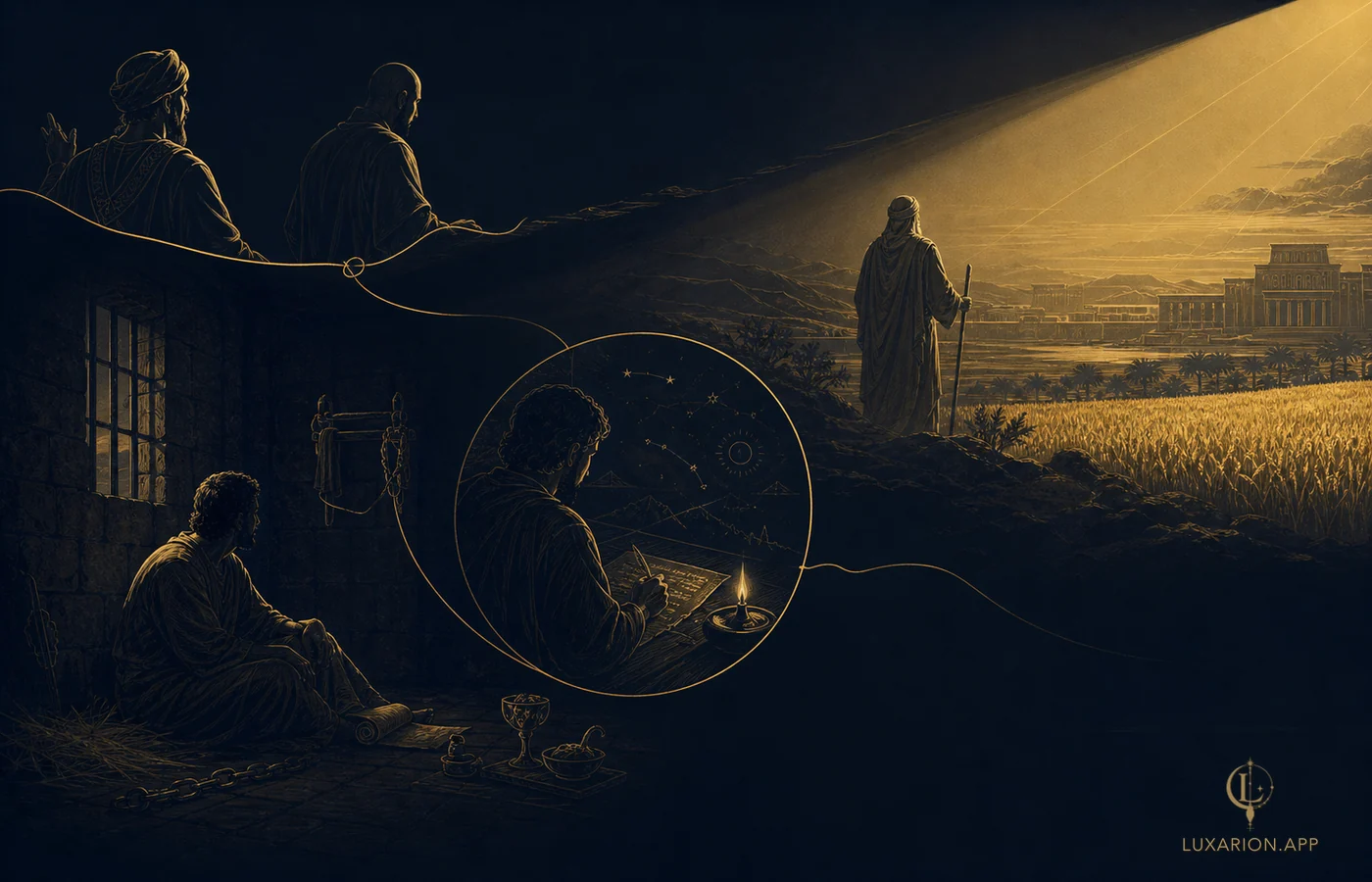
Two long narratives sit at the centre of this theme and both are worth knowing, because both refuse the easy resolution.
Joseph — Yusuf in the Islamic telling — spends years between the well and the throne, including a long imprisonment on a false charge, with a genuinely cruel detail: the man he helps and who promises to remember him forgets, and the forgetting costs additional years. The narrative does not treat those years as a gap between the interesting parts. They are where the character required by the ending is formed, and it is in the cell that the interpreter who later saves a nation first reads dreams for others — a knowledge the story says his Lord taught him.
His father Jacob carries the theme's central phrase. Told his son is dead, he says he will practise ṣabrun jamīl — beautiful patience. The adjective is doing enormous work. Not stoic patience, not resigned patience: beautiful. The tradition's commentators generally read it as patience without complaint to people — Jacob grieves openly, weeps until his sight fails, and directs the complaint upward rather than outward. Which means the phrase is not asking you to be serene. It is distinguishing between grief, which is permitted and even honoured, and bitterness, which corrodes.
Job makes the same point from the other direction, and it is worth correcting the popular version. The Job of the book is not quietly accepting. He argues, at length and with considerable heat, and demands a hearing. What he does not do is curse and let go. The tradition remembers him as the model of patience while the text shows him complaining bitterly — which tells you that the virtue was never understood to require silence.
What the marshmallow studies add
The marshmallow test is usually cited here: children who could wait for a second treat had better outcomes years later, therefore delayed gratification is the master virtue.
The later research complicates this in a way that is genuinely useful rather than merely deflating. Much of the effect tracks the child's material circumstances and, crucially, whether adults in their life had reliably kept promises before. A child who has learned that promised things do not arrive is behaving rationally by taking the sure treat.
The lesson for a waiting season is therefore not "be more disciplined". The studies found from outside what the tradition says from inside: people wait well when they trust that the waiting is kept. The tradition's word for that trust is tawakkul — reliance on the One who does not break a promise — and it names who keeps it. If you find waiting unusually unbearable, the question worth asking is not what is wrong with your willpower but where your trust was broken, and trust can be rebuilt, in prayer as much as in people.
Four disciplines that make an interval count
What follows is the practical core, assembled from what the traditions actually prescribed rather than from encouragement.
One: keep a form. Every contemplative tradition responds to formless time with a fixed shape — hours of prayer, a rule, a retreat with a defined length. The principle is that when external structure disappears, internal structure must be supplied deliberately, or the days will dissolve. Concretely: fixed wake time, one anchored practice at the same hour daily, one weekly point of contact with another person. This sounds trivial and is the single highest-yield intervention available in a waiting season.
Two: shorten the horizon. The suffering in an interval is almost entirely produced by looking at the whole of it. Nobody can wait indefinitely; everybody can get through today. This is not self-deception — it is the correct scale of attention for a period whose end you genuinely cannot see. Judge the day on whether you did the day's work, not on whether the situation resolved.
Three: do the adjacent work. The thing you are waiting for is blocked; the things next to it are usually not. The craft can be sharpened while the commission does not come. This is the discipline that converts an interval from lost time into preparation, and it is the one thing that reliably makes people say afterwards that the waiting was the making of them.
Four: set a review date, not an end date. You cannot decide when the answer arrives. You can decide when you will reassess whether this is still waiting rather than stuckness or avoidance. Put a date in the calendar — a month, three months — and on that date, run the four-way test at the top of this article again. This is what prevents a deliberate fallow season from silently becoming an abandoned field.
If the interval has the marks of a blockage, or you want to know what the season is holding and when it turns, that is what our spiritual reading is for; and when the interval concerns another person, the compatibility tool reads the two charts together.
Three intervals, worked through
The job search that has gone quiet. Forty applications, four interviews, no offer. This is the case where the three-way test matters most, because it is very often not a waiting season at all. If the applications are going into portals and nothing else is happening, there is an available move — people, not forms — and the flatness is blockage rather than fallow. If the approach is genuinely broad and the market is genuinely slow, then it is waiting, and the adjacent work is the whole discipline: the skill sharpened, the portfolio rebuilt, the network warmed. Judge the week by what you built, not by the inbox. And if the same door has closed at the same step five times, look at the fourth state before calling it a market.
The relationship in suspension. Someone has asked for time, or has not decided, and you are holding a position that has no end date. This is the hardest kind, because the outcome turns on another heart. A reading can tell you what that heart holds and which way it is leaning, and there is lawful work that reaches a heart by God's leave — but the discipline here is still the fourth one, a review date, and it must be honest: a month, not "when they are ready", because "when they are ready" is a horizon that recedes. What you are deciding on that date is your own willingness to keep waiting, which is entirely yours.
The illness or recovery that is slow. Here the fallow image is literal rather than figurative: healing genuinely is invisible work performed by a body on its own schedule, and impatience genuinely does damage. The relevant discipline is the second — shorten the horizon — and the relevant permission is that you are not obliged to be productive. The adjacent work in a recovery may simply be rest, and rest counts. The tradition pairs the treatment with prayer, as it always has: seek the cure, and ask the One who sends it.
What to say to someone in one

Since you will more often be next to a waiting season than in one, it is worth knowing what helps. Three things reliably do.
Name the season out loud. Most people in an interval are privately convinced they are failing. Saying "this is a hard stretch and it is not evidence about you" does more than any advice, because it supplies the missing framework.
Be specific about time. "It will happen" is not believable and quietly implies you know something you do not. "I will check in on the first of next month" is believable, and it keeps someone company on a horizon they cannot see the end of.
And offer the adjacent work rather than the outcome. You cannot produce the job or the diagnosis. You can look at the portfolio, make the introduction, sit in the room. The traditions are consistent that presence is the thing that transfers; advice usually is not.
What the interval is protecting you from
There is a reframe worth holding, though it should be offered carefully rather than as consolation.
Sometimes an interval is a delay. And sometimes what feels like a closed door is the absence of something you would have taken and should not have. The job that did not come through in a month you were desperate. The person who did not call back when you would have accepted anything. Very few people can see this at the time, and almost everyone can see it at five years. The Qur'an says it in one line: it may be that you dislike a thing while it is good for you (2:216).
This should not be said to someone in the first week of a hard thing — that is the error described in what is written and what is yours, where we take up why "everything happens for a reason" so often wounds. But held privately, as a possibility rather than a certainty, it does real work. It permits the thought that the flatness is not necessarily a verdict on your worth, which is the thought most people in a waiting season have quietly stopped being able to think.
How to know when the waiting is over
Waiting seasons rarely end with an announcement. Three signs are reliable.
The first is that an action becomes available that genuinely was not before — not one you were avoiding, but one that did not exist. This is kairos, and it usually looks smaller than expected: a message, an opening, a person suddenly reachable.
The second is that the thing you were waiting for stops being the organising centre of your attention. Often this precedes the resolution rather than following it, which people find unnerving and which is completely normal.
The third, and least welcome: sometimes the season ends because the answer is no, and the waiting was for a thing that will not come. That is a real ending too, and it deserves to be recognised as one rather than extended indefinitely by hope that has become a habit. Knowing when a thing has ended is its own difficult skill, and we treat it directly in knowing when to hold on and when to let go.
The related questions sit close by. The discipline of choosing when the information is incomplete is how to decide when you cannot know. When the stalled thing is specifically work, the particular knots are in work, provision and the honest exit. And the question of whether the restlessness you feel is signal or noise belongs to the quiet sense.
The thing worth taking from all of it
The traditions agree, across languages that never met, that the interval is not the pause between the parts of a life. It is one of the parts.
That claim is easy to say and hard to believe while you are inside one. But it has a testable consequence, which is why it is worth more than encouragement: people who came through long waits well almost never describe the waiting as empty in retrospect. They describe it as the period in which something was assembled that they could not have assembled while moving — a skill, a clarity, a tolerance, a friendship, a correction of course they would never have made if the first road had stayed open.
You cannot make the season shorter. You can decide whether it is fallow or abandoned, and that decision is genuinely yours, and it is very nearly the whole of what is yours here. Which is, as it happens, exactly enough.
The library teaches the craft. A reading applies it to you.
Get your personal reading