

Being Chased in Dreams: Who Is Really Doing the Running
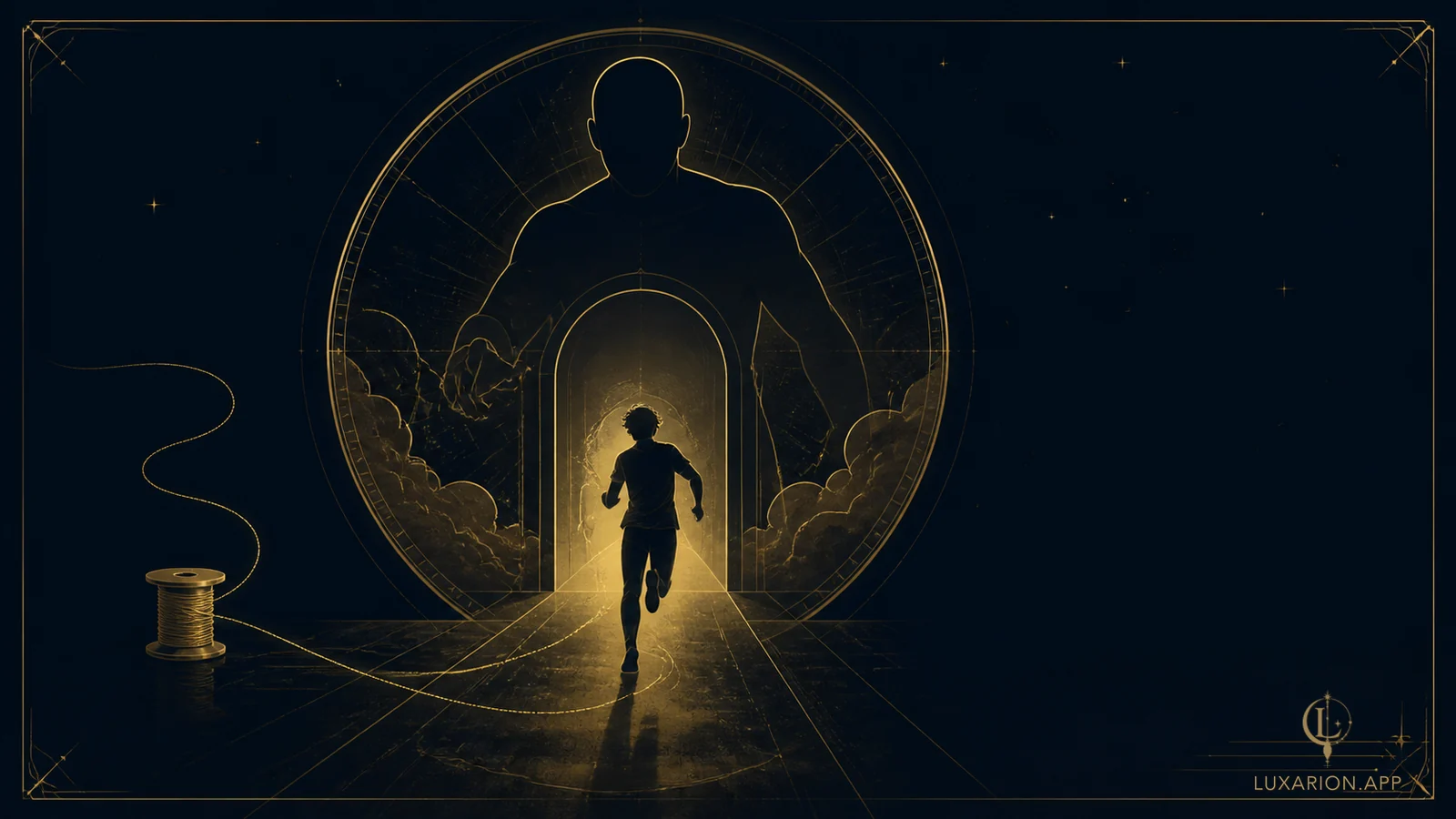
The chase is one of the most common dreams on earth. The traditions read it with one voice — and the identity of the pursuer is the whole reading.
You are running. The ground is wrong somehow — too soft, too steep, too long. Something is behind you and gaining, and your legs are moving with that specific dream slowness, as though the air had thickened. You wake before it reaches you. You almost always wake before it reaches you.
This is the most widely shared dream on earth. Every collection of dreams ever assembled, in every language that kept records, has the chase near the top. And every serious tradition of dream interpretation makes the same first move with it — a move that most people skip, which is why the chase dream so often gets read backwards.
The move is this: before you ask what the chase means, ask who is chasing. Not what the running means. Not what the falling ground means. Who — or what — is behind you. In the classical material the identity of the pursuer is not a detail of the reading. It is the reading. Everything else is staging.
What follows is that method, worked out properly: what the traditions read in a pursuer, the six kinds of pursuer and how each is read, why your legs do that, what the sleep researchers found when they counted, the counter-move every tradition prescribes, when a returning chase is one of the signs of sihr or the eye, and a practical sequence you can run on your own chase dream tonight.
What the traditions read in a chase
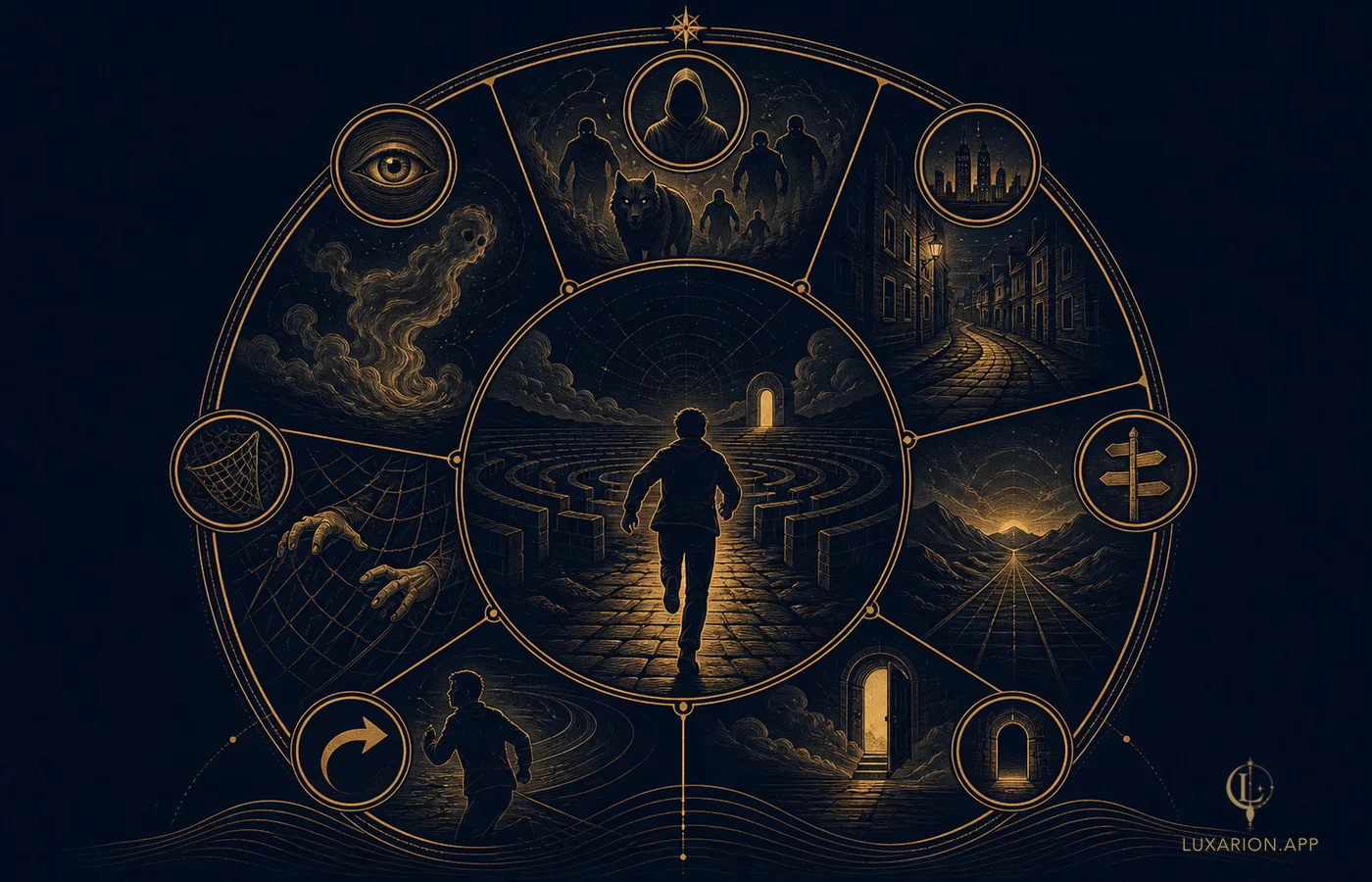
Traditions that never met each other read the chase in three registers, and a careful reader keeps all three in view. The pursuer can be a real enemy, or a harm on its way. The classical collections read a pursuing beast as the kind of adversary it resembles — a lion as an oppressor with power, a dog as a base enemy, a snake as an enemy who works unseen — and they read the flight itself as safety: whoever flees a thing in a dream escapes it, in the words of Moses, I fled from you when I feared you, and my Lord granted me judgement. It can be something the dreamer is avoiding awake, the reading the Greek material and the modern literature share. And when it returns night after night with certain marks, it can be one of the signs of sihr, the evil eye or the touch of the jinn, which the practitioners of ruqya have described for centuries.
The second register is the commonest in an ordinary week. There the dream has not sent a predator; it has given a shape to an avoidance already under way, and made you feel it from the inside — as motion, as effort, as the particular exhaustion of running from a thing you cannot outrun because it is travelling with you.
In that register the chase feels physically precise and narratively vague. The feeling is exact: dread, urgency, the sense of a closing distance. The plot is generic: a road, a corridor, a stairwell, a house that keeps producing rooms. The dream is rendering a stance.
Such a dream needs to be located — matched to the thing in your waking life that is currently in the position of the pursuer. The other two registers ask for more: an enemy is read by the pursuer's nature and by what the dream shows of the outcome, and signs of harm are uncovered and treated. The questions below sort one from another.
When the pursuer is a portion of the dreamer
The Arabic tradition's central methodological insight — the one attached to the name of Ibn Sirin, whose method underwrites the great medieval collections — is that a figure in a dream most often stands not for itself but for an attribute, a season, or a role that the dreamer associates with it. Your uncle in a dream is often not your uncle. He is the thing your uncle carries for you: a kind of authority, a period of your life, an unfinished argument.
Apply that to the chase and one reading opens: the figure behind you may be an attribute behind you — something belonging to you, or claiming you, that you are currently at a distance from and working to keep at a distance.
Artemidorus, writing in Greek and with no contact with the Arabic material, makes a structurally identical move in the Oneirocritica: he insists that the same image means different things to different dreamers according to their trade, their circumstances, their habits — and he organises entire sections around that principle rather than around the images themselves. Two traditions, no contact, the same first principle.
The practical consequence is uncomfortable for anyone who wants a quick answer: a chase dream cannot be read from the chase alone. Half the text is the dreamer. Any reading offered without knowing who is doing the dreaming is a guess wearing the costume of knowledge. This is the point we make at length in how the old interpreters actually worked, and the chase is where it bites hardest, because the chase is exactly the dream people most want a one-line answer to.
Six pursuers, and how each is read
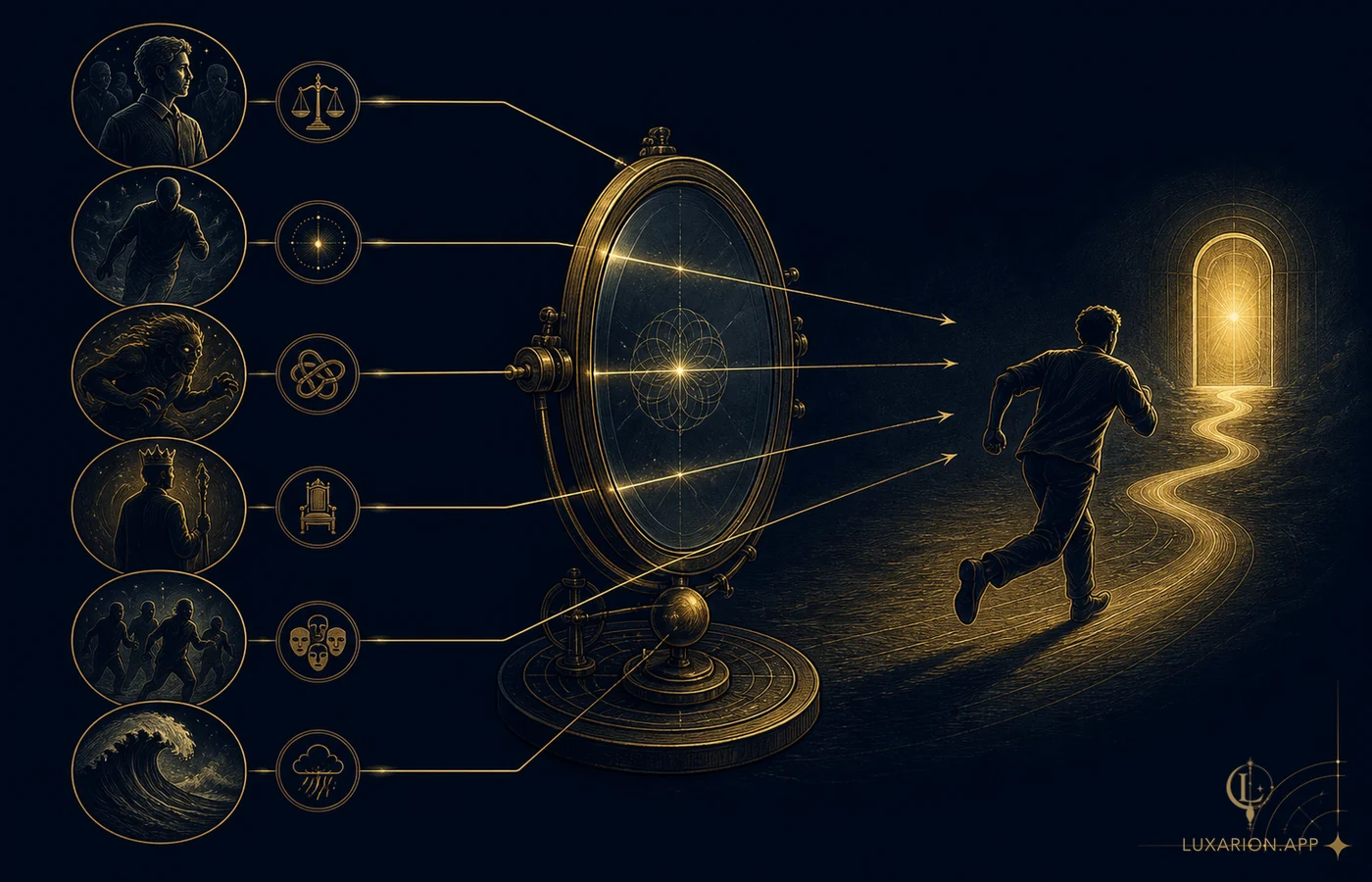
Here is where the classical material earns its keep. It does not offer one meaning for "being chased." It offers a taxonomy of pursuers, and the readings genuinely differ.
Someone you know. The most straightforward and the most often misread. Most often the known face stands for what that person carries in your life — an expectation you have absorbed, a judgement you are anticipating, an obligation you have not answered. The classical collections also read a known pursuer as that person's real enmity or envy toward the dreamer, especially when the dream is clear and returns. The craft's discipline is in the order: the ordinary reading first, the harder one only on the dream's own evidence, and never an accusation made on a dream alone.
A stranger with no face. Extremely common. In an ordinary week it is read as the pursuit of something not yet named: the facelessness is the information, and in practice it is the pursuer of people carrying a decision they have not admitted they are carrying. When it returns night after night, with a heaviness on waking, practitioners of ruqya count it among the marks they look for when uncovering the eye or the touch of the jinn.
An animal. The animal's nature is the reading. A dog and a snake are not interchangeable. The classical collections read the pursuing animal as an adversary of its kind — the lion an oppressor with power, the dog a base enemy, the snake an enemy who works unseen — and a pursuing animal can also point to something in you that operates below deliberation, appetite or temper or fear, that you are treating as external. In the ruqya literature, repeated pursuit by black dogs, cats or snakes is among the signs looked for when sihr is suspected. Snakes carry a dense and often positive symbolic history of their own, which we open up in what the serpent has actually meant.
A crowd. Read as social rather than personal. Pursuit by many is the shape that reputation, obligation, and belonging take when they exceed what you can carry. It is the dream of the over-committed and of people living under someone else's expectations.
Something formless. A darkness, a sound, a presence. In an ordinary week this is dread before it has found its object. When it comes as a pressing presence at the edge of sleep and keeps returning, the tradition reads it with the signs of the eye and the jinn, and meets it with refuge sought in God.
Nothing at all. The most interesting case, and one that most modern readers miss: dreams in which you are running, urgently, without ever establishing that anything is behind you. The tradition is unusually direct here — this is the dream of the person whose life has become flight as a default posture. There is no pursuer. There is only running that has forgotten its reason.
The legs that will not work
Almost everyone who dreams of being chased reports the same physical detail: the legs are wrong. You are running through water, or through tar, or running hard and staying in place. This detail is so consistent that it deserves an explanation rather than a symbol.
The explanation is not mysterious and does not diminish the dream at all. During REM sleep — the phase in which most vivid, narrative dreams occur — the body's voluntary muscles are held in a state of near-total inhibition. Motor commands are issued; almost nothing reaches the limbs. You are, in a real physiological sense, running as hard as you can while lying perfectly still. The dream then does what dreams do: it takes the raw sensation and builds a story around it. Thick air. Heavy legs. Ground like syrup.
The same mechanism, encountered at the boundary of waking rather than mid-dream, produces sleep paralysis — the experience of being awake, aware, and unable to move, often with a strong sense of presence in the room. Cultures across the world have named it and given it a face; in Arabic it is al-jāthūm, which many read as the touch of the jinn, and the adhkar before sleep are the tradition's protection against it. We give it its own article in the weight in the night.
Knowing the mechanism costs the dream nothing. The heavy legs are the body's part; the pursuer is what the dream brings, and that is the part worth reading — whether it turns out to be the self's own talk, an enemy shown in advance, or something at work that needs uncovering.
What happened when researchers counted
Two lines of modern work are worth having beside the classical reading.
The first is the systematic content analysis begun by Calvin Hall, who collected and coded tens of thousands of dream reports rather than theorising about them. The finding relevant here: aggressive and threatening content is dramatically over-represented in dreams relative to waking life, and the dreamer is far more often the target of the aggression than its source. Dreams tilt toward threat. That is measurable and stable across the collections.
The second is the threat-simulation account associated with Antti Revonsuo, which proposes that dreaming evolved in part as a rehearsal system — a safe environment in which to run threatening scenarios repeatedly and cheaply. On that account the chase is practice: the mind returns to material it considers unresolved and runs it again. The tradition keeps the warning dream beside it, in which a clear chase shows an adversary before he moves.
The rehearsal account describes one register of the chase well — the self's own talk about the thing you have not settled. It has nothing to say about the enemy the dream shows or the harm it points to, and the tradition does.
There is also a genuinely lovely piece of etymology here. Our word panic comes from Pan, the Greek god of wild and lonely places, who was said to fill travellers with sudden, sourceless terror in empty country. The oldest name we have for this feeling already contains the observation that the terror often arrives without a visible pursuer. The Greeks noticed what the dream keeps showing.
The counter-move: turn around
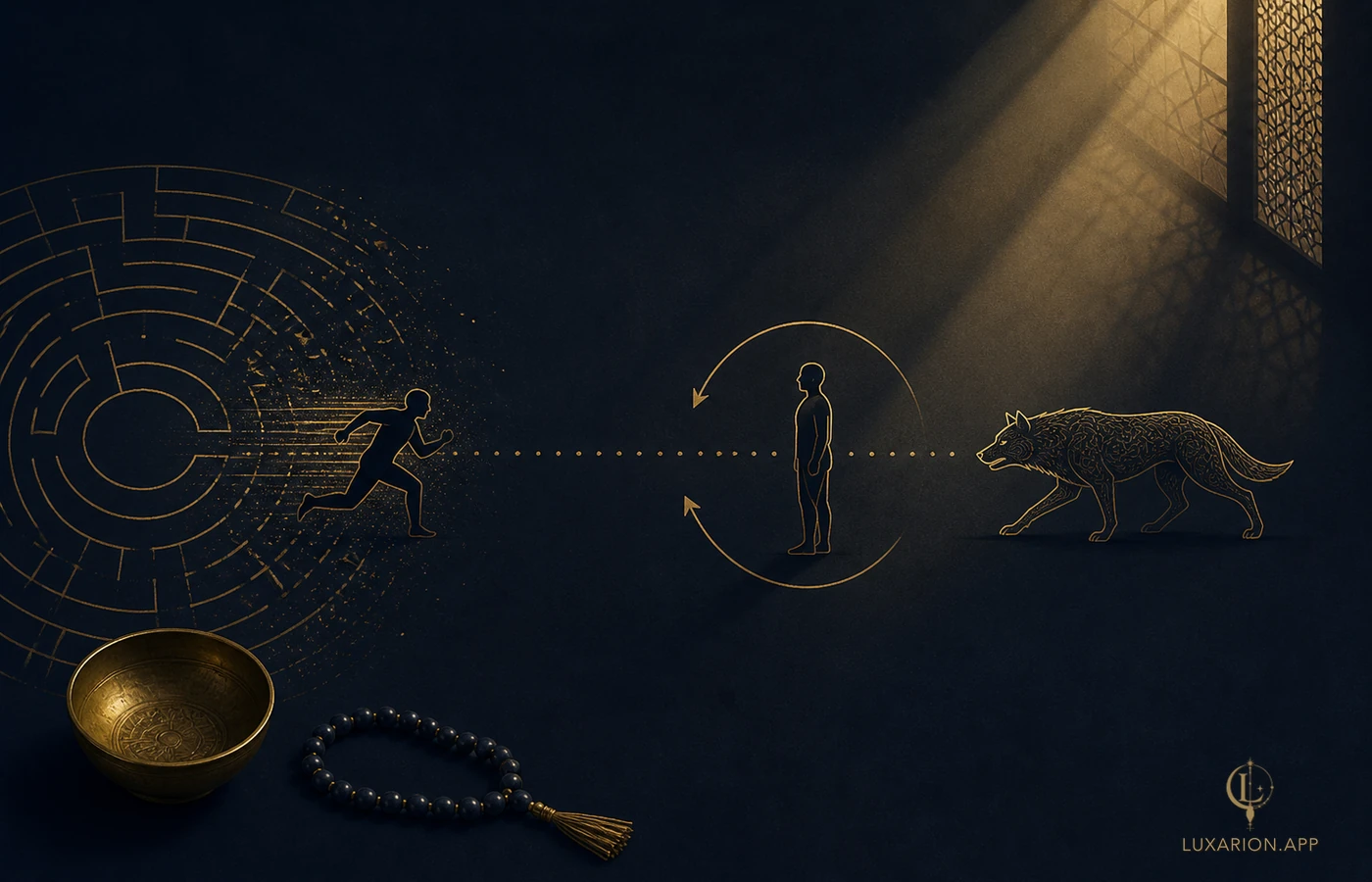
Every tradition that treats the chase seriously arrives at the same instruction, and it is the most useful sentence in this entire article: turn and face the pursuer.
In the Sufi material this is framed as the discipline of looking directly at what the self is fleeing, on the understanding that the fleeing is what sustains the fear. al-Ghazali devotes long passages of the Revival of the Religious Sciences to the observation that avoidance strengthens exactly what it avoids — that the soul which will not examine a thing gives that thing permission to grow in the dark. He is describing waking life, but the description fits the dream so exactly that the practice transfers whole.
The Greek material reaches the same conclusion by a different road, and so does the modern clinical literature: for recurring nightmares, the interventions with the best record involve rehearsing a changed ending while awake — deliberately imagining turning, stopping, speaking to the pursuer — rather than trying to suppress the dream. The tradition's first protection comes before any of it: the adhkar of sleep said each night — the Verse of the Throne, the last two suras, and refuge sought in God's perfect words from the evil of what He created — and ruqya where the signs call for it.
Some dreamers manage the turn inside the dream itself, which is one of the ordinary uses of lucid dreaming. But you do not need lucidity for the practice to work, and this is the important part: the turn can be made awake. Sit down, put yourself back in the dream deliberately, and turn around in your imagination. Look at what is there. Almost everyone who does this finds the same two things — that the pursuer is smaller than the running implied, and that it has a name.
Three chases worth knowing
Literature has thought about pursuit longer than psychology has, and three of its chases illuminate the dream.
Oedipus runs from a prophecy and runs directly into it. The structure is exact and worth sitting with: the flight is the mechanism of arrival. Every step taken to avoid the thing is a step toward it, and the running is what makes the outcome possible. Anyone who has watched someone flee a conversation for a year and then have it under the worst possible conditions has watched this play.
Javert, in Victor Hugo's great novel, pursues Valjean across decades — and the pursuit consumes the pursuer entirely. Javert has no life outside the chase. When the chase resolves, he cannot survive it. Some pursuers in dreams are like this: an old grievance or an old standard that has been running for so long it has become the whole of a person's structure.
Ahab, in Melville, inverts everything. Here the hunter is the one destroyed, and the reader understands early that the whale is not really the subject of the book. Some chase dreams are Ahab dreams — you are the one pursuing, and what you are pursuing has become a way of avoiding something else entirely.
Three shapes: the flight that causes the arrival, the pursuit that consumes the pursuer, the hunt that is itself an avoidance. Most chase dreams are one of these.
The etiquette, which is not decoration
The interpretive traditions carry rules of conduct, and with frightening dreams those rules do real work.
Seek refuge from a frightening dream, and do not tell it abroad. The hadith is exact: a frightening dream is from Satan; the one who sees it spits lightly to the left three times, seeks refuge in God from its harm, turns onto the other side and tells no one — and it will not harm him. The clinical literature has since noticed its own part of this: a frightening image retold six times has been rehearsed six times.
Where readings are equally available, offer the better one. Not concealment of the difficult, but a refusal to select the frightening reading when the material does not require it.
Hear fresh fear before you interpret it. Someone in the first week of a loss or a rupture is heard first and read gently afterward; interpretation rushed at that stage adds weight rather than lifting it — a discipline we open up in when the reading says no.
Do not make a dream an accusation. A dream can show an enemy or an envier, and the tradition reads such a dream with care; it is never used on its own to accuse a named person, and never used to pronounce on anyone's health, which belongs to a physician.
Seven questions for your own chase dream
This is the sequence a careful interpreter would run, and you can run all of it yourself.
1. Who or what was behind you? Be specific. Known, unknown, animal, crowd, formless, or nothing. Do not smooth it — the exact register matters.
2. Did you ever see it? Seen and unseen are different dreams. Unseen pursuers point to something unnamed; seen ones point to something known and refused.
3. Where were you running? The setting usually carries the subject while the chase carries only the urgency. Your childhood street, your workplace, and a place you have never been are three different dreams.
4. Were you running from or toward? Some chase dreams have a destination. Most do not. A chase with a destination is a different reading — that is a dream about a choice, not about avoidance.
5. What happened at the end? Woke, caught, escaped, turned. Escape is read as safety from what pursued you. Being caught is read by what caught you: an enemy who reaches you in a clear dream is a warning to take your precautions, while a pursuer from within who finally reaches you often marks the end of a long avoidance.
6. What did you feel — precisely? Fear, dread, guilt, urgency, and embarrassment are five different dreams wearing one costume. Guilt in a chase dream is the strongest single signal in the whole set, and it usually names its own subject within about a minute of honest thought.
7. What are you currently not answering? An unread message, an unsaid sentence, an unmade decision, an appointment not booked. This is the question the previous six exist to make answerable. In our experience it is answered correctly on the first attempt far more often than people expect.
When the chase keeps coming back
A single chase dream and a chase dream that returns every few weeks are two different objects, and the traditions treat them differently.
The returning dream is read as insistence — something sent and still unread. The classical instinct is that repetition is not emphasis but non-receipt: the dream comes back because its errand is not finished, and it will keep coming back while the situation that produces it stays exactly as it is. We open the mechanics of that in why the same letter keeps arriving.
What tends to end a recurring chase, in both the classical account and the clinical one, is not analysis. It is a change in the waking situation — a conversation actually held, a decision actually made, a thing actually named. The dream is remarkably responsive to real movement, and remarkably unimpressed by insight alone.
When the chase keeps returning with the marks the ruqya literature describes — pursuing animals, black dogs or cats or snakes, a pressing presence, waking heavy and afraid, alongside a blockage in love or livelihood with no ordinary cause — the house reads it as possible sihr, envy or the touch of the jinn. That is uncovered and treated: ruqya, the adhkar, and the work that lifts what is found.
And there is a threshold worth naming plainly: waking in terror without recall, or nightmares several times a week with a real daytime cost, belong with a physician as well as with a reading. The two are not alternatives, and the tradition itself sends people to physicians.
What to do this week
Concretely, in order.
Write it before you move. Seven minutes, first thing, before the day overwrites it. Pursuer, place, ending, feeling. The chase dream loses its specifics faster than almost any other kind.
Name the pursuer in one sentence. Not a symbol — a sentence. "The conversation with my brother that I have been not-having since March." If the sentence does not come, write the six candidates and let it sit a day.
Make the turn while awake. Five minutes, eyes closed, back in the dream, turning around deliberately. Look at it. This is the single highest-yield thing in this article.
Do one small piece of the avoided thing. Not the whole thing. Send the message, book the appointment, say the first sentence. The dream responds to movement, not to resolution.
Keep the record for a month. Chase dreams cluster around specific weeks, and the cluster is usually the answer. You will not see the pattern from one dream; you will see it clearly from eight.
A last word on who is running
The title of this piece asks who is really doing the running. In the register most people meet most often, both figures are you — the one running and the one behind — and that is why such a chase can never be won and never quite lost. Sometimes the one behind is not you at all, and the tradition's readings for an enemy and for harm at work are there for that.
Which is also the good news in it. A pursuer that is a portion of yourself is a pursuer you can talk to. It has been trying to get your attention, in the only room where it has your undivided attention, using the only method that reliably works on a person who is not listening: it made you feel it.
If you have a chase dream that keeps returning and you want it read properly — with the questions asked in the right order, against your actual life rather than a symbol list — that is the work our interpreters do. You can bring it to a dream interpretation session, and you will be asked most of the seven questions above before anyone offers you a reading; where the signs of harm are there, a spiritual reading looks for what is at work. That order is not a formality. It is the craft.
The library teaches the craft. A reading applies it to you.
Get your personal reading