

How to Ask About Love: The Question Is Half the Reading
One branch of the tradition formally refuses a badly built question. Its rules are three centuries old and they are still the best guide to what to ask.
Watch an experienced reader work and you notice something clients rarely see: most of the session's skill is spent before a single card is turned. It goes on the question.
Love questions arrive at every reading table more often than all other subjects combined, and they arrive in the worst possible condition, because longing writes tangled questions. What is unusual is that the tradition anticipated this and wrote rules about it — rules that are three and a half centuries old and still the most practical thing anyone has said on the subject.
The branch that formally refuses you
Horary astrology answers a single question from a chart cast for the moment it is asked. Because the whole method rests on the question, it is the one branch that had to develop a theory of what makes a question answerable at all.
William Lilly set the English form of it in Christian Astrology in 1647, and his conditions are blunt. The question must be sincere, singular and genuinely undecided. He warns against askers who are testing the astrologer, who ask the same thing twice hoping for a better answer, and who ask what they have in fact already decided. A chart cast for a question like that, in his framing, does not deserve judgement.
Underneath the technical apparatus is a rule every reading craft keeps: a divinatory system answers the question it is given, and a blurry question comes back blurred. Ask carelessly and even a perfect oracle has nothing precise to answer.
The three shapes love questions arrive in
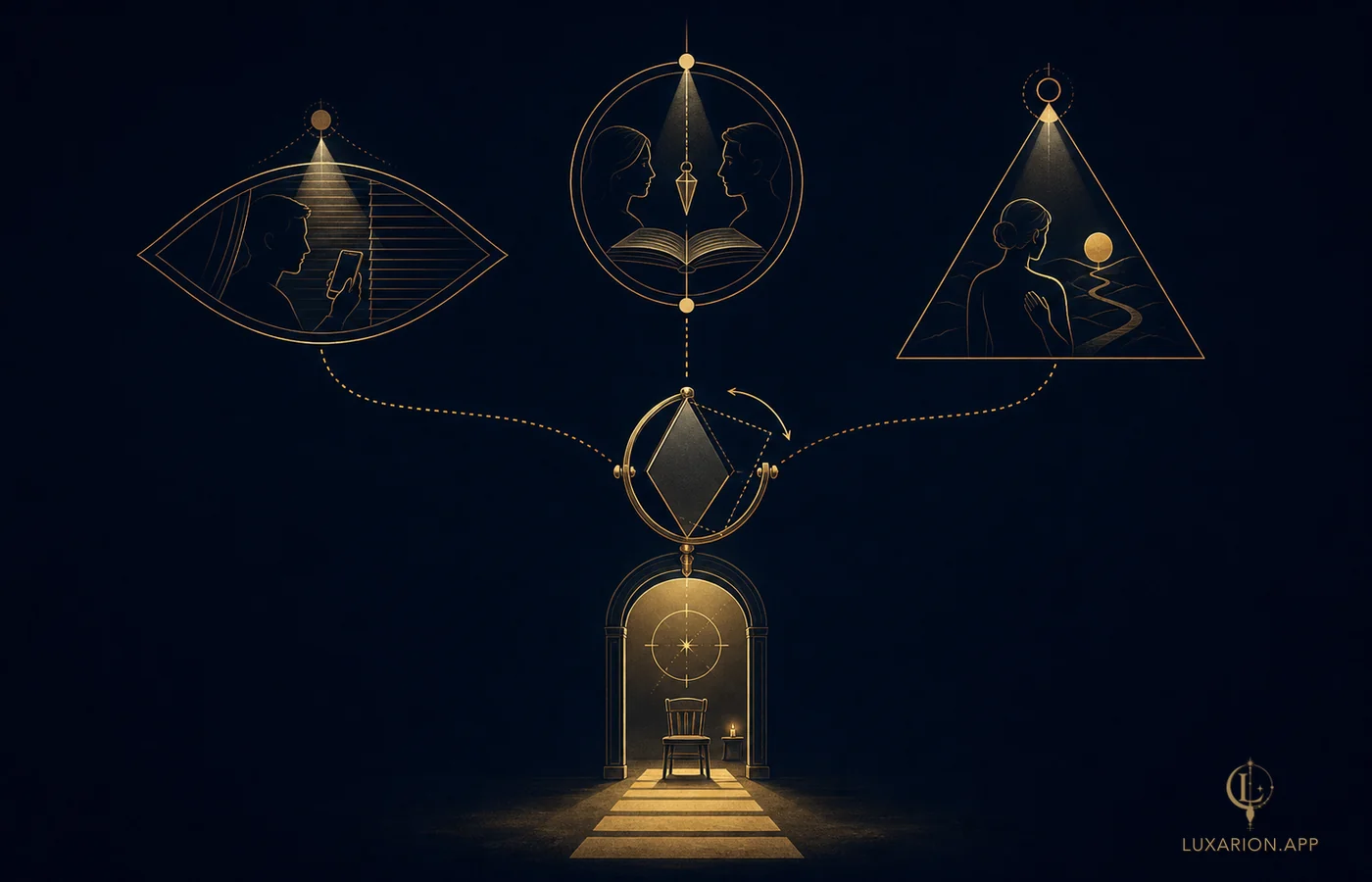
Sort enough of them and they fall into three. Each can be read; each needs building differently.
The question about the other person's heart. What is he thinking. Does she still care. Will he reach out. A reading looks at exactly this: what the other person carries toward you, what is holding them back, and what is moving between the two of you. It answers best when the question is aimed at the bond — the person named, the situation plain — rather than at every message they might have sent.
The question about the outcome. Will we end up together. A reading shows where the bond is heading as it stands now — its direction, what carries it forward and what stands in its way. That road moves with the choices of two free people, with prayer and with God's decree, so a reader gives the direction plainly and never pronounces a bond sealed or doomed: the stars incline, they do not compel.
The question about your own part. What is this longing asking of me. What pattern am I repeating. What would loving well look like this month. These give a reading the widest room, and they are the ones you can act on the same evening.
A reader's first craft is shaping: taking the question as it arrives and, with the asker, giving it one subject, one person and one season, so that the reading can answer it cleanly.
The person who is not there
This is where the craft is most exact, because the person you are asking about is not in the room.
A love reading still reads them. It reads the bond between you from your side of it — what they carry toward you, what holds them back, what is drawing the two of you together or apart, and where it is heading. That is what a love consultation is built to give, and the old horary rules point the same way: the question belongs to the one who asks it, about a bond that is truly theirs.
And when love needs work rather than a reading — a heart to draw back, a harmony to restore between two people — that is spiritual work, done by the house's practitioners and asked for when you request your spiritual piece.
Where two people both want to look, two full charts compared show what forms between them and where the bond is heading, which is the argument of compatibility is a verb.
Building the question, concretely
Four rules, and they take about a minute to apply.
Ask one thing. A question with an "and" in it is two questions wearing a coat, and the answer will serve neither.
Ask about a season. "This autumn" gives a reading a frame, and a reading gives its sharpest answer about the season in front of you. "Ever" dissolves the frame.
Name the person and the situation. Who, how long, and where things stand now. A reading of a bond needs the bond in front of it.
Ask when you can bear any answer. A question asked in desperation is not yet ripe, which is the same rule seen from the reader's side in when the reading says no.
This is a skill and it is trainable. A daily single-card practice is the gymnasium — someone who has asked one clean question every morning for a year asks sharp questions of every reading after, which is part of the case made in one card a day.
What a well-built love question returns
Something happens when the question is right: the reading comes back sharp.
The cards, the cup or the chart describe the bond — what is moving between you, what the other person carries, what stands in the way — and they describe you in love: your reach, your guard, the exact point where your generosity turns into disappearance. And they show where it is heading, and what this season asks of you.
The beloved stays free, as every tradition holds, and the reading shows the bond as it stands at the hour it is read. A question asked well gets that picture clearly.
Common questions
What should I ask about my ex? Ask it plainly: whether the door is still open, what they carry toward you now, and what stands in the way. A reading answers that. And if what you want is to draw them back rather than to know, that is spiritual work rather than a reading.
Can a reading tell me if someone loves me? Yes. It reads what the other person carries toward you and what is moving between you, and a good reader says what the reading shows plainly, without dressing a guess as certainty.
Is it wrong to ask about someone without telling them? No. A love reading reads your bond with them, seen from your side of it, which is exactly what it is for.
Why do I get a different answer every time I ask? Because the tradition's rule about repeated questions is doing its work. Asking twice usually means the first answer was heard and rejected.
How specific should the timeframe be? Narrow enough to name a season — this month, this autumn — so the reading can say what that season brings.
Where to go from here
If you would rather practise the asking first, the daily card is the training ground, and a tarot reading is the same instrument with a practitioner on the other side of it.
Once your question is shaped, a love reading is the room for it. If you would rather look at the structure first, the birth chart calculator is free and shows the placements a reading would work from.
And if the question is about how you love rather than about one person, the placement the tradition assigns to that is Venus: your Venus sign.
And if the question turns out to be about a relationship rather than a person, that is how two charts are compared.
The library teaches the craft. A reading applies it to you.
Get your personal reading