

Your Venus Sign: The Two-Sign Rule Nobody Tells You

Venus never strays far from the Sun, so yours is in your Sun sign or one of its neighbours. That single fact changes how the placement reads.
Here is a fact about your chart that almost nothing written on this subject mentions, and it will save you a search.
Your Venus is in your Sun sign, or in one of the two signs on either side of it. Always. There are no exceptions.
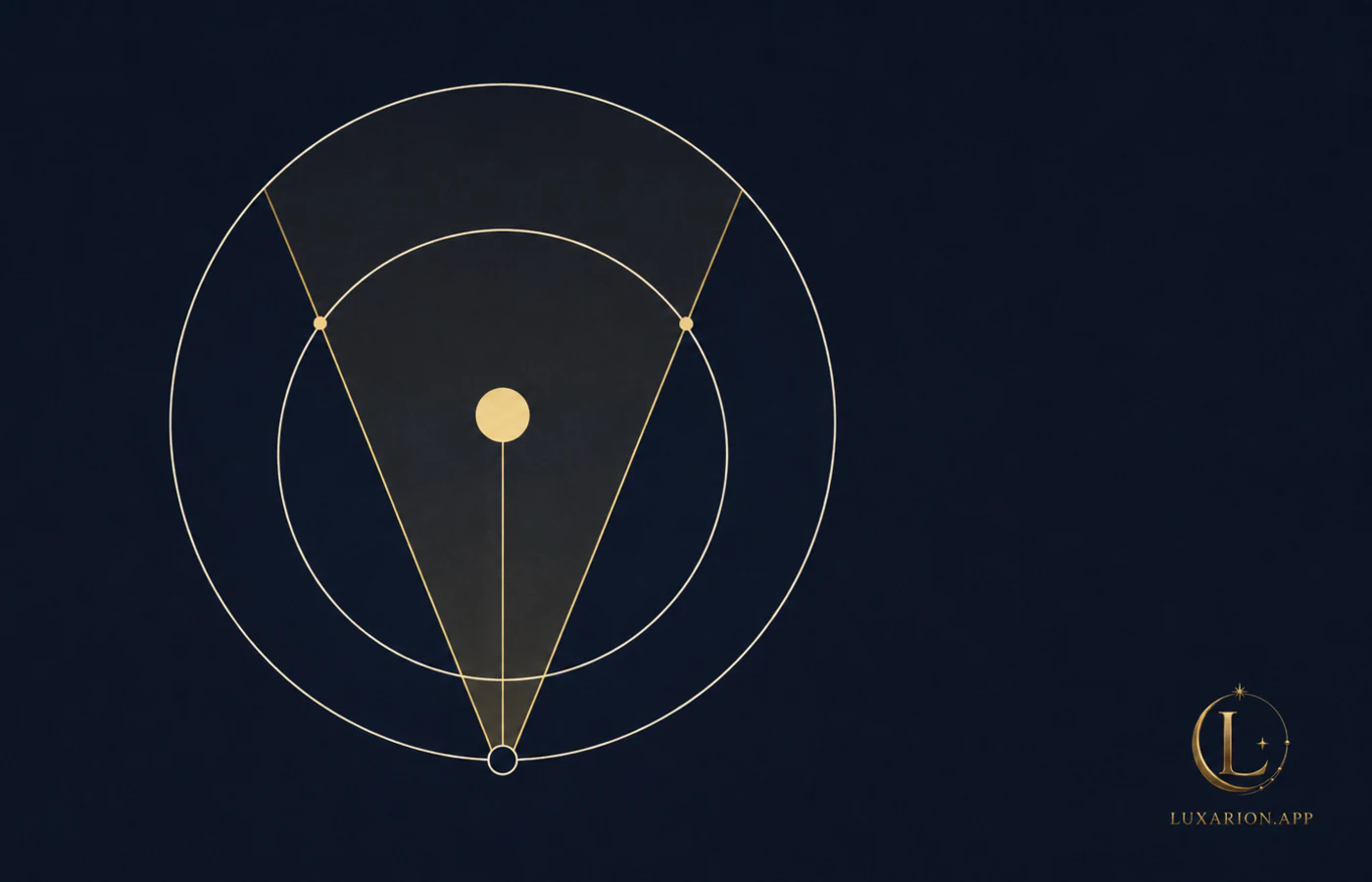
That is not an interpretive claim. It is orbital geometry. Venus orbits closer to the Sun than we do, which means that from Earth it can never appear far from the Sun in the sky — its maximum elongation is about forty-seven degrees, a little over one and a half signs. Venus is the bright thing low in the west after sunset or low in the east before dawn, and it is never overhead at midnight, because it cannot be.
So if your Sun is in Taurus, your Venus is in Pisces, Aries, Taurus, Gemini or Cancer. Five possibilities out of twelve, and you can narrow them further in a minute. This is the most useful thing to know about the placement before you know anything else about it, and it also explains something people find strange: why so many people's Venus sits in their Sun sign, and why Venus and Sun in the same sign is a very common configuration rather than a rare one.
This article is what follows from that — including a distinction the tradition made for two thousand years and the modern guides have dropped entirely.
What Venus is actually assigned to
Start with the job description, because "the love planet" is a compression that loses most of the content.
In the traditional scheme Venus governs two signs, and the pairing tells you the whole range. It rules Taurus, which is the sign of what is kept, held and enjoyed. And it rules Libra, which is the sign of what is weighed, balanced and agreed. Those are not the same subject. One is about value and the other is about relation.
Venus covers both because they are the same faculty pointed in two directions: the capacity to find something worth having. Applied to objects it produces taste, comfort, and what you will spend money on. Applied to people it produces attraction, affection, and what you will make room for.
This is why a Venus reading that only talks about romance is doing half the job. Your Venus placement describes the rooms you want to sit in, the music that does not grate, the fabric you keep buying without noticing, and the specific gestures that register to you as care. Those all come from the same place, and noticing the pattern across all of them is usually more revealing than any single sentence about your love life.
The distinction from Mars matters here and is often blurred. Venus is what you are drawn toward and how you give affection. Mars is how you pursue and what you do about it. Two people can want very similar things and go about getting them in completely different ways, and that difference is Mars, not Venus.
Morning star, evening star
Now the part the modern guides have lost, and it is the most interesting thing in the whole subject.
Because Venus stays near the Sun, it is visible either just before sunrise or just after sunset, never both in the same season. The ancients treated these as two distinct things and gave them different names: Phosphorus, the light-bringer, rising ahead of the Sun; and Hesperus, the evening star, following it down. Latin gave the same pair Lucifer and Vesper. It took a while for it to be established that these were one body.
Traditional astrology kept the distinction long after the astronomy was settled, and read the two conditions differently. A Venus that rises before the Sun — the morning star, in the degrees before it in zodiacal order — was read as more forward, more independent, quicker to move first. A Venus that sets after the Sun — the evening star — was read as more receptive, slower to declare, more inclined to be sought.
You can check which you have in one step: look at the degrees. If your Venus is at a lower zodiacal degree than your Sun, it rises first and you have a morning-star Venus. If it is at a higher degree, it follows and you have an evening-star Venus.
Whether you find the interpretation persuasive or not, the observation underneath it is real and worth having: two people with Venus in the same sign can have it on opposite sides of the Sun, and the tradition has always regarded those as different placements. It is one of the few genuinely discriminating pieces of technique available in a subject that is otherwise mostly twelve short paragraphs.
Venus and the Sun in the same sign, and what it means
Because of the two-sign rule, a large minority of people have Venus in exactly the same sign as their Sun, and it is worth reading that configuration on its own rather than treating it as a coincidence.
When they coincide, what a person is oriented toward and what pleases them point the same way. That produces a particular coherence: taste and purpose agree, and the person is rarely torn between what they are building and what they enjoy. It also produces a particular blind spot, because there is no internal second opinion. A Sun and Venus both in Capricorn will build something durable and find durability genuinely pleasant, and will have very little native access to the argument for doing something purely for the delight of it.
The tradition adds a further distinction here that is easy to check. When Venus is within a few degrees of the Sun it is combust — too close to be seen at all, lost in the glare — and the older texts read that as a Venus whose expression is overwhelmed by the solar purpose. In plain terms: someone whose sense of what is pleasant tends to get absorbed into what they are trying to achieve, and who has to be deliberate about protecting it.
The opposite configuration, Venus at maximum elongation, is the brightest Venus in the sky and reads as its most distinct: a taste that clearly is not the same thing as the ambition, and a person who knows the difference.
Finding yours, and the one thing that can go wrong
Venus moves quickly — it can cross a sign in under three weeks, and in a retrograde period it can cross back. So unlike the Sun, the date alone is not always enough.
The reliable route is a chart. Luxarion's free birth chart calculator returns Venus with the rest, and it needs only your date, place and, ideally, time. Without a birth time you will still get the sign correctly except on the rare day Venus changes sign; with a time you also get the house, which is where the placement becomes specific rather than general.
The thing that goes wrong is the boundary. If you were born on a day Venus changed sign, an hour of error puts you in the wrong one, and every subsequent reading will be about someone else. Two symptoms of this: the description feels almost right but consistently slightly off, and the description of the adjacent sign feels better. If that is happening, get the exact degree rather than the sign name; a Venus at zero or twenty-nine degrees is worth checking carefully.
The twelve, in one line each

Short, because the useful work in this subject is in the sections around them rather than in the labels themselves.
Venus in Aries — moves first, likes the beginning, loses interest in a stalemate.
Taurus — wants to be able to touch it. Steady, sensory, slow to leave.
Gemini — falls for the conversation. Needs to be interested before anything else.
Cancer — gives care as the primary currency, and reads care as the proof.
Leo — wants to be chosen visibly, and gives generously in return.
Virgo — shows affection by doing something useful, and is often not credited for it.
Libra — wants the thing to be pleasant, and will work hard to keep it so.
Scorpio — wants depth or nothing, and finds the shallow version worse than none.
Sagittarius — needs the door unlocked, and will stay far longer than expected if it is.
Capricorn — shows love by turning up reliably for years, which some partners read as coolness.
Aquarius — wants a friendship underneath, and finds intensity without one alarming.
Pisces — gives easily and boundlessly, and needs someone who will tell it where the edges are.
Read your own and then read the two on either side, because your Venus is within that neighbourhood of your Sun and the comparison shows you what your Venus adds that your Sun does not.
Why two people who love each other miss each other

This is the most practical use of the placement, and it deserves the space.
Everyone gives affection in their own Venus. That is not a choice; it is what registers to you as an expression of care, so it is what you produce when you feel it. And everyone reads affection in their own Venus too — you recognise as love the things that would mean love if you did them.
So a Venus in Virgo fixes the thing that has been broken for a month, and a Venus in Leo does not notice, because to a Venus in Leo love is announced. Meanwhile the Leo Venus plans something generous and public, and the Virgo Venus finds it uncomfortable and slightly beside the point. Both are giving. Neither is receiving. Nobody has done anything wrong.
The useful move is not to change how you give — that rarely works and tends to feel false. It is to learn to read the other person's dialect. A partner who checks your tyres is not failing to say it; they are saying it in Virgo. A partner who wants to tell everyone is not being shallow; they are saying it in Leo.
Practitioners will tell you this is where a large fraction of ordinary relationship trouble actually sits — not in whether two people care about each other but in whether either can hear the other's version of the sentence. It is also why the article arguing that compatibility is a verb and this one belong together: the placement describes a dialect, and dialects are learnable.
An exercise worth an evening
Reading a placement is easy and remembering it is not. This exercise makes it stick, and it takes about an hour.
Make three lists, without consulting any astrology at all.
Ten things you own that you keep replacing with the same thing. Not what you would buy with unlimited money — what you actually re-buy. The specific pen, the same cut of shirt, the one kind of chair. This list is Venus in its Taurus register, and it is remarkably stable across a life.
Five moments when you felt genuinely cared for. Not the biggest gestures — the ones that landed. Write what actually happened in each, in one sentence. This list is your Venus dialect stated in your own words, and it is the one to show a partner.
Three things other people find charming that you find effortful, and three you do without noticing. The second group is nearly always Venusian and nearly always invisible to the person doing it.
Now read your Venus sign, and mark every line in the three lists it explains. Most people find the second list lights up hardest. And the exercise has a use beyond astrology: those five sentences are the most useful thing you can hand someone who is trying to love you well and keeps guessing wrong.
Venus retrograde, in the chart and in the sky
Worth a section because it comes up constantly and is usually explained badly.
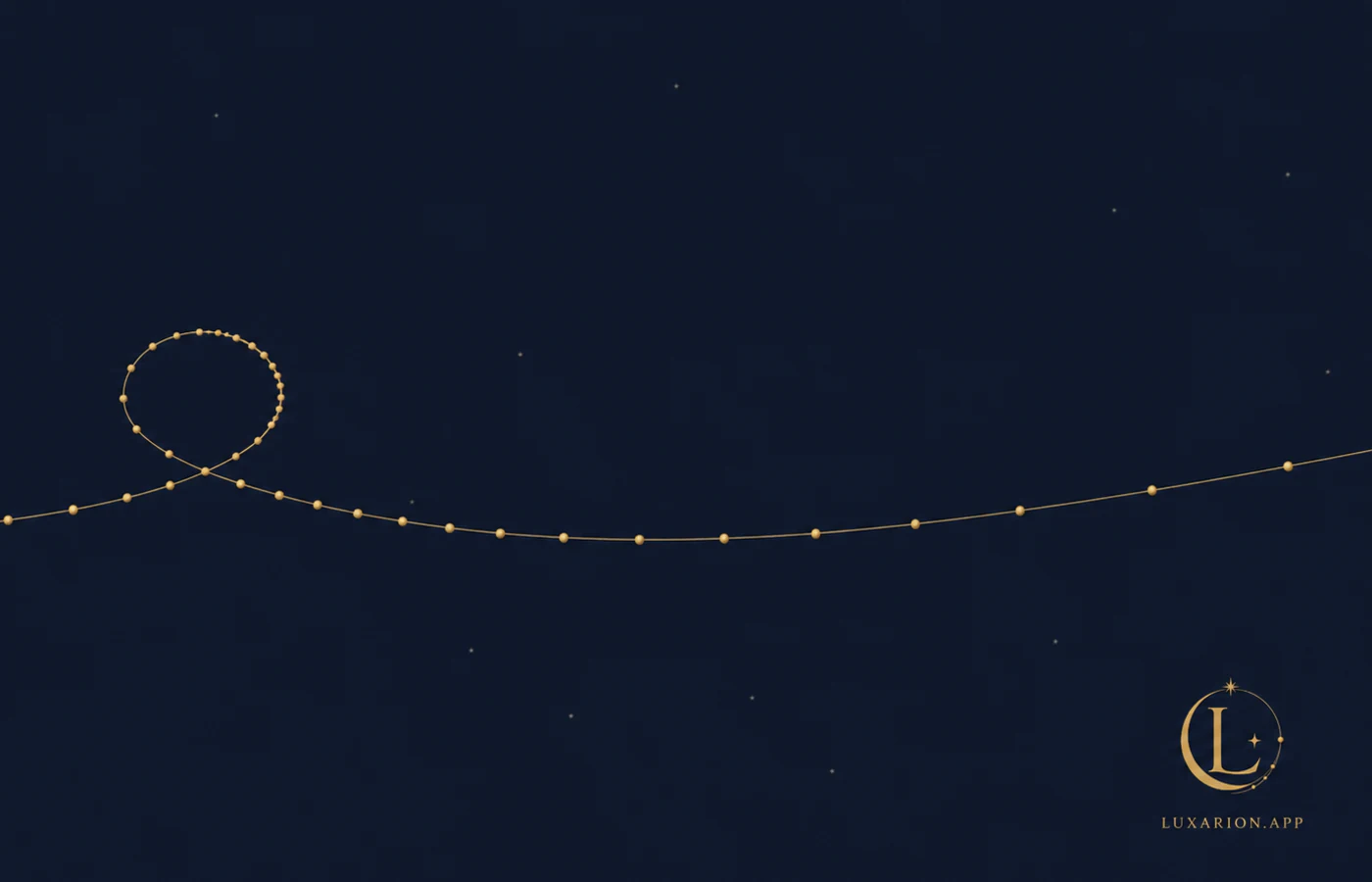
Every eighteen months or so, Venus appears to reverse direction for about forty days. This is apparent retrograde motion, the same effect that produces the more famous Mercury version: we overtake the planet on the inside track and it seems to slide backwards against the stars for a while. Nothing about Venus itself changes.
About one person in twenty-five is born during one of these periods and therefore has Venus retrograde natally. The traditional reading is not misfortune. It is a Venus whose expression is turned inward before it turns outward: people who work out what they value privately first, are often slower to declare, and frequently report that their taste and their choices took longer to settle than their peers'. It is very common in people whose relationship with what they want was worked out rather than assumed.
As for the transiting periods, the sensible advice is narrower than the alarming version circulated online. It is a poor window for making an irreversible aesthetic commitment you have not thought about — the tattoo, the drastic haircut before an event, the expensive thing bought at speed. It is a good window for revisiting: old contacts resurface, half-finished creative work asks to be looked at again, and the question of what you actually value tends to come up on its own. That is a re-examination period, which is what a retrograde is everywhere in this tradition.
Where Venus came from
Short, because the lineage explains why the associations are what they are.
The planet was tracked as a deity long before it was a planet in our sense. In Mesopotamia it belonged to Inanna, and the Venus tablets kept for that goddess are among the oldest continuous astronomical records anywhere — a fact worth pausing on, because it means people were writing down the position of this specific body for many centuries before anyone wrote down a myth about it.
Greek tradition attached Aphrodite to it, Roman tradition Venus, and the association with beauty, attraction and the arts came with them. What changed in the Latin West much later was the vocabulary of love itself: the twelfth-century troubadours and the literature of courtly love invented a way of speaking about desire — as service, as refinement, as something that improves the lover — that still shapes how European languages talk about romance. Modern Venus readings inherit a good deal of that vocabulary without noticing.
Two traditions with no contact reached similar places, which is the kind of convergence worth noticing. The Arabic love literature was producing its own detailed anatomy of attraction in the same centuries, and the classical Persian romances were doing the same in verse. Any modern account of Venus is standing on all of it.
Common questions
How do I find my Venus sign without a birth time? Date and place are enough on almost every day. The exception is the day Venus changes sign, and if the description feels persistently near-miss, that is the thing to check.
Is Venus more important than the Sun in love? More specific, not more important. The Sun says what the life is oriented toward; Venus says what registers as pleasant and worth having. In matters of attraction and affection Venus is the more precise instrument.
What about Venus in the houses? The house says where the Venusian faculty operates — Venus in the tenth puts taste and charm into public standing, Venus in the fourth puts it into the home. That is the layer that needs a birth time, and it is set out fully in the article on the twelve houses.
Does my partner's Venus need to match mine? No, and matching is not what the tradition looks for. The comparison of two charts is its own technique with its own rules, and the piece on synastry is where that is worked out.
What if my Venus is in a sign I dislike? Read it twice: once as romance and once as taste. A great many people who find the love description unflattering recognise the taste description immediately, and that recognition usually reframes the first one.
Can a Venus sign change? The placement is fixed at birth. What changes is how much of it you have grown into; the tradition is consistent that the placements describe a capacity, and capacities develop.
Why do so many people have Venus in the same sign as their Sun? Because of the two-sign rule: with only five candidate signs and Venus spending long stretches close to the Sun, the coincidence is common by construction rather than significant by rarity.
Is Venus the same as a love language? The frameworks overlap and are not the same. A love language is a taxonomy of expression with a handful of categories; Venus is a placement with a sign, a degree, a house, a phase and a set of aspects. If the popular framework has been useful to you, the placement will usually tell you which of its categories is yours and, more usefully, why.
What if I do not recognise myself in any of it? Two ordinary explanations before any interesting one. Check the boundary, since a Venus at the very start or end of a sign is the commonest cause. And read the house rather than the sign — a strongly placed house often speaks louder than the sign in a person's actual experience.
Reading yours properly
Get the degree first. The free chart gives you Venus by sign and degree, which is what you need to check the morning-or-evening question and to be sure about the boundary. That takes two minutes and it is the whole foundation.
Then do the useful exercise: read your Venus sign, read your Sun sign, and write down where they disagree. That gap is where most of the interesting material lives, because it is the difference between what your life is aimed at and what actually pleases you — and a surprising number of people have never looked at it directly.
If the question underneath all this is about a particular person, that is a different instrument. A love consultation with Luxarion works from your own situation rather than from a placement description, and it can do what no article can: ask you the second question. And if you want the whole chart rather than one planet, a natal chart reading puts Venus back among the others, which is where it makes the most sense — a single placement read alone is always a little louder than it deserves.
The library teaches the craft. A reading applies it to you.
Get your personal reading