

The Evil Eye: Why the Same Belief Grew in So Many Places

It is not really about malice. In almost every version, the look that does the damage is an admiring one — and that changes everything.
Draw a map of where people hang a blue bead over a door, and it covers an enormous stretch of the world: Turkey, Greece, the Levant, Iran, Egypt, the Maghreb, Italy, Spain, Portugal, much of South Asia, and — carried by migration and then rooted — a great deal of Latin America. Different objects, different words, the same idea.
A belief that appears in that many places, in that much detail, usually has something behind it, and the interesting question is what. It is not simple diffusion; some of these traditions have no plausible line of contact. Something in the human situation keeps producing this.
The answer, once you see it, reorganises everything else — and it starts with a fact almost every popular account gets wrong. The evil eye is not, in most of its traditions, about malice. The look that does the damage is usually an admiring one, and often comes from someone who loves you.
This article is what follows from that: what the belief is actually managing, why the objects all look the way they do, why the verbal customs are the real technology, and what people do about it.
The look that admires
Start here, because everything else falls out of it.
In the classical versions of this belief, the dangerous moment is not a curse. It is the moment when someone looks at what you have — the baby, the new car, the harvest, the face, the good news — and feels, without meaning to and often without noticing, a small ungenerous pull. Not hatred. The ordinary human flicker that arrives uninvited when someone else has what you wanted.
That is why the customs cluster around praise rather than around enemies. It is why the grandmother tenses when a stranger says the baby is beautiful. It is why, in Arabic-speaking families, a compliment that arrives without the accompanying phrase feels incomplete and faintly alarming, and why the phrase itself — mashallah, what God has willed — is not a formality but a repair.
And it explains the detail that most confuses outsiders: in many traditions the person who gives the eye is not blamed. They did not intend it. Several traditions hold that a person can give the eye to their own child, or to their own possessions, which makes no sense at all under a malice model and perfect sense under this one.
So the subject of this belief is not wickedness. It is envy — the unspeakable emotion, the one nobody admits to, the one that arrives before you can stop it — and the whole apparatus that grew up around it is a technology for handling admiration safely.
Where the belief clusters, and why
Now the distribution, which is the strongest piece of evidence for that reading.
Look at the map again and ask what those societies share. They are, overwhelmingly, places where praise is socially obligatory and envy is socially unspeakable. Where you must admire a neighbour's new house out loud. Where a guest must compliment the food. Where a baby must be exclaimed over. Where visible good fortune is displayed rather than concealed — and where, simultaneously, admitting that you resent someone else's good fortune is close to shameful.
That combination creates a real and constant social problem. Compliments must be given, envy must not be voiced, and everybody knows perfectly well that the two travel together. Something has to carry the weight.
The evil eye carries it, and does so with considerable elegance. It gives the feeling a name and a location outside the relationship — the eye, not your neighbour — so that the friendship survives. It supplies a phrase you can attach to a compliment that neutralises it. And it gives the person who was praised something to do afterwards, which is not nothing when you are anxious about your own good fortune.
Notice what this means for the objects. In societies where wealth is hidden, this belief is weaker or absent. In societies where it is displayed, it is strong. The belief tracks the social conditions rather than the geography, and that is why it turns up independently wherever those conditions exist.
The objects, and what they have in common
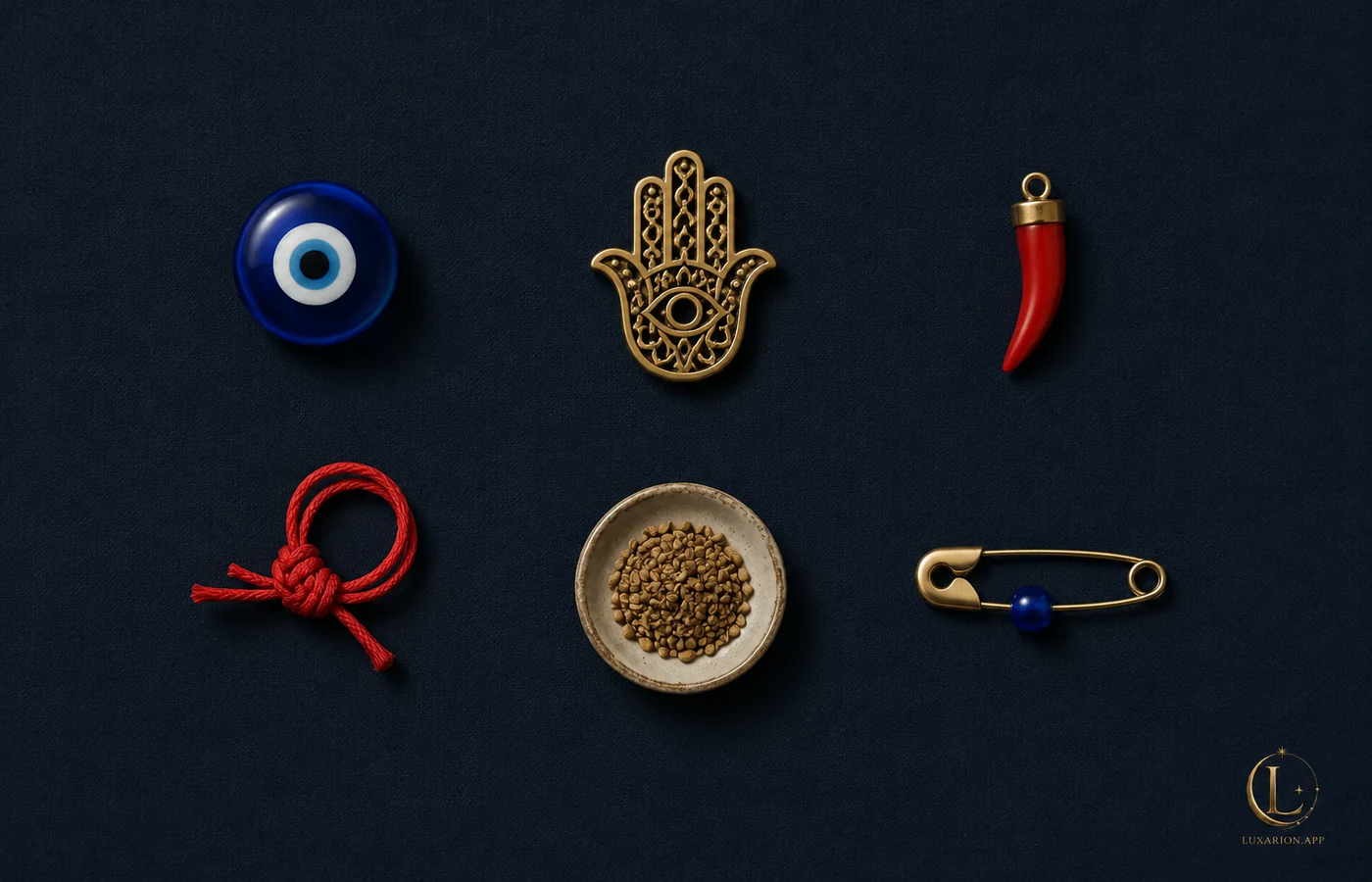
There are a great many of them and they look nothing alike, which makes what they share more interesting.
The blue bead of Turkey and the eastern Mediterranean: a glass eye, blue on white on black. The hamsa, an open hand, often with an eye in the palm, across North Africa and the Levant. The cornicello, the little red horn of southern Italy. Red thread on a wrist across South Asia and beyond. A single black mark placed on the cheek of a beautiful child in several traditions, deliberately spoiling the perfection.
What do a bead, a hand, a horn, a thread and a smudge have in common? Every one of them is designed to be the first thing you see.
That is the whole functional logic, and once you have it, the entire category becomes legible. If the danger is in the unguarded look, then the defence is to give the look somewhere else to land. The bead is more eye-catching than the baby. The horn is brighter than the shirt. The mark on the cheek breaks the perfection that would otherwise draw the pull. Practitioners say some of these objects "take" the look, and that description is exactly right about what the object is doing.
Which also explains the most-reported piece of folklore about them: that a nazar bead which cracks has done its work. Whether or not you take that literally, it is a coherent piece of design thinking — the object was made to absorb something, and an absorbed thing leaves a mark.
The blue itself has a practical history worth knowing. Blue glass was, for most of the Mediterranean's history, both striking and comparatively achievable, and the craft that makes these beads is still alive: they are produced by a small number of glassmakers around İzmir, working wood-fired furnaces, and the craftsmanship and beliefs around the beads have been recognised by UNESCO as living intangible heritage.
The words are the real technology

The objects get all the attention and are the less important half. The working part of this tradition is verbal.
Almost every culture with this belief has developed a phrase you attach to a compliment. Arabic has mashallah and tabarakallah. Hebrew has bli ayin hara. Persian and Turkish have their own. English, having largely lost the framework, kept the gesture and forgot the reason — touch wood, said after mentioning good fortune, is the same move stripped of its explanation.
These phrases do a precise piece of social work, and they are worth understanding as protocol rather than as incantation. Attaching one to a compliment says three things at once: I am admiring you, I am not claiming it for myself, and I know that admiration can carry something. It lets the praise be given fully, which matters, because the alternative in these societies — not praising — is itself a serious message.
There is a second verbal custom that is even more revealing: the deflection by the person praised. Say something is beautiful and the owner will often reply that it is old, or cheap, or nothing, or has a fault. Outsiders read this as excessive modesty. It is not. It is the other half of the protocol — the praised person reducing exposure — and in a society running this system, both halves are simply good manners.
Whatever you believe about the eye itself, the protocol is a real solution to a real problem, and it is why these customs have survived urbanisation, migration and every wave of modernity that was supposed to end them.
The classical trail
The belief is documented very early, which is worth knowing because it shows how stable it has been.
Pliny the Elder, writing in the first century, records people who were said to harm with a look and discusses protections against them as a matter of ordinary reporting rather than curiosity. Roman practice used the fascinum — a phallic charm, worn by children and hung on carts — as an apotropaic device, and it worked on exactly the principle described above: it was startling, and it took the look.
And that Latin word has a long afterlife that English speakers use daily without noticing. Fascinum gave fascinare, to bewitch by looking, which gave the modern fascinate. When you say something is fascinating, you are using, in a worn-down form, the vocabulary of the evil eye.
The same continuity shows in the objects. A Roman child wore a charm; a Turkish child wears a bead; a Neapolitan wears a horn. The materials changed and the logic did not.
What people do about it
Every tradition has remedies, and they are worth describing properly rather than listing, because they are more coherent than they look.
Smoke. Across Iran and much of Central Asia, the seeds of wild rue are burned and the smoke passed around a person or a room. The seeds pop audibly as they burn, which is part of the point: the remedy is loud, visible and smells strong, and everyone present knows it is happening.
Lead. In Turkey and the Balkans, molten lead is poured into cold water over the affected person's head; the shapes it makes are read, and the pouring is repeated until the lead comes out smooth. Note the structure — it both diagnoses and treats, and it ends with a visible sign that the thing is finished.
Salt, water, recitation. Salt thrown on a fire, water passed around a head and poured at a threshold, and in Muslim households the reciting of specific short chapters over the affected person. In several traditions the person who gave the look is asked to wash and the water is then used on the afflicted — which is a striking custom, because it treats the giver as blameless and involves them in the repair.
What all of these share is a shape: something is done, it is done publicly, and it has a clear end. That is the same shape as every good ritual for anxiety anywhere. If you are worried that something you love is exposed, doing a definite thing with a definite ending is genuinely useful, and the traditions arrived at that independently many times over.
One honest note, briefly, because it matters: physical symptoms belong to a doctor. That is not a criticism of the customs; it is the same division of labour every serious practitioner already observes.
Who is thought to carry it
A detail worth including, because it is where the belief becomes socially delicate and where a careless account does real harm.
Many traditions hold that some people give the eye more readily than others, and the descriptions are remarkably consistent across places that never met: the person of unusual intensity, the person with a long-held disappointment, the person who arrives at your good news carrying an absence of their own. It is not a description of bad character. It is a description of proximity to want.
That consistency is easy to explain under the reading above. If the mechanism is the pull of admiration meeting an unmet longing, then the person most exposed to it is the one with the longing — the childless guest at the naming, the one who wanted the job you got. The tradition is, in effect, noticing something true and slightly painful about how good news lands on people whose own is delayed.
Which is exactly why the customs around it must be handled with care, and where they can go badly wrong. Naming a specific person as the one who gave the eye is the single most damaging thing anyone does with this belief. It converts a general, blameless model into an accusation, and the traditions themselves resist it: the giver is usually held not to have intended anything, and in several versions is invited into the remedy rather than excluded from it.
The practical rule that follows is a good one to keep. Use the framework on yourself and never on your neighbour. Be thoughtful about what you display, be generous with the phrase when you admire, and decline to speculate about who. The version of this belief that circulates as suspicion of named people has lost the thing that made it wise.
The most elegant solution in the whole tradition
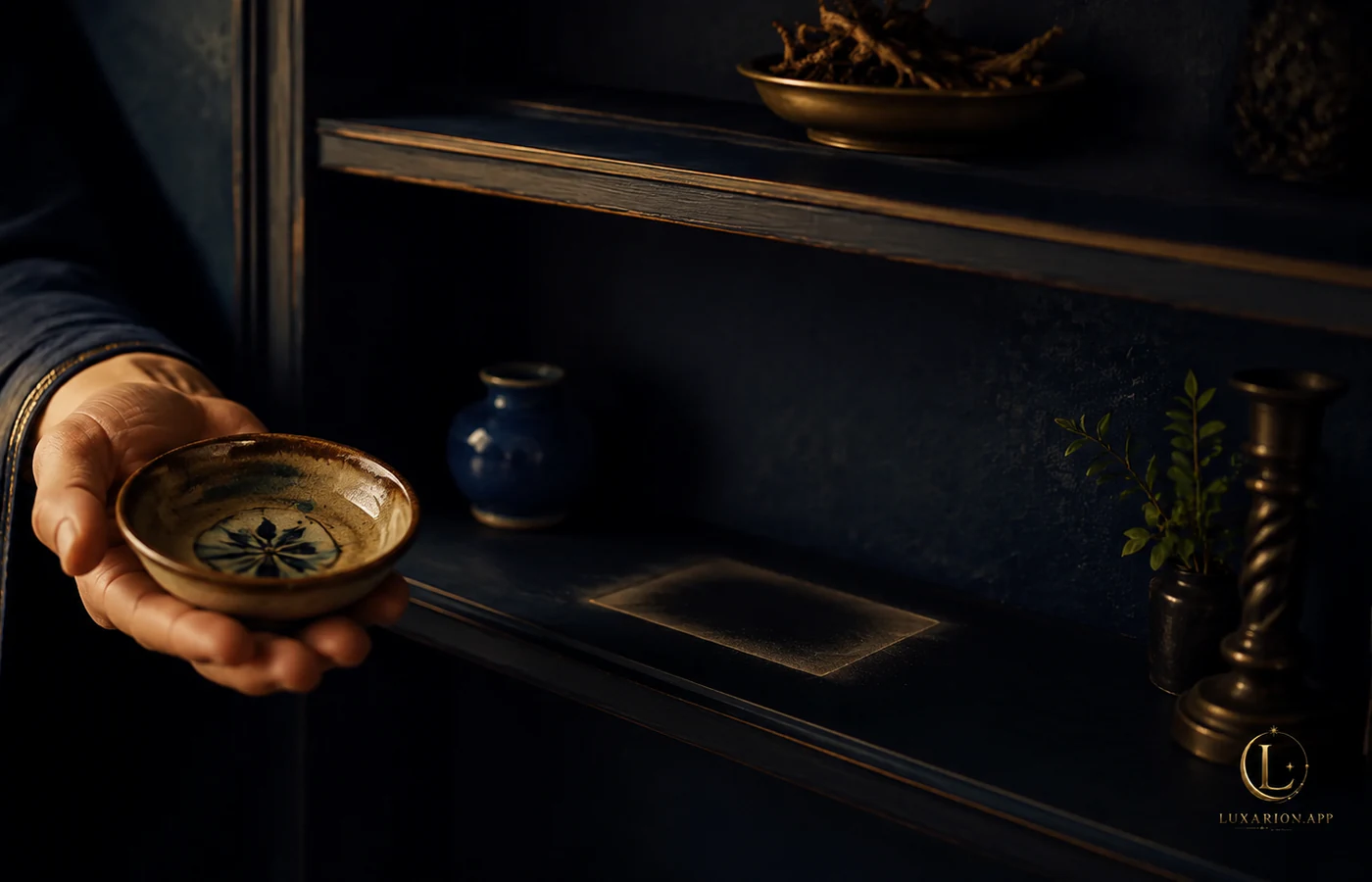
There is one custom that deserves to be better known, because it resolves the underlying problem completely rather than managing it.
In several cultures, if a guest admires something in your house with too much feeling, the correct response is to give it to them.
Read that against everything above and see how neat it is. The danger was the gap between what you have and what they want. Close the gap and the danger is gone. The object moves, the envy has nothing to attach to, and — this is the part that makes it more than clever — the relationship is strengthened rather than protected, because a gift creates an obligation and an obligation is a bond.
It also has a disciplining effect in the other direction, which is why it works as a social system. In a household running this rule, guests learn to admire with measure. You do not gush over something you would be embarrassed to be given.
Anthropologists studying gift exchange have described this pattern in many societies: the circulation of objects as a way of preventing the accumulation of resentment. The evil-eye version puts a name and a fear on the resentment, which makes the custom easier to keep than an abstract principle would be.
The same problem, in a new form

It would be a mistake to file this as a village belief that modernity dissolved, because the conditions that produce it have not gone anywhere — they have intensified.
Consider what a social feed is. It is a technology for the compulsory display of good fortune to a large audience of people who cannot say what they feel about it. Praise is obligatory and public; envy is unspeakable and private. That is precisely the configuration described above, scaled up by several orders of magnitude.
And the customs have reappeared, in the way customs do, without anyone deciding. People post the good news late, or after the fact, or not at all. They keep the pregnancy quiet for three months. They obscure the child's face. They caption a photograph with a phrase that deflects it. They say they do not want to jinx it — which is a sentence with the old belief inside it, worn smooth.
None of that requires anyone to hold a theory about the eye. It requires only the same intuition the tradition encoded: displayed good fortune costs something, and it is wise to be deliberate about how much you display. That intuition is old, widely shared, and has not been improved on.
Common questions
Is the evil eye about someone wishing me harm? In most traditions, no. The dangerous look is admiring, often unintentional, and frequently comes from someone fond of you. That is why the customs cluster around compliments rather than around enemies.
Do I have to believe in it for the customs to be worth keeping? The verbal protocol works as courtesy regardless: attaching a phrase to a compliment, and answering praise with modesty, are good manners in any framework.
What if a nazar bead breaks? The customary reading is that it took something and is finished. Replace it if you like; the tradition treats a broken one as having done its job rather than as a bad sign.
Can a person give themselves the eye? Several traditions say yes, and it is the strongest evidence that malice is not the mechanism — the model is about the intensity of the look, not the intent behind it.
What colour or object should I use? Use what belongs to your own tradition, or what you find beautiful. The functional requirement is only that it catches the eye first, and every version of the object satisfies that.
Is there a right way to compliment someone? The tradition's own answer is very practical: praise fully, attach the phrase your language provides, and do not linger. In cultures without such a phrase, "I'm so glad for you" does most of the same work.
What should I do if I feel exposed after being praised? Something definite with a clear ending — that is the whole logic of the remedies. The specific act matters far less than that it finishes.
If this is on your mind
Most of what is above is usable immediately and costs nothing: attach the phrase, answer praise lightly, be deliberate about what you display, and if you feel exposed, do something with a beginning and an end.
But there is a version of this that is not about custom at all, and it is worth naming. Some people arrive at this subject because they are carrying a persistent sense of being watched, resented, or held back — a run of things going wrong that has started to feel directed. That is a real and heavy thing to hold alone, and it is usually not answered by an object.
A spiritual reading with Luxarion is built for exactly that conversation: someone who takes the concern seriously, works from your actual situation, and helps you separate what is genuinely weighing on you from what has attached itself to it. That separation is most of the relief.
And if what you are really navigating is a relationship where the admiration and the resentment run together — which is where this belief lives — the article on asking about love properly works the same ground, and the piece on intuition takes up the question of when a persistent feeling is worth trusting.
The library teaches the craft. A reading applies it to you.
Get your personal reading