

The Cup Remembers: How Coffee Reading Actually Works
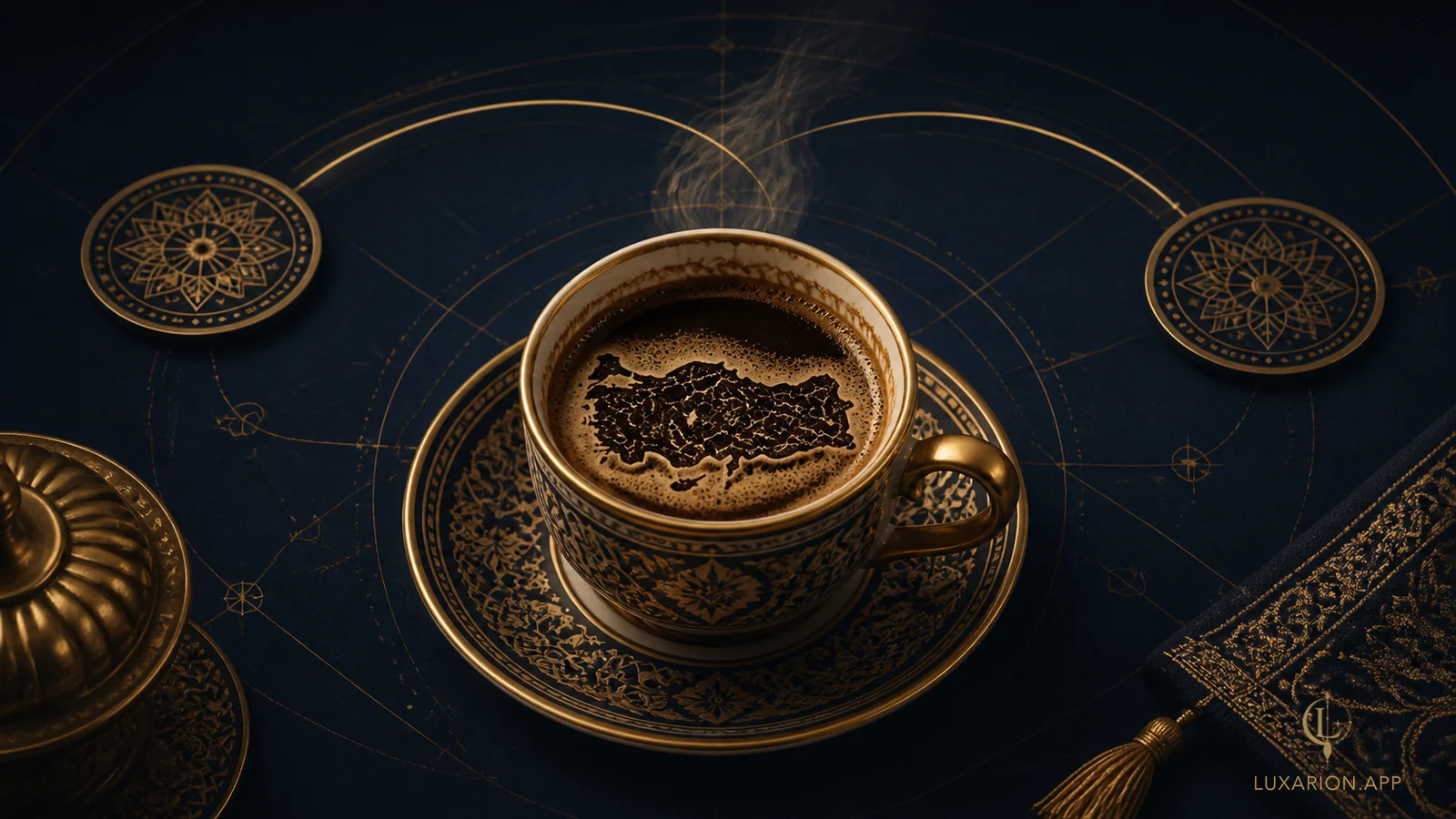
Coffee reading from the inside: what the cup takes from the one who drank, why symbol lists are training wheels, and how a reader reads what is coming.
There is a moment, just after the last sip, when the cup is still warm in your hand and the room has gone quiet. Most people rush past it. The old readers say this is the moment the reading actually happens, and that everything afterwards is deciphering.
That claim sounds like a poetic flourish. It is not. It is a precise statement about where the information in a coffee reading comes from — and once you understand it, most of what is confusing about this craft resolves at once: why the same cup gives different readings to different readers, why the symbol dictionaries never quite work, why a reading given fast by a stranger feels thin, and why the tradition has spent four centuries insisting on the wait.
This article is about the mechanism. Not the ritual — we set that out step by step in the Turkish coffee reading guide — but what is actually going on when a reading works.
A young craft with an old shape
Reading residue in a cup is a very old idea, but coffee reading in particular is younger than palm or star reading, because coffee itself is young.
The bean left Yemen in the fifteenth century — the Sufi lodges around Mocha drank it to stay wakeful through night devotions — and reached Istanbul by the mid-1500s, where the coffeehouse was born. Reading the residue seems to have grown up in Ottoman households soon after: a domestic art, passed between women across generations, practised over conversation.
That last phrase matters, though not in the way it is usually taken. The talk was the setting the craft grew up in; the cup was always the thing being read.
When UNESCO inscribed Turkish coffee culture on its Intangible Heritage list in 2013, what it described was a ritual of hospitality and talk. The fal, the reading, grew up inside that hospitality: something done for a guest, at a table, with the cup passed between two people, and much of its etiquette comes from that. But what the reader reads is the cup.
What the cup actually remembers
Take the title seriously for a moment, because the tradition means something specific by it.
Physically, the cup remembers the drinking. It holds a record of how you drank — which side, how fast, whether you turned it, how much you left. That record is real and readable, and a practitioner who has seen thousands of cups reads it before any shape is discussed.
But the tradition means something larger, and it is worth stating plainly: the cup takes the state of the one who drank from it. The intention held over it, the hand that turned it, the minutes it sat cooling while the question stayed in the room — the grounds settle under all of that, and what they settle into is the season coming toward that person. That is what a reader lifts and reads: the shape the drinker's near future has left in the grounds.
Readings are given with the cup between two people because both of them can see what it shows. It is the thing you can both point at while a difficult matter is named — and in the households where this was practised, the cup often named what nobody at the table would have raised.
The sitting is part of the method
Here is a claim the tradition makes and the quick readings miss: a cup read in a hurry, by a stranger who never asks what it was drunk over, loses much of what it could have given.
The grounds are the same; what is missing is the question. A cup answers what was brought to it, and a reader who does not know what the drinker came with can see the shapes and still not know which matter they belong to. That is why a reader asks, and why the conversation around a cup is part of the craft: it tells the reader where to look, while the cup tells them what is there.
You can see this in the structure of an actual reading. The reader says something about the rim; the drinker says "that will be the thing with my brother"; the reader turns the cup and says "then look where it is going". The drinker has named the matter and the cup has shown its direction. Nothing in that sequence is a performance, and the news in it is the cup's.
This is also why the craft has always been transmitted through apprenticeship and oral tradition rather than through books. You cannot learn from a page how a band of grounds looks when it is carrying news. You can only sit beside someone who reads well, several hundred times, until you find you can see it too.
And it explains a thing that surprises people: the most valued readers in the tradition were rarely the most talkative. They were the ones who knew when to stop, when not to press, and when to let a silence run — because what the cup has shown lands better when the drinker has room to receive it.
Why symbol lists are training wheels
Every beginner wants the dictionary. Bird means news, fish means provision, snake means a rival, a road means a journey. And the dictionary is genuinely useful — we have set out the working vocabulary in coffee cup reading symbols and the logic beneath the images in the bird, the ladder, the key.
But ask any reader with grey in her hair and she will tell you the dictionary is where reading begins, not where it lives.
The reason is structural. A list gives you entries, and a cup is not a list of entries. A cup is a single field in which things sit in relation to one another — near the handle or far from it, at the rim or in the base, heavy on one side and clean on the other. The meaning is carried by the arrangement at least as much as by the items.
A reader working from the dictionary alone produces a reading like a sentence with no grammar: fifteen nouns in a row, all technically present, adding up to nothing. Everyone who has sat through one knows the feeling. It is not that the reader saw the wrong things. It is that seeing is not the same as reading.
Relations, not entries
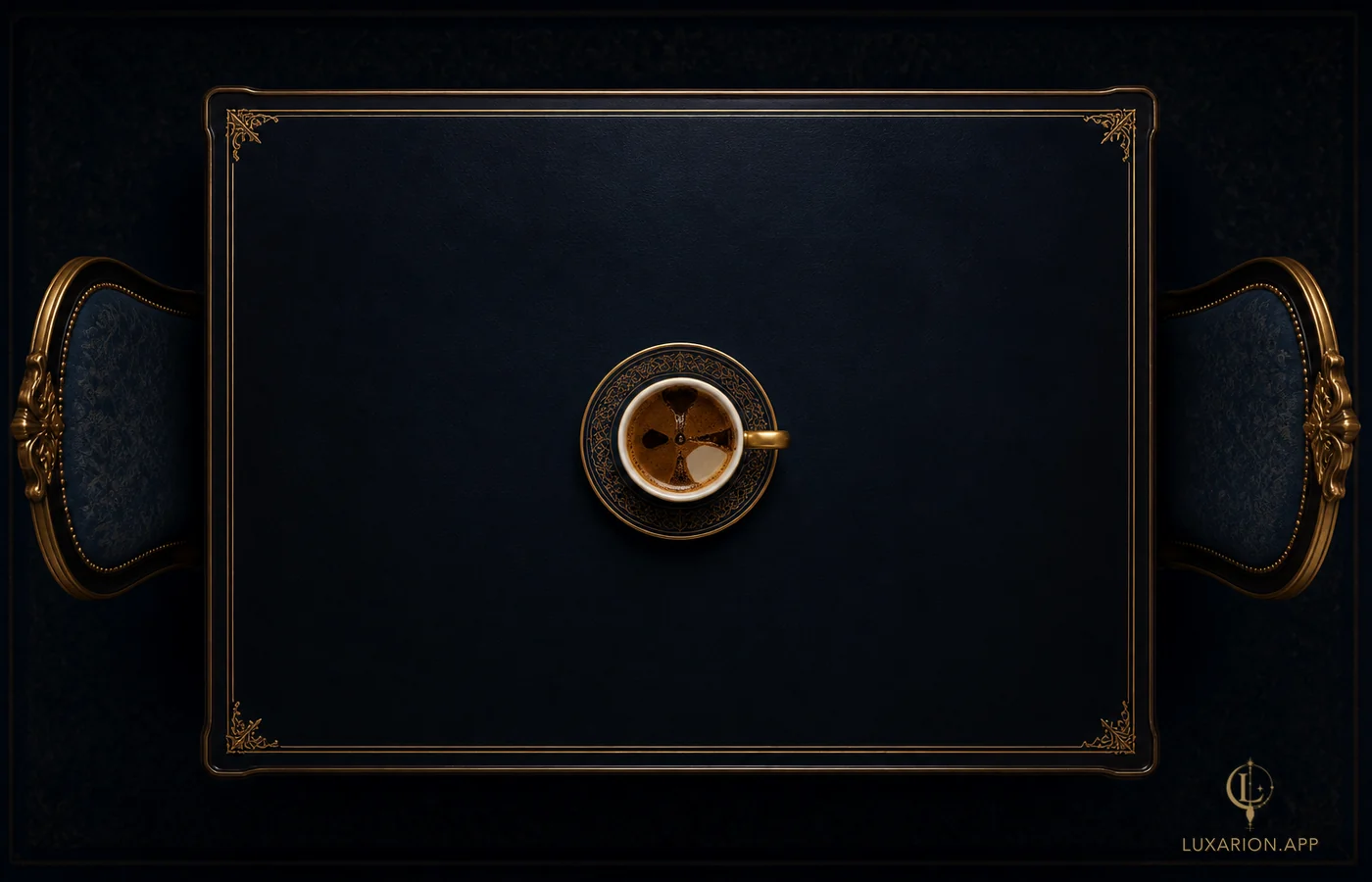
What replaces the dictionary is a small set of relational questions, and these are what a trained eye is actually running.
Where is the weight? A cup heavy at the base and clean at the rim says something entirely different from the reverse — and this is read before any shape is named.
Which side of the handle? The handle stands for the drinker and their household. A shape near it sits close to home; the same shape across the cup belongs to someone else's story. Two identical marks, opposite sides, two different readings.
What is next to what? A road running toward a mark is not the same as a road running away from it. A shape that sits alone is not the same shape as one embedded in a crowded band.
What direction is it moving? The grounds have flowed. Direction is in the material, and the tradition reads it: toward the handle is coming home, away is going out.
What is empty? Clear space is material too. Most beginners read only the marks and treat the blank as background — a mistake the tradition names explicitly, because a swept clean band is one of the more informative things a cup can show.
Notice that none of these questions requires you to know what a bird means. They can all be answered by looking. This is why the tradition's teaching sequence puts them first: an eye that can see arrangement will get further with a small vocabulary than an eye that has memorised two hundred entries and cannot see structure.
The order a reading moves in
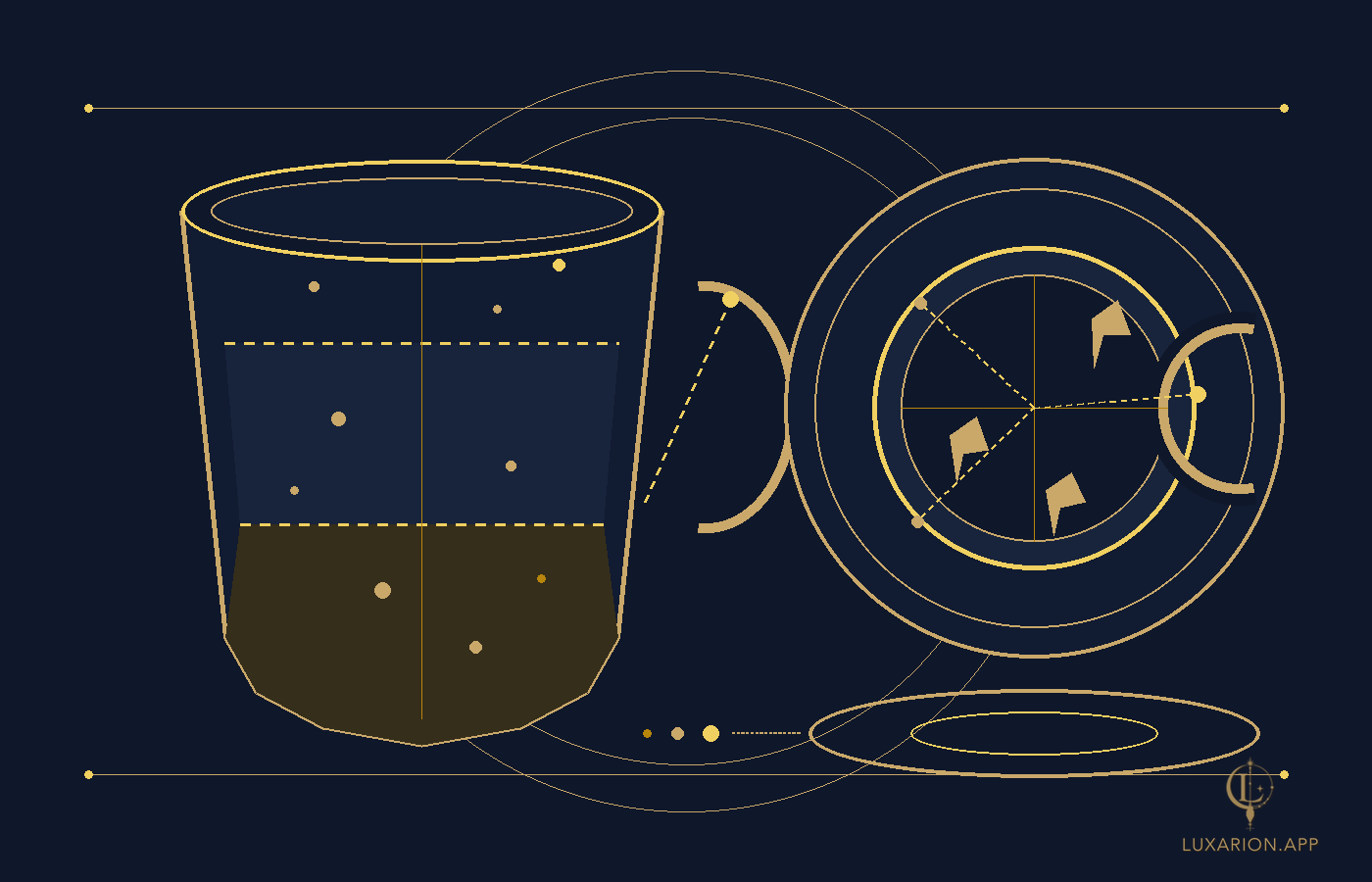
Because so much of the craft is about arrangement rather than vocabulary, the sequence a reader follows is itself most of the technique. It is remarkably consistent across the regional branches.
The whole first. Heavy or light, crowded or sparse. This is read before anything is named, and it sets the register for everything after it: a sparse cup and a crowded one are different kinds of season regardless of what is in them.
Then the distribution. Rim, middle, base — where the material has gathered. This answers the question of what time the matter lives in, which is the question most beginners try to answer with symbols instead.
Then the handle. Orientation. Near and far, mine and someone else's. Nothing sits in its right place until this has been done, which is why a reader turns the cup in their hands before speaking.
Then the strong shapes. Three or four, not fifteen. What genuinely stands out, not what can be found with effort.
Then the saucer. What has left the cup: what is finished, on its way out, or spilling into someone else's life.
Then the sentence. One or two lines that hold the rest together. A reading that never reaches this is a list, and the drinker will feel the difference even if they cannot name it.
What is worth noticing is that the first three steps are entirely structural. A reader who does only those and never names a single symbol will still produce something a person can use — which is, in the end, the clearest possible demonstration of where the information in this craft actually sits.
The wait, and what it is doing
Cups are read cool, and the tradition is uncompromising about it. There are two reasons, and only one of them is about the coffee.
The first is physical: the sediment is still moving for the first minutes after the turn, and it needs time to slide and dry into its final edges. A cup read hot is read half-formed. That much is straightforward.
The second is about the drinker. The wait is the time in which the cup takes its state: the saucer is on, the intention is held, and nothing is hurried. Readers speak of the cup settling in both senses — the grounds finding their edges and the question finding its place in them.
That is the reason readers treat the waiting as part of the divination rather than as a delay before it — and the reason a cup turned and read in ninety seconds gives a thin reading however well its symbols are named.
What a seasoned reader is actually tracking
Watch an experienced reader closely and you will notice that their attention moves between the cup and the person holding it.
They are tracking which matter a shape belongs to. A road in the cup is a journey, but whose, and toward what, is settled by the drinker's circumstances, and a reader watches for the moment a sign finds its place in a life. That is listening in the service of the cup: it places what the cup shows; it does not supply it.
They are tracking pace. Whether to keep going or to stop. Whether a subject has been opened too fast. Whether the person in front of them has arrived with something heavy that has not yet been said.
They are tracking their own certainty. A good reader can tell the difference between a mark that is genuinely prominent and a mark they want to see, and they say the second kind differently or not at all. That distinction is most of what separates twenty years of practice from two.
The tradition says a reader is made by cups, not by books, and it means the seeing that only comes after thousands of cups. Outside the craft, Michael Polanyi called knowledge of that kind tacit knowledge, and research on expertise describes the same shape: the expert sees the pattern, the novice sees the parts.
Why the same cup reads differently
People sometimes find this troubling and assume it must be a flaw. Within the craft it is understood, and well described.
Part of it is the reader's eye. In a crowded cup, which shape stands out first depends on where the eye starts and how much it has seen, and the tradition says so in its own words — two readers see two cups — which is why the order of reading is fixed. Psychology has names for the eye's part, figure and ground and the Gestalt account of the readiness to see form, and they describe the reader's eye rather than what the grounds carry.
The larger part is depth. A cup carries more than any single reading exhausts, and two good readers will each lift what their eye is trained to see — one the journey at the rim, the other the rival in the middle band — the way two physicians examining the same patient each find what their training looks for. Where two sound readings of one cup differ, they usually differ in emphasis rather than in direction.
What the tradition asks of a reader in light of this is discipline. Read the arrangement before the symbol. Say what is prominent and not what you would prefer. Give the cup back. That is what the etiquette is for.
The intention, and why the drinker turns the cup
Before the saucer goes on, the drinker holds an intention — in Turkish, niyet, the same word used for the intention formed before prayer. Then the drinker, not the reader, turns the cup.
Both details are near-universal across the regional branches, and both are doing the same work: they make the person with the question a participant rather than an audience.
This matters more than it looks. The intention is what ties the cup to the question: a cup drunk with no niyet is read for the drinker's season as a whole, while a cup drunk over a named matter answers that matter. And the turn by the drinker's own hand is how the cup takes their state rather than the reader's.
The tradition does claim that the one who holds the question is present in how the grounds fall. That is why the drinker, and no one else, turns the cup — and why, at the end of a Turkish reading, the drinker presses a thumb into the base of the cup over a wish and the reader reads the print for its answer. Anyone who has watched both kinds of reading can see the difference in what the cup gives.
The reading and the life it lands in
Here is what most often actually happens in a good reading, described plainly.
The cup shows an image — a road, a bird at the rim, a heavy band near the handle. The reader places it: this season, this household, this direction. And the drinker, hearing it, recognises the matter it belongs to, often one they had not yet said aloud and sometimes one they had not yet let themselves see.
Psychology would describe the drinker's part as autobiographical memory answering a cue, and that describes the recognition well enough. It does not describe the cup. The image was chosen by no one at the table, and it points at what is coming as well as at what has been. The recognition is the drinker's; the news is the cup's.
Readers describe the result the same way across regions: a good reading ends with the drinker knowing what is on its way and where it is coming from. The reader's craft is to see that clearly, place it rightly, and then not talk over the moment it lands.
This is what a reading gives you: the near season read off the cup — what is approaching and from where — and, with it, what you are carrying set into a shape you can act on.
Reading your own cup

The tradition permits it and quietly warns about it, and the warning follows directly from everything above.
Reading your own cup, you are both the one who chooses which shape is prominent and the one who decides what it refers to, and nobody is there to question the choice — which is a short walk from finding exactly what you sat down hoping for. The cup still carries your season; what goes missing is the second eye.
Practitioners who read for themselves generally use two safeguards. They write down what they saw before interpreting it, in plain description: this is heavy, this is near the handle, this band is clean. And they do not return to the cup afterwards. It is written down, it is dated, and it is finished — which is also why most households wash the cup immediately, and give exactly that reason.
Then they look at what they wrote in a season's time. That is the practice the craft actually recommends, and it is more useful than any number of same-day interpretations.
What the craft keeps to
Being exact about the craft's reach is part of the craft. It is what the older tradition itself says, and it is the difference between the household craft and the version that gives it a bad name.
It speaks in seasons — near, forming, distant, and within the near season this week or the weeks ahead — and treats that as its most accurate register. What it shows about the people around the drinker — who is coming, who is thinking of them, whose envy sits near the handle — it says plainly, and it reads a cup for the one who drank it. It keeps away from the body: illness is for a physician. And it never makes a reading hang on a remedy someone happens to be selling.
These are old rules with practical reasons behind them, and the fullest treatment of what the craft reaches is in is coffee reading real?.
What it does claim is this. The arrangement in the cup was set by the one who drank it and made by nothing anyone at the table controlled, and a trained eye reads it for what is approaching and from which quarter — the visitor, the news, the journey, the obstacle forming near the rim, the thing still distant at the base. A reader who offers the talk around the cup and not the news in it has not read it.
The cup remembers what you did not put there
Come back to the moment after the last sip.
What is in your hand at that point is a small ceramic cup with wet grounds in it. And yet the readers are right that the reading has already happened, because everything that will be read in the next twenty minutes is already there: the question you came in holding, the intention you drank over, and the season that has settled into the grounds while the ritual gathered it into one place.
The grounds hold all of it in a form that can be seen — a surface with structure in it, made by nothing anyone at the table controlled.
That is what the phrase means. The cup remembers the one who drank from it, and the grounds carry what nobody at the table put there on purpose: an arrangement made while the cup was cooling, and the season it points toward. The craft is the practice of reading it truly.
If you would like a cup read that way — with the arrangement read before the symbol, and the cup handed back — that is what our coffee reading is.
The library teaches the craft. A reading applies it to you.
Get your personal reading