Coffee Cup Symbols: Families, Not a Dictionary
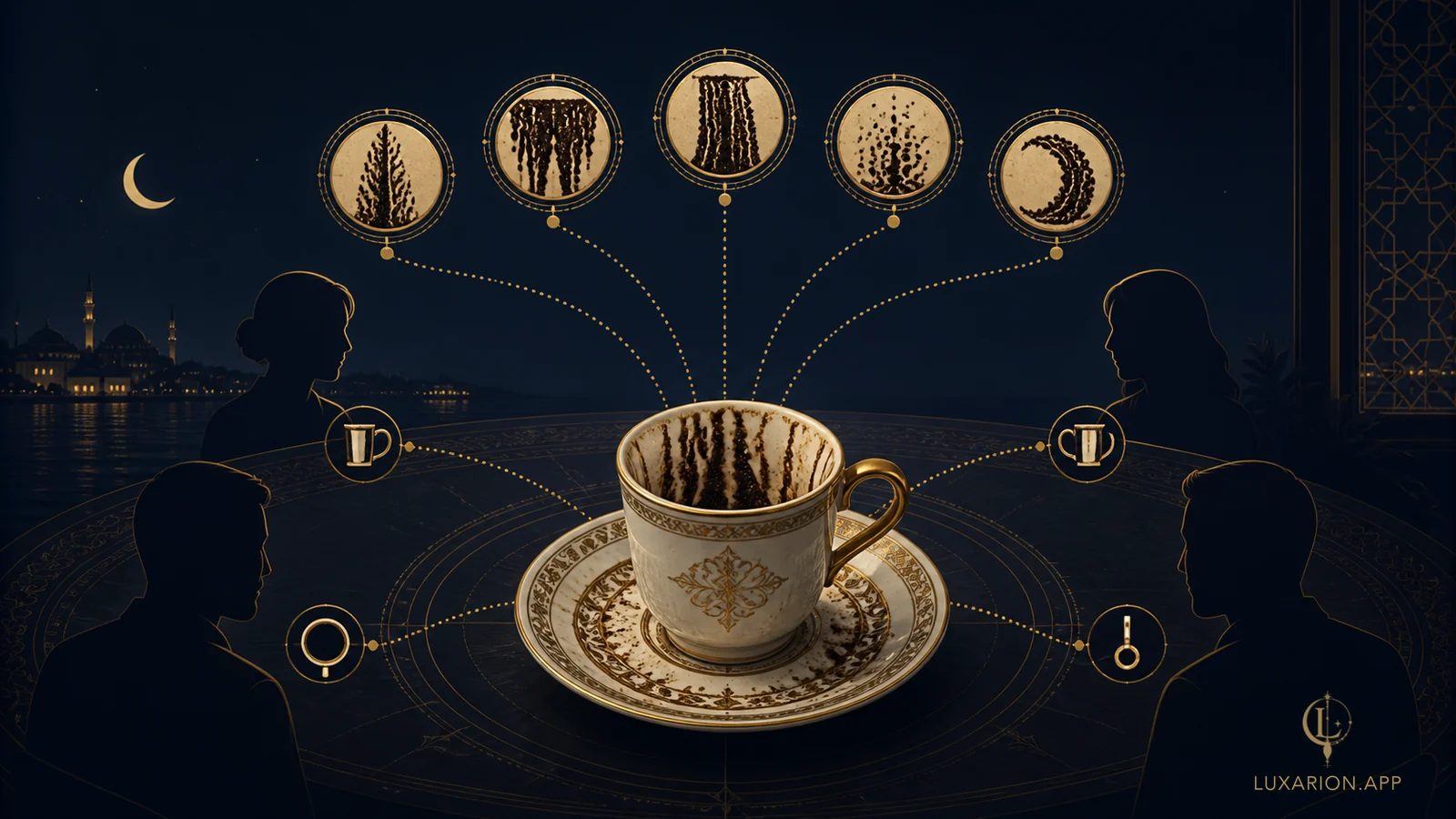
The vocabulary of the cup is learnable — not as five hundred entries but as a handful of families, each read against where it fell and who is sitting there.
Every generation prints a new coffee-symbol dictionary, and every seasoned reader keeps hers on a shelf she rarely visits.
Not because the dictionaries are wrong exactly. A fish did tend to mean provision. A snake did tend to mean a current under the surface. The entries record something real. The trouble is that a dictionary answers the one question a cup never asks: what does this symbol mean in general?
The cup only ever asks what a symbol means here — in this region, beside these neighbours, for this person, this week. And that is not a limitation to apologise for. It is the whole method, shared with every serious interpretive craft, and we set it out in how the old interpreters actually worked.
Still, the vocabulary is genuinely learnable, and it organises beautifully — not as five hundred entries but as a handful of families with shared logic. Learn the families and you can read a shape you have never seen before, which is precisely what a list cannot teach you to do.
Why families work better than entries
The case for organising this way is worth making, because it is not merely a convenience.
A dictionary has a fixed number of entries and the cup does not. Grounds produce a bounded but not enumerable set of forms, and you will regularly see something that is recognisably a shape without being any of the five hundred listed ones. At that moment a list has nothing to offer and a family does: you ask which family it belongs to and read from the family's logic.
A half-formed animal you cannot identify is still an animal — so ask what it is doing and which way it faces. An enclosure whose exact geometry is unclear is still an enclosure — so ask whether it is closed or open. This is why practitioners can read a cup fluently while owning no list at all, and why beginners with an excellent list stall the moment reality declines to match it.
The families also encode something the entries obscure: that the vocabulary was not assigned but accumulated. Four hundred years of readers converged on these groupings because the physics of a settling cup produces them — long strokes where the liquid ran, clusters where it pooled, rings where an edge held and withdrew, clean ground where it never reached. The families are closer to the material than the entries are.
And they are portable. The same logic reads a tea cup, where the branch is older and the shapes differ slightly. A list built for coffee is useless there; a family logic transfers intact. We set the whole comparison out in what tasseography actually is.
The four coordinates that decide a symbol
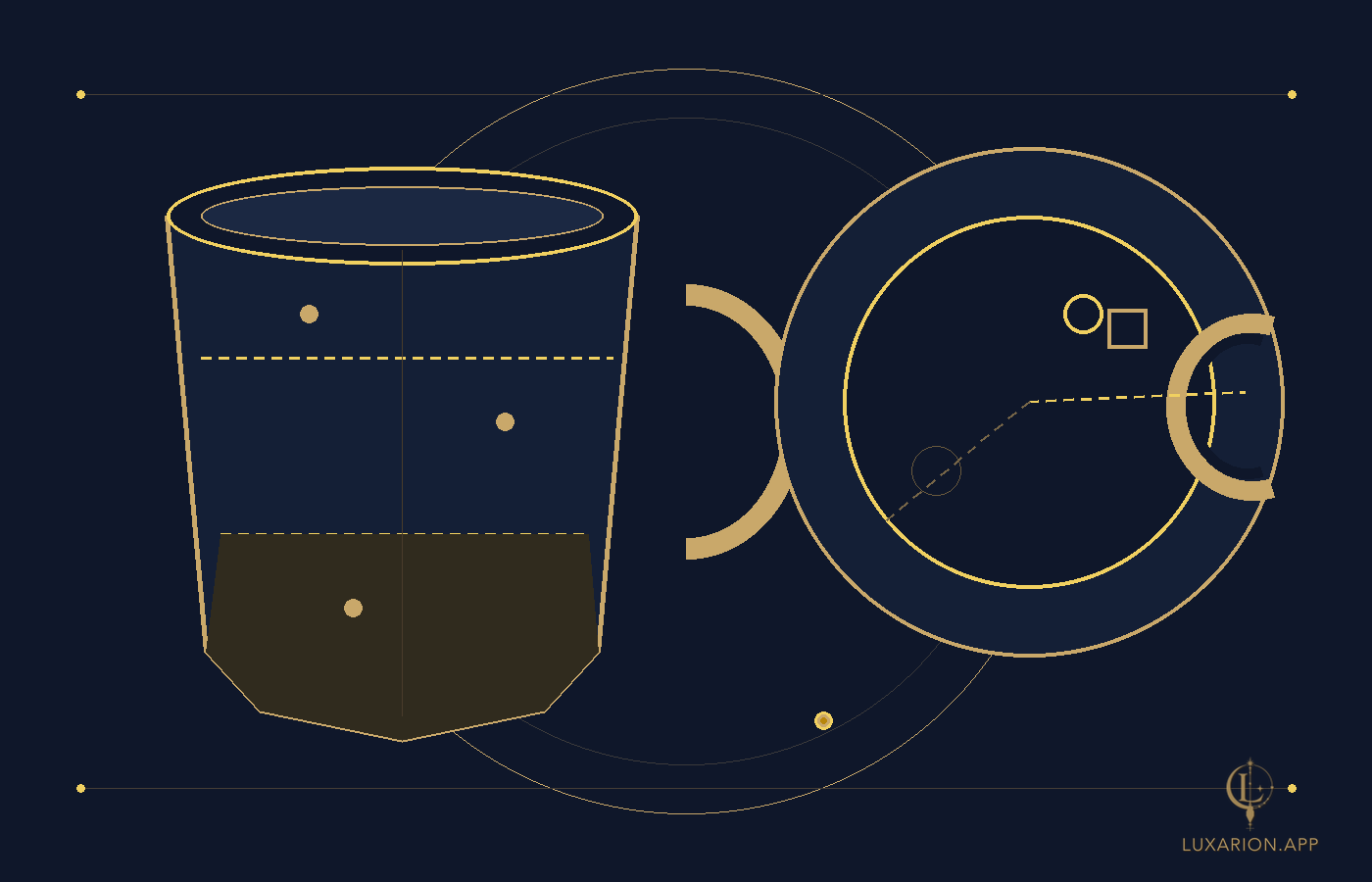
Before any family, the frame. A mark's meaning is fixed by four things, and a reading that skips them is reading a dictionary aloud.
Where it fell. The cup divides. The rim is the near present — days and weeks, what is already in motion. The middle band is the season forming. The base is what lies deeper or further off. And the handle is the anchor: marks near it concern the drinker's household and immediate circle, marks opposite concern the distant and the outside. A reader orients the whole cup by the handle before saying a word. We walk through the full geography in the Turkish coffee reading guide.
What is beside it. Meaning in a cup is relational. A road beside a door is a different statement from a road beside a knot. Practitioners read pairs before they read marks.
Who is drinking. The same shape means different things to a person who has just moved countries and a person who has not left their street in thirty years. This is the principle that governs the whole family of reading crafts, and it is the one amateurs skip in all of them.
How clear it is. A sharp, well-defined shape is weighted; a vague suggestion of a shape is not. Practitioners are strict about this, and it eliminates most of the over-reading beginners do.
Creatures
The largest family and the one the dictionaries most over-specify. The useful principle: an animal is read through its known character, not through a fixed assignment. Ask what the creature is famous for, and you will usually arrive where the tradition arrived.
Birds carry word and movement. News, a message, an arrival. Their direction matters more than their species — a bird heading toward the handle brings something home; away from it, something leaves. Near the rim, the news is close.
Snakes are currents under the surface. Not malice by default, and the reflex reading of a snake as an enemy is a modern coarsening. The older material reads it as something moving unseen — which may be a person, but is just as often a process. The serpent carries a dense and frequently favourable symbolic history that we open in what the serpent has actually meant.
Fish, in most Levantine and Anatolian tellings, are provision and increase. Near the base, something long awaited is finally approaching.
Dogs are loyalty and company — read for who stands with you rather than for events.
Horses are strength directed somewhere: travel, effort, a project that will require carrying.
Scorpions and insects are small persistent irritations rather than catastrophes. The scale of the creature tends to match the scale of the matter, which is a genuinely reliable rule of thumb across the whole family.
Paths and passages
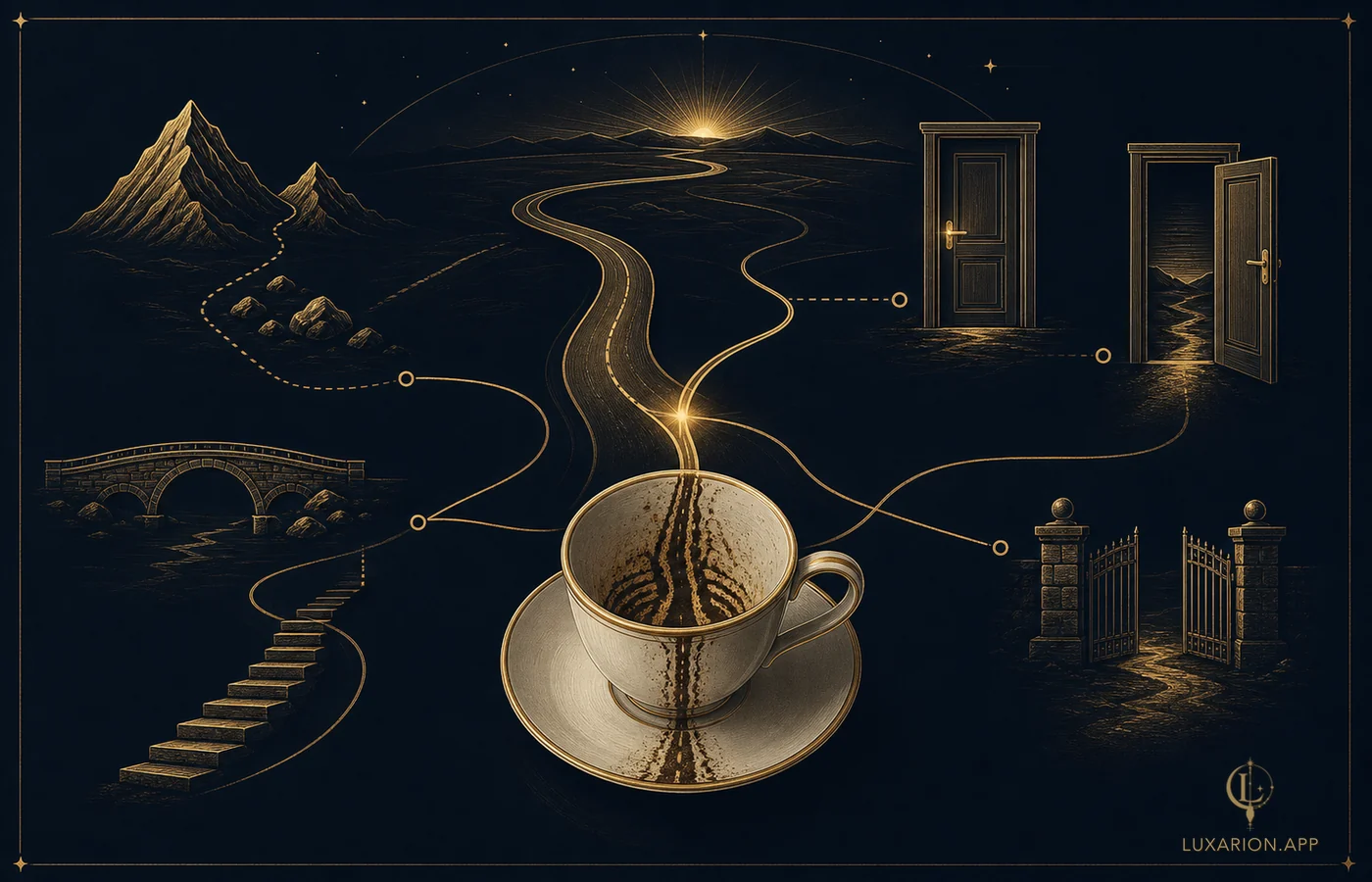
The family that speaks about movement and possibility, and the one that behaves most consistently across regions.
Roads and long lines. A journey or a change of course. Clarity says more than length: a clean, definite road reads as something settled; a broken or wavering one, as a course not yet resolved. Two roads meeting is a decision point.
Doors and gates. An opening or a passage. Open or closed changes it, and position relative to the handle decides the domain — a door near the handle concerns the household, opposite it concerns something outside that must be approached.
Stairs. Ascent by degrees. Something reached gradually rather than in a leap. The number of steps is not counted in the serious material, contrary to popular versions.
Bridges. A crossing that requires something to be built or accepted first. Read as available rather than automatic.
Mountains and obstacles. Read for scale and for whether there is a way around visible in the pattern — an obstruction with a clear path beside it is a very different reading from one without.
Bindings and enclosures
The family concerning commitment, constraint and protection — and the one most often misread as ominous.
Rings. A bond or a commitment; sometimes an obligation rather than a relationship, which is a distinction worth holding. A complete ring is not a broken one, and the difference is the whole reading.
Knots. Something tangled. The classical reading is that a knot asks to be untied rather than cut — that is, it needs patience and sequence rather than force. Position near the handle makes it domestic.
Chains and repeated links. A sequence of obligations, one leading to another. Read for whether the chain is continuous or has a gap in it.
Squares. In the older material, protection and containment — a matter held safely within limits. The square is one of the most consistently favourable marks in the vocabulary and one that popular lists frequently get backwards.
Grids and crosshatching. Excess of the quality belonging to that region rather than absence of it. Grids read as complication, not as ruin.
Vessels, dwellings and the things that hold
A family the popular lists barely separate out, and one that carries a surprising amount.
Houses and buildings. Read on the drinker's own life and household rather than on property. Position against the handle decides whose house — near it, yours; opposite, someone else's, or a life shaped to another person's measure. A building with a clear door is a different reading from one without.
Cups, bowls and containers. What holds and what is held. Full or empty matters more than the shape, and an overturned vessel is read as something released rather than something lost — a distinction the older material is careful about and the popular versions usually invert.
Boxes and chests. Something kept, stored or not yet opened. Read near the base, it is old material; near the rim, something being decided about now.
Trees. Growth that took time and cannot be hurried. A tree with visible roots reads on what a situation is founded on; one without, on what has grown quickly and may not be anchored.
What unites this family is that each mark asks the same question in a different register: what is being held, and is the holding still needed? That question is often the most useful thing a cup produces, because it is the one people rarely put to themselves.
Human figures and their parts
The family that carries the most emotional weight and demands the most restraint.
Whole figures. Read for posture and orientation before anything else — approaching or departing, facing the handle or away. A figure walking toward the handle is someone coming into your circle.
Faces and profiles. A person present in the matter. Here the tradition draws its hardest line: a face is read as what that person carries for the drinker, never as a report on the person themselves. The rule is absolute in every serious lineage, and it is drawn to protect the drinker as much as the absent party. We open the whole ethic in when the reading says no.
Hands. Giving or receiving, depending on orientation. Also work — a hand in the region of the base often concerns the labour underneath a situation.
Eyes. Attention. Being seen, or needing to look at something. Notably, the older material does not read an eye as malice; that association is regional and comparatively recent.
Marks of writing and number
A small family, easy to over-read, and worth a warning.
Letters. Frequently the most over-interpreted mark in the whole vocabulary. Practitioners treat a clear letter as pointing toward a name in the matter — and then ask, rather than announcing. A reader who names a person from a letter shape has left the craft.
Numbers. Read as quantity or duration when very clear, and ignored when not. The temptation to read a number as a date is the single most common way the craft gets misused, and every serious practitioner declines it.
Straight lines and strokes. Direction and decisiveness. Several parallel strokes read as a matter with multiple simultaneous strands.
The family beginners ignore: empty space
Clean, unmarked areas of the cup are among the most informative features in the whole vocabulary, and almost every beginner reads past them looking for shapes.
An open rim reads as immediate clarity — nothing pressing, room to move.
An open base reads as a matter without deep complication underneath it, which is very often the best news in a cup.
A cup that is generally sparse is not an empty reading. It is read as a settled period, and practitioners will say so plainly rather than manufacturing content to fill the session.
A cup that is uniformly dense is read as a crowded season — too much at once — and often produces the most useful conversation of any pattern, because it names something the drinker has felt but not articulated.
The general principle: the distribution is read before any shape. Heavy or open, clustered at the rim or the base, one region crowded and another bare. That impression is the frame everything else is read inside, and it is more reliable than any individual mark.
How the same shape reads in three different cups
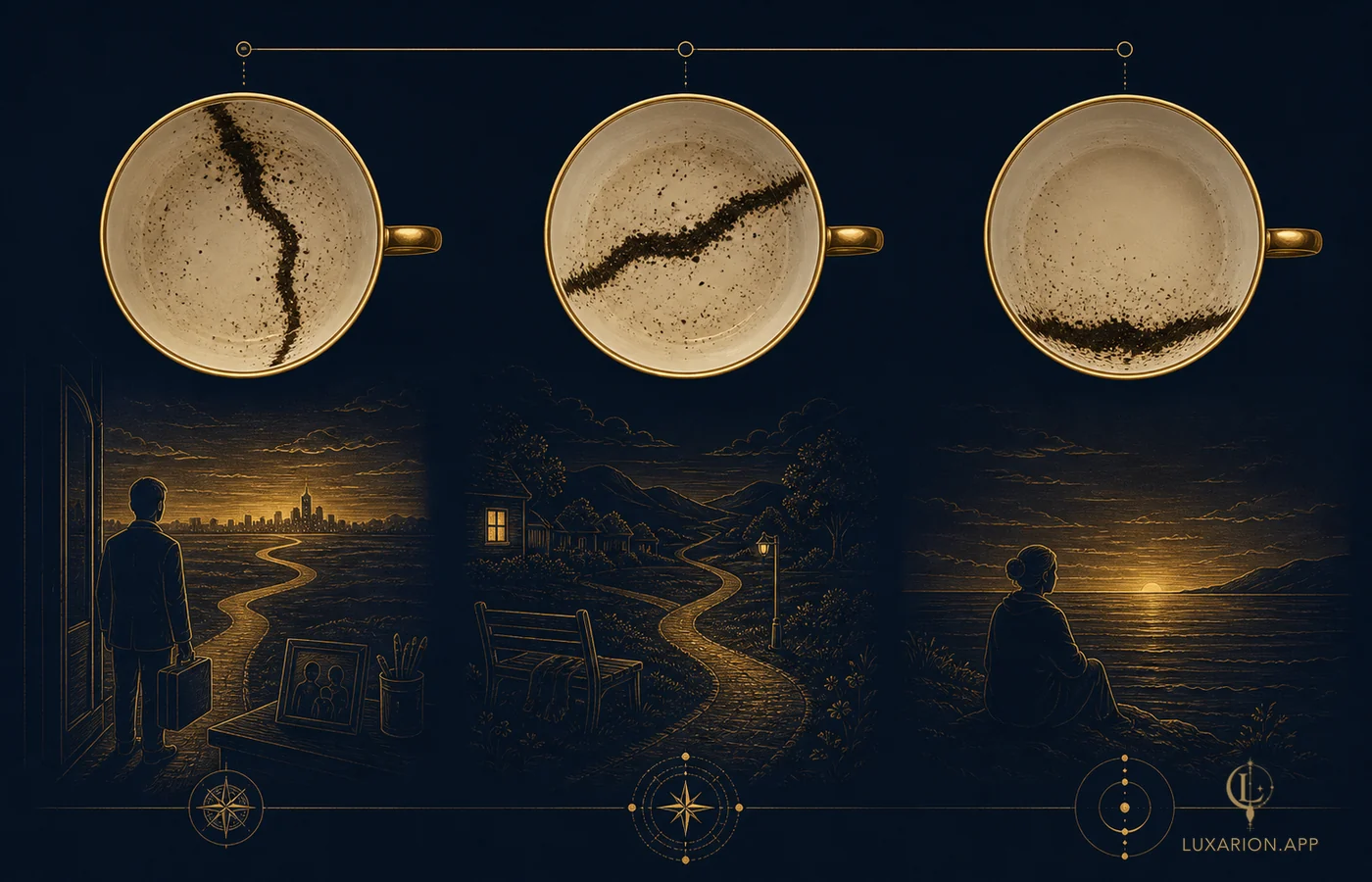
An illustration, because the principle stays abstract until you watch it work.
Take a road — a clear long stroke crossing a region. One shape, three cups.
In the cup of someone who has just been offered a job in another city. Near the rim, running away from the handle. Read as the move being genuinely live and near — and the reading turns immediately to what is unfinished at home, because the handle end of that stroke is where the road begins.
In the cup of someone who has not left their neighbourhood in years and did not come to talk about travel. Same stroke, mid-cup. Here it is almost certainly not literal movement. A road in a settled life reads as a change of course — often the beginning of something that will look like a departure from the outside and feel like a return from the inside.
In the cup of someone in the middle of a grief. Same stroke, at the base. Practitioners read this gently and slowly, and often decline to press it at all. At the base it concerns something deep and not yet surfaced, and the etiquette of not interpreting over fresh loss takes precedence over the mark.
Three readings, one shape. Nothing about the stroke changed; everything about its coordinates did. And note that in the third cup the correct move was partly not to read it — which no dictionary will ever tell you, because a dictionary has no way to know who is holding the cup.
How to weigh a symbol: the three-signs rule
Here is the discipline that separates a reading from a guess, and it is the rule practitioners repeat to every student.
Never build on a single mark. A practised reader gathers three concordant signs in different regions before saying anything substantial. One shape is an observation; three agreeing shapes are a reading.
Why: because a single mark is exactly what an eager mind produces on demand. Three marks that independently point the same direction are much harder to manufacture, and the requirement to find them is what keeps the reader honest.
The corollary is equally important and less often stated. If you cannot find three, say so. "I do not see anything clear about that here" is a mark of competence in every branch of this craft. A cup that will not yield is common and unremarkable, and a reader who always finds an answer is not reading.
And a practical rule about weighting: a mark near the rim carries more immediate weight than the same mark at the base, a clear mark outweighs a vague one, and a mark repeated in two regions outweighs a single striking one. Practitioners weigh before they interpret.
Four ways symbols get misread
Reading the shape instead of the person. The central error, and the one every branch of this family warns against in nearly identical language. The list is a starting point; the person finishes it.
Reading a mark as an event rather than a condition. Cups are read for the near season and for situations, not for dated occurrences. A road is not a plane ticket; it is a movement in your circumstances.
Treating a frightening shape as a verdict. The tradition's own instruction is that where readings are equally available, the better one is offered — not concealing difficulty, but refusing to select the alarming reading when the cup does not require it. Popular symbol lists systematically ignore this and are darker than the practice they claim to describe.
Reading a third party. Restated because it matters most: your cup is made of your material. It does not carry news about someone else's intentions, health or future.
Building your own vocabulary
The vocabulary that will serve you best is not printed anywhere, and assembling it takes about a month.
Photograph your cup before you read it. Daylight, no flash. This costs nothing and gives you a record you can compare against later, which memory cannot provide.
Write what you see before you interpret it. The same discipline that governs dream records, and for the same reason: interpreting while recording contaminates the record, and you begin writing down the version you expect.
Note the date and one line about the week. The single most useful column, and the one everyone omits. Without it you cannot later check whether a shape corresponded to anything.
After a month, read the record end to end. What recurs for you is your vocabulary. It will be short — a dozen entries is plenty — and it will outperform any printed list because it is fitted to you. This is the same method we set out for dream symbols in your own dream alphabet.
What you are building is a trained perception — the kind Michael Polanyi called tacit knowledge, which takes in far more than it can articulate and is assembled by volume. It is the same structure as any developed expertise, and it is why this craft passes by apprenticeship rather than from a book.
What a reader does that a list cannot
Worth stating plainly, because it explains why the vocabulary is the smaller half of the craft.
A practised reader has seen thousands of cups. They know which shapes are common in which region and which are unusual — and, crucially, which are simply how that particular coffee behaves. They read the saucer, which beginners forget entirely. They orient by the handle before speaking. They gather three signs before committing. And they are reading you as much as the cup: which shape you looked at first, the question you asked second, the moment your answers got shorter.
None of that is in a dictionary, and none of it can be. The vocabulary is the part that can be written down, which is exactly why it is the part that gets printed and the part people mistake for the whole.
Which is also the honest answer to why a session differs from reading your own cup with a list beside you. Both are legitimate and the second is genuinely worth doing. But one of them includes someone who has done this ten thousand times and will ask you the question you were avoiding.
If you would like your cup read properly — oriented by the handle, weighed before it is interpreted, kept inside the near season, and ending with something to do — that is what our readers do. You can book a coffee cup reading. And if you want the honest account of what the craft claims for itself, it is in is coffee reading real.
The library teaches the craft. A reading applies it to you.
Get your personal reading