

Turkish Coffee Reading: The Tradition, Start to Finish
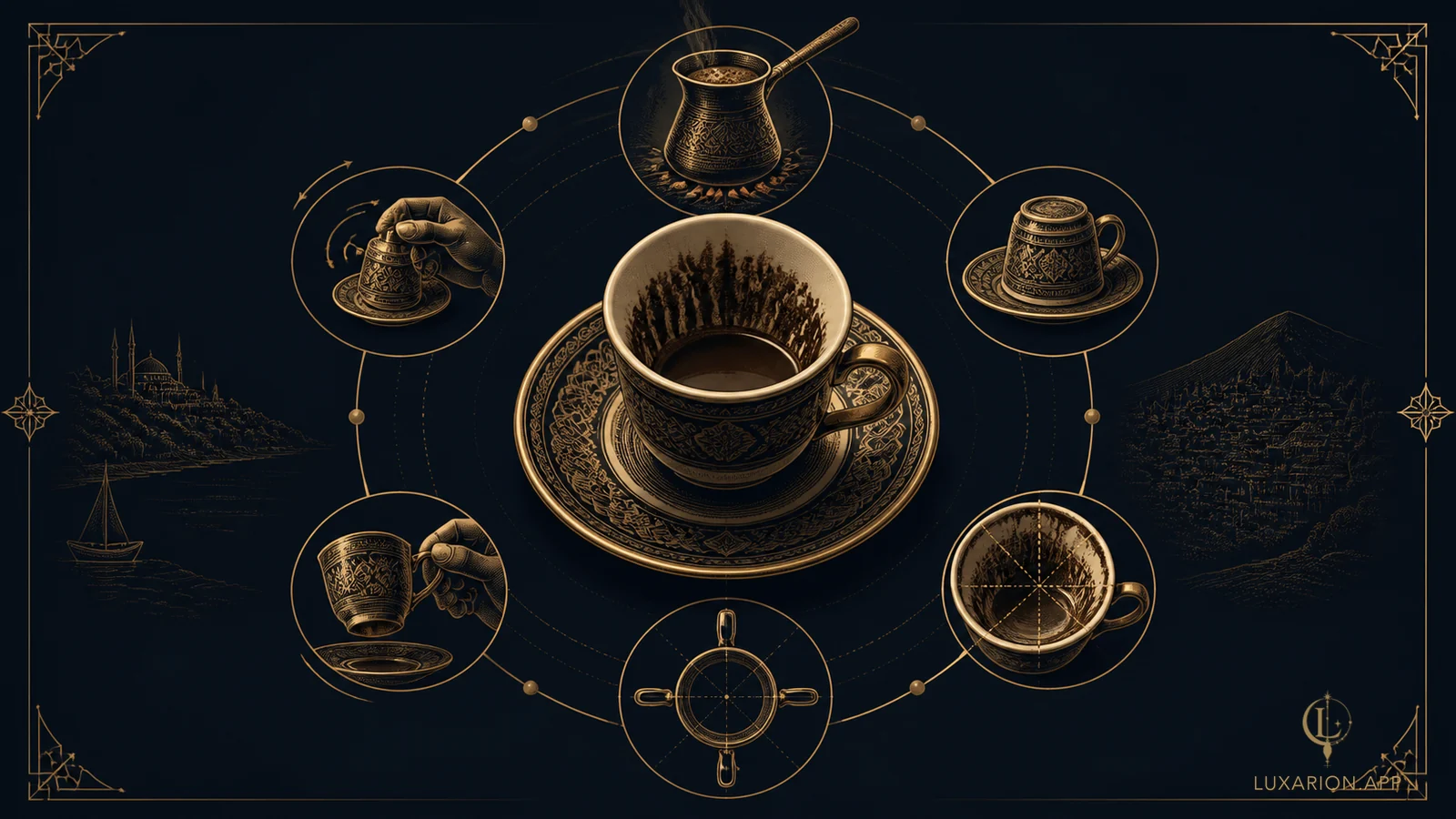
The brewing, the turn, the wait, the lift, the geography of the cup — the complete ritual with its rules, and the rules are the interesting part.
Nobody sat down one afternoon and invented coffee reading. It accumulated — in the coffeehouses of sixteenth-century Istanbul, in kitchens from Sarajevo to Beirut, in the pause after a visit when the cups were cooling and someone's aunt turned one over without being asked.
What survived those centuries is not a party trick. It is a small, complete ritual with rules — and the rules are the interesting part, because almost every one of them turns out to be doing work rather than decorating.
What follows is the whole sequence from the grind to the last word: how the coffee must be made and why, the turn and what it is for, the wait, the lift, the full geography of the cup, the order a reader works in, how the regional traditions differ, and how to keep the ritual properly at home.
Where the ritual came from
The sequence has a history, and knowing it explains why the parts are shaped as they are.
Coffee reaches the Ottoman world in the sixteenth century, and with it comes the coffeehouse — a genuinely new kind of public room, where people who were not related sat together at length, without alcohol and without a religious occasion. Nothing quite like it had existed. It produced a new kind of conversation: long, mixed, unhurried. Cup reading grew up inside that conversation rather than alongside it.
The domestic version mattered even more. In households across the region the afternoon cup was one of the few reliably protected hours in a day of obligations, and often one of the few settings where women spoke to each other at length without an audience. The reading is what legitimised the length of it. You cannot rush a cup that has to cool — and that sentence is close to the whole social history of the practice.
Ibn Khaldun had already described, before coffee reached the region, how crafts of this kind pass: by habituated practice within a community rather than by text, so that a craft loses more when its chain of practitioners breaks than when its books are lost. That account fits this one exactly. There is no founding manual for cup reading. There is a living chain, transmitted by apprenticeship — the younger person sitting beside the older one through hundreds of cups.
Which is why the ritual looks the way it does. Nobody designed it. It was corrected, slowly, by people who had every reason to drop any part that did not earn its place.
The coffee itself
The ritual begins before anyone thinks about reading, and the preparation is not incidental — it is what makes a reading possible at all.
The coffee must be the fine-ground, unfiltered kind. Turkish coffee is the common name, though Armenians, Greeks, Bosnians and Arabs each claim the cup with equal right and each name it for themselves. The grind matters more than almost anything else: it must be finer than espresso, close to powder, because only a fine grind adheres to the cup wall in a readable film. Coarse grounds slump and clump, and the pattern comes out mute.
It is brewed in a cezve — the small long-handled pot — unsweetened or barely sweetened, brought slowly to the point where the foam rises, and never boiled hard. The foam is poured out with it. Practitioners are firm about the slow heat, and the reason is practical rather than ceremonial: a fast boil breaks the grounds up differently and the deposit is coarser.
Sugar is a real variable. Heavy sweetening changes how the grounds settle and, in the judgement of most readers, muddies the pattern. The tradition's compromise is that the drinker chooses the sweetness and the reader simply notes it, the way any craftsperson notes a property of their material.
And the cup matters. A small porcelain cup, white inside, smooth-glazed. A dark interior makes the pattern unreadable, and a matte or porous surface will not hold a fine film. That the traditional cup is white inside is not an aesthetic preference; it is a working requirement.
The drinking
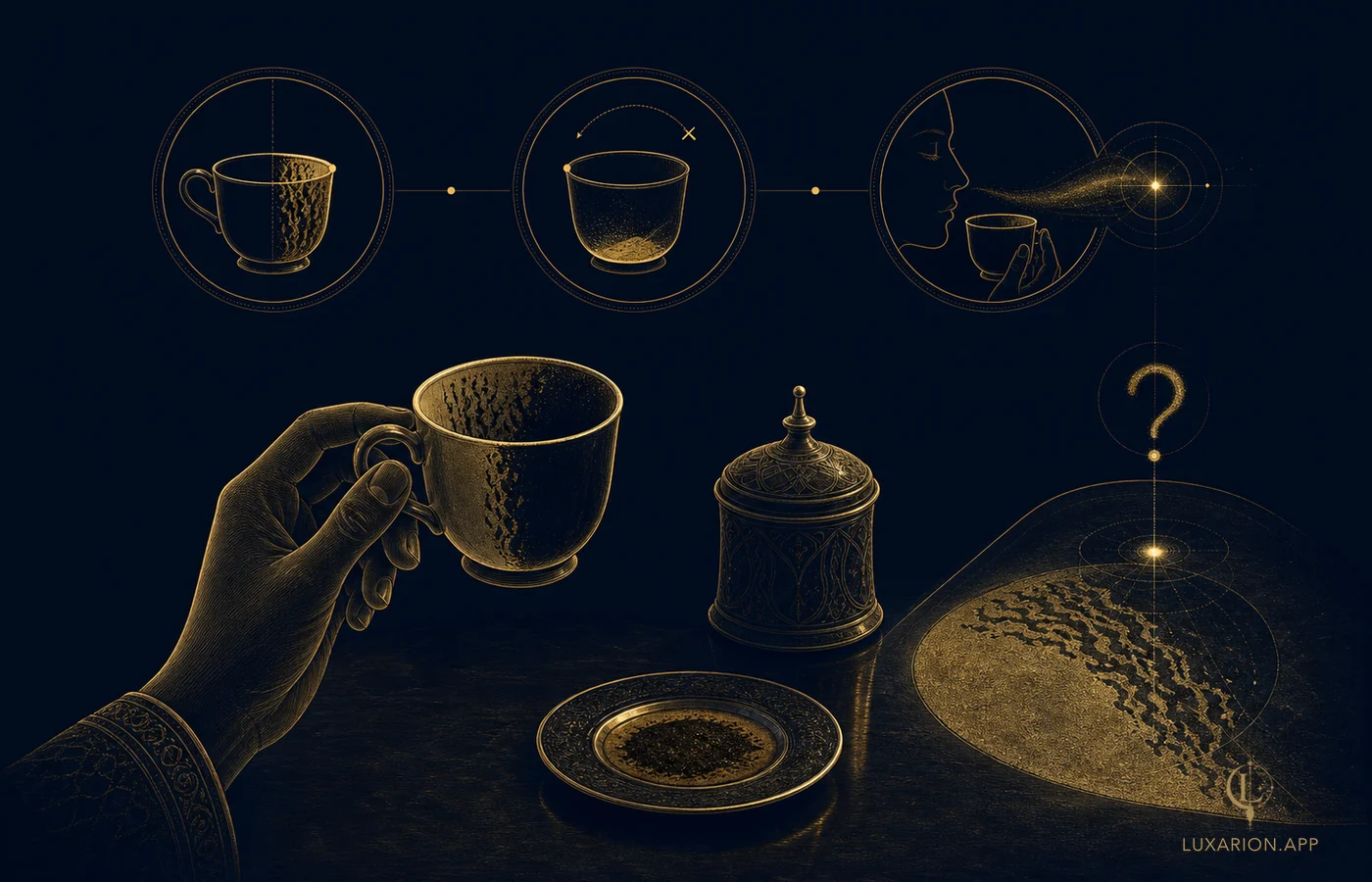
Three rules govern how the cup is drunk, and each of them is doing something.
Drink from one side only. The cup is not rotated as it empties. This leaves the opposite wall clean and gives the settling grounds a consistent surface to work on, which is why the resulting pattern has structure rather than being smeared all round.
Leave the last sip. The muddy bottom is not drunk. It is the material the reading is made from, and a cup drunk dry gives very little.
Hold a question, or simply an openness. Most traditions have the drinker do this in the moment before turning. The point is not that holding a question alters how the grounds fall; it is that it makes the drinker a participant rather than an audience, and readings where that has not happened are noticeably thinner.
The turn
The single most ritualised moment, and the one most often performed carelessly.
The saucer goes over the cup. The drinker — not the reader — holds them together and turns them over. This detail is close to universal across the branches, and the logic is consistent: the pattern must come out of an act the person completed themselves.
Before or during the turn, most traditions have the drinker make a small circular motion, three times. Direction varies by region and nobody agrees, which is itself informative — where a detail varies freely across four centuries and a dozen countries, it is carrying less weight than the details that do not vary.
Then the inverted cup is set down and left. Some traditions place a coin or a ring on the base; some have the drinker press a thumb into the base. These are regional and optional.
What is not optional is that the cup is left alone. Lifting early is the most common error at this stage and it ruins the reading, for a plain physical reason: the grounds are still running.
The wait, which is not theatre
The cup must cool. In practice this is somewhere between five and fifteen minutes depending on the room, and it is the part of the ritual that modern impatience most wants to skip.
It is doing three things at once.
The pattern is still forming. The grounds continue to drain and settle for the first minutes. Read too early and you are reading an unfinished image.
The edges are sharpening. As the deposit dries, shapes that were vague while wet become defined. A practitioner who says "let us wait a moment" mid-reading is not hesitating; that is the craft.
The room is being held. Nobody gets up during the cooling. It produces a protected stretch of time in which a conversation can go somewhere, and that is a large part of why this practice took root in domestic life rather than remaining a coffeehouse novelty.
Heat and humidity change the drying speed but not the meanings. On a damp day a reader waits longer — and someone who does not know this will mistake an unsettled cup for a sparse one.
The lift
How the cup comes off the saucer is itself read, and beginners skip it entirely.
Look at the saucer before lifting. Lifting disturbs some of what is on it. Practitioners look first, always.
A cup that will not lift. If the cup sticks, the classical reading is that the matter is not ready to be discussed, and the reading stops there. This is one of the clearest cases of a refusal built into the ritual itself, and there is neither fault nor bad omen in it — the time has simply not come. We open the whole discipline of declining in when the reading says no.
What ran onto the saucer. Read for direction: what ran toward the handle side returns home; what ran away goes outward. Heavy grounds on the saucer say a great deal has already left the matter, which for someone complaining of being stuck is good news.
The geography of the cup

Here is the part that makes the difference between a reading and a recitation, and it is the framework everything else sits inside.
The cup is not one picture. It divides, and where a mark falls changes what it says.
The rim is the near present — days and weeks, what is already in motion. Marks here read as immediate, and usually as things the drinker already half knows.
The middle band is the season forming: the weeks ahead, what is composing itself but has not arrived.
The base is what lies deeper or further off — older material, roots, the thing under the thing. A heavy base with a clear rim reads very differently from the reverse.
The handle is the anchor, and this is the detail outsiders most often miss. The handle stands for the drinker and their home. Marks near it concern the household, the family, the immediate circle; marks opposite concern the distant, the foreign, the outside. A reader orients the entire cup by the handle before saying a single word, and a reading conducted without doing so is not really a reading.
The saucer carries what has left the cup — what is finished, leaving, or has spilled outward into other people's lives.
The division is not arbitrary; it comes out of the physics. The grounds settle downward while the cup is drunk, so once it is inverted, what is near the rim settled last and what is at the base settled first. The order of time is written into the material. The tradition did not assign a symbol — it named what it saw.
The order a reader works in
Consistent across the whole region, which is itself evidence of a genuinely transmitted method.
The whole before the parts. Density, distribution, whether the pattern is heavy or open, clustered at the rim or the base, one region crowded and another bare. This impression is the frame, and it is more reliable than any individual mark. Almost every beginner skips it to hunt for recognisable shapes.
Orient by the handle. Before naming anything.
Pairs before marks. Meaning in a cup is relational. A road beside a door is a different statement from a road beside a knot.
Three concordant signs before committing. A practised reader gathers three agreeing marks in different regions before saying anything substantial. One shape is an observation; three are a reading. We set out the full vocabulary and this rule in what the shapes mean.
Then the questions. A good reader names what they see and asks what it touches, and the answer shapes what comes next. A reader who talks for twenty minutes without asking anything is performing rather than reading.
And it ends with something to do. The oldest quality marker in every reading tradition: an interpretation that ends in news is incomplete; one that ends in a next step is finished.
How the regional traditions differ
The practice travelled everywhere the unfiltered cup went, and the variations are worth knowing — mostly because they show you what is essential and what is local.
Turkish and Balkan practice is the most elaborated: full attention to the handle axis, the saucer read as a matter of course, and the most developed regional vocabulary.
Greek practice shares the structure almost exactly and differs mainly in vocabulary and in some customs around the turn.
Bosnian practice is closely related and notable for how firmly the social frame is kept — the reading is embedded in a visit and is not performed outside one.
Levantine and Arab practice, alongside Arabic coffee and its own hospitality customs, tends to weight the handle relationship heavily and to be especially careful about the third-party boundary.
Now note what does not vary: orienting by the handle, reading the whole before the parts, asking before telling, staying inside the near season, and refusing when the material or the moment is wrong. Five constants across four centuries and a dozen countries.
That distinction is practically useful. If a reader uses a vocabulary you do not recognise, there is nothing wrong — peoples differ. If they start from a shape before the whole, or tell before they ask, that is not a regional difference; that is a departure from the craft. UNESCO's recognition of Turkish coffee culture as intangible cultural heritage names the thing precisely: the craft is inseparable from the social practice around it.
What a reader is doing that is not in the ritual
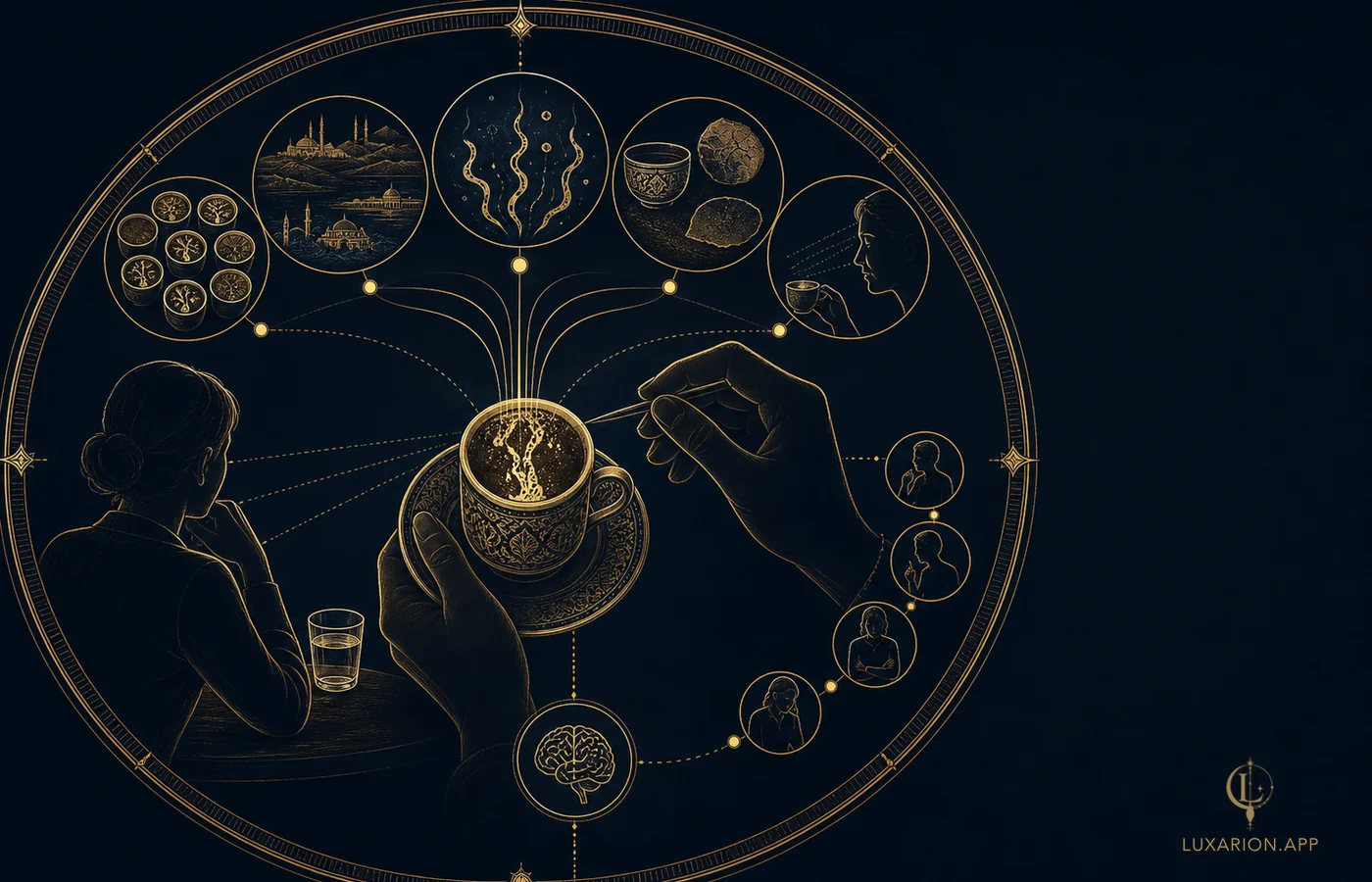
Everything above can be written down, which is exactly why it gets written down — and why people mistake it for the whole craft.
The part that cannot be set out on a page is the perception. A practised reader has seen thousands of cups and knows which shapes are common in which region, which are unusual, and — most importantly — which are simply how that particular coffee, in that particular cup, behaves. Distinguishing a meaningful mark from a property of the material is the quietest skill in the whole practice and the one that takes longest to acquire.
They are also reading you. Which shape you looked at first. The question you asked second, which is usually the real one. The moment your answers got shorter. This is trained perception of exactly the kind Michael Polanyi called tacit knowledge — it takes in far more than it can articulate and is built by volume rather than by study. It is the same structure as any developed expertise.
That is why two readers produce two different sessions from the same cup, and why choosing a reader matters more than anything about the coffee. And it is the honest answer to why a session differs from keeping the ritual yourself at home. Both are legitimate and the second is genuinely worth doing. But one of them includes someone who has done this ten thousand times and will ask you the question you were steering around.
The etiquette
The rules of conduct are not decoration, and they are the fastest way to tell a practised reader from an unpractised one.
Stay in the near season. The classical instruction is that a cup speaks to roughly the next forty days. A reader ranging over your whole life has left the tradition.
No dates. No named years, and no reading a number as a date.
No third parties. Your cup is made of your material. It does not carry news about someone else's intentions, health or future. Every serious lineage draws this line, and it protects you as much as the absent person.
Nothing medical. A careful reader may say your hands look tired. Naming an illness is outside the craft entirely.
Where readings are equally available, offer the better one. Not concealment of the difficult — refusal to select the frightening reading when the cup does not require it.
Refuse when the moment is wrong. Someone in the middle of an acute crisis is generally not read for, and this is neither a rejection nor a bad sign: the near season cannot be seen from inside the storm.
Keeping the ritual at home
You can do this properly this week, and doing it yourself teaches more than reading about it.
Fine grind, small white cup, unhurried heat. The three things that most often go wrong, and all three are equipment rather than skill.
Drink from one side, leave the last sip.
Let the drinker turn their own cup. Small rule, present in all three branches of the family, and its reason is legible: the pattern should come from an act the person completed.
Wait a full minute at minimum, and longer on a damp day.
Photograph the cup in daylight before you read it. Costs nothing, and gives you a record memory cannot provide.
Write what you see before you interpret it. The same discipline that governs dream records, and for the same reason. Keep it for a month and what recurs for you becomes your own vocabulary — the principle we set out in your own dream alphabet.
Start with your own cup. You know your own situation, so you can test what you saw against what you know — a check the cup of a stranger cannot give you. Most of what a beginner learns comes from being able to tell themselves that a reading did not hold.
Do not read for others while you are learning. This is the ethical rule and not modesty. A beginner reading for family as entertainment can say a sentence that sits in someone's chest for a year, and every branch teaches the refusal early for exactly this reason.
The rules are the interesting part
Look back at the sequence and notice how little of it is arbitrary.
The fine grind is required for a readable film. Drinking from one side gives the deposit a clean surface. Leaving the last sip preserves the material. The drinker turning their own cup makes the image come from their own completed act. The wait lets the pattern finish forming and the edges sharpen — and holds the room still long enough for a real conversation. The handle orients everything. The refusals keep the craft inside what it can actually do.
A tradition that was merely decorative would not have accumulated this many working parts, and it certainly would not have kept them consistent across four centuries and a dozen languages. What you are looking at is a method that was corrected by practice over a very long time, in households that had no reason to preserve anything that did not work.
If you would like your cup read by someone trained in it — oriented by the handle, weighed before it is interpreted, kept inside the season, and ending with something to do — that is what our readers do. You can book a coffee cup reading. And if you want the honest account of what the craft claims for itself first, it is set out in is coffee reading real.
The library teaches the craft. A reading applies it to you.
Get your personal reading