

What Is Tasseography? The Art of Reading What Remains
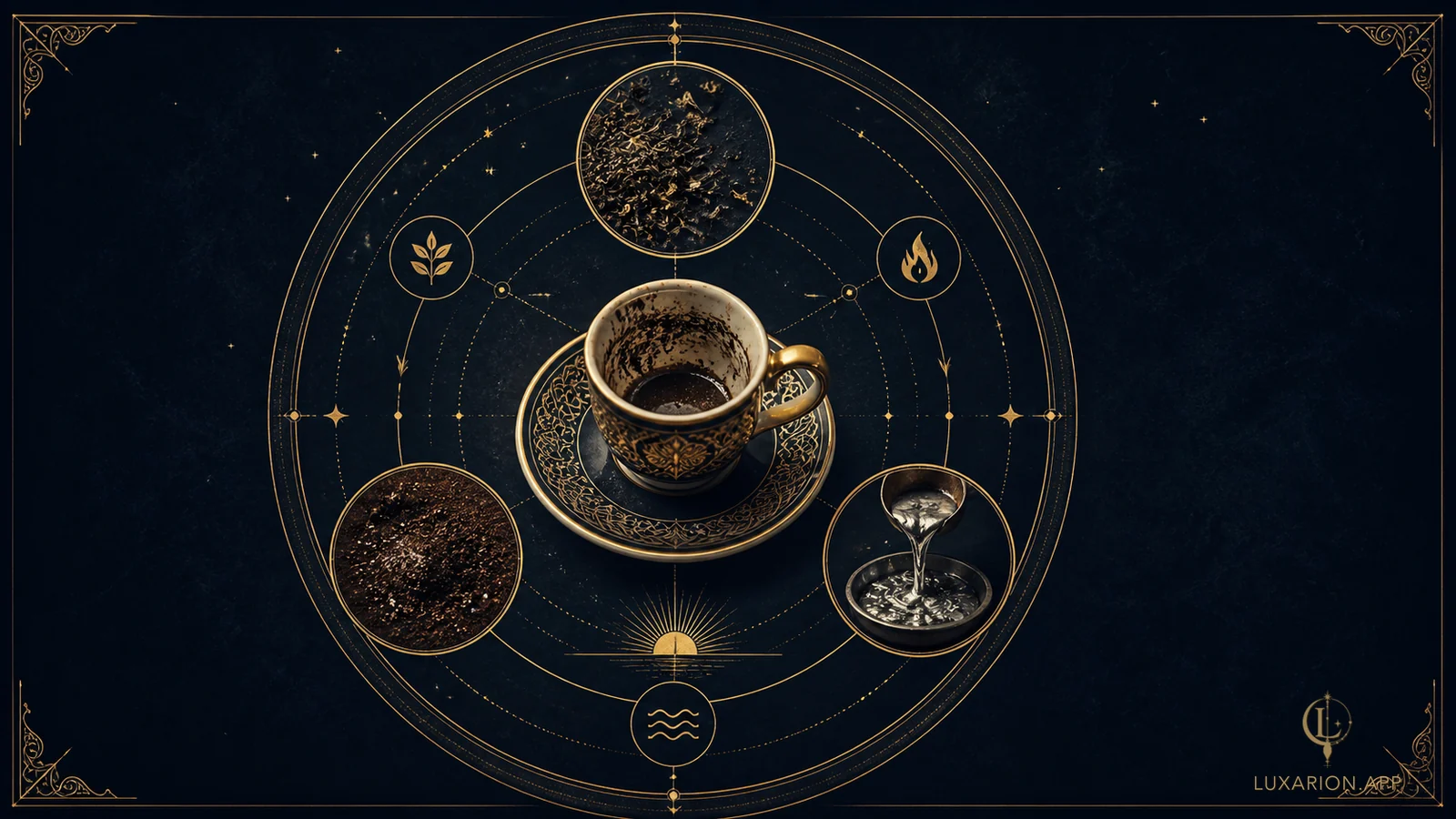
Tea leaves, coffee grounds, molten lead in water — three branches of one family, with one premise: when something is finished, what remains is a record.
The word is scholarly Greek stitched to a French root — tasse, cup, and -graphy, writing — and like most such coinages it arrived long after the thing it names. The practice is far older than the word, and far wider than coffee.
Tasseography is the family name for every craft that reads the residue of a ritual. Tea leaves in China and later in the parlours of Britain. Coffee grounds across the Ottoman world and everywhere it traded. Molten wax or lead dropped hissing into cold water across Central Europe and the Balkans. Different vessels, different substances, different centuries — and one premise underneath all of them:
When something is finished, what remains is not waste. It is a record.
That is a genuinely interesting idea, and it is worth taking seriously rather than skipping past. What follows is the three branches and where each came from, what they share as a method, how the craft is actually transmitted, the ethics all three developed independently, and how to try the practice yourself.
Why residue at all
Before the branches, the premise deserves a moment, because it is stranger and better than it first sounds.
Consider what the reading needs in order to work at all. It needs an image nobody arranged. If you drew the pattern yourself you would draw what you already know, and the session would return you exactly what you brought to it. So the craft requires a source of form that is outside the intentions of both people in the room — and residue is the most available such source that has ever existed.
It is also free, which matters more than it sounds. Every one of these traditions grew among ordinary households, not courts. Nobody had to buy anything. The tea was going to be drunk, the coffee poured, the year turned. The craft attached itself to a thing that was already happening, and that is a large part of why it spread so far and lasted so long.
And it is intimate. A cup you drank from carries your afternoon in it. A pattern made from your own grounds is, in a plain and unmysterious sense, yours in a way that a shuffled deck is not. Several branches make something of this: the drinker must finish the cup themselves, and in most versions the drinker — not the reader — performs the flip.
Put those three together and you have the family's whole logic: an unrepeatable image, produced at no cost, out of the person's own completed act. It would be difficult to design a better basis for a reading craft, and nobody designed this one. It accumulated.
Three branches, one family
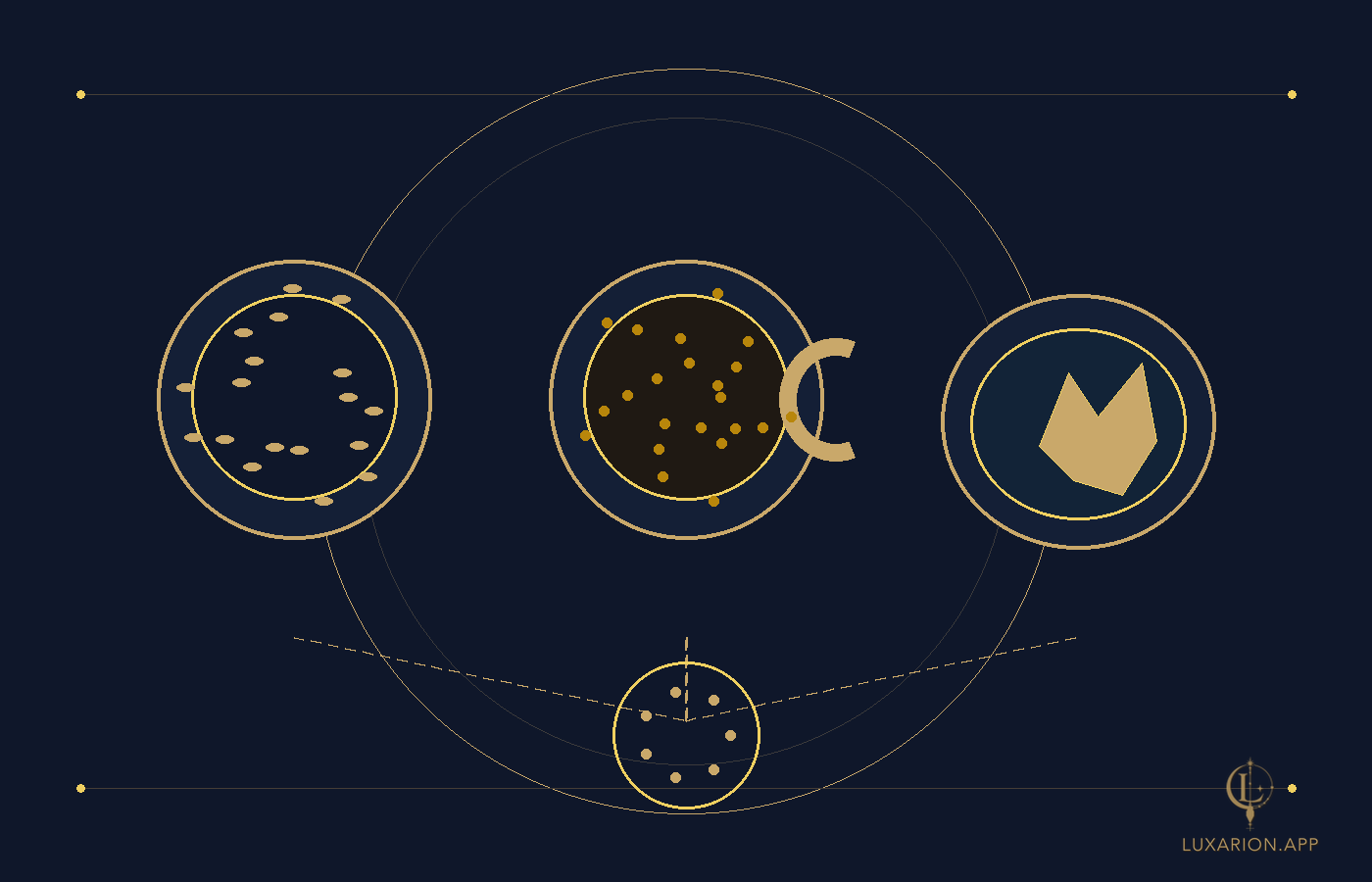
The branches developed largely apart, and the differences between them are as instructive as the similarities.
The tea branch is the oldest on paper. Leaf reading appears in Chinese sources well before Europe took up the drink, growing naturally out of a culture in which tea was prepared loose and drunk from open cups. The history of tea and the westward journey of porcelain along the Silk Road carried both the drink and its attendant customs. By the eighteenth and nineteenth centuries leaf reading had entered British drawing rooms, and by the Victorian era it had printed manuals and a settled parlour vocabulary of its own.
The coffee branch grew up in the Ottoman lands after coffee reached Istanbul in the sixteenth century, and it developed the richest ritual grammar of the three: the flip, the rest, the saucer, the regions of the cup, the anchoring of everything to the handle. It is also the branch with the widest continuous practice today, from the Balkans to the Levant to North Africa. We walk through its full method in the Turkish coffee reading guide.
The wax and lead branch is the strangest to modern eyes and the most dramatic to watch. Molybdomancy — pouring molten metal or wax into water and reading the shape that freezes — is attested across Central Europe, the Nordic countries, the Balkans and Turkey. It is characteristically a threshold custom rather than a daily one, performed at the turn of the year or at Epiphany, and read for the year ahead rather than the coming weeks. Where the cup traditions are domestic and frequent, this one is annual and ceremonial.
What the three have in common
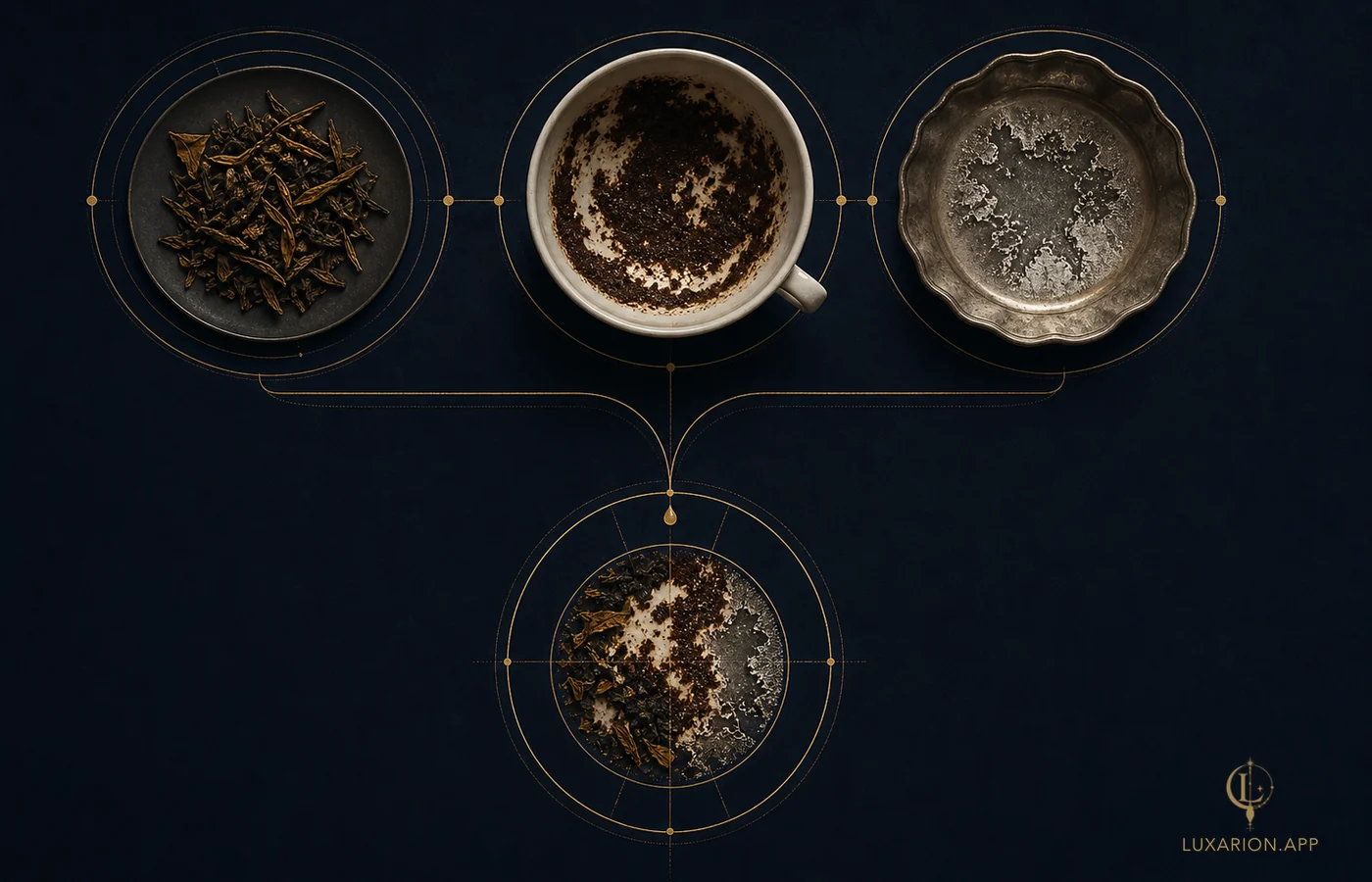
Set them side by side and the shared structure is striking, especially given how little contact the branches had.
The image must be unrepeatable. In all three, the pattern is produced by a process nobody controls — leaves settling, grounds draining, metal freezing. No practitioner has seen this exact shape before and none will see it again. That is not incidental. A reading needs something in front of it that neither party arranged.
The image is a by-product, not a purpose. The tea was for drinking, the coffee for hospitality, the metal for the ritual of the evening. The reading takes what the ritual left behind. This is the family's actual signature and the reason the word fits all three: they read residue.
The whole is read before the parts. Density, distribution, weight, openness. Every branch teaches this and every beginner in every branch ignores it in favour of hunting for recognisable shapes.
The reading is addressed to a person. Not issued as a pronouncement. All three branches ask about the person before interpreting the pattern, which is the same principle that governs dream interpretation and hand reading — we set it out in how the old interpreters actually worked.
The reading ends in something to do. This is the oldest quality marker in every reading tradition, and all three branches have it: an interpretation that ends in news is incomplete; one that ends in a next step is finished.
Five shared features across three traditions that grew up in different centuries and different languages. That convergence is the strongest evidence that the family is a real family and not a label imposed afterwards by scholars.
The tea branch, in practice
Leaf reading is the gentlest of the three and the easiest to try, because the equipment is a teapot without a strainer.
The method: loose leaf tea, a wide pale cup, drink down to a spoonful of liquid, swirl three times with the left hand, invert onto the saucer, turn the cup upright and read. The handle anchors the reading exactly as it does in the coffee branch — near the handle is the drinker and their household, opposite is the wider world.
The cup divides by height. The rim is the immediate, the sides are the developing weeks, the bottom is what lies deeper or further off. Leaves clustered at the rim read as things already in motion; a heavy bottom with a clear rim reads as material that is old, unfinished, or still underneath.
The British parlour version added something the older Chinese material did not emphasise: a large printed vocabulary of shapes, sold in manuals. That made the practice accessible and also, in the view of serious practitioners, slightly worse — because a printed list encourages reading the shape instead of the person. The correction is the same one every branch of this family makes: the list is a starting point, and the person finishes it.
The coffee branch, in practice
The coffee branch is the most developed, and the reason is structural rather than cultural.
Turkish coffee is brewed unfiltered. The grounds are fine, they cling, and the drink is served in small cups several times a day in ordinary households. That combination — a substance that reliably leaves an unrepeatable image, produced many times daily, in a setting where people are already sitting together — is what allowed a genuinely detailed craft to accumulate. Four hundred years of practitioners looking at cups is a long filter.
The coffeehouse did the rest. It was a new kind of public room, and it produced a new kind of long, unhurried, mixed conversation. Cup reading grew up inside that conversation. And the domestic version mattered even more: the afternoon cup was one of the few protected hours in a household day, and the reading was what legitimised its length. You cannot rush a cup that has to cool.
Arabic coffee and its own hospitality customs run alongside, and the practice travelled everywhere the unfiltered cup went. UNESCO's recognition of Turkish coffee culture as intangible cultural heritage names the thing precisely: the craft is inseparable from the social practice around it. We open the full symbol vocabulary in what the shapes mean.
The wax and lead branch, in practice
This one deserves more attention than it usually gets, because it shows what the family looks like when the reading is annual rather than daily.
A small quantity of lead — tin and wax are the common modern substitutes, and safer ones — is melted over a flame and poured into a bowl of cold water. It freezes instantly into a shape that is often intricate and always unrepeatable. In many regional versions the shape itself is read; in others the piece is held up to a light and its shadow is read, which is a lovely refinement and produces a quite different image from the same object.
Because it is performed at the turn of the year, the reading covers the year rather than the coming weeks — the widest time horizon anywhere in the family. And because it is done once annually, in company, it carries a different social weight: it is a shared event rather than a private conversation, closer to a rite of passage than to a consultation.
What it shares with the cups is the essential thing. Nobody controls the shape. The reader looks at the whole before the parts. And the reading is addressed to the person who poured.
How the craft is actually transmitted
None of these branches has a founding manual, and that is worth understanding rather than treating as a gap.
They pass by apprenticeship and oral tradition — mother to daughter, neighbour to neighbour, the younger person sitting beside the older one through hundreds of cups. Ibn Khaldun had already described this mode of transmission in the Muqaddimah before coffee even reached the region: crafts are carried by habituated practice within a community, not by text, and a craft loses more when its chain of practitioners breaks than when its books are lost.
What is actually being transmitted is a trained perception — the kind Michael Polanyi called tacit knowledge, which takes in far more than it can articulate. A practised reader knows which shapes are common in which region of the cup, which are unusual, and which are simply how that particular coffee behaves. That is a form of pattern recognition built by volume, and it is the same structure as any developed expertise.
It also explains the one thing beginners find frustrating: you cannot get there from a book. You can learn the regions and the common shapes in an hour. Knowing which mark carries weight in this cup takes hundreds of cups and someone beside you.
The ethics all three developed
Here is the detail that most repays attention. Three branches, largely separate, arrived at nearly identical rules of conduct.
Stay inside the horizon. The cup traditions read weeks — the classical instruction for coffee is roughly forty days. The metal tradition reads the year. Neither ranges over a lifetime, and a reader who does has left the craft.
Refuse when the material or the moment is wrong. A saucer that sticks, a pattern that comes out muddy, a person in the middle of a crisis. The answer is conversation instead. This discipline of declining is the clearest mark of a real practitioner in every branch, and we open it in when the reading says no.
No dates, no third parties. No named years, and no claims about what an absent person intends or feels. Every branch draws both lines, and they are drawn to protect the person in front of you as much as the person who is not there.
Nothing medical. A careful reader may observe that you look tired. Naming an illness is outside the craft entirely and belongs with a doctor.
Where readings are equally available, offer the better one. Not concealing the difficult — refusing to select the frightening reading when the material does not require it.
Three traditions with different substances and different calendars converging on the same five rules is not a coincidence. It is what happens when practitioners spend centuries watching what their readings actually do to people, and correcting.
Where the family sits among the reading crafts
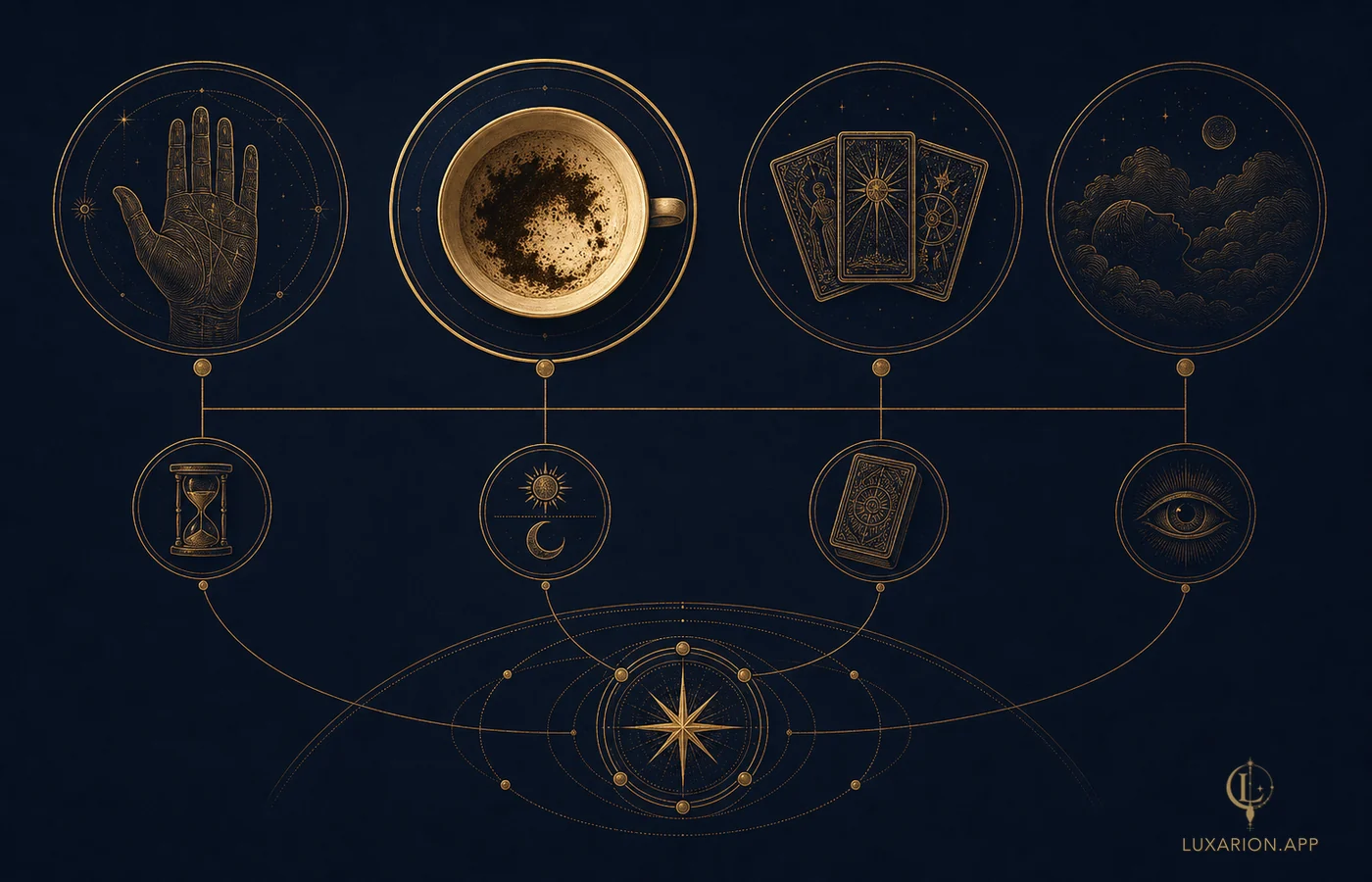
It is worth placing tasseography against its neighbours, because the differences are real.
Unlike palmistry, the image is not carried by the person. A hand is a long record of one life and changes over years; a cup is made fresh in ten minutes and speaks to a season. That is why hands are read for character and cups for circumstance.
Unlike tarot, there is no fixed set of images. A deck has seventy-eight cards with accumulated meanings; a cup has whatever the grounds did this time. Tarot's vocabulary is closed and deep, tasseography's is open and shallow — which makes tarot better for structure and the cup better for surprise.
And unlike dream interpretation, the material is external and shared. Two people can look at the same cup. Nobody else can look at your dream, which is why dream work depends so heavily on the dreamer's report and cup reading does not.
What all four share is the first move: ask about the person before interpreting the material. That is the actual family resemblance across every serious reading craft, and it is the thing amateurs in all of them skip.
What a reading is actually for
Having covered mechanics, it is worth being plain about what the practice delivers, since people arrive expecting the wrong thing and then feel let down by the right one.
A reading gives you three things reliably. Articulation — you arrive with a tangle and leave with a sentence. Permission — the ritual makes it possible to say aloud something that has not been sayable, and readers will tell you that sessions often end with the drinker telling them something rather than the reverse. Attention — for a quarter of an hour, someone considers your situation carefully and says what they see.
None of these is a consolation prize for not getting a prophecy. They are what people actually come for, whatever they say at the door, and they are why the craft survived when a great many more confident systems did not.
It is also worth saying who gets the most from it. People with one live question do better than people wanting a general forecast. People who answer the reader's questions do better than people testing them — withholding does not run an experiment, it just reduces the material and then treats the resulting thinness as proof. And people who take the small step at the end do far better than people who treat the reading as a finished product.
And one honest limit: a reading does not make the decision for you, and should not. Anyone who leaves complaining that the reader would not say what to do has run into the craft's firmest rule rather than its failure.
Trying it yourself
The tea branch is the easiest entry, and you can do a serviceable job this week.
Use loose leaf and a pale wide cup. A dark or narrow cup makes the pattern unreadable, which is most of why home attempts fail.
Leave a spoonful of liquid, swirl three times, invert on the saucer. Wait a full minute. The pattern is still settling and rushing it is the second most common mistake.
Find the handle first. Everything is oriented from it. Near the handle is home and the immediate circle; opposite is the outside world.
Read the whole before any shape. Is it heavy or open? Clustered at the rim or the base? That impression is the reading's frame, and it is more reliable than any individual mark.
Write down what you see before you interpret it. The same discipline that governs dream records, and for the same reason: interpreting while recording contaminates the record. Keep a notebook for a month and what recurs for you becomes your own vocabulary — the principle we set out in your own dream alphabet.
Do not read for others while you are learning. This is the ethical rule, not a modesty. A beginner reading for family as entertainment can say a sentence that sits in someone's chest for a year. Every branch teaches the refusal early for exactly this reason.
Reading what remains
The premise is worth returning to, because it is the reason this family exists at all and it is more thoughtful than the word suggests.
Every one of these crafts takes the leftover — the thing that would be rinsed away — and treats it as worth attention. The tea is drunk and the leaves stay. The coffee is shared and the grounds stay. The year turns and the metal cools. In each case a practice has grown up around the conviction that the residue of something completed carries a shape, and that the shape rewards looking at.
That is why the family survived four centuries of upheaval while a great many more confident systems did not. It costs nothing, it uses what was already there, and it produces something people badly want and rarely get: a structured hour in which someone looks carefully at their situation and says what they see.
If you would like your cup read by someone trained in the coffee branch — who will ask before they answer, stay inside the season, and send you home with a step rather than a prophecy — that is what our readers do. You can book a coffee cup reading. And if you want the honest account of what the craft claims for itself, it is set out in is coffee reading real.
The library teaches the craft. A reading applies it to you.
Get your personal reading