

Ink as Witness: What Writing It Down Actually Does

Writing is more upright for testimony, says the verse on debts. Why the page is the witness that does not move, and why it has to be re-read.
Every practice in this library — the cup, the daily card, the dream at dawn, the evening review — ends at the same object if you follow it far enough. A page.
The tradition put it in writing first. Nūn — by the pen, and what they inscribe: the Qur'an swears by the pen, and speaks of the Lord who taught by the pen. When it orders a debt to be written down, it gives the reason in so many words: writing is more just with God, more upright for testimony, and nearer to preventing doubt. Memory is a witness that wavers. The page is the one that does not.
The scholars carried the rule into knowledge — bind knowledge by writing it, a saying handed down from ʿUmar — and the Sufi masters carried it into the reckoning of the soul. And every life, the tradition holds, is written in any case: on the day of account each person is handed a book and told, read your book; your own soul suffices this day as reckoner against you. A notebook kept honestly is a small copy of that book, written while it can still be corrected.
What the trials describe from outside
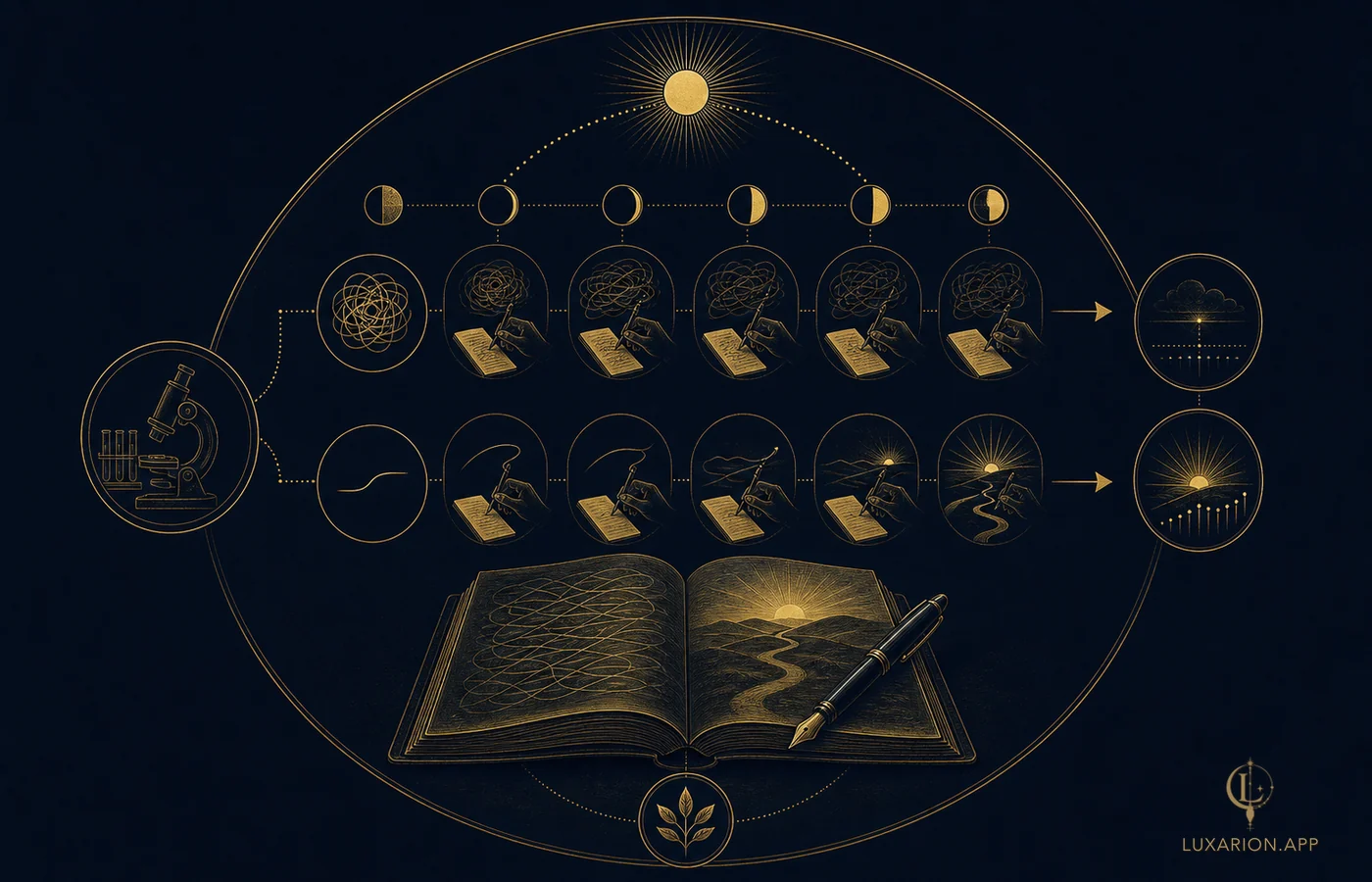
Modern psychology has tested one narrow part of this. Since the 1980s the expressive writing paradigm — associated above all with James Pennebaker — has been run hundreds of times. The protocol is simple: fifteen to twenty minutes of writing about a difficult experience, on several consecutive days, against a control group writing about neutral topics.
The largest meta-analysis of it, published in Psychological Bulletin in 2006, pooled the literature and reported an average effect size of r = .075.
The trials measured a narrow thing — a change in health and mood after a few days of writing — and found it small and consistent, which is more than most self-help practices can say. They did not measure what the page is kept for here: testimony, reckoning, and the pattern that only shows itself across a year of entries.
The more useful finding is in the moderators. Effects are strongest when the writing builds a narrative across the days — moving from what happened toward what it meant — rather than re-venting the same loop. The trials found what the craft already requires: the page helps when it moves. The loop written down is still the loop, the whisper we set apart from the reckoning in the evening return.
The two liars the page replaces
The mechanism the traditions describe is less about writing than about the alternatives.
Tell your day to a friend and it improves in the telling. The friend loves you and your voice edits for the audience — not dishonestly, just automatically.
Tell it to your own memory and it degrades in the other direction. Memory is not an archive. Recalling something makes it briefly editable, and it is re-stored afterwards in a form shaped by the mood you recalled it in — so the past gets quietly re-sentenced to match tonight.
Between the flattering friend and the revising memory there is a third witness available for the price of paper. What you wrote on Tuesday is what you wrote on Tuesday. Come back to it in March and it has not softened, sharpened or taken sides. That stubbornness is the entire offer.
A record nobody re-reads is not a record
Here is the part beginners skip and long practitioners insist on.
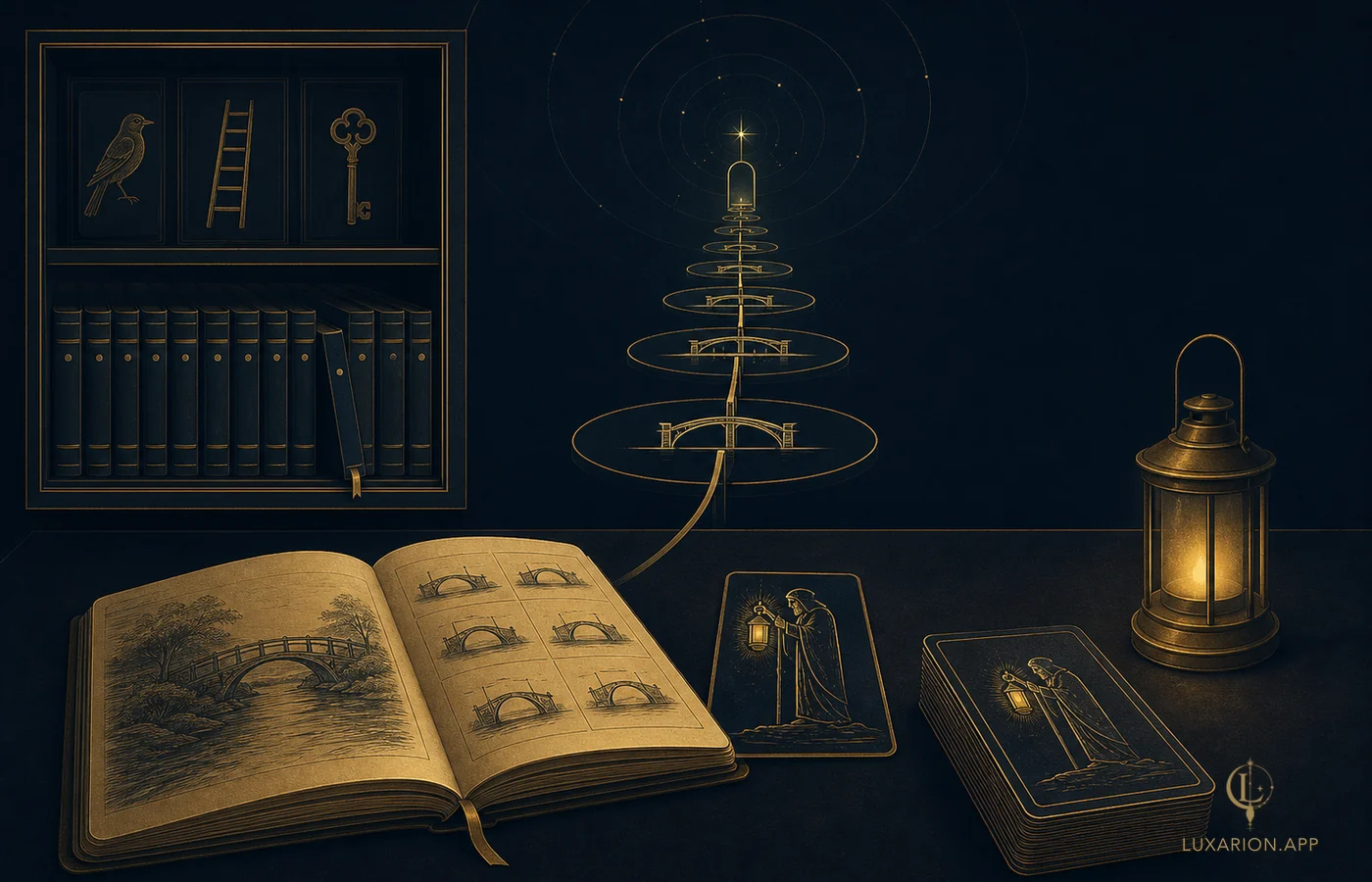
An unread notebook is not a witness. It is a landfill with a nice cover. The value is not deposited by writing; it is realised by returning.
The dream journal earns its keep the month you re-read it and notice the same bridge appearing every time a decision looms — your private alphabet, whose building is described in the bird, the ladder, the key. The card journal earns its keep when a year of mornings shows you that one card keeps arriving before your best decisions rather than your loneliest ones, which is the concordance in one card a day.
So set a re-reading rhythm as fixed as the writing rhythm. Monthly is enough. The writing is the deposit; the re-reading is the interest, and most people never collect it.
Craft notes from long practice
Small rules that recur wherever this is done well.
Date everything. The entry that seems trivial today is evidence in a year, and undated evidence is not evidence.
One notebook, not five. Scattered witnesses cannot testify. A single sequence is what makes a pattern visible.
By hand, if you can bear it. Not because keyboards are impure, but because the hand is slower than thought, and slowness forces selection. Selection is the thinking part.
Never write for a reader. The page is written before no one but you and the One who already knows the day. The emperor whose private notes became one of the most-read books of antiquity never meant anyone to see them, which is exactly why they are honest.
Burning is allowed. When something is too raw to keep, use the old permission: write it fully, read it once, destroy it. The witness serves you, not the other way around.
The quiet meta-skill
Underneath all of it, the page trains the same faculty every craft in this library trains from a different side: the ability to look at what is actually there — in a cup, a card, a dream, a day — before deciding what it means.
Ink buys the pause between seeing and concluding. That pause has its own essay, the quiet sense, and the page is where it does its daily exercises.
Common questions
How long should I write? Fifteen to twenty minutes, as the trials used, is enough. Longer is not better and often turns into the loop.
Every day? The record the tradition keeps is daily — the evening reckoning is nightly — and a pattern only shows in a long sequence. The trials tested something narrower, a few consecutive days around one difficult thing, and that short run has its place too.
Does typing count? The research mostly did not distinguish, so type if that is what you will actually do. The handwriting argument is about selection, not virtue.
What if it makes me feel worse? A day or two of heaviness after writing about something hard is common and passes. If it does not, stop, say the words of refuge, and take it to a person rather than a page.
What do I do with old notebooks? Re-read them on a schedule, and destroy what you need to. Keeping everything is not a virtue.
Where to go from here
If you would rather not start from a blank page, Daily Cosmos offers a line each day you can keep in your own journal — which is a gentler first entry than an empty notebook, and it dates itself. When the re-reading turns up something you cannot place — the same knot returning, a door that keeps closing — a spiritual reading reads what is at work behind it.
The smallest version is the nightly one in the evening return; the monthly rhythm that supports it is in living by the Moon. Both work better with a page than without one.
The library teaches the craft. A reading applies it to you.
Get your personal reading