

You Are Not Your Sun Sign: The Twelve-Box Format Is Ninety Years Old
If your horoscope has never quite fit, the reason is historical. The twelve-signs-for-everybody format was invented for a newspaper column in 1930.
Almost everyone who reads horoscopes has had the same quiet thought: this does not sound like me. The usual responses are that you are reading the wrong column, or that you have not read enough of them, or that you are a difficult case.
There is a better explanation and it has nothing to do with you. The format you are reading was invented in 1930, for a newspaper, to fill a page. It was never how the practice worked, and the people who work in the practice have said so continuously for the ninety years since.
This article is the history and the arithmetic behind that sentence: where the twelve boxes came from, what the tradition did instead, how little your sun sign actually narrows down, why the descriptions can still feel accurate, and what to look at if you want something that distinguishes you from the several hundred million people who share your birth month.
The column that created the format
In August 1930 the Sunday Express asked the astrologer R. H. Naylor to write something about the newborn Princess Margaret. The piece did well. The paper commissioned more, and when a follow-up mentioned danger to British aircraft around the time the R101 airship crashed, the column became a fixture. By 1937 it was running regularly under the title Your Stars.
Naylor faced a production problem no astrologer had faced before: how do you write a personal reading for several million readers you know nothing about? The answer he arrived at is the format everyone now takes for astrology itself — sort the entire readership into twelve groups by birth month, and write one paragraph per group.
Sun sign astrology is that solution, and it spread because it worked as publishing, not because anyone claimed it worked better than what came before. It requires exactly one input, the reader already knows it, and it fits a column. Every constraint that shaped it was a constraint of newsprint.
It is worth saying plainly that this is not a scandal. It is a genre — a short daily reading keyed to the Sun's sign, and there is nothing wrong with reading one. The problem is only that a format designed to address twelve groups gets mistaken for a practice designed to address one person, and then people conclude the whole subject is not for them when the format was never aimed at them individually in the first place.
What the older practice actually read
Go back before 1930 and the sun sign is not the headline. It is not even the first thing consulted.
Hellenistic astrology — the system that took shape around the Mediterranean in the last centuries BCE and that everything later derives from — begins with a full chart drawn for a moment: the positions of the Sun, the Moon and the visible planets, and the degree rising on the eastern horizon. Ptolemy organised this material in the Tetrabiblos in the second century, and his emphasis is on relationships and configurations, not on a single placement read alone.
The two most weighted points were traditionally the Sun and the Moon together — the "lights" — and the rising degree. There is even a doctrine, sect, that changes how the whole chart is read depending on whether the birth was by day or by night, on the grounds that a daytime chart and a nighttime chart are different instruments. Nothing in that structure supports reducing a person to their Sun.
The Arabic and Persian transmission kept the same architecture. Abu Ma'shar in the ninth century, al-Biruni in the eleventh — whose account of the technical apparatus is the most careful ever written — and al-Tusi at the Maragheh observatory all worked from complete charts computed from tables. None of them had a twelve-paragraph format, because none of them was writing for a readership.
Three placements, before anything else
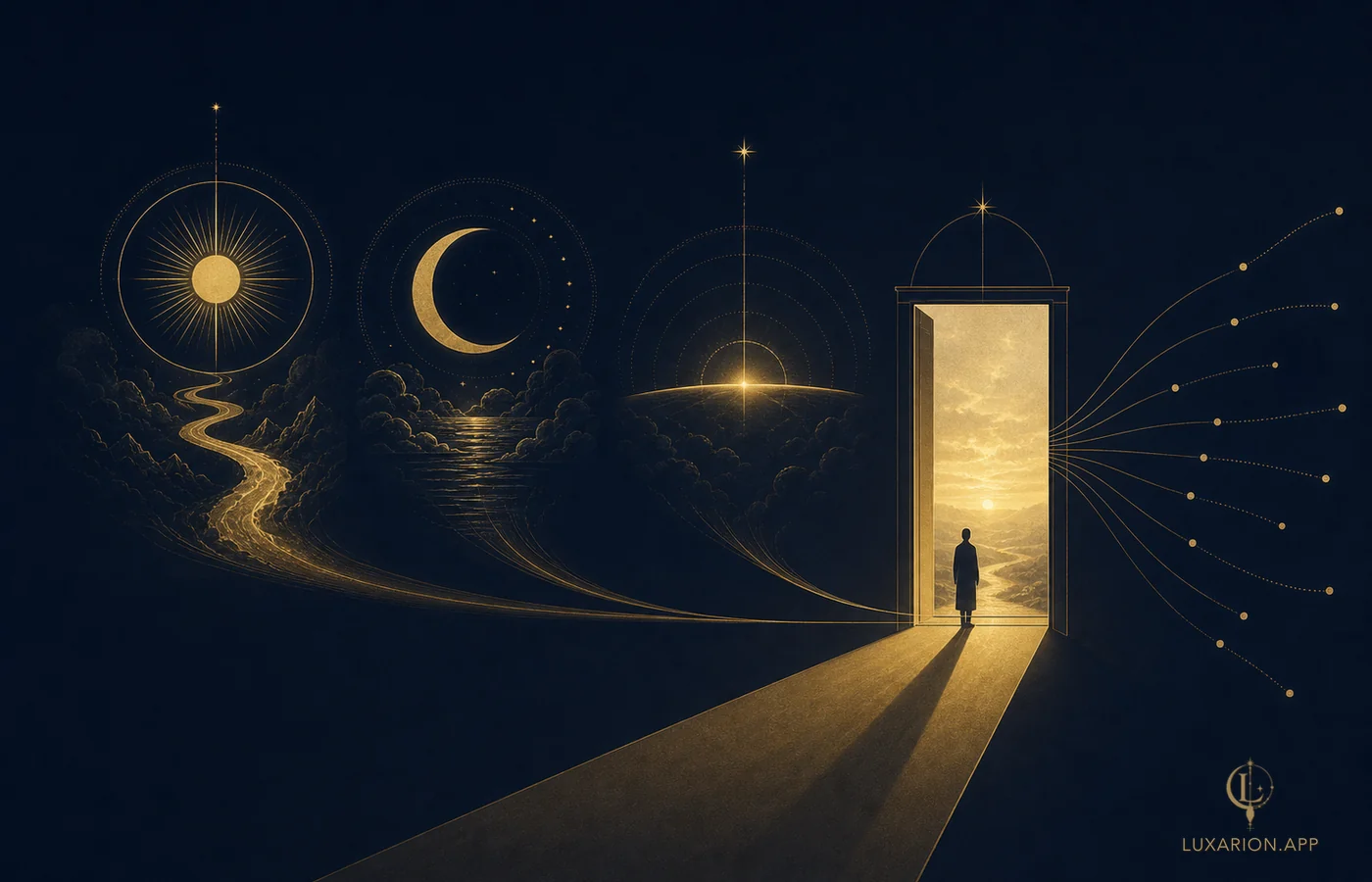
The shorthand practitioners actually use when they have thirty seconds is not one placement but three: the Sun, the Moon and the rising sign.
The reason is speed of change, and it is a purely practical reason. The Sun stays in a sign about a month. The Moon changes every two and a half days. The rising sign changes roughly every two hours. Stack the three and you have moved from a description that fits a twelfth of humanity to one that fits a much smaller group — because each faster-moving placement cuts the population again.
What each of the three actually asks is a longer subject, and we give it its own article: the Sun, the Moon and the rising sign. If you want the rising sign specifically — the one that needs your birth time and that most people have never had calculated properly — that is the rising sign, calculated properly.
And then the parts nobody puts in a column
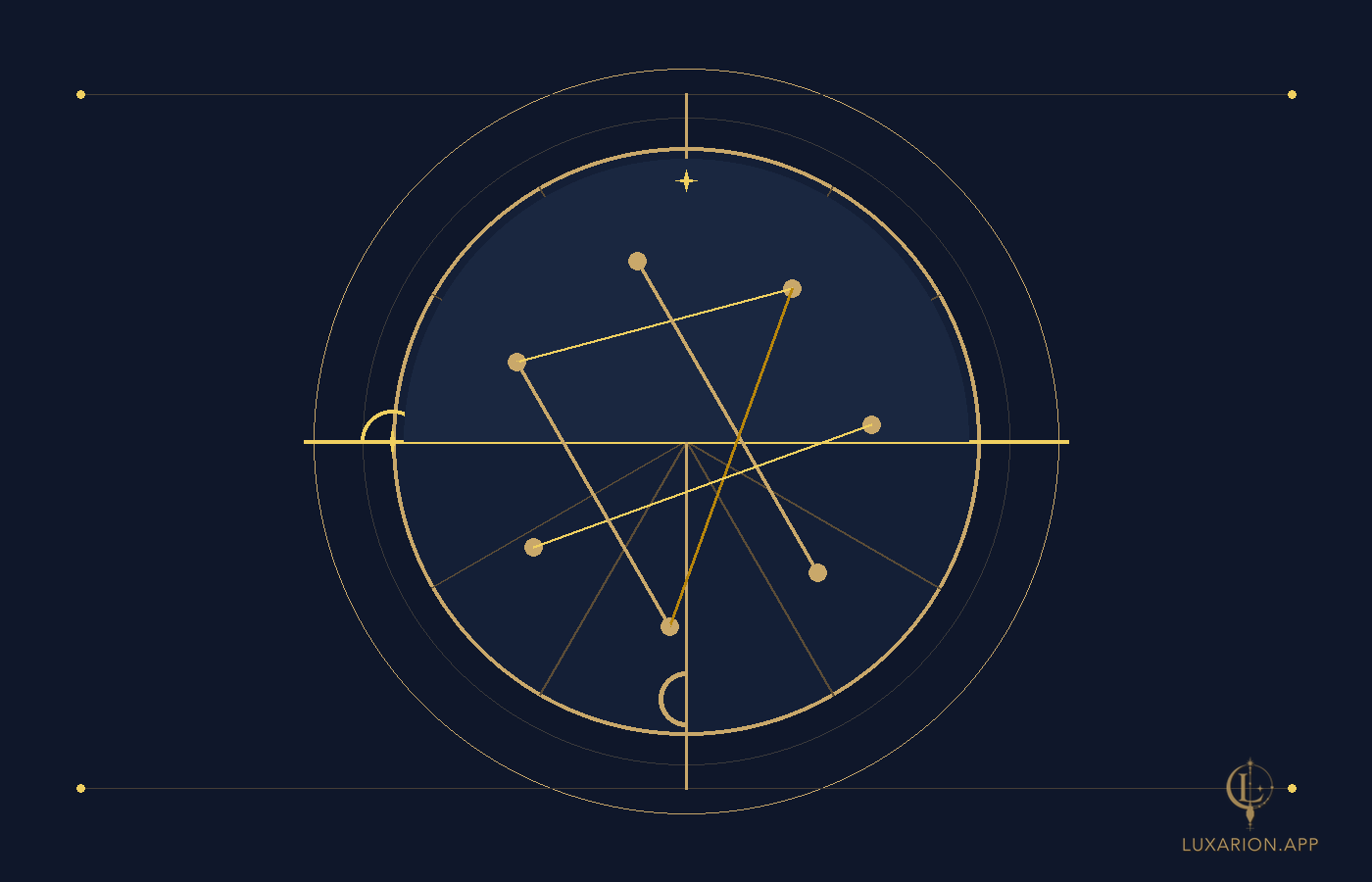
Even the three are an abbreviation. A chart carries a good deal more, and the extra material is precisely what a twelve-box format has no room for.
The houses. The wheel is cut into twelve houses — the departments of a life — and every planet falls into one. The same Mars means something different in the sector of work than in the sector of home. The houses are measured from the rising degree, which is why the birth time is load-bearing rather than decorative.
The aspects. The angles between planets are read as relationships: bodies at ninety degrees pull against each other, at a hundred and twenty they cooperate. An aspect is a statement about two placements at once, and a chart typically has dozens. This is where a reading stops sounding like a list and starts sounding like a person, because it is where contradictions live.
Sect, rulership, condition. Whether the birth was by day or by night; which planet governs the rising sign and where that planet sits; whether a body is in a sign that suits it. These are the qualifiers that make two people with identical Sun, Moon and rising still read differently.
Put the whole apparatus together and the number of possible charts is astronomically large. That is the sense in which no two charts are alike — not a poetic claim, an arithmetic one.
How little a sun sign actually narrows
Numbers make this concrete in a way that argument does not.
Your sun sign puts you in a group of roughly one in twelve people. On a planet of eight billion, that is on the order of six hundred and fifty million people. Any statement true of all of them is, by construction, a statement about human beings in general rather than about you.
Add the Moon and you are somewhere near one in a hundred and fifty. Add the rising sign and you are near one in eighteen hundred — and that last figure is approximate for a reason worth knowing: rising signs are not equally common. Because the twelve signs cross the horizon at different speeds depending on latitude, some are far more frequent as ascendants than others.
Keep going — the other eight bodies, their houses, the aspects between them — and the count runs past the number of people who have ever lived. The chart is not a category. It is closer to a configuration, and a configuration with that many degrees of freedom does not repeat.
This is also the cleanest answer to "my friend and I are both Leos and we are nothing alike". Of course you are not. You share one placement out of dozens, and it is the slowest-moving one on the list.
Where the twelve descriptions come from
There is a further thing worth knowing about sign descriptions, because it explains why they read as schematic even when they are well written: they are built on a grid.
The twelve signs are organised by two crossing classifications. Four elements — fire, earth, air, water — and three modalities, usually rendered cardinal, fixed and mutable, describing whether a sign is held to initiate, sustain or adapt. Four times three is twelve, and the fit is exact: every sign is one element and one modality, and no combination repeats.
So Aries is cardinal fire and Leo is fixed fire; they share a temperature and differ in what they do with it. Virgo is mutable earth and Capricorn is cardinal earth; same material, different posture. Once you see the grid you can practically derive the standard descriptions, which is why a column's paragraphs can sound as though they came off a production line. The grid is the tradition's own architecture; what a column cannot add is everything else in the chart.
Then add the older layer: each sign has a governing planet, and in the tradition a sign is read partly through the condition of that planet in the specific chart. That is the step that turns a category into a statement about one person — and it is the step a column cannot take, because it does not have your chart.
Which reframes the complaint. A sun-sign paragraph is not a bad description of you. It is an accurate description of a cell in a grid, offered where a description of a person was expected.
Same birthday, different chart
Take two people born on the same date — 12 June 1992, say — one in Lisbon at dawn and one in Jakarta in the evening.
Identical Sun sign. Every column, quiz and compatibility chart in the world treats them as the same input.
Their Moons are probably in different signs: the Moon changes sign every two and a half days, so a large fraction of a day's separation is enough to matter, and their birth moments are most of a day apart. Their rising signs are almost certainly different — the ascendant turns through the whole zodiac in a day, and they were born at different hours and at latitudes on opposite sides of the equator, where the fast and slow signs swap places.
Because the rising signs differ, the twelve houses are cut differently, so every planet they do share by sign lands in a different department of life. The same Venus that sits in the sector of home for one sits in the sector of work for the other. And their aspects — the angles between planets — differ too, since the Moon has moved.
Two people, one birthday, and beyond a single placement almost nothing in common. That is not an exotic case. It is the ordinary situation of everyone who shares your birthday, and it is what the twelve-box format necessarily discards.
Why the columns still feel accurate
Here is a fair question: if a sun-sign paragraph addresses six hundred million people, why does it so often land?
Part of the answer is that the Sun's sign is real and its temperament is shared. A column addressed to a twelfth of the population speaks at that altitude, and what it says about the season's weather for that sign does land. What it cannot reach are the parts of you that the Sun does not carry.
The other part is that a chart goes further than a column can. Reading "you have been holding something back" in a column, most people can find the thing. A chart reading asks the harder version — what is held back, from whom, and when it will move — and that is the version it is built to answer.
None of which makes the daily column worthless. It reads the day's sky for a sign, and that is a real reading at its own distance. Our own daily horoscopes are written for that distance — the day's transits read for each sign — and a chart reading is the version written for one person.
The step from column to chart is also a step in time. A column reads the day's transits against a sign; a chart reading reads the same transits against your own placements — Saturn crossing your Moon, Jupiter over your rising degree — which is how the tradition names the seasons of one life rather than the weather of a month. That is where the future in astrology becomes specific: not a paragraph for millions, but a transit falling on a degree that is yours.
What kind of claim this is
Since this article is about being precise, it should be precise about itself.
The astronomy is measurement. Where the Sun, Moon and planets stood at a given moment, and which degree was rising at a given place — these are computed quantities with correct answers, and everything above about speeds and populations follows from arithmetic.
What those positions signify about a person is the tradition's reading — two millennia of it — of the influences, timing and correspondences the sky carries. That is the reading this house practises, and it is precise enough to be worked with.
And the thesis follows: the twelve-box format is a thin version of the practice it comes from. Judging astrology by a newspaper column is like judging medicine by a magazine quiz — look at what the practice actually consists of first.
Reading your own chart in ten minutes
Once you have the chart in front of you, here is a first pass that gets you further than any amount of sign-reading.
1. Read the three as a sentence, not a list. Sun in one sign, Moon in another, rising in a third. Say it as: oriented toward X, needs Y to feel safe, arrives looking like Z. Most of the "astrology never fit me" feeling dissolves at this step, because the contradiction you could not place is usually the gap between the Sun and the rising.
2. Find the two or three placements that repeat. If four bodies sit in water signs, that emphasis says more than any single placement. Practitioners read concentration before they read detail.
3. Look at which houses are crowded and which are empty. An empty house is not a missing life area; it usually means that department runs without much drama. A crowded one is where the chart concentrates.
4. Note the ruler of your rising sign and where it sits. In traditional practice this is the chart's main thread — the planet the whole chart is read through.
5. Resist closing it too fast. The useful reading is the one you return to in six months with a specific question, not the one that hands you an identity in a paragraph.
Common questions
So is my sun sign wrong? No — it is correct and it is small. The Sun really was in that sign. It is one placement among many, and the one you share with the most people.
What does the Sun mean in a full chart, then? Most schools read it as direction rather than description: what a life is oriented toward, what makes effort feel worth it. That is a different question from "what are you like", which is largely why the columns feel off.
Does the "thirteenth sign" story mean my sign changed? No. Western astrology uses the tropical zodiac, which is anchored to the seasons — the March equinox — rather than to the constellations, so the slow drift of the Earth's axis does not reassign anyone. It is a real astronomical phenomenon and a non-event for your chart.
I do not know my birth time. Is any of this available to me? Most of it. Every planet's sign and the aspects between them are computable from the date alone. What needs the time is the rising sign and the houses. Half a chart is a real thing; it just has to be labelled honestly.
Why does Vedic astrology give me a different sign? Because it measures from a different starting point. Western practice uses the tropical zodiac, anchored to the March equinox; Indian astrology generally uses the sidereal zodiac, anchored to the stars. The two have drifted about twenty-four degrees apart, which is most of a sign. Neither is a miscalculation — they are answering slightly different questions, and the tropical and sidereal distinction is the whole of it.
Is there a placement that describes personality better than the Sun? Most practitioners would say the question is malformed: personality is not one placement but the interaction between several. If forced, many would nominate the rising sign for how you come across and the Moon for how you actually feel — which is already two answers, and that is the point.
Does this mean daily horoscopes are pointless? No — they are a genre with a known scope. A daily horoscope reads the day's sky for your sign the way a regional forecast reads the weather for a region; for your own street, the chart and its transits carry the rest.
Where should I start? With your actual chart rather than more reading about signs. Calculate it, look at the Sun, Moon and rising together, and read those three as a set.
Where to go from here
The single most useful step is to stop reading about a category and look at a configuration. Luxarion's birth chart calculator is free and returns your Sun, Moon and rising along with the planets and the houses they occupy; give it your birth date, city, and the most precise time you have.
Then read the three together — reading the three together — and, if the rising sign is the piece you have never had properly calculated, the mechanics of getting it right. If you would rather have the chart read than computed, a natal chart reading starts from the same numbers.
And if you read a column tomorrow morning, read it. The argument here was never that the genre is worthless — only that it is a summary written for six hundred million people, and that you are entitled to the version written for one.
You are still a Leo, or a Pisces, or whatever the column says. It is simply the least interesting true thing about your chart.
The library teaches the craft. A reading applies it to you.
Get your personal reading