

Your Rising Sign, Calculated Properly: Why the Two-Hour Rule Is an Average

Every page repeats that the ascendant changes every two hours. It is an average — and knowing where that number comes from stops you calculating the wrong one.
Somebody searched for the phrase ascendant changes every two hours source, and that is one of the better questions in astrology, because it is the question of someone who has read the claim four times and noticed that nobody ever says where it comes from.
Here is where it comes from. There are twelve signs. The sky turns once in roughly twenty-four hours. Twenty-four divided by twelve is two. That is the entire derivation.
It is a real number and a useful one, and it is an average — the kind of average that describes the set without describing a single member of it. The actual time each sign spends crossing the eastern horizon depends on which sign it is and how far north or south you were born, and the spread is not small: at the latitude of Paris, one sign takes about an hour to rise and another takes nearly three.
That gap is the reason the free hour-table you found gave you an answer you did not recognise. This article is about the machinery underneath: what is physically rising, why the durations are uneven, what the ascendant does to the rest of a chart, and how to get your own calculated from the three pieces of information it actually needs.
What is actually rising
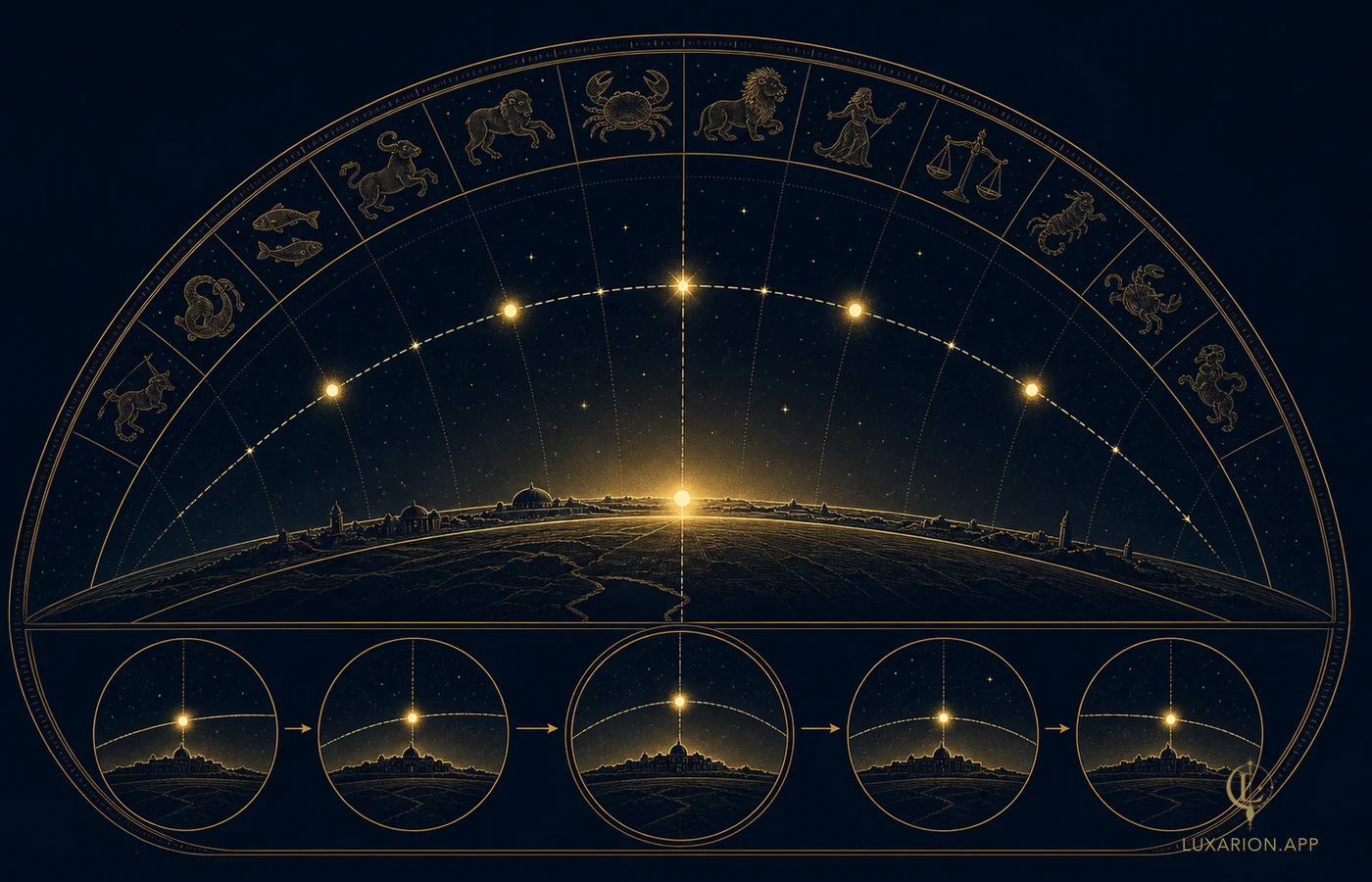
Stand outside before dawn and face east. The line where the ground meets the sky is your horizon — not a fixed thing in space, but a plane defined by exactly where you are standing. Move a few hundred kilometres north and your horizon tilts relative to the stars.
Across that horizon, all night, objects climb into view: stars, planets, the Moon. They are not moving. The Earth is turning beneath them at about fifteen degrees an hour, and the effect from the ground is a sky that rises in the east and sets in the west.
Now add one more line. The Sun traces a path through the year called the ecliptic, and the band of sky either side of that path is divided into the twelve signs of the zodiac. The ecliptic is tilted about 23.4 degrees to the Earth's equator — that axial tilt is what gives us seasons, and it is also, as we will see, what makes the rising times uneven.
The ascendant is the point where the ecliptic crosses your eastern horizon at a given moment. The sign containing that point is your rising sign. It is a genuinely astronomical quantity: given a date, a clock time and a pair of coordinates, it has one correct value, computable to the arc-second, and two people who compute it correctly will agree.
What the ascendant is taken to mean is a separate question, and one we come back to at the end. The measurement and the interpretation are two different kinds of claim, and keeping them apart is the difference between an article you can trust and one you cannot.
Why "every two hours" is an average and not a fact
If the ecliptic lay flat along the celestial equator, each sign would rise in exactly two hours everywhere on Earth and the tables would work. It does not lie flat. It is tilted, and it crosses your horizon at an angle that changes through the day and changes again with your latitude.
The consequence is that signs cross the eastern horizon at visibly different speeds. Wikipedia's own article on the ascendant works the numbers for two cities, and they are worth quoting because they are the concrete version of everything above:
- At the latitude of Paris — Pisces and Aries take roughly one hour to cross the eastern horizon. Virgo and Libra take about two hours and forty-five minutes.
- At the latitude of Saint Petersburg — the same fast signs take about thirty-five minutes. The same slow ones take three hours and twenty.
At the equator the twelve are near enough equal; the further from it you were born, the wider the spread. In the southern hemisphere the fast and slow signs swap places.
Three practical things follow, and none of them appear on the hour-table pages.
First, rising signs are not equally common. If Virgo occupies two hours and forty-five minutes of every day at your latitude and Aries occupies one, then at that latitude roughly three times as many people are born with Virgo rising as with Aries rising. The twelve are not a fair lottery.
Second, the fast signs are where tables fail hardest. A two-hour grid assumes every sign gets a two-hour slot. For a sign that really rises in an hour, the grid is wrong by up to a full sign, and the error is systematic — it is not bad luck, it happens to everyone born under that sign.
Third, a table is silently built for one place. Whoever made it picked a latitude — usually the capital city — and the further you were born from it, the further the table drifts. A birth in northern Scotland and a birth in Sicily are not the same calculation, and no table that asks only for a date and a clock time can tell the difference.
The same clock time gives a different answer in March and in September
Here is the fact that quietly destroys the entire hour-table genre, and it has nothing to do with latitude.
Our clocks run on solar time — they are built to keep the Sun overhead at roughly noon. But the ascendant is a question about the stars, and the stars keep a slightly different schedule, called sidereal time. A sidereal day is about four minutes shorter than a solar one, because in the twenty-four hours it takes Earth to turn back under the Sun, it has also moved a little way around the Sun and has to turn a fraction further to catch up.
Four minutes a day sounds negligible. It is not, because it accumulates: four minutes a day is two hours a month, and twenty-four hours across a year. The sky visible at 21:00 in January is the sky visible at 19:00 in February and at 03:00 the previous July.
Applied to the ascendant, this means the rising sign at 14:00 on 1 March is not the rising sign at 14:00 on 1 September. Same clock, same city, roughly opposite side of the zodiac. A table that asks only for your hour is missing the input that does most of the work.
You can see it without any equipment. Note which constellations are overhead at a fixed hour one evening, then look again at the same hour a month later. Everything has shifted west by about two hours' worth of sky. That drift is precisely what the ascendant calculation is tracking, and it is why the date is not a formality.
A worked example
Two people are born in the same hospital in Istanbul on 12 June 1992. One arrives at 05:40, the other at 07:10 — ninety minutes apart, the same day, the same building, the same midwife.
They share a Sun sign; the Sun moves about a degree a day and has barely stirred. They almost certainly share a Moon sign; the Moon covers roughly half a degree an hour and will not have changed sign in ninety minutes unless it was already at the very end of one.
The ascendant is a different story. In ninety minutes it advances about forty-five degrees on average — more if a fast-rising sign is on the horizon, less if a slow one is. It is entirely ordinary for those two births to have different rising signs, and when they do, every house boundary in the two charts sits in a different place. Two charts, one day, one city: same Sun, same Moon, different frame around both.
This is what practitioners mean when they say the birth time is not a detail. It is the input that separates two people born the same day, and it is the only one of the three that regularly goes missing.
What the ascendant does to everything else
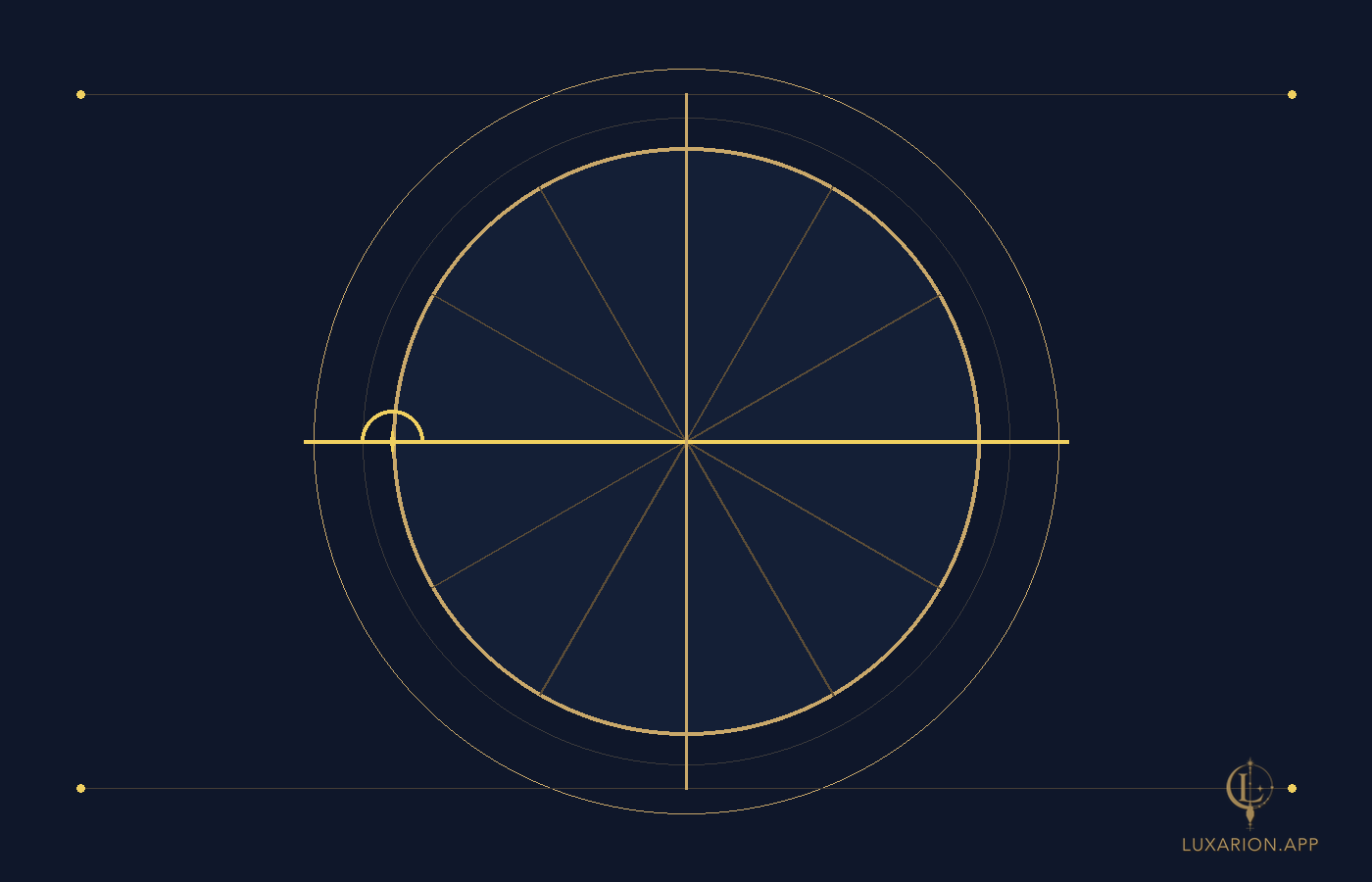
If the ascendant only told you one more sign, an approximate answer would be tolerable. It does much more than that, which is why practitioners are so insistent about birth times.
A birth chart is divided into twelve houses — the sectors traditionally associated with the departments of a life: body and appearance, money, siblings and short journeys, home, and so on round the wheel. The houses are measured from the ascendant. It is the first cut of the circle; every other boundary follows from it.
So an ascendant that is off by one sign does not produce a chart with one detail wrong. It produces a chart in which every planet has been relocated to a different department of life. The Mars that a correct chart puts in the sector of work appears, in the wrong chart, in the sector of partnership. Nothing looks broken. The reading is simply about somebody else.
Luxarion's calculator uses the Placidus system, the most widely used of the several methods for dividing the houses; the systems differ in how they cut the intervening space, and all of them start from the same ascendant. That is the point: the ascendant is the load-bearing measurement, whichever system you prefer.
The three inputs, and the one that goes wrong
A correct ascendant needs exactly three things, and they are not equally reliable.
Date of birth. Almost never wrong. Where it is wrong, it is wrong by a lot — a midnight birth recorded on the following day, a birth certificate issued weeks later in a country with different conventions — and it is worth a glance if your chart has never made sense.
Place of birth. Reliable, but be specific. The hospital's town, not the region. Latitude is what shapes the rising times, so a hundred kilometres north or south genuinely matters near the edges of a sign.
Time of birth. This is the fragile one, and it is fragile in two different ways.
The first is precision. If your birth time is recorded to the nearest fifteen minutes — as it often is, because someone glanced at a wall clock during a busy night — you may be within a sign of the boundary without knowing it. Ascendant degrees advance continuously; there is no rounding in the sky.
The second is subtler and catches almost everyone. The number written on your certificate is a civil clock reading, not an astronomical one. Civil clocks are political objects. They are set by time zones, and those zones have been redrawn more often than people expect, and many countries add an hour for part of the year under daylight saving time — and the rules for when that hour starts and stops have themselves changed repeatedly.
To convert a clock reading into a real position of the sky, you need to know what the offset actually was in that place, on that date. That information exists: it is maintained in the IANA time zone database, the same reference every operating system uses, and it records the historical rules country by country and year by year.
This is why Luxarion's free birth chart calculator asks you to pick your birth city from a list rather than typing an offset. Choosing the city attaches the full historical rule set for that place, so a birth at 14:00 in July 1985 and a birth at 14:00 in January 1985 are converted differently — because they were different moments in the sky, whatever the clock said.
Why the free hour tables give the wrong answer
Now the three failures can be stated together. A typical "rising sign by hour" table asks for your sun sign and your birth hour and returns an ascendant. To do that with two inputs, it must assume three things:
- That every sign rises in two hours. At any latitude away from the equator, some rise in half that.
- That you were born at the table's latitude. It cannot ask, so it has to pick one and hope.
- That your clock reading is already the right offset. It has no date, so it cannot know whether summer time was in force.
Each assumption can move the answer by a sign on its own. Together they can move it by two. The table is not being dishonest; it is doing arithmetic with numbers it was never given.
The related genre — calculating a rising sign without a birth time — deserves a plain answer. It cannot be done. The ascendant is defined by the moment; with no moment there is no ascendant, and any tool that prints one is printing a guess. Luxarion's calculator will not: leave the time field empty and it returns your Sun and Moon and tells you the rising sign is unknown, because that is the truthful output. Half a chart, honestly labelled, is worth more than a whole one that might belong to a stranger.
How to recover a birth time you do not have
Most people who think their birth time is lost have simply not looked in the right place. In rough order of reliability:
The long-form birth certificate. The short certificate people carry usually omits the hour; the long form — the full record held by the registering authority — often includes it. In the United States this is the "vault copy" or long-form certificate ordered from the state's vital records office. Rules vary by country and it is worth checking what your own birth registry actually holds before assuming the time is gone.
Hospital records. Delivery notes record the time of birth as a clinical fact. Retention periods vary, but many hospitals hold maternity records for decades.
The baby book, the back of a photograph, the telegram. Families wrote it down more often than they remember. A grandmother's diary has settled more charts than any calculator.
Your parents' memory — used carefully. "Just after the morning news" is a better datum than "sometime in the morning", because it can be pinned to a schedule. Anchor the memory to an event with a known time rather than asking for a number.
If it is genuinely unrecoverable, you have not lost the chart — you have lost part of it. Every planet's sign, and the angles between the planets, can still be calculated for the date. What you cannot have are the houses and the ascendant. A good reading tells you which of its statements rest on the missing piece, and a good tool refuses to invent it.
What the rising sign is held to mean
Everything above is measurement. This section is interpretation, and it is worth being clear about the difference: the ascendant's position is an astronomical fact; what it signifies about a person is a claim made by an interpretive tradition, offered as a lens for self-reflection rather than as a finding about how the world works.
Within that tradition the ascendant has a consistent job. It describes the manner of arrival: the way you enter a room, the register strangers read you in, the reflexes that fire before deliberation does. Ptolemy treats the rising degree as the chart's foundation in the Tetrabiblos, and every later school inherits that emphasis, whatever else it revises.
The everyday phrasing is that the ascendant is a mask. That is nearly right and slightly unfair. A mask implies concealment, and the more useful reading is a doorway: the part of you that meets the world first, shaped as much by what the world kept responding to as by anything you chose. Someone with a reserved ascendant and an expansive Sun is not lying about either. They are describing the difference between the entrance hall and the room.
This is also why the rising sign is the placement people most often say "fits" once they finally have it calculated correctly. It is the one other people can see.
Common questions
Does the rising sign really change every two hours? On average, yes — twelve signs, one rotation, two hours each. In practice it varies by sign and by latitude: near Paris, from about one hour to about two and three-quarters. The average is a good rule of thumb and a poor calculator.
Can I find my rising sign without a birth time? No. The ascendant is defined by the instant of birth. Without it there is no answer, only a guess with a confident font.
My birth time is approximate. Is the chart useless? Not at all — it is uncertain in a known way. Calculate the chart for the earliest and latest plausible times. If the ascendant is the same for both, you have it. If it differs, you have narrowed it to two candidates and you know exactly what to go looking for.
Do twins have the same rising sign? Usually, but not always. The ascendant moves about half a degree a minute, so twins born twenty minutes apart are around ten degrees apart — and if the first was born near the end of a sign, the second has a different one.
Is the rising sign more important than the sun sign? They answer different questions, so ranking them is the wrong move. The Sun is what a life is oriented toward; the ascendant is how it arrives. We take up the whole comparison in the Sun, Moon and rising sign together, and the reasons the sun sign alone carries so little in why you are not your sun sign.
Why do two sites give me different rising signs? Almost always the time zone. One applied summer time for your birth date and the other did not. Check whether each asked for your birth city or only a country — the one that asked for the city has the better chance of being right.
Getting yours
Find the most precise birth time you can, identify the city, and calculate it once, properly. Luxarion's birth chart calculator is free, applies the historical time rules for the place you were born, and returns your Sun, Moon and rising together with the planets and the houses they fall in — or tells you plainly that the rising sign is unknown if you have no time to give it.
If you want the chart read rather than computed, a natal chart reading works from the same calculation and takes it further. Either way, the sequence is the same: get the measurement right first. Everything downstream inherits it.
The library teaches the craft. A reading applies it to you.
Get your personal reading