

Sun, Moon and Rising: Three Questions, Not Three Labels
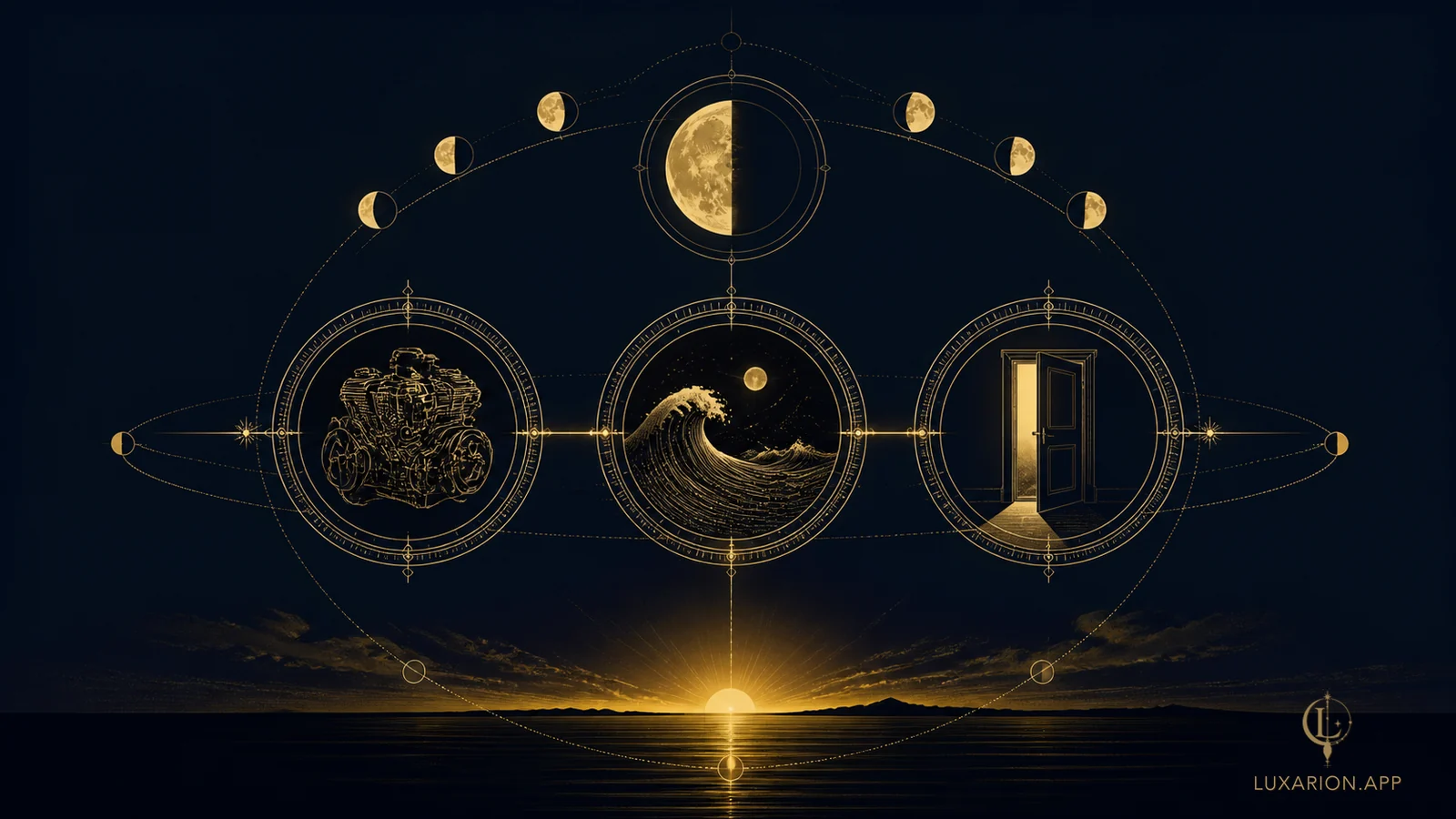
Most confusion about the big three comes from asking one placement for another one's answer. Each is built to answer a different question.
The big three get introduced as three labels — core self, emotions, mask — and that framing is where most of the confusion starts. Three labels invite the question which one is the real me, and that question has no answer, because the three were never competing.
They are three questions. Different questions, asked of the same chart, that happen to be answerable by three placements that move at three very different speeds.
- The Sun asks: what is this life for — what does it keep moving toward?
- The Moon asks: what does this person need in order to be all right?
- The rising sign asks: how does this person arrive — what meets the room first?
Once you hold them as questions, the thing that used to feel like a contradiction becomes the most useful part of the chart. This article takes each in turn, then spends most of its length on what happens when they disagree — because that is where a chart stops being a description and starts being usable.
The Sun: what the life is for
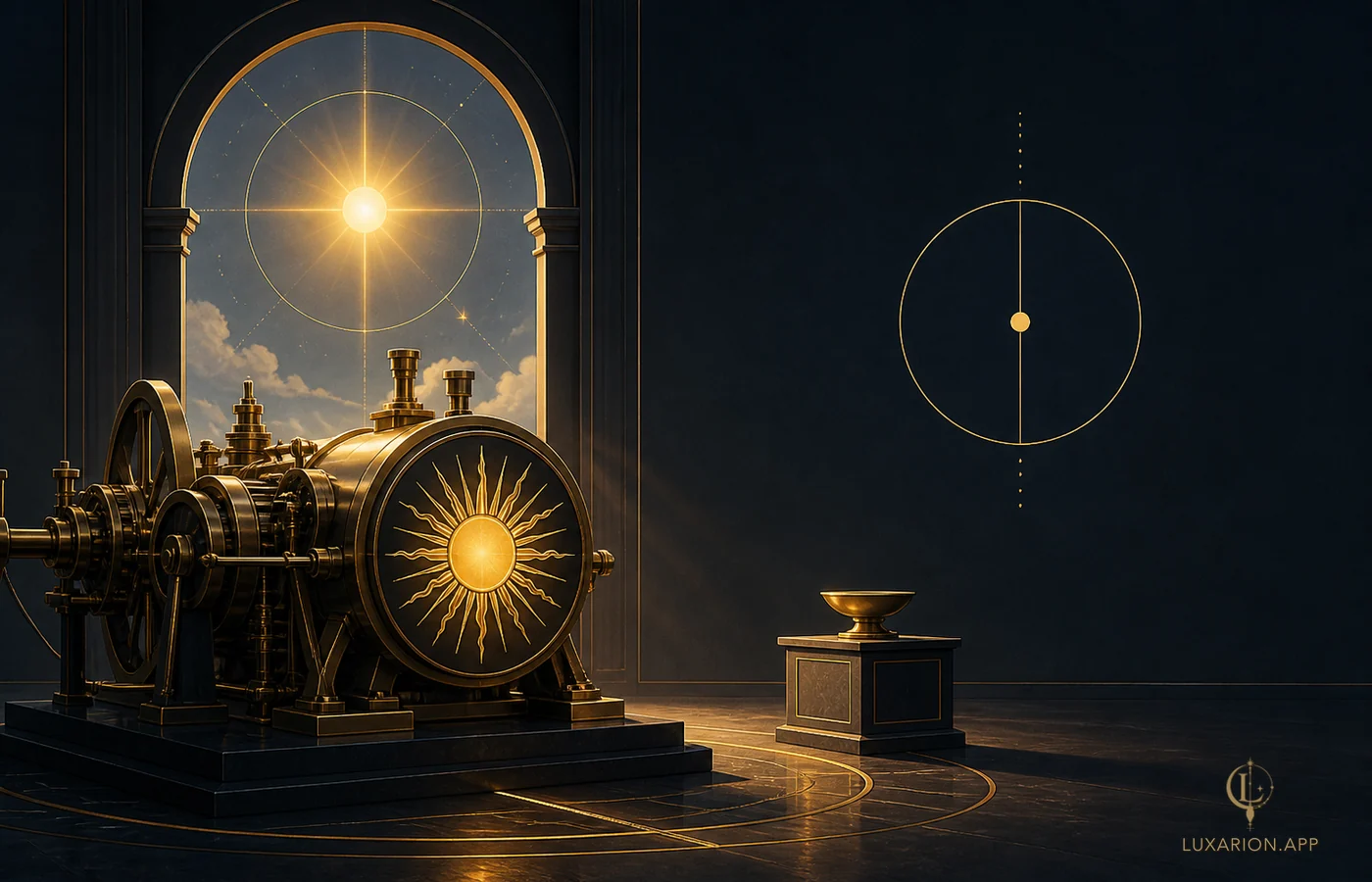
The Sun spends about a month in each sign, which means it is the placement you share with the most people and the one every horoscope column is written about. That is exactly why it gets misread.
The tradition does not treat the Sun as a personality description. It treats it as a direction: what a life is oriented toward, where vitality comes from, what makes effort feel worth the cost rather than merely tiring. Ptolemy and everyone after him place the luminaries at the centre of a chart for this reason — the Sun is the thing the rest is organised around.
Read that way, a Sun sign becomes a much more interesting statement, and a more forgiving one. A Sun in a sign associated with visibility is not a claim that you are outgoing. It is a claim that something in you is fed by being seen, and that a life arranged to avoid ever being seen will feel like it is running on the wrong fuel — whatever your manner is like.
It also explains a pattern people notice and cannot account for: the Sun sign tends to fit better with age. At twenty you are mostly your circumstances and your reflexes. At forty you have made enough choices for a direction to be visible in them. The placement did not change; the distance travelled along it did.
And if you have decided the sun sign is worthless because the columns never fit, that conclusion is worth revisiting from a different angle — we take it up in full in why you are not your sun sign.
The Moon: what it takes to be all right
The Moon changes sign every two and a half days. It is the placement most people have never looked up, and the one that most often produces the reaction that is uncomfortably accurate.
Where the Sun is about direction, the Moon is about need. What settles you. What you reach for when the day has gone badly. What "safe" concretely consists of — quiet, or company, or a plan, or an unstructured afternoon. In older language the Moon governs the domestic, the habitual, and the maternal, and in practice it reads as the part of a person that is not on display and does not want to be.
Two things follow that are worth knowing.
The Moon is where the private contradiction usually lives. A composed, ambitious Sun with a Moon in a sign associated with feeling and retreat produces someone who is genuinely both — driven in daylight and in need of a great deal more comfort than they let on. Neither half is a performance.
The Moon is calculable without a birth time, usually. Because it moves about half a degree an hour, a birth date and place are enough to determine the Moon's sign on most days. On the days it changes sign, they are not — which is one of the few places where an hour or two of uncertainty genuinely matters even without the ascendant.
The rising sign: what meets the room first
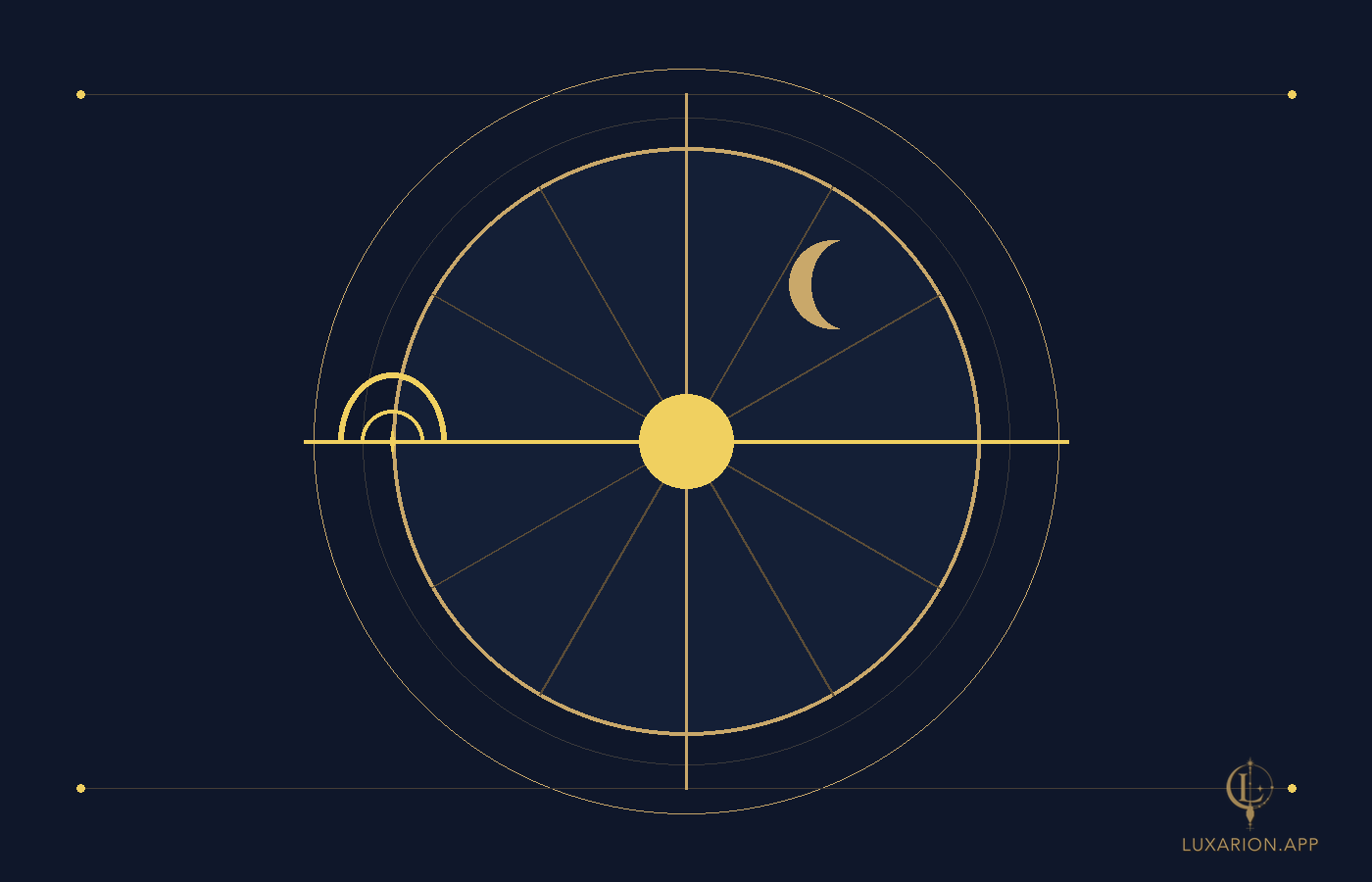
The rising sign — the ascendant — is the degree of the zodiac climbing the eastern horizon at the moment of birth. It changes roughly every two hours, which makes it the fastest of the three and the one that most sharply distinguishes two people born the same day.
Its question is arrival. How you enter a room, the register a stranger reads you in, the reflexes that fire before you have decided anything. It is the only one of the three that other people can observe directly, which is why it is the placement friends recognise instantly and you often do not.
The rising sign also does structural work the other two do not: the twelve houses are measured from it. Every planet in the chart lands in a department of life determined by where the ascendant falls, so getting it wrong does not misplace one detail — it relocates everything. This is why the rising sign is the one placement that genuinely requires an accurate birth time, and why the calculation has more traps in it than people expect. The mechanics, including why the hour tables you find online will often give you the wrong one, are in the rising sign, calculated properly.
When the three disagree
Here is the part that makes the big three worth knowing, and it is almost always skipped.
If your Sun, Moon and rising were all in the same sign, you would be an unusually consistent person and a fairly uninformative chart. Most people are not that. Most people have three placements pulling in three directions, and the specific shape of that disagreement is the most useful thing a first reading can hand you.
Consider the three most common shapes.
Sun against rising. Someone oriented toward something expansive, arriving in a reserved manner. The world consistently reads them as more contained than they are, and they spend years feeling slightly mistranslated. Naming the gap does more than any amount of advice: it is not that they are shy about their ambition, it is that the arrival and the direction are different placements.
Sun against Moon. A direction that costs the thing the person needs. Ambition that requires exactly the exposure that leaves them depleted. This one is not resolved, it is budgeted — the practical reading is that the Moon's requirements are not optional and have to be scheduled, not overcome.
Moon against rising. Someone who arrives warmly and needs solitude, or who arrives briskly and needs reassurance. This is the shape most often mistaken for being fake. It is not: one is what people meet, the other is what restores them, and there is no rule that those must match.
In every case the useful move is the same. Stop asking which is the real one. Ask what each is asking for, and notice which of the three you have been systematically ignoring — because that is usually the answer to whatever made you look up your chart in the first place.
Reading the three as one sentence
The practical technique is to refuse the list format. Instead of Sun in A, Moon in B, rising in C, say it as a single sentence with the relationships in it:
"Oriented toward A, needs B to be all right, arrives looking like C."
Then read it aloud and notice where it strains. If A and C sit comfortably together and B is the odd one, you have a person whose public life is coherent and whose private requirements go unmet. If B and C agree and A is the outlier, you have someone comfortable in their own life and quietly unsure what it is for.
This takes about a minute and gets further than a page of sign descriptions, because it is asking the chart a structural question rather than looking up three definitions.
A quick reference by element
Twelve descriptions per placement would be thirty-six paragraphs and most of them would be filler. The four elements carry most of the useful distinction, so here is the compressed version — what a Moon of each element tends to need, and how a rising of each element tends to land.
Fire (Aries, Leo, Sagittarius). A fire Moon settles through motion and expression: it needs somewhere to put the energy, and goes flat when contained too long. A fire rising arrives at temperature — noticed quickly, read as confident whether or not that is how it feels from inside.
Earth (Taurus, Virgo, Capricorn). An earth Moon settles through the tangible: a routine that holds, a body that is fed and rested, a plan with edges. Reassurance in the abstract does very little for it. An earth rising arrives as steadiness — read as reliable and slightly reserved, sometimes as harder to reach than the person actually is.
Air (Gemini, Libra, Aquarius). An air Moon settles by putting things into words: it processes out loud and feels trapped by a feeling it cannot articulate or discuss. An air rising arrives conversationally — read as easy and approachable, occasionally as lighter than the person is.
Water (Cancer, Scorpio, Pisces). A water Moon settles through depth of contact: one person who genuinely understands does more than a room of friendly acquaintances, and it needs recovery time after exposure. A water rising arrives with atmosphere — read as intense or gentle depending on the sign, and almost always as having more going on beneath than is being said.
The Sun works differently in this framework — its element describes what feeds a direction rather than what soothes or how one lands — which is another reason the three do not reduce to one another.
Three worked configurations
Abstract structure is easier to see in concrete cases. These are configurations, not people; the point is the shape.
Capricorn Sun, Cancer Moon, Gemini rising. Oriented toward building something durable, needs a great deal more emotional shelter than the direction implies, and arrives light and conversational. Others meet the Gemini and assume the whole person is easy-going; the Capricorn is doing the actual steering, and the Cancer is the part that gets neglected because neither of the other two makes room for it. The practical reading is that this configuration overruns on effort and underspends on rest, and knows it only after the fact.
Pisces Sun, Virgo Moon, Scorpio rising. Oriented toward something diffuse and meaningful, needs order and competence to feel all right, and arrives with intensity. The Sun and the Moon are pulling directly against each other — a direction that resists structure, a need that requires it — and the Scorpio arrival makes the whole thing read as deliberate when internally it is anything but. The useful sentence here is that the Virgo Moon is not a betrayal of the Piscean direction; it is the scaffolding without which the direction never gets built.
Leo Sun, Aquarius Moon, Taurus rising. Oriented toward being seen and mattering, needs distance and independence to be all right, and arrives slow and solid. This one confuses people who know the person at only one distance. Colleagues see the Taurus. Close friends see the Leo. Almost nobody sees the Aquarius Moon, including sometimes the person themselves, who mistakes their need for space for something wrong with them rather than a stated requirement of the chart.
Notice what these have in common: in every case, the actionable content is the tension, not any single placement. A reading that only lists three signs has thrown away the part that was worth having.
Which one is "really" you?
The honest answer is that the question imports an assumption the tradition does not share — that a person has one true layer and the rest is packaging.
If you want a working answer anyway: the rising is what others meet, the Moon is what you experience, and the Sun is what you are becoming. All three are you. They differ in who has access to them.
There is also a rough developmental pattern that practitioners notice, which is worth taking as an observation rather than a law: younger people tend to recognise themselves in the rising and the Moon, and to find the Sun description unconvincing. Older people report the reverse. That is what you would expect if the Sun is a direction rather than a description — a direction is more visible once some of it has been walked.
What the three do not cover
It is worth being clear about the limits, because "the big three" is sometimes sold as if it were the whole chart.
It is not. It is three placements out of a dozen or more bodies, plus twelve houses, plus the aspects between everything. The three are the standard first pass because they are the fastest-moving and therefore the most distinguishing — not because the rest is decoration.
In particular, the three tell you nothing about where in life any of this plays out. That is the houses' job, and it is entirely possible for two people with identical big threes to have those placements landing in completely different departments of a life. If the big three feels accurate but abstract, the houses are usually the missing piece, and they are in the same free calculation.
Where the three came from
"Big three" is recent packaging, but the emphasis behind it is not, and knowing that changes how much weight the shorthand deserves.
Classical practice grouped the Sun and Moon together as the two lights and gave them first weight, with the ascendant as the third point of reference — the degree from which the whole chart is framed. That grouping shows up across the tradition's transmission, from the Greek material Ptolemy systematised through the Arabic and Persian commentators who carried it forward.
What is genuinely modern is the name and the idea that these three constitute a portrait on their own. The older practice treated them as the first three things you establish before doing the work, not as the work itself. That is a meaningful difference: the shorthand is a fair summary of an old priority, and a poor substitute for a full reading.
It is also worth noticing why these three and not, say, the three fastest planets. The answer is that two of them are the lights — the two bodies that visibly govern day and night — and the third is the only point in the chart determined by the observer's own horizon. They are the three that connect a chart to a specific person standing in a specific place, which is exactly what a chart is trying to be.
Getting all three
You need three inputs: your birth date, your birth city, and your birth time. The first two are usually easy; the third is the one that goes missing, and it is the one the rising sign cannot do without.
Luxarion's birth chart calculator is free and returns all three together, along with the planets and the houses they fall in. It asks for your birth city rather than a time zone offset, so the historical time rules for that place and date are applied for you. If you do not have a birth time, it gives you the Sun and Moon and says the rising sign is unknown rather than guessing — which is the honest output, and better than a confident wrong answer.
If you want the three read rather than listed, a natal chart reading starts from the same calculation and works through the interactions — the disagreements above, in your specific configuration, with the houses included.
Common questions
Do I need my exact birth time for all three? Only for the rising sign. The Sun needs the date; the Moon needs the date and usually nothing more; the rising needs the time and the place.
My rising sign describes me better than my Sun. Is that normal? Very. It is the placement other people see, so it is the one your self-image has been trained on. It is also, in the developmental pattern above, the one that fits earliest.
Can my Moon and rising be the same sign? Yes, and it produces an unusually legible person — what they show and what they need are the same thing. It is neither better nor worse; it simply removes one of the tensions described above.
What if all three are in the same sign? Then that sign's themes are unusually concentrated, and practitioners read that concentration as significant in itself. It is uncommon: roughly a one-in-a-few-hundred configuration, and less than that once the uneven distribution of rising signs is taken into account.
Is the big three a traditional idea? The packaging is modern; the emphasis is not. Classical practice weighted the two luminaries — Sun and Moon — together with the ascendant above other points, so the modern shorthand is a fair summary of an old priority under a new name.
Where does the Moon sign come from if I do not know my birth time? From the date and place. The Moon covers about half a degree an hour, so it is only ambiguous on the days it changes sign — and a good calculator will show you the degree, which tells you whether you are near a boundary.
Where to go next
Calculate the three, write them as one sentence, and sit with the place where the sentence strains. That single exercise is worth more than reading three separate sign descriptions.
Then, depending on which part you want to go deeper into: the mechanics of the rising sign if the calculation is what you are unsure about, or why the sun sign alone carries so little if you arrived here sceptical. Both start from the same free chart calculation, and both end in the same place: three questions, asked properly, about one person.
The library teaches the craft. A reading applies it to you.
Get your personal reading