

The Twelve Houses: What an Empty House Really Means
Most charts have empty houses, and almost every list of twelve leaves out the technique that reads them. Here it is, with the rest.
Almost everyone arrives at this subject through the same door, and it is not the one the guides expect. They have looked at their chart, found the seventh house — the one every list labels marriage and partnership — and found it empty. No planets. Nothing in it at all.
And the question that follows is genuinely upsetting: does that mean nothing happens there?
The answer is no, and the reason is the single most useful piece of technique in this whole subject. An empty house is read through its ruler. The sign on the cusp of that house has a planet that governs it, that planet is somewhere in your chart, and where it sits is where the business of that house is actually conducted. A seventh house in Libra sends you to Venus; find Venus and you have found the reading.
Most charts have empty houses. With ten bodies and twelve compartments, they are unavoidable — a chart with something in every house would be the unusual one. And almost no list of twelve mentions this, which is why so many people spend a year believing their chart has holes in it.
This article is the rest of what those lists leave out: what a house actually is, why two astrologers can put the same planet in two different houses and both be right, what the twelve cover, and the method for reading any one of them properly.
What a house actually is
Start here, because almost every confusion downstream comes from this one point being skipped.
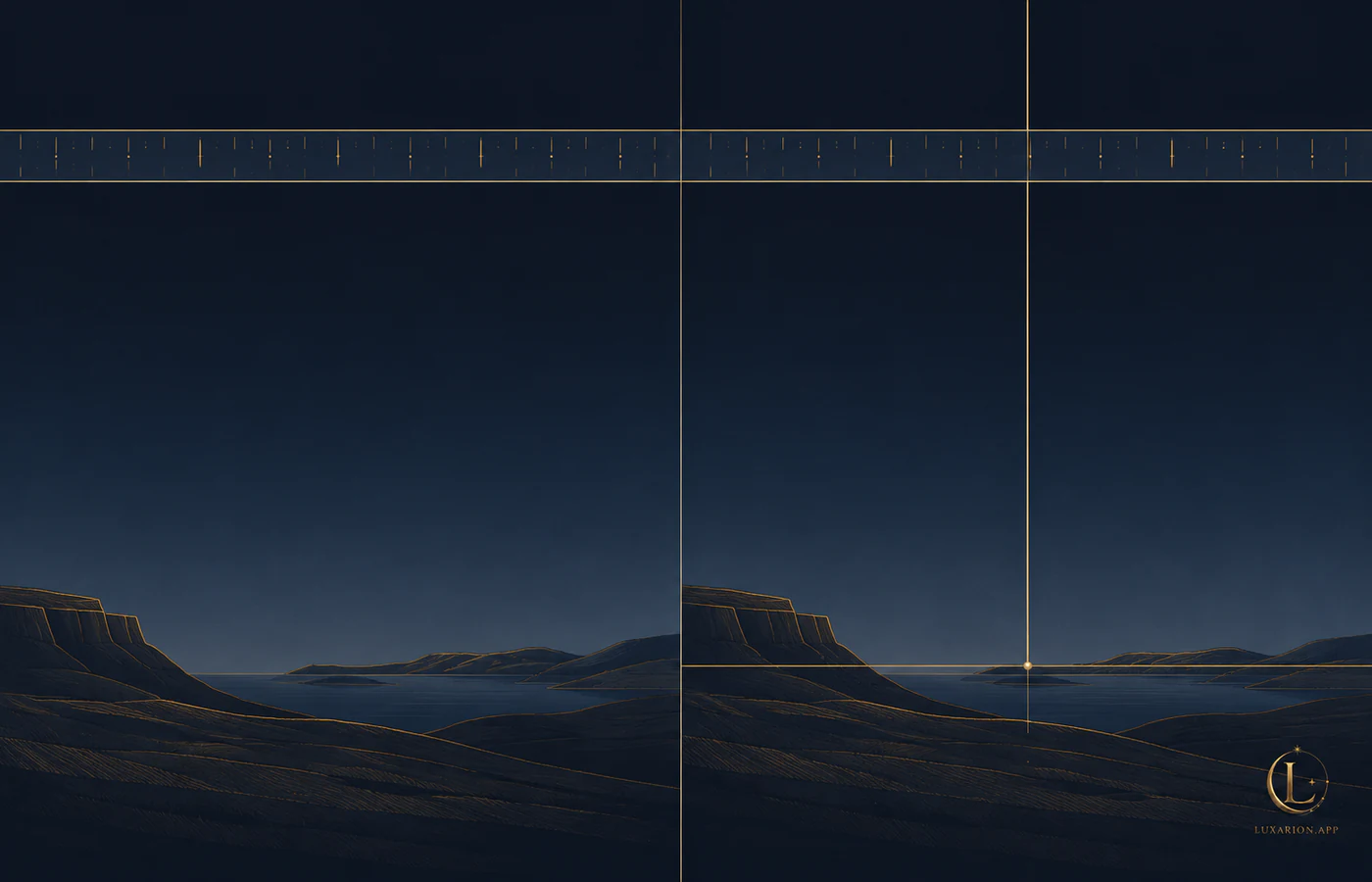
A sign is a division of the zodiac — a band of sky measured from a fixed starting point, shared by everyone alive at that moment. A house is something else entirely. It is a division of the sky above the place you were born, at the minute you were born, measured from your own horizon and from the meridian overhead.
That difference is the reason houses need a birth time and signs do not. The Sun stays in Leo for a month; the point rising on the eastern horizon moves through the entire zodiac in twenty-four hours. Four minutes of clock time moves the whole house structure by about one degree. Two people born on the same day in the same city, an hour apart, share every sign placement and have a completely different house layout.
The four cardinal points fall out of the geometry directly. The ascendant is the degree rising in the east — the beginning of the first house. Opposite it, the descendant, beginning the seventh. Overhead, the midheaven begins the tenth; underfoot, its opposite begins the fourth. Those four are not conventions. They are where the horizon and the meridian actually cut the ecliptic at your moment and your place.
So the useful summary: signs say what, houses say where. A planet's sign describes the manner of its operation; its house describes the department of life it operates in. Mars in Aries is a particular way of acting; Mars in Aries in the sixth is that way of acting, applied to work and to the body.
Why two astrologers can disagree, and both be right
Here is the thing beginners are almost never told, and not telling them causes real damage.
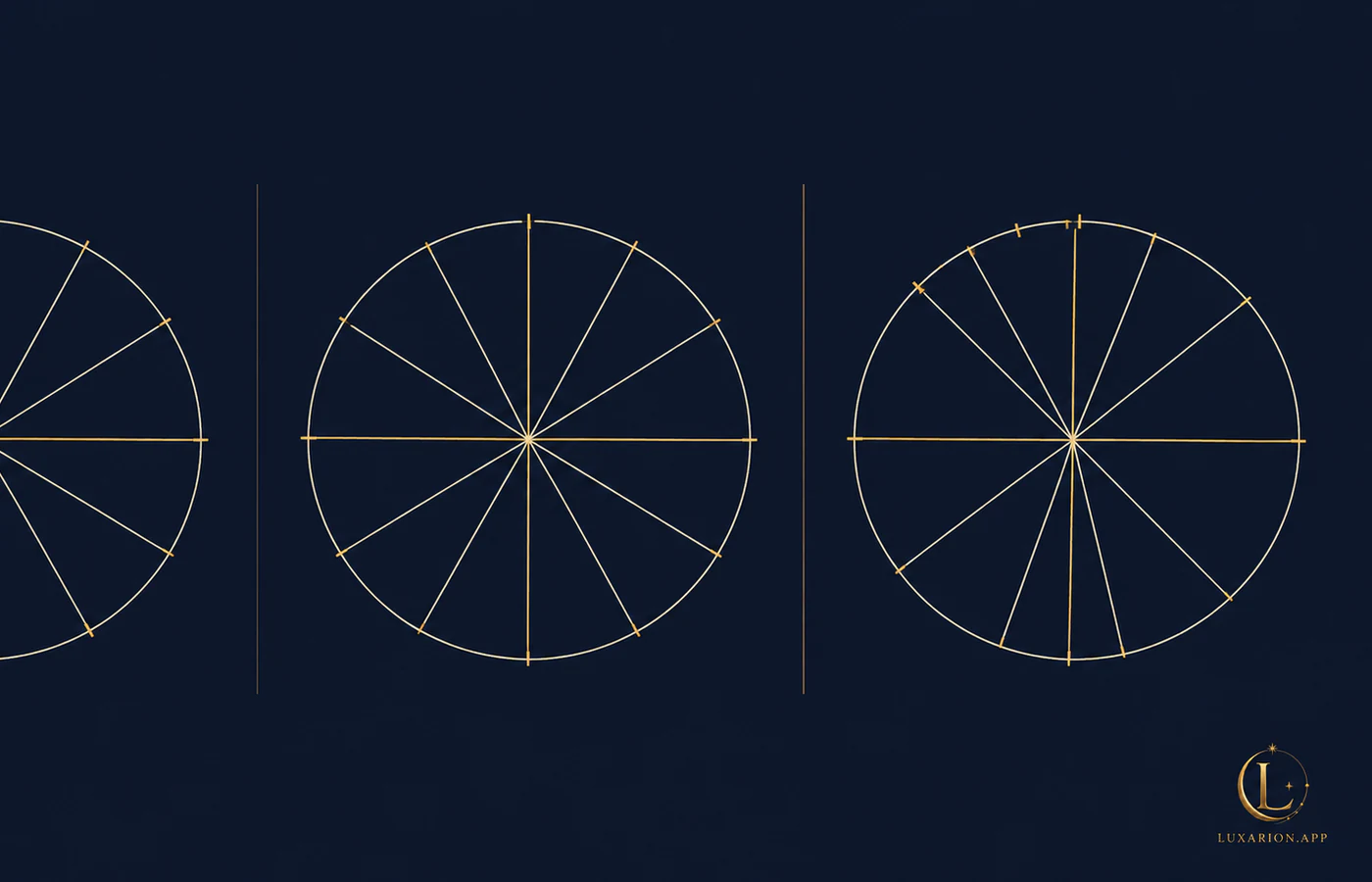
Once you have the ascendant and the midheaven, you still have to decide how to divide the space between them into twelve. There is more than one defensible way to do that, and the methods are called house systems.
Whole sign is the oldest: the sign the ascendant falls in becomes the entire first house, the next sign the entire second, and so on. Every house is exactly thirty degrees, and cusps sit at zero degrees of a sign. This is what the Hellenistic astrologers used, and it has come back into wide use in the last thirty years.
Placidus, named for the seventeenth-century monk who popularised it, divides by time rather than by space: it asks how long a degree takes to rise, and splits that. Houses come out unequal, sometimes dramatically so at high latitudes. It is the default in most software and therefore the one most people have seen.
Equal house takes the ascendant's exact degree and counts thirty degrees at a time from it, so the cusps are equal but do not align with sign boundaries.
Now the consequence, which is the part that matters. A planet sitting near a cusp can be in the ninth house in one system and the tenth in another. That is not an error and it is not either astrologer being careless. It is a genuine, old, unresolved technical choice, and practitioners have argued about it for as long as there have been houses — Valens in the second century, Firmicus Maternus in the fourth, and every generation since.
Knowing this is protective. When you read two interpretations of your chart that put Saturn in different houses, you now know exactly what happened, and you know what to ask: which system are you using, and why? A practitioner who can answer that clearly is one who has thought about their craft.
The four angles, read as a set
Before the twelve, learn the four. The angular cusps are the load-bearing structure of a chart, and reading them as two axes rather than four points is a considerable shortcut.
The first-seventh axis is the self against the other. Whatever sign rises, the opposite sign sits on the seventh, so the qualities you meet the world with and the qualities you seek in a counterpart are always complementary by construction. This is a structural fact, not a coincidence, and it is the reason the seventh house is so often described as the traits a person does not carry themselves. A chart with Aries rising has Libra on the descendant: arrives directly, and is drawn to what negotiates.
The fourth-tenth axis is the private against the public. The midheaven is the highest point of the sky at your moment — the most exposed degree of the chart — and the fourth is its buried opposite. Read together they describe the relation between what a life is seen to be and what it rests on. Where they are in tension, careers tend to be built at some cost to the foundation, and the person usually knows it.
Two habits follow. First, always note the ruler of each angle and where it sits; four rulers, four locations, and you have the skeleton of the chart before touching a single planet's own meaning. Second, when a transit arrives at an angle, treat it as significant even if nothing is physically there — the angles are sensitive points in their own right, which is one of the clearest practical differences between an angle and an ordinary cusp.
The structure the lists never show
The twelve are not a list. They are a system with a shape, and the shape does most of the interpretive work.
They divide by strength of position into three groups of four. The angular houses — first, fourth, seventh, tenth — sit on the four cardinal points, and the tradition reads planets there as strongest and most visible in a life. The succedent houses — second, fifth, eighth, eleventh — follow the angles and are read as holding and consolidating. The cadent houses — third, sixth, ninth, twelfth — fall away from the angles and are read as adaptive, mental, preparatory.
They also divide by subject into four groups of three, which is why houses that look unrelated in a list turn out to belong together. The first, fifth and ninth concern identity, expression and meaning. The second, sixth and tenth concern resources, work and standing. The third, seventh and eleventh concern relation. The fourth, eighth and twelfth concern what is held, inherited and hidden.
Use this the moment you look at a chart. Before reading a single planet, ask: where is the emphasis? A chart with four planets in cadent houses belongs to a different kind of life than one with four on the angles, and that observation is available in five seconds and is more informative than any single placement.
The twelve, briefly and honestly
Short entries, because the interpretive weight is in the method above rather than in the labels.
First — the body, the manner, the arriving. How you meet a room before anyone knows anything about you.
Second — what you hold. Money, possessions, and the older and better sense: what you can call your own, including your own capacities.
Third — the near world. Siblings, neighbours, short journeys, speech, the ordinary daily exchange of information.
Fourth — the foundation. Home, land, family line, the private interior, and what a life rests on.
Fifth — what comes out of you. Children, creation, play, romance in its courting sense, risk taken for pleasure.
Sixth — the daily order. Work as routine rather than as career, health as maintenance, service, and the small obligations that structure a week.
Seventh — the other. Marriage and partnership, and equally the open adversary; the tradition treats both as the same house because both are a person you must deal with directly.
Eighth — what is shared and what is transformed. Other people's resources, debt and inheritance, and the classical association with mortality.
Ninth — the far world. Long journeys, foreign places, law, higher learning, and belief.
Tenth — the visible. Vocation, reputation, standing, the thing you are known for.
Eleventh — the wider circle. Friends, alliances, groups, and what you hope for.
Twelfth — what is behind the scene. Retreat, confinement, the unexamined, and what a person does when nobody is watching.
Notice the movement. The first six are largely about the self and its immediate ground; the second six are about what the self meets. That progression is not decorative — it is why the seventh sits opposite the first and reads as the other, and why the tenth sits opposite the fourth as the public against the private.
Reading one house properly: five steps

This is the technique, and it works the same whether the house is crowded or empty.
- Find the sign on the cusp. That sign is the tone of the house's affairs — the manner in which its business tends to be conducted.
- Find that sign's ruler. Every sign has a governing planet, and that planet is the house's agent.
- Find where the ruler is. Its house is where the matter is actually handled. A seventh house ruled by Venus, with Venus in the tenth, says that partnership and public standing are entangled — a reading you would never get from the seventh house alone.
- Read any planets actually in the house. These are guests with strong opinions. They colour the affairs directly, and more of them means more emphasis, not more luck.
- Check what aspects the house. A planet elsewhere in the chart in tight aspect to the cusp or its ruler is part of the story.
Work an example. Suppose your tenth house cusp is in Cancer, so the Moon rules your vocation. The Moon is in your fourth, in Capricorn. Four steps in and you have something specific: the matter of public standing is governed by something that wants privacy, situated in the house of home and origin, in the sign of structure. That reads as a career that keeps circling back to family and to the private, and that will not sit right if it is only public. No list of twelve could produce that sentence, because it comes from the relationship rather than the label.
Do this once for every house and you have read a chart. It takes an evening. It is also, incidentally, the fastest way to learn the twelve, because you learn them by using them rather than by memorising a table.
Three charts, and what the houses added
Short worked examples, because the difference between a list and a reading is only visible in a real configuration.
A stellium in the sixth. Three planets in the house of daily work and routine, with everything else scattered. The sign matters less than the concentration: this is a life in which the ordinary weekday carries most of the weight, and where health, habit and the shape of the working day are where the person's fortunes actually turn. Read from signs alone, the same chart looks unremarkable.
An empty ninth ruled by a planet in the second. No planets in the house of the far world, but its ruler sits in the house of resources. The matter of travel, study and belief is conducted through the question of what it costs and whether it can be afforded. That is a specific and recognisable life, and it comes entirely from step three of the method.
Angular Saturn. Saturn on any of the four angles is one of the most legible single placements there is, and it reads very differently by which angle. On the first it is a manner: measured, older-seeming, slow to arrive. On the tenth it is a vocation: authority earned late and held long. On the fourth it is a foundation: something in the origin that was heavy, and a person who builds carefully because of it. Same planet, same sign, three different lives — and the only thing that distinguishes them is the house.
The birth-time problem, and what to do about it

Everything above depends on one number, so it deserves a straight section.
Houses need the time of birth. Signs mostly do not — the Moon is the only one that can change sign within a day. So a person without a birth time still has a real chart with real placements; what they do not have is the house layout, and therefore not the ascendant either.
Three practical things. First, look for the time before you conclude you do not have it: many countries record it on the birth certificate or in hospital records, and a surprising number of people find it on a document they already own. Second, if you have an approximate time — "sometime in the morning" — that is worth more than nothing: it narrows the ascendant to two or three signs, and a practitioner can often work with that and say so honestly. Third, watch the time zone. The offset in force at your birth date, including any daylight-saving rule then in effect, is a common and consequential error; a chart calculated an hour out will place several planets in the wrong houses. Good calculators handle this from the historical time-zone database, and it is worth checking that yours does.
A note on rectification: the practice of working backwards from life events to an exact birth time. It is a real technique with a long history, it is skilled work, and it is not something to buy casually — the honest practitioners describe it as an estimate that improves with evidence, not as a retrieval of a fact.
Where the system came from
Brief, because it explains why the vocabulary is the way it is.
Houses appear in the Hellenistic astrology of the eastern Mediterranean in the last centuries before the common era, already twelve, already tied to the horizon. Ptolemy gives a version in the second century; Valens gives a much more practical one at roughly the same time, and Valens is the better guide to how the houses were actually used.
The system then travelled. It was translated, extended and argued over in Arabic and Persian for several centuries — Abū Maʿshar and al-Bīrūnī are the two names anyone reading in this field eventually meets — and returned to Latin Europe through those translations rather than directly from Greek. That is why so much technical vocabulary in a modern chart carries Arabic and Persian ancestry underneath its Latin surface.
Then came the arguments about division, which have never stopped, and which are the healthiest thing about the tradition: a craft in which nobody argues about method is a craft that has stopped being practised.
Common questions
Which house is the most important? The honest answer is the one your own chart emphasises. Structurally, the first and tenth carry the most weight because they sit on the two most visible angles; practically, the house holding the most planets is where the life is loudest.
What if a house has four planets and the rest have none? That is a stellium, and it is a strong signature. It concentrates a great deal of a life into one department, which is intense rather than fortunate; the reading usually turns on how the rest of the chart supports or resists that concentration.
Can a planet be in two houses? Not in one system. Across systems, yes — see the section above. A planet within a few degrees of a cusp is genuinely ambiguous and worth reading both ways.
Do the houses relate to the signs one to one? There is a natural correspondence — the first with Aries, the second with Taurus, and so on — and it is useful for learning the flavour of each house. It is not how a real chart works; your first house is whatever sign was rising for you.
What about the twelfth house? Is it bad? It has an old reputation it has largely outgrown. Read it as what is behind the scene rather than what is wrong: retreat, preparation, the parts of a life that need to be unobserved to work. Plenty of people with strong twelfth houses do their best work in private and are perfectly happy.
Do I need to know my houses to use astrology at all? No. Sun, Moon and the personal planets say a great deal without them, and the article on the big three is the natural starting point. The houses are what turn a general description into a particular one.
Getting yours
Start with the chart itself. Luxarion's free birth chart calculator returns your houses along with the placements, and if you have your birth time it will give you the ascendant and midheaven that the whole structure hangs from. An evening with the five-step method above and your own chart teaches more than any list of twelve.
If you would rather have it read than learned, a natal chart reading works from the same figures and does the part this article cannot: weighing your houses against each other, in your own life, rather than in general. That weighing is the whole craft, and it is why the piece on the rising sign and the one on the Saturn return both end at the same place — the house is what makes a general transit into your transit.
And if you came here because your seventh house was empty: go and find its ruler. That is where your answer has been the whole time.
The library teaches the craft. A reading applies it to you.
Get your personal reading