

Is Coffee Reading Real? What the Cup Shows, and How
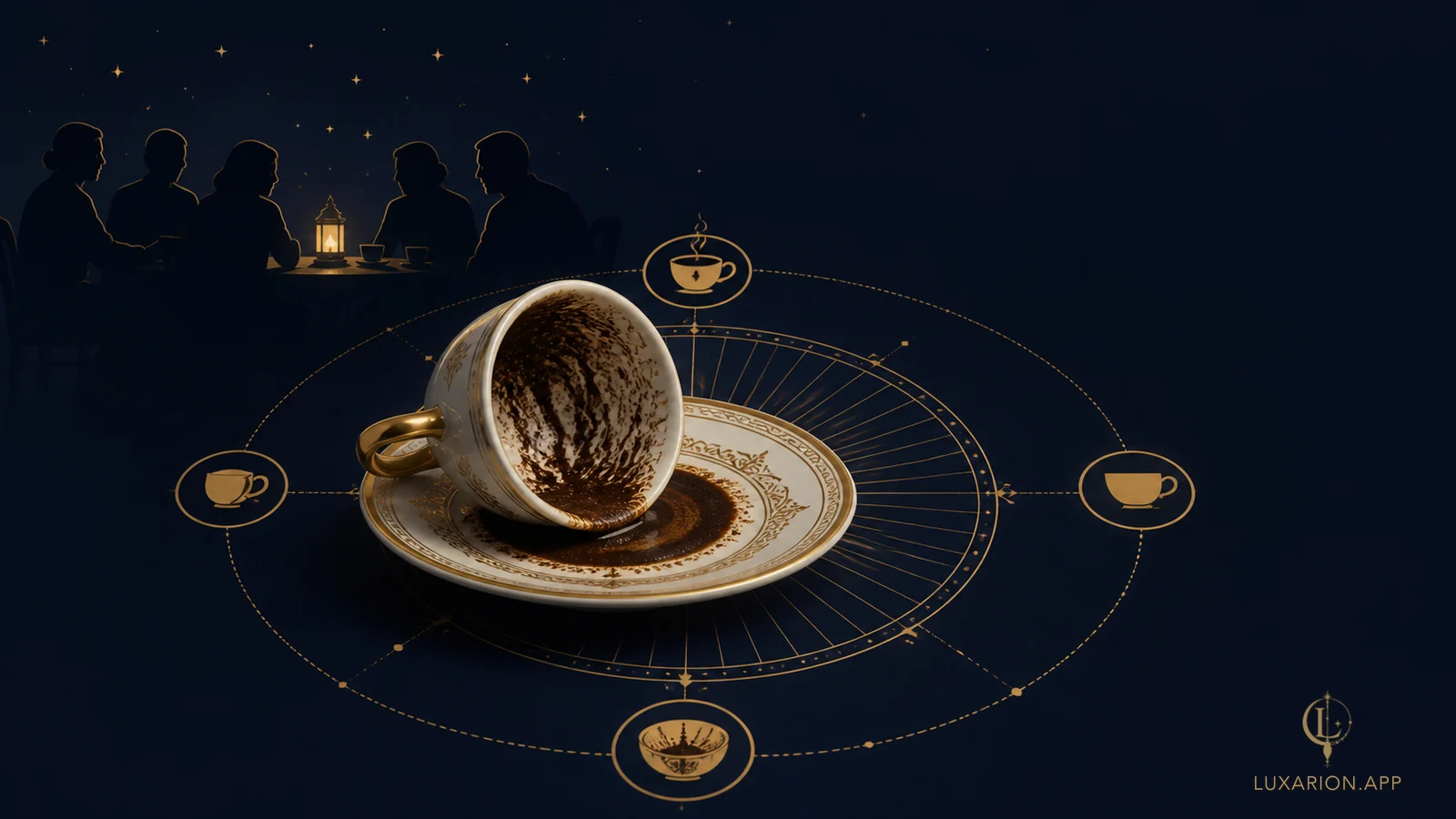
Yes. What a cup shows, how a reader sees it, and the four-century tradition that has carried the craft without a break.
It is the question people ask before they hand over their cup, and it deserves a full answer.
The word real carries three questions: is the practice genuine, is the reader doing something skilled, and does the cup show what is true. The three have the same answer, and the rest of this article shows why.
Yes. Coffee cup reading is a continuous, disciplined tradition with four centuries of practice behind it, transmitted by apprenticeship, with a real technique and a real ethic — and the cup shows what is moving toward the one who drank from it: news on its way, people approaching, roads opening, money coming in or going out, a heart turning, envy that needs guarding against, and how near each of them stands.
What follows is what a cup shows and how, where the tradition came from, how a reading is conducted, the discipline the readers keep, and how to tell a good cup reading from a poor one.
What a cup reaches
Listen to how practitioners talk and two things come into focus: how far a cup reaches, and the discipline that keeps a reading true.
A cup speaks of the near season. The readers' instruction is that a cup carries roughly the next forty days — what is on its way and how close it has come — which is why a cup read every week or two follows a life as it moves.
A reader declines a cup that is not ready to be read — a saucer that sticks, a pattern that comes out muddy, a wrong hour, a person who arrived in the middle of a crisis — and the answer that day is tea instead. This discipline of declining is one of the clearest marks of a real practitioner, and we open it at length in when the reading says no.
And the reading is always addressed to this person in this situation. A stranger on the road is a real reading, and a good reader places it: near the handle or far from it, at the rim or at the base, arriving this week or within the season, and bringing what. This knot near your handle — something at home is waiting to be said aloud is how an aunt who loved you read a cup. The difference between the fairground and the tradition is not whether the cup speaks of what is coming. It is whether the reader has learned to read where, when and for whom.
Notice what that discipline implies. Readers draw these lines because the cup is taken seriously: careful rules grow up around a craft whose words come true.
Four centuries, unbroken
The practice has a real history, and knowing it changes how the question sounds.
Coffee reaches the Ottoman world in the sixteenth century, and with it comes the coffeehouse — a genuinely new kind of public space. The history of coffee and the history of the cup reading are the same history; the practice grows directly out of how the drink is prepared. Turkish coffee is brewed unfiltered, the grounds settle, and a cup that has been drunk leaves a pattern. Every cup, every day, in every household. The tradition is built on the one substance that reliably produces a fresh image several times a day.
Arabic coffee and its own hospitality customs run alongside, and the reading practice spreads across the whole region and into the Balkans, Greece, the Levant and North Africa — everywhere the unfiltered cup went.
What is remarkable is the continuity. This has been transmitted, mother to daughter and neighbour to neighbour, without interruption, for four hundred years. UNESCO's recognition of Turkish coffee culture as intangible cultural heritage names exactly this: the tradition is inseparable from the social practice around it.
Ibn Khaldun, writing before coffee's arrival, had already set out in the Muqaddimah how such crafts are transmitted — by habituated practice within a community rather than by text — and that account fits cup reading exactly. There is no founding manual. There is a living chain of practitioners, which is a different and in some ways sturdier form of authority.
What the coffeehouse did
One more piece of history, because it explains why this particular craft took root as deeply as it did and why it still carries the social weight it carries.
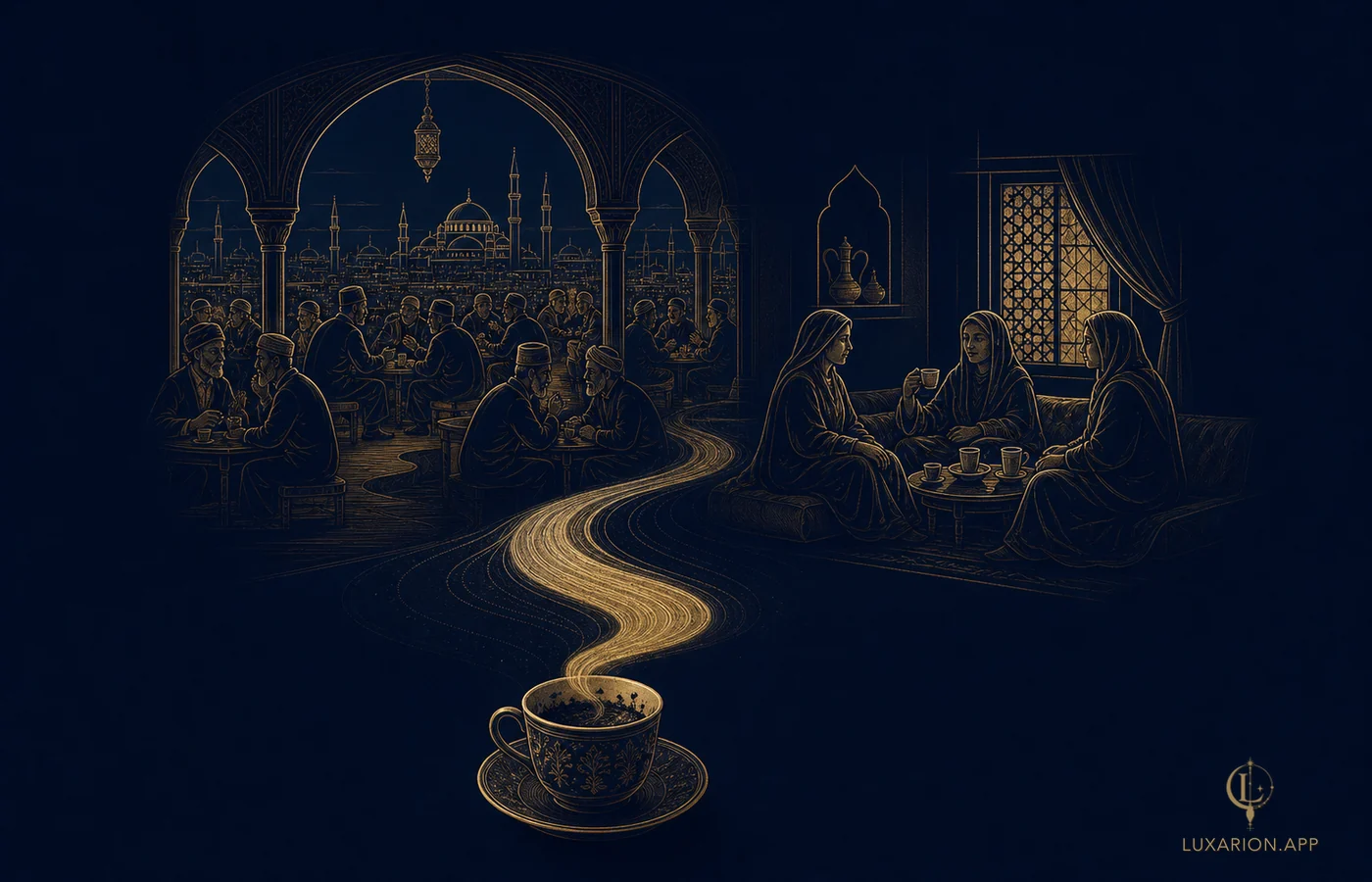
The coffeehouse arrived in the Ottoman world as something genuinely new: a public room where people who were not related sat together, at length, without drinking alcohol and without a religious occasion. Nothing quite like it had existed. It produced a new kind of conversation — long, mixed, unhurried — and cup reading grew up inside that conversation rather than alongside it.
The domestic version matters even more. In households across the region, the afternoon cup was one of the few reliably protected hours in a day of obligations, and often one of the few settings where women spoke to each other at length without an audience. The reading was the thing that legitimised the length of it. You cannot rush a cup that has to cool.
That setting is where the craft was carried, and it explains how far it spread. What kept people turning their cups over for four centuries was what the cups told them — the news that came, the traveller who arrived, the match that was made, the trouble that was avoided — and a household remembers a cup that proved true.
It also explains something people notice and cannot place: why a cup reading feels more like being cared for than like being told. It was built inside hospitality. The reading and the pouring are the same gesture, and the practitioners have never treated them as separable.
What happens in a reading
Three things meet in a good cup reading.
The cup itself. The pattern in the cup is new every time and cannot be repeated — it formed from the cup this person drank, turned and let settle, and that is why it speaks of them and of no one else. The tradition's own phrase is that the cup is honest: it shows what it shows, and it shows it to the one who drank first.
The reader's sight. A practised reader sees the cup whole — its regions, its density, its roads and knots — and reads what it carries: what is moving toward the drinker, from which direction, and how near. Over a cup, questions can be asked that would be intrusive anywhere else, and the reader asks them to place what the cup shows inside the life of the one who drank.
The drinker's intention. The question held while the cup was drunk and turned is the question the grounds answer. Anyone who has watched a family cup reading has seen a question answered that had never been asked aloud.
The tradition's rituals — the flip, the rest, the reading of the regions — are not decoration. They are how the cup is made ready to speak. We set out the regions and their vocabulary in the Turkish coffee reading guide, and the symbol vocabulary in what the shapes mean.
The regions of the cup
The single most important structural fact about a cup reading, and the one most often missed by people watching from outside: the cup is not read as one picture. It is divided, and where a mark falls changes what it says.
The rim is the near present — days and weeks, what is already in motion. Marks here are read as immediate: what is already at the door.
The middle band is the developing season, the weeks ahead, what is forming but not yet arrived.
The base is what lies deeper or further off — older material, roots, the thing underneath the thing. A heavy base with a clear rim reads very differently from the reverse.
The handle is the anchor, and this is the detail that surprises people most. The handle stands for the drinker and their home. Marks near it concern the household, the family, the immediate circle; marks opposite it concern what is distant, foreign, outside. A reader will orient the whole cup by the handle before saying a word, and a reading conducted without doing so is not really a reading.
The saucer carries what has left the cup — what is finished, or leaving, or has spilled outward into other people's lives.
This is why the same shape means different things in different places, and why "what does a bird mean" is not quite an answerable question. A bird at the rim near the handle and a bird at the base opposite it are two different statements. The grammar is in the geography, and it is a genuine grammar — taught, transmitted and consistent across a very wide region.
The reader's gift
If you want to know whether a cup is being read well, watch the reader as well as the cup.
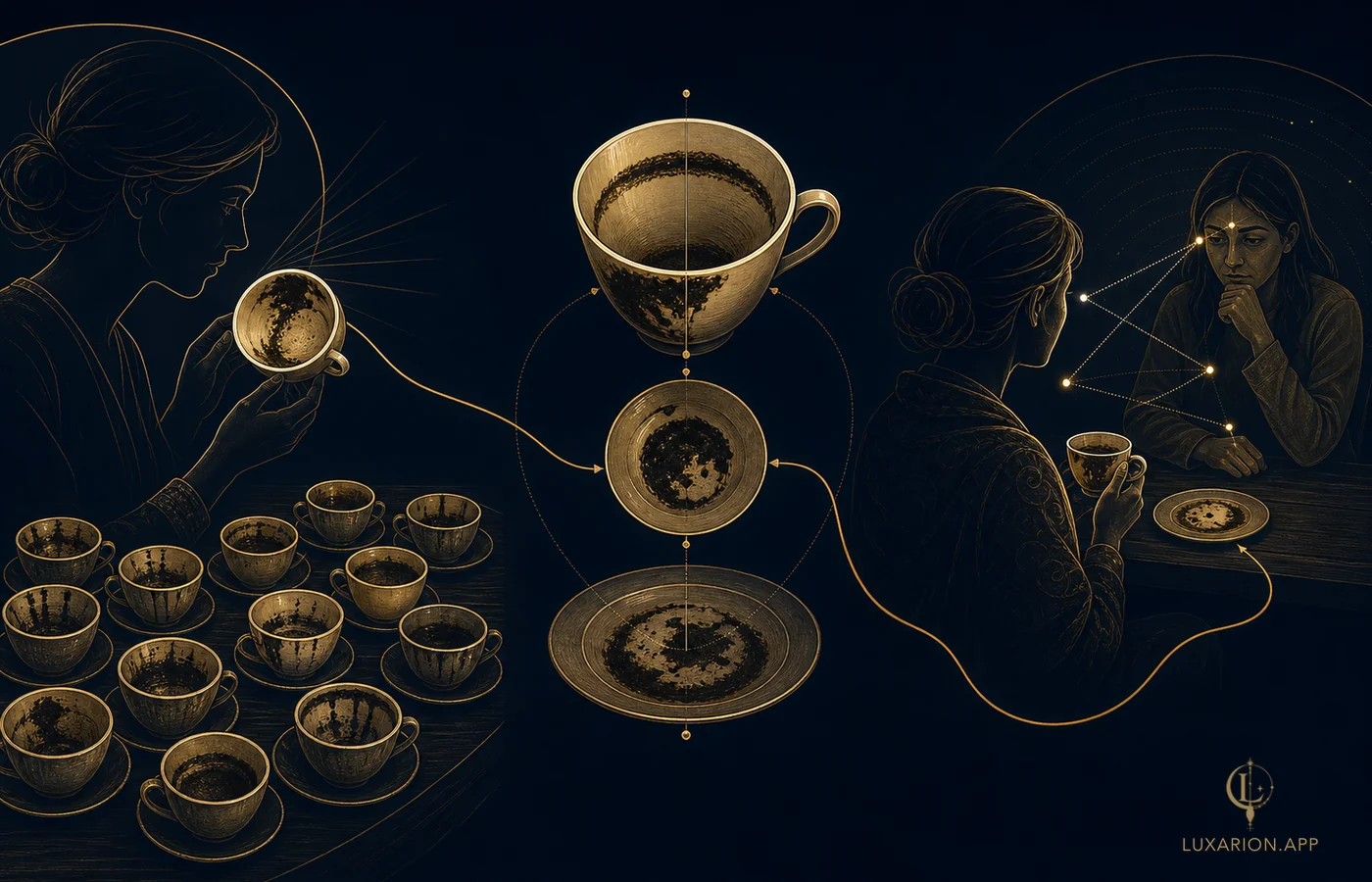
A practised reader has seen thousands of cups. They know which shapes are common and which are unusual in that region of the cup. They know that a heavy ring near the rim means something different from the same ring at the base. They read the whole cup before any single mark, and they read the saucer, which beginners forget entirely.
They read the drinker too, as the tradition teaches: the firāsa of a practised reader, the insight that sees what a face and a manner carry, working together with what the cup shows. It takes in far more than it can put into words — what Michael Polanyi called tacit knowledge describes its outward form — and it is built by reading thousands of cups, which is why cup reading is taught by sitting beside someone who can do it rather than from a book.
That is why a gifted reader finds more in the same cup than a beginner does, and why choosing a reader matters more than anything about the coffee. What that sight is, we open in The Quiet Sense.
Why the images are not arbitrary
A reasonable question: if the pattern is different every time, how can there be a shared vocabulary at all?
Because the vocabulary was not assigned — it accumulated. Four hundred years of readers looking at cups converged on a set of shapes that recur and a set of readings that came true. A bird near the rim, a road, a knot, a ring, an open space: these appear again and again because a settling cup forms a bounded family of shapes, and generation after generation of readers recorded what each one brought.
That is how every craft vocabulary forms. It is not a system imposed on the material; it is a record of what practitioners kept finding there. And it comes with the instruction that it must be fitted to the person rather than applied mechanically — the interpreter asks about you before reading the shape, which is the same principle that governs dream interpretation and hand reading. We set that principle out in how the old interpreters actually worked.
Readers explain why a cup can speak the way every divinatory craft does: the one who drinks, turns and waits puts their own season into the cup, and the grounds settle into its shape. Carl Jung, working from outside the craft, built his account of synchronicity around the same experience — that the pattern and the life answer each other.
How a reading is conducted
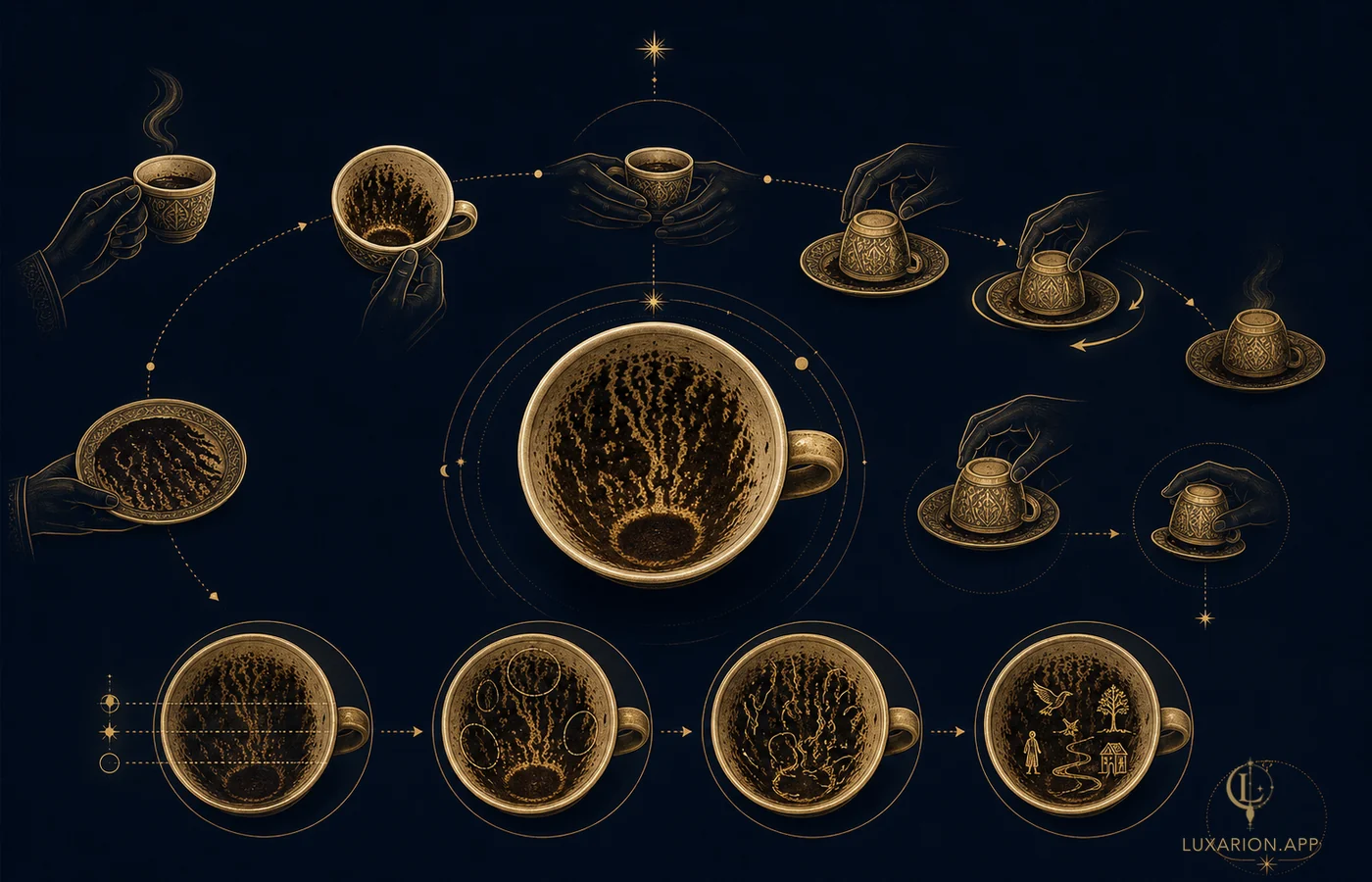
The sequence is remarkably consistent across the whole region, which is itself evidence of a real transmitted method.
The cup is drunk, not emptied. A little liquid stays. The drinker holds the cup a moment — many traditions have them think of their question here.
The cup is inverted onto the saucer and turned, in most traditions three times, then left to cool. The waiting is not theatre; the pattern is still forming.
The saucer is read too. Where the grounds ran, whether the cup stuck. A cup that will not lift is traditionally read as a matter not ready to be discussed, and the reading stops there. Beginners skip the saucer; practitioners never do.
The whole before the parts. Density, distribution, whether the pattern is heavy or open, near the rim or near the base. The rim is read as the near present, the base as what is further off or deeper down.
Then the shapes, and then the questions. A good reader names what they see and asks what it touches. The answer you give shapes the next thing they say. That is the craft working correctly.
And it ends with what to do. A cup that brings news also brings its counsel: what to prepare for, what to guard against, which door to walk through. A reading that names what is coming and what to do about it is finished.
Three misunderstandings worth clearing up
Three things get said about cup reading constantly, and all three are worth correcting because they get in the way of using the practice well.
"You have to believe in it for it to work." The cup does not wait for belief. It shows what it shows to the one who drank from it; what it asks is a sincere question and a cup turned with intention. People who sat down curious have heard their situation named exactly, and have seen what the cup announced arrive.
"It only works because the reader knows you." A stranger who has never met you can name what is coming, because it is in the cup. Family readings and readings by a stranger are different experiences, and both are legitimate: a relative brings context, a stranger brings none, which is why some people take to a stranger exactly the questions family cannot be neutral about. The tradition contains both and always has.
"The reader is just telling you what you want to hear." Any practitioner will tell you the opposite is the harder discipline and the more common complaint — good readers say the uncomfortable thing when the cup carries it, and the etiquette specifically instructs them to choose the kinder reading only where the cup genuinely permits both. A reading that never says anything difficult is a poor reading, and the tradition names it as such.
What all three share is an assumption that the reading is something done to a passive person. It is not. The cup, the reader and the drinker are three participants, and the sessions that disappoint are almost always the ones where the third participant did not show up.
How to tell a good reading from a poor one
Six markers, all of which you can judge yourself.
Were you asked things? A reader who talks for twenty minutes without asking you anything is performing. The questions place what the cup shows inside your life; a reader who never asks is reading at no one.
Did it stay in the near season? Cups are read for weeks, not decades. A reader ranging over your whole life has left the tradition.
Were there refusals? "I do not see anything there" and "that is not something the cup tells us" are marks of competence. A reading with no edges anywhere is a warning sign.
Did it keep to the cup's own reach? The cup speaks within its near season, and a reader who names a year for a marriage or a death has left the craft. What the cup shows about the people around you — who is thinking of you, who envies you, who is on the way — is read from the cup and never invented.
Did it address your actual situation? Or deliver material that would fit anyone in the room?
Did the reader look at the cup before looking at you? A small tell, and a reliable one. Practitioners orient the cup, find the handle and take in the whole distribution before they say anything at all. Someone who begins talking while the cup is still cooling is working from a script rather than from what is in front of them.
Did you leave lighter or heavier? Not that a reading should always be pleasant — some true things weigh. But you should leave more able to move, not less.
So — should you have your cup read?
A cup does not give lottery numbers or calendar dates, and anyone who offers them is working outside the tradition rather than deep inside it.
If you are carrying a question and want to know what is moving toward you, then yes — that is precisely what a cup is for. People come out of good cup readings knowing what is on its way, what to guard against and one specific thing to do, and they come back to say what arrived. That is what the tradition has been delivering across four centuries and a dozen countries.
It is also worth saying who tends to get the most from it. People who arrive with one specific live question do better than people who arrive wanting a general forecast. People who answer the reader's questions properly do better than people who test them. And people who act on what the cup told them do very much better than people who treat the reading as a story — because in this tradition a reading is followed through: the cup announces, and the drinker prepares.
The answer to the title, then, is yes. The tradition is real, the skill is real, the transmission is unbroken, and the ethic is stricter than most people expect. What a cup gives you is a true reading of your near season — what is coming, from where, and how soon — delivered by someone trained to see it.
If you would like your cup read properly — by someone who will ask before they answer, stay inside the season, and send you home knowing what is moving and what to do about it — that is what our readers do. You can book a coffee cup reading. And if you want the tradition's own vocabulary first, it is set out in what tasseography actually is.
The library teaches the craft. A reading applies it to you.
Get your personal reading