

A World Rolled Small: The Intimate Life of Talismanic Scrolls
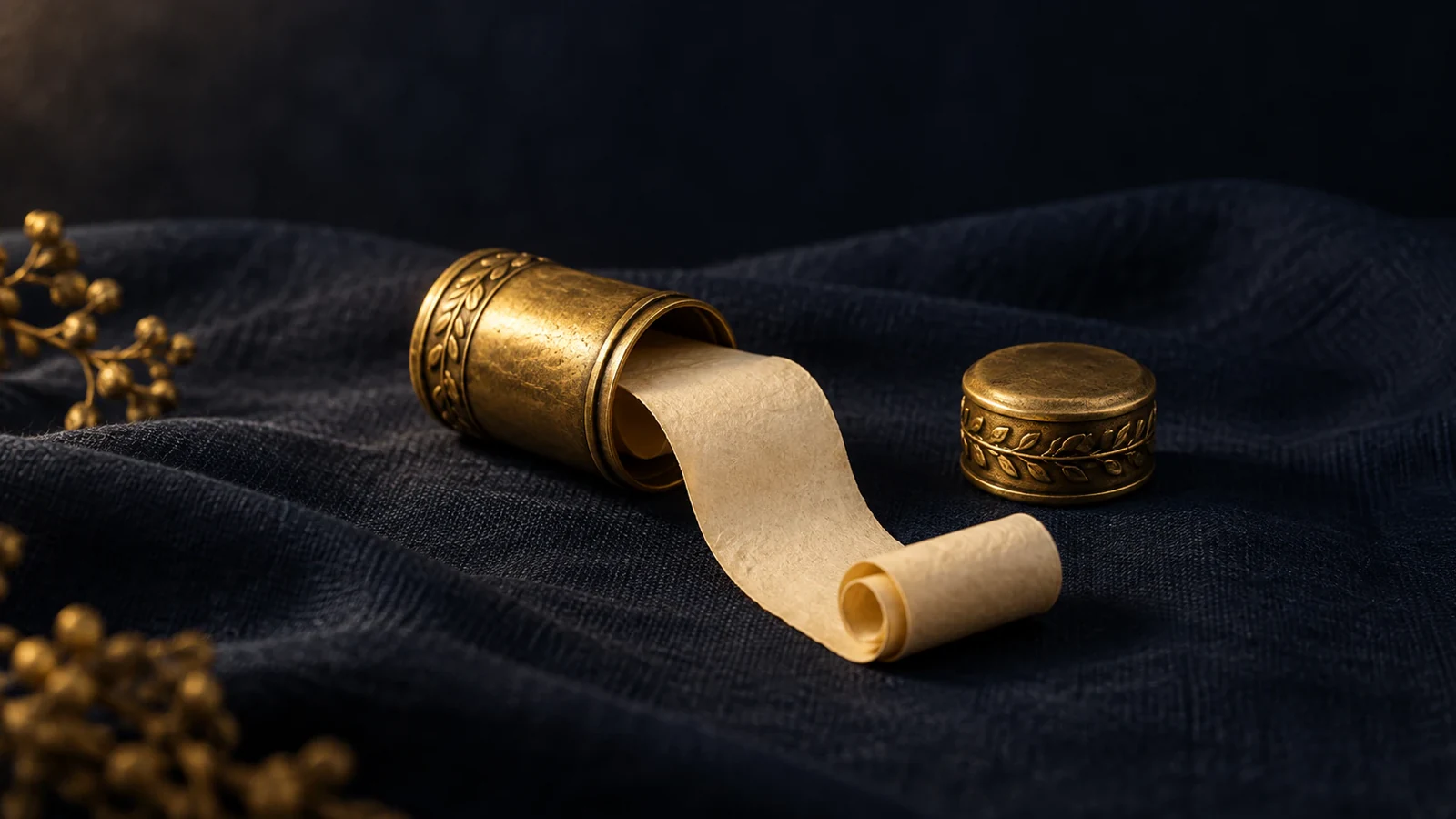
Sixty-eight centimetres of prayer, rolled into a silver case 7.6 centimetres long and worn at the body: the life of the talismanic scroll.
A narrow strip can take up more room in the imagination than a large book.
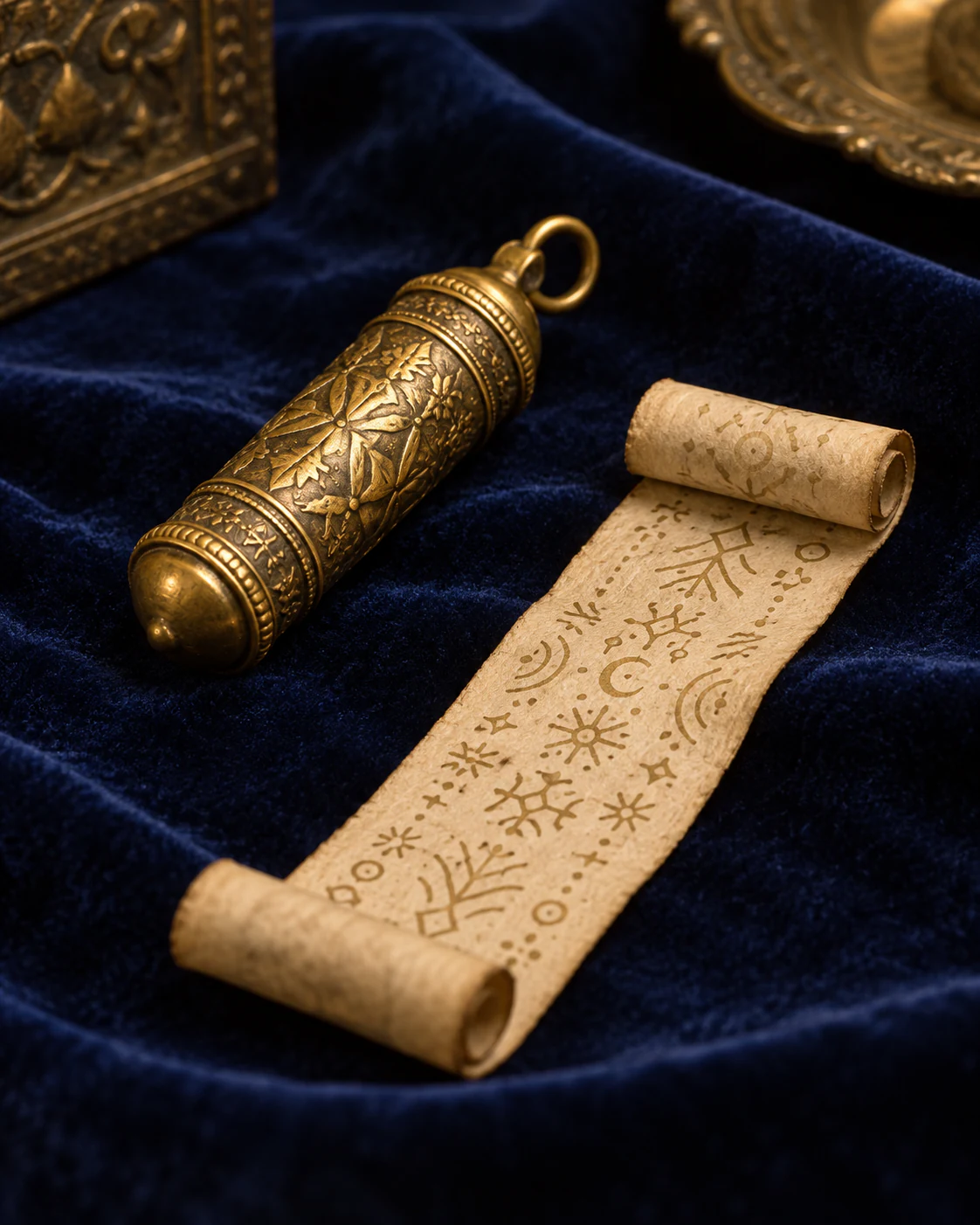
Picture a small case resting in a palm. Its outside gives little away: a closure, a curve of metal, a loop for a cord. Inside, a long roll of writing has been brought into a space that seems too small to hold it.
The contrast is where this story begins. A scroll has length. A case has closeness. Put them together and a text becomes something you carry.
These scrolls were made to protect. The words on them are words of refuge, and the case kept those words against the body, where protection is wanted. Their paper and parchment, their printing and penmanship, and the cases that held them tell how that protection was made and how it was carried.
Small is a relationship
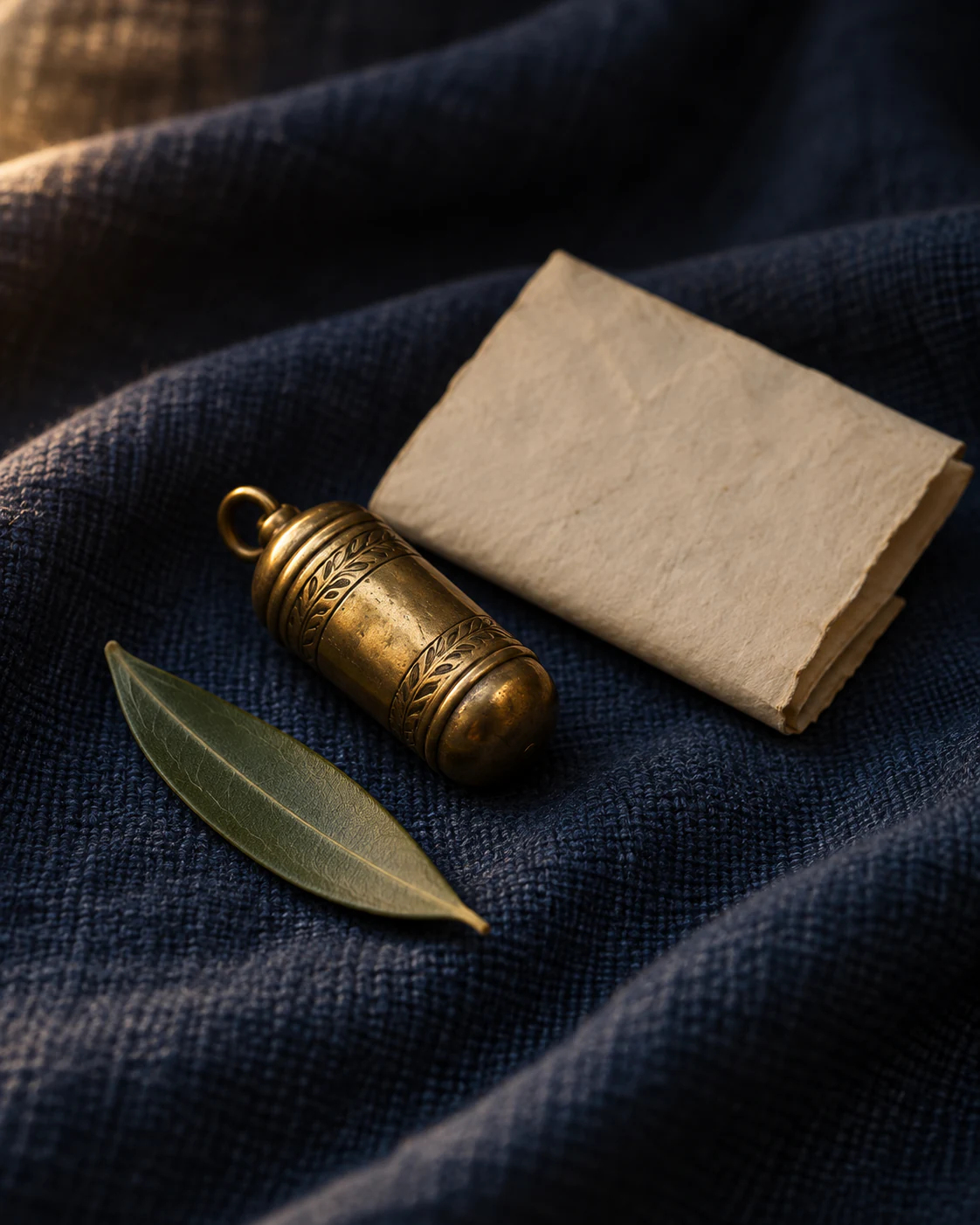
"Miniature" describes the writing, the way the scroll is stored, or the object's scale beside an ordinary book. A scroll is long when it is unrolled and small when it is put away, and both are true of it.
That is why a photograph misleads. A scroll shown flat fills the frame. A case photographed alone looks like an ornament. Only together do they show what the object is: a text made to be carried.
A map spread across a table and the same map folded in a pocket are one surface at two scales, one for looking at and one for going with.
The case is part of the object
A container decides what is seen and what is kept back. It gives the text a boundary, a way to travel, and a place against the body of the person who keeps it. In an amulet, the case belongs to the object as much as the writing does.
Each case tells how it was made and how it was worn. Whose road or whose vow it went with is a story the objects keep to themselves.
Two scrolls from Egypt, a case from Iran
The Metropolitan Museum of Art holds a talismanic scroll from eleventh-century Egypt, of the Fatimid period, ink on paper, 24.9 by 7.9 centimetres, accession number 1978.546.34. A second scroll from eleventh-century Egypt, 1978.546.32, is also ink on paper, and the museum catalogues it as block-printed.
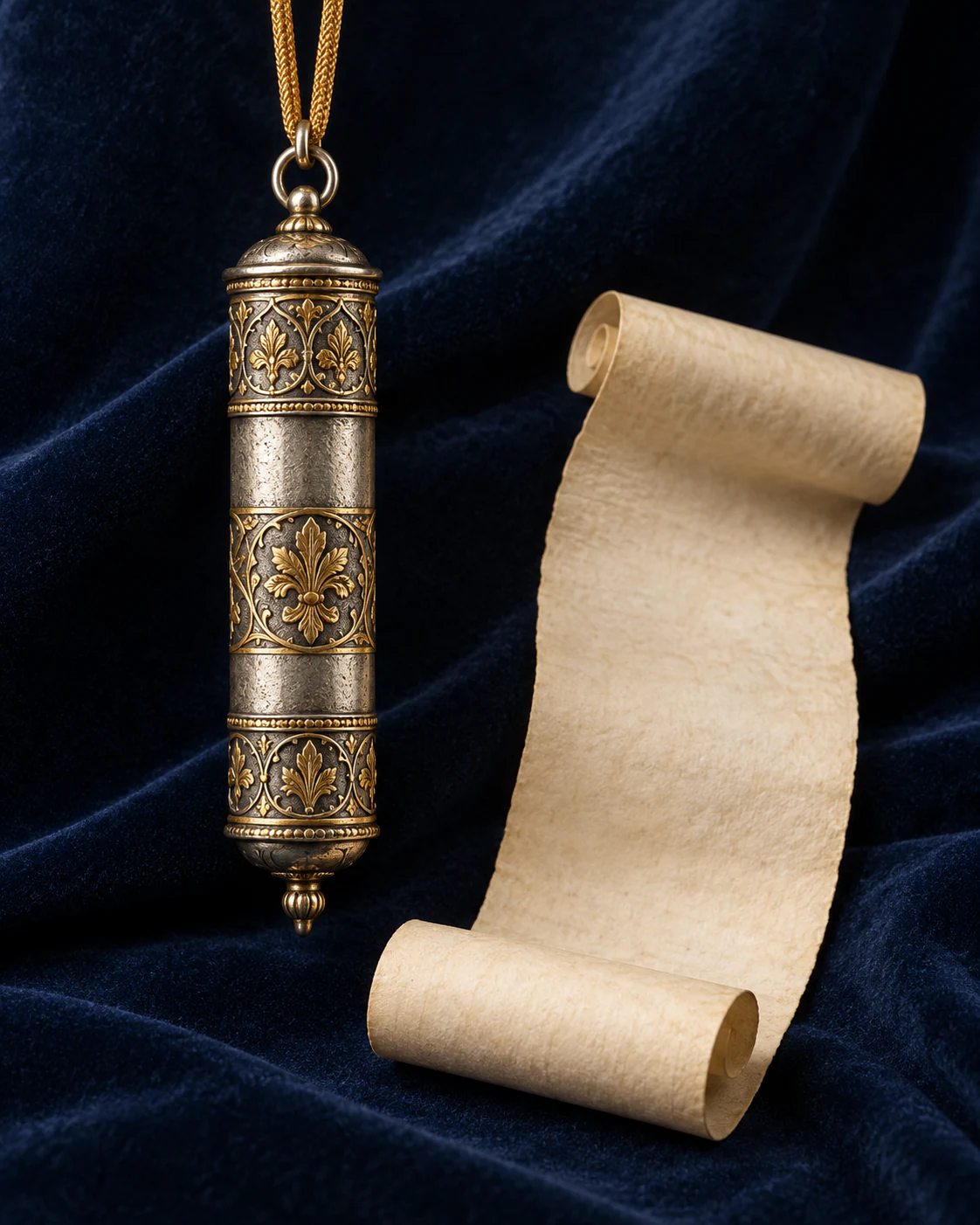
The Smithsonian's National Museum of Asian Art holds a hexagonal silver amulet case with its original prayer scroll, S2018.6a–c, from Qajar Iran, late eighteenth or early nineteenth century; the writing is probably from around 1800. The scroll is thin parchment, unusual at a time when paper was the rule, and it measures 68 by 4.5 centimetres. The case that holds it is 7.6 centimetres long, with three small loops to hang it as a horizontal pendant.
Sixty-eight centimetres of prayer, rolled into a case 7.6 centimetres long: that is a world rolled small, and the whole art of these objects in a single measurement.
Centuries and the breadth of the Islamic world lie between the Egyptian scrolls and the Iranian case, and the same purpose runs through both: words of refuge, kept near.
Printed and penned
The Met records 1978.546.32 as printed, so delicate writing proves nothing about a pen; each object's record gives its technique. A printed scroll came from a design that could be repeated, a penned one from a single hand for a single copy. The technique says nothing by itself about how personal the use was, how many copies existed, or who asked for this one.
The words of refuge are the same words whichever way they reached the paper, and a printed copy worn against the body carries them as fully as a penned one.
Words of refuge, a seal and a carried prayer
The Fatimid scroll, 1978.546.34, is written in kufic script, and its words turn away the evil eye and seek refuge in the Qur'an. That is its work. Words of refuge protect by God's leave, and a scroll that carries them carries the protection wherever its owner goes. The eye it turns away is the eye the blue bead and the spoken blessing guard against, and the evil eye and its protection have an article of their own.
On the block-printed scroll, a six-pointed star is named as the seal of Solomon. The seal is one of the oldest signs of protection in the tradition, the sign of the prophet-king to whom God gave command over the jinn, set on the paper beside the words.
The Iranian case opens its inscription with the Throne Verse, Qur'an 2:255, the verse of God's sovereignty and guardianship, recited for protection to this day. Written on the outside, it stands on the boundary between the wearer and the prayer enclosed within. On the scroll itself, invocations in the name of God run on both sides in larger red and blue script.
Word, emblem and case each do their part. The word calls on God. The emblem gathers an inherited sign of protection. The case keeps both against the body, and each object speaks its own language of refuge.
The text that works unread
We expect writing to give up its information whenever someone opens it. Carried sacred writing keeps another relationship with its keeper: its presence is the point. The Smithsonian notes that the prayers in the Iranian scroll were not meant to be read as such; together, they work as a talisman. The Met describes such writings carried on the person or fixed to a weapon.
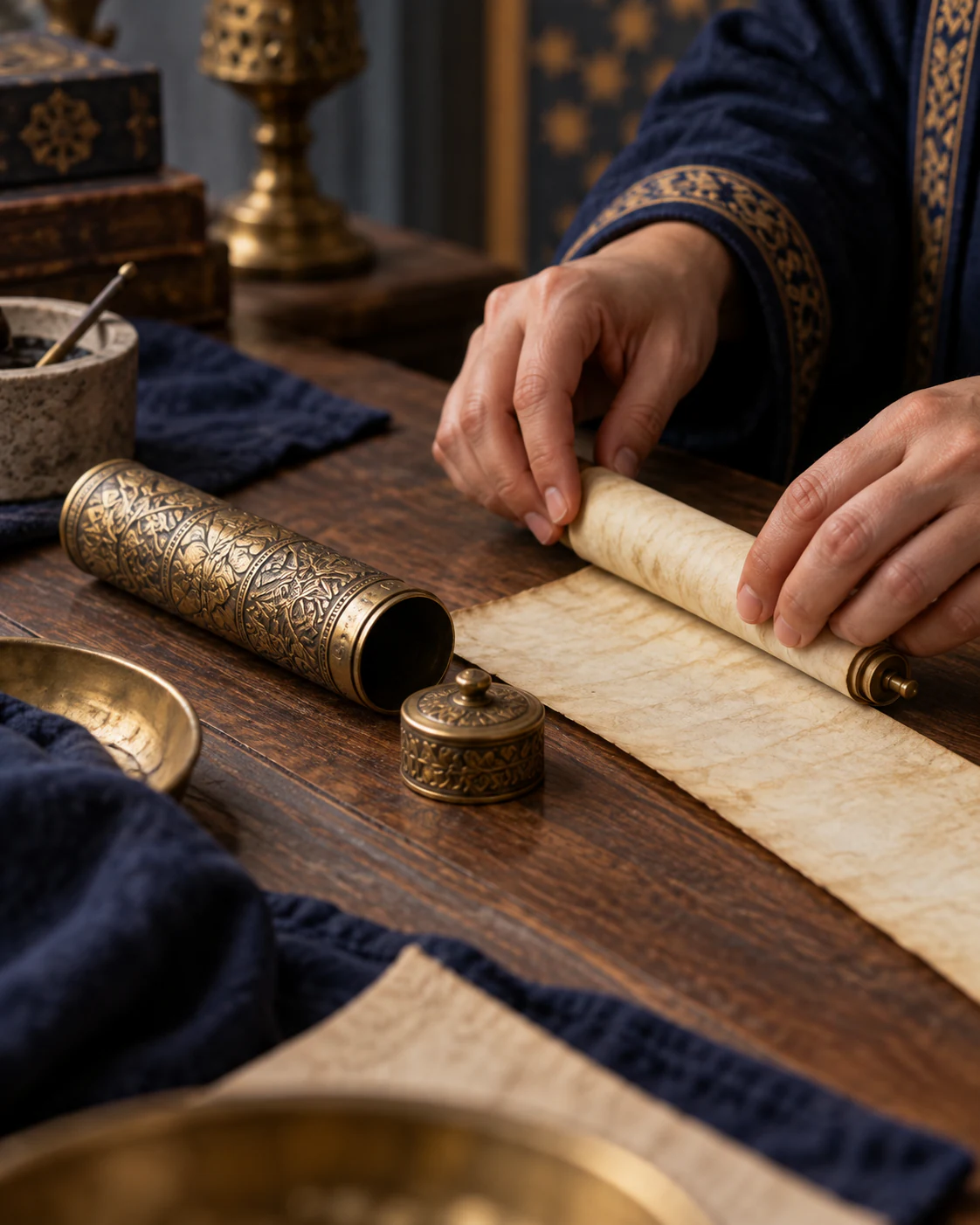
Hidden, miniature and unreadable are three different things. The writing on these scrolls is legible to anyone trained to read it. It was carried in a form that kept it out of view, and it went on working there. The paper strip and the parchment strip bring different textures to the same gesture: a surface that unrolls into length, gathers into a small space and rides against the body. The Iranian case was made to be worn, hung from its three loops with the scroll closed inside, and the words do their work from there.
The romance of the unreadable
Unfamiliar script attracts a ready-made story: the stranger the marks, the stronger the object must be. An unfamiliar hand is often an ordinary style to a trained reader. And knowing a script on sight is a different thing from reading every word: you can recognise Arabic writing without reading the passage, or see a decorative arrangement without knowing its purpose.
The strength of these words lies in what they say and in whom they call on. The careful reader moves in stages: what can be seen on the object, what has been transcribed, what the words say, and where the gaps remain.
Prayer, amulet, talisman, charm
The words overlap, and each names something exact. A prayer, a du'a, is speech addressed to God, spoken or written. An amulet is an object worn or carried to guard the one who bears it, and a written amulet carries its words on the body. A talisman is made with names, letters, figures or seals set out for a purpose, to draw good or to turn harm away. A charm is the formula itself, spoken or written. Scholars call the whole family apotropaic, from the Greek for turning away.
One object can be several of these at once. The Iranian scroll is a prayer, carried in an amulet case, working as a talisman. Mahmoud Omidsalar's entry on charms in the Encyclopaedia Iranica gathers the many spoken and written forms protection has taken in Iran.
A sacred name on such an object is an invocation, a named sign or an attribution within the tradition, and telling which is part of reading the object. The seal of Solomon calls on Solomon; the maker remains unnamed.
When an inherited case becomes a question
Imagine someone finds a small closed case among a grandmother's things; the example is invented. They remember it in a drawer and know nothing of what it holds or how old it is.
The first question is whether it is a blessing or a danger. Most often it is exactly what it looks like: a family's prayer, kept close, and it is kept with the respect owed to the words inside it. For the one who finds it, it also speaks of continuity: a prayer entrusted by an earlier generation, and the wish for protection that travelled with it. You hold a fragment, and the relationship it carries is wide: a promise, a remembered prayer, a bond with those who came before you.
If its presence unsettles the home, and a weight comes over the rooms where it is kept, that is a matter for a spiritual reading, which sees what is actually at work around a person and what lifts it.
Protection, carried
The wish that made these scrolls has not changed: to keep words of refuge near through a voyage, a new house, a child's first years, a change of life. A piece prepared for protection carries that purpose, as the scrolls carried theirs. Its protection comes by God's leave, so it is asked for and kept, and never promised as a date.
The question the scrolls still ask is what you want kept near you as your life changes: an intention, a commitment, a remembered prayer, a way of asking for help. The form still says what it always said: a long text made small, so that what a life holds can be carried into the next moment.
Questions readers ask about talismanic scrolls
Were all talismanic scrolls handwritten?
No. The Met's scroll 1978.546.32, from eleventh-century Egypt, is block-printed. Each object's record gives its technique.
Does miniature mean the whole scroll is tiny?
No. The writing and the case are small; the strip can be long. The Smithsonian's Iranian scroll is 68 centimetres long and rolls into a case 7.6 centimetres long.
Are all objects called talismanic part of one religion?
No. The word is used across many traditions and collections. The scrolls described here belong to the Islamic tradition of protection: Qur'anic words of refuge, the Throne Verse, the seal of Solomon.
Can a photograph show whether one is genuine?
Dating and authenticating an old case is the work of a specialist in manuscripts or metalwork, with the object in hand.
Does the prayer inside make the case protective?
Yes. The words of refuge are the protection. That is why they were written, rolled and carried, and why the case kept them against the body: refuge is sought with God, and the protection comes by His leave.
What should I do with an inherited case?
Keep it with the respect owed to the words inside, and keep what you know of it apart from what you felt on finding it. A family's prayer kept close is a trust. If the home is unsettled around it, spiritual uncovering sees what is really there.
Carried close, today
There is a quiet dignity in an object whose contents are larger than its visible form.
Luxarion prepares such pieces today, pendants and cases among them, each made for the purpose it is asked to carry, such as protection and fortification. A spiritual piece is the living form of what this article describes: words of refuge and a purpose, made small enough to keep against the body.
Sixty-eight centimetres of prayer fit in a case the length of a finger. What it holds is larger still.
The library teaches the craft. A reading applies it to you.
Get your personal reading