

Synastry: An Aspect Is an Angle With a Tolerance
Every synastry guide lists the contacts to look for. Almost none says how close they must be to count — which is the part that decides everything.
Read four guides to synastry and you will come away with the same shopping list every time: Sun–Moon for emotional fit, Venus–Mars for chemistry, Moon–Moon for comfort, Saturn for commitment. The lists are broadly consistent, and they are right as far as they go.
What almost none of them tells you is how close two planets have to be before the contact counts. And that omission is not a detail. It is the difference between a measurement and a pattern you can find in anything.
Because here is the arithmetic: two charts contain ten bodies each. Compare every planet in one against every planet in the other and you have a hundred pairs. Allow any angle to count and you will find "aspects" in every direction between any two people alive. The list is not what makes synastry a craft. The tolerance is.
What is actually being laid over what
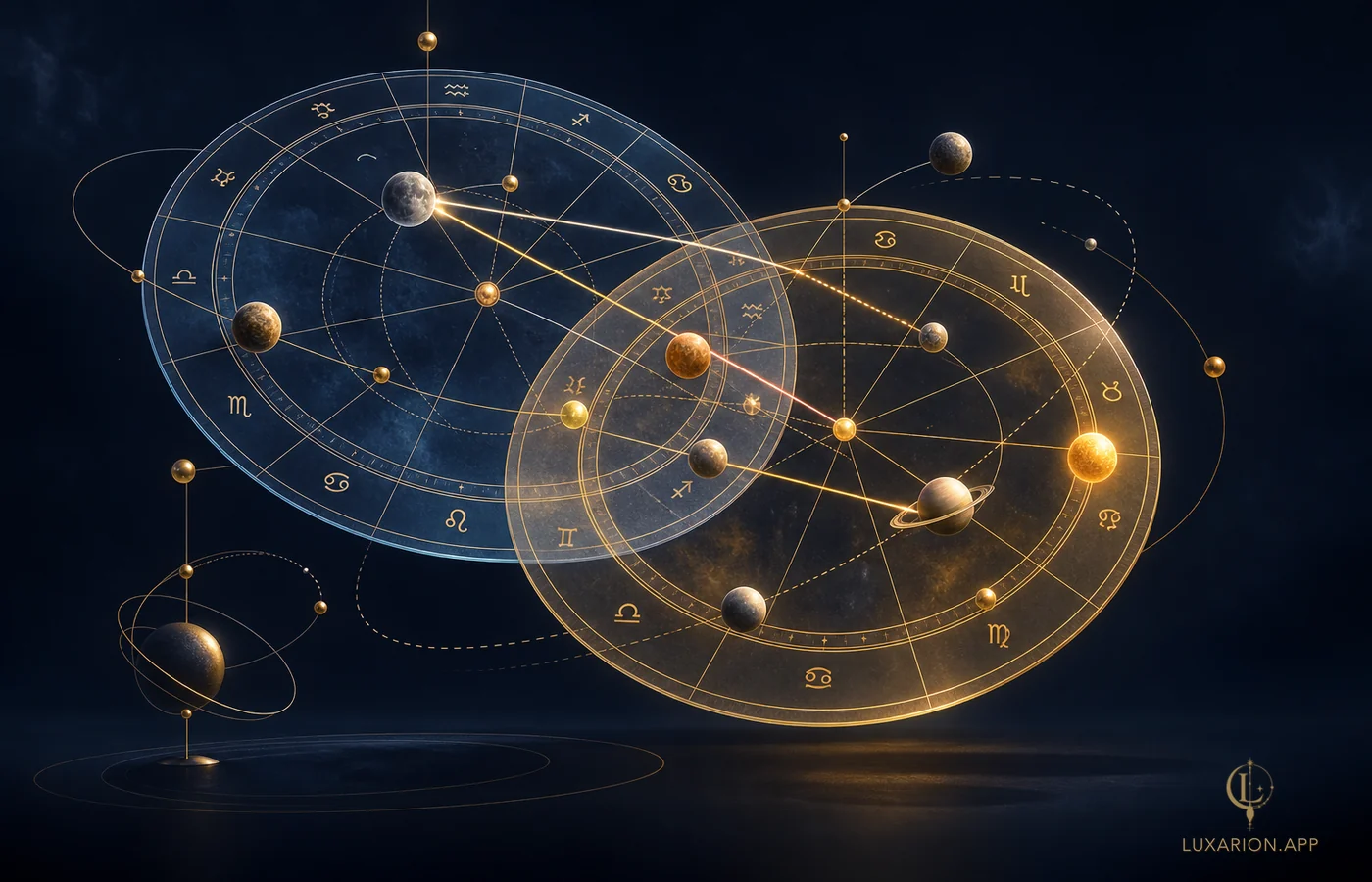
Synastry is a procedure before it is an interpretation, and the procedure is simple to state.
Take two birth charts, each computed for its own moment and place. Then measure the angular distance between every body in the first and every body in the second — your Moon to their Saturn, your Venus to their Mars, and so on across the grid. Those cross-chart distances are the raw material. Nothing else in synastry exists without them.
This is a different operation from matching two sun signs, which is the first page a compatibility quiz reads. What it yields is a hundred measured angles, and the handful that sit close to specific values are the ones the reading is built on.
Which values? That is the next part, and it is the older half of the subject.
The five angles the tradition actually uses
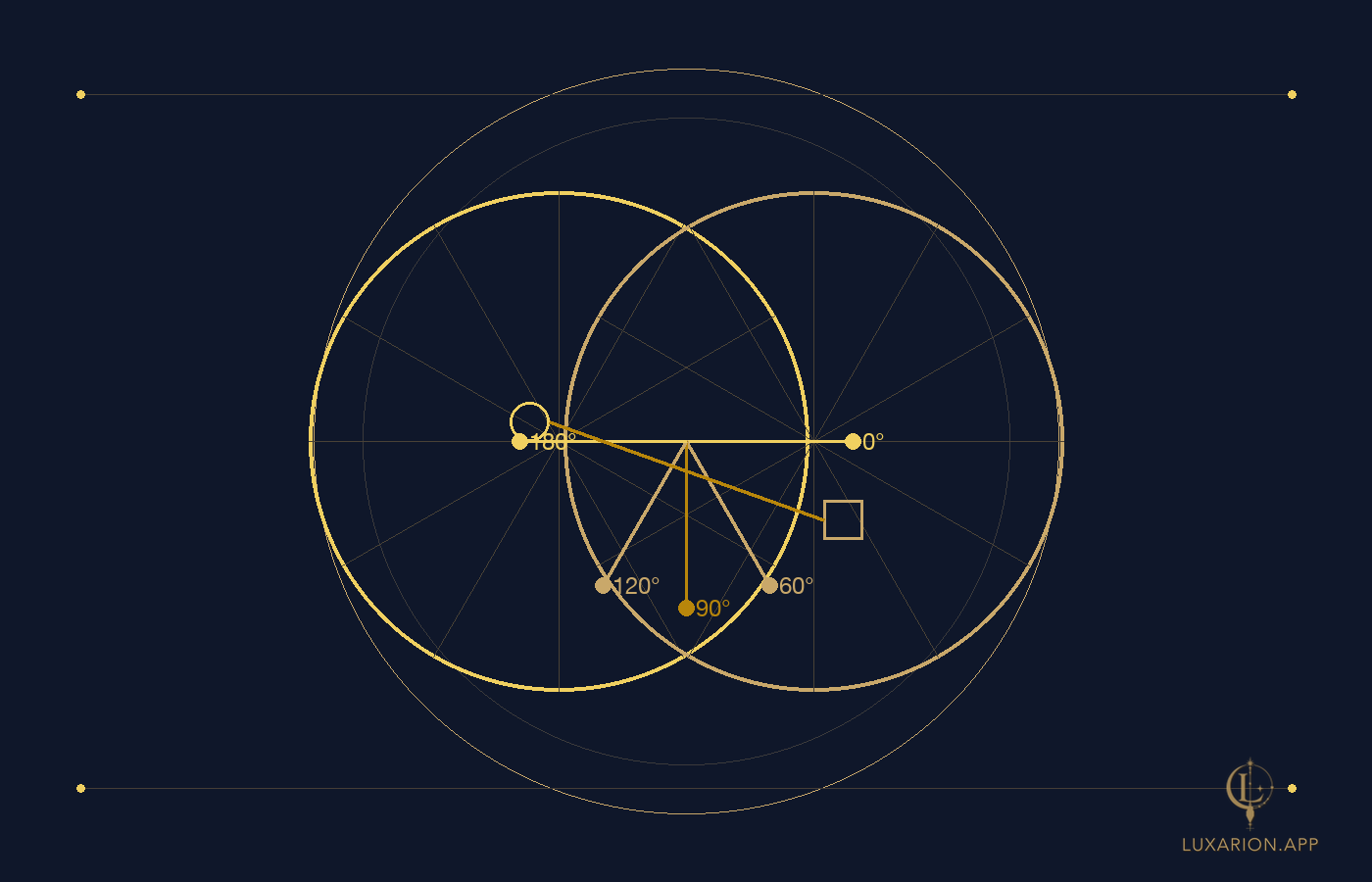
The classical set is short. An aspect is one of a small number of angular relationships, and the ones inherited from Ptolemy are these:
- 0° — conjunction. The two bodies occupy the same degree: fusion. Whatever the two planets signify arrives together, for better and worse.
- 60° — sextile. Easy cooperation that still asks someone to act on it.
- 90° — square. Friction: the two functions want different things and keep interrupting each other.
- 120° — trine. A flow so easy it often goes unnoticed until it is absent.
- 180° — opposition. A facing pair: visible, negotiable, and prone to one person carrying both ends.
Notice these are divisions of the circle — a half, a third, a quarter, a sixth. The circle's simple fractions are where planets speak to each other, and the rule is fixed before any chart is opened, which is what gives each contact its weight.
The orb: the number the lists leave out
No two planets across two charts will sit at exactly 90.000°. So the tradition allows a margin, and that margin is called the orb.
Orbs are a matter of school rather than physics — different practitioners work with different values — but the shape of the convention is consistent: a few degrees for the major aspects, wider for the conjunction, wider again when the Sun or Moon is involved, tighter for minor aspects. A contact 1° from exact is treated as loud. The same contact 7° out is treated as barely present, or not present at all.
Three things follow, and they are the whole reason this section exists.
An aspect without an orb is not a claim. "You have Venus square his Mars" means something quite different at 0.5° than at 6°. A reading that never mentions the distance is describing a category, not a measurement.
Tight contacts are rare, which is what makes them worth anything. If you compare two charts and find three contacts inside two degrees, that is a genuinely specific finding about those two charts. If you find twenty-five contacts because the orb was set to ten degrees, you have found nothing — you would have found twenty-five with anyone.
The orb is also where a reading drifts. Widen it enough and any hoped-for aspect appears — which is what happens when a reader wants the chart to say something. "How close is it?" is the most useful question a client can ask, and a good practitioner welcomes it.
What the contacts mean
Everything above is measurement — angles, tolerances, arithmetic. This section is the reading itself: what those angles mean for a relationship, and which way they show it heading.
The meanings are more specific, and less romantic, than the lists suggest.
Moon contacts carry heavy weight, because the Moon is need rather than preference. One person's Moon touching another's Saturn is the classic example: it marks a place where comfort will be asked to become durable — reliable, a little dry, requiring deliberate warmth.
Venus–Mars is the one every list leads with, and it is heat. Heat is one thing and staying power another: the chart shows staying power in its Saturn and Moon contacts, and reading longevity from Venus–Mars alone is the most common misreading of a synastry chart.
Saturn contacts are weight: what will be tested, what will endure, what will feel like an obligation before it feels like a choice. Couples often name these as the hardest contacts and the reason they are still together.
And a chart comparison produces a mixed set every time. There is no configuration that is all trines, and practitioners are generally suspicious of a reading that reports one.
Two rules the reading holds itself to
Both are worth putting in writing, because both are routinely broken.
The reading shows where a bond is heading; the choice to stay belongs to the two people in it. The traditional maxim — the stars incline, they do not compel — applies with double force where two free people are involved. A practitioner who reads a chart and says "leave him" has stopped doing the craft.
A comparison describes the weather a bond is born with, and two people work it. Long marriages are full of contacts that "should not work" and were simply worked. The map is real and worth having; the two people are the ones walking.
A comparison can be read for one person asking about a bond, or for two people looking at it together, and the version two people read together gives them a shared language for it. We take the question up from the asker's side in how to ask a question about love.
How to read a comparison with discipline
A practical order of operations, if you have two charts in front of you.
1. Set the orb first and write it down. Before you look. Choosing the tolerance after seeing the angles is how you find whatever you were hoping for.
2. Sort by exactness, not by planet. The tightest three or four contacts are the reading. The rest are context at best.
3. Read both directions. Your Saturn on their Moon is not the same statement as their Saturn on your Moon. Synastry is not symmetrical, and treating it as though it were loses half the information.
4. Count the hard contacts in full. If the tight set is mostly squares, say so. A reading that reports only the trines is not a reading.
5. Read where it is heading. The tight contacts, read in both directions, show which way the bond tends — where it will warm, where it will be tested, what it will ask of each person. Give that in words rather than a score: "your Saturn sits on my Moon" names the place the bond will be asked to mature, and it opens a conversation where a number closes one.
Common questions
Do we both need exact birth times? For the planet-to-planet contacts, no — most planets move slowly enough that dates and places will do. For anything involving the ascendant or the houses, yes, and that is a large part of what a full comparison adds.
What is a composite chart? A third chart built from the mathematical midpoints of two charts, which shows the relationship's own character rather than either person's. It answers a different question from synastry: synastry asks how two people affect each other, the composite asks what the pair is like as a unit.
Is a square always bad? No, and the tradition is clearer about this than the internet is. A square is friction, and friction produces both conflict and heat. A relationship with no hard contacts tends to be pleasant and inert.
How many aspects should we expect? With a sensible orb, a handful of tight ones and a longer tail of loose ones. If a report hands you thirty significant aspects, check what orb it used.
Can synastry show whether we will last? It reads the bond's direction: what holds, what will be tested, and what each contact asks of you both. Saturn contacts carry staying power, Moon contacts carry comfort, and the tightest contacts show where the road bends. The two of you walk it — the stars incline, and they do not compel.
Where does the word come from? From Greek — roughly "stars together". The practice is much older than the English word for it.
Where to take this
If you want the angles computed rather than guessed at, start with two charts: Luxarion's birth chart calculator is free and gives each person's placements with degrees, which is what makes an orb checkable. For a reading of the comparison itself, a compatibility reading works from both charts rather than from two sun signs.
Before either of those, the free compatibility checker answers the quick version in seconds and asks for nothing but two signs — useful for a first look, and built as one. And where the real question is not the geometry but what to do next with someone, a love consultation takes the situation rather than the chart.
And if you arrived here from the question underneath the technique — whether compatibility is a thing two people have — that is a different argument and it has its own piece: compatibility is a verb.
The library teaches the craft. A reading applies it to you.
Get your personal reading