Upright
The well-worn path is the right one here. This card points to learning from someone who knows, to a commitment made in the proper form, to values shared with a community. Seek a mentor, or become one. Do it the established way, respect the ritual, and take your place in something older and larger than you.
Reversed
The rules no longer fit, or they are being followed without belief. The Hierophant reversed shows empty convention, pressure to conform, or a teacher who does not deserve blind trust. You are being asked to question what you were handed and to keep only what is true for you.
In love
Shared values and a formal commitment: an engagement, a marriage, a meeting of the families. If you are single, love comes through your community or through people you trust. Ask early whether your beliefs about life run the same way.
In work
Institutions, formal training and proven methods are on your side. Follow the procedure, earn the qualification, listen to the experienced colleague. This is not the moment to break the mould. Learn the craft as it is taught first.
Yes or no?
Yes. Follow the proper path and honour your commitments, and it holds.
The Hierophant upright meaning in depth
The Hierophant is the fifth card of the major arcana, the card of teaching and of wisdom handed down. Where The Emperor rules the outer world, The Hierophant tends the inner one through faith, ritual, learning and shared belief. Upright, the card says the answer lies in what has been tested by time: a teaching, a community, a proper way of doing things.
Readers take him as the bridge between heaven and daily life: the priest, the elder, the master of a craft, the institution that carries knowledge from one generation to the next. He stands for belonging as much as for learning, and he often appears when you are about to join something larger than yourself, such as a school, a faith community, a profession, or a family through marriage.
The Hierophant reversed meaning
Reversed, The Hierophant marks a break with what is expected. In some readings the break is healthy: you are outgrowing a belief, a method or a group, and it is time to find your own way to the sacred. In others it is a warning about dogma, about a group that values loyalty over truth, or a mentor whose private life does not match his teaching.
The reversed card also speaks of family expectations: the career chosen to please parents, the wedding planned for the guests, the faith practised from habit alone. Unconventional choices are favoured now, as long as they come from conviction and not from reaction. Rebellion without a direction is only another kind of obedience.
The Hierophant in love: single, in a relationship and marriage
For a single person, The Hierophant brings love through familiar channels: an introduction by family or friends, a meeting at a place of worship, a class, a community event. The person who arrives shares your values and wants something serious, and the courtship follows the traditional pace.
In a relationship, this is one of the strongest signs of formal commitment in the deck. Readers link it with engagements, weddings and blessings given by family or faith. Beyond the ceremony, it asks what the two of you believe in together: the rituals you keep, the way you will raise a family, the values that will hold you when feelings run low.
The Hierophant reversed in love and reconciliation with an ex
Reversed in love, the card describes a relationship that does not fit the expected mould: different backgrounds, a family that disapproves, a bond the world does not yet recognise. It also warns of a commitment kept out of duty rather than love, or of pressure to marry before you are ready. For some, it is freedom from old rules about what love should look like.
When the question is an ex, The Hierophant upright points to reconciliation through a mediator, a family elder or a return to the values you once shared. Reversed, it warns against going back only to satisfy other people's expectations.
The Hierophant as feelings: how does he or she feel about you
As feelings, The Hierophant shows respect and serious intentions. This person sees you as someone to commit to properly, in the right way and in the right order, and is thinking about what their family would say. Their feelings grow steadily rather than in a rush, and loyalty matters to them as much as attraction.
Reversed as feelings, they feel caught between what they want and what is expected of them. Family pressure, religious differences or their own fixed ideas about relationships are holding them back from showing what they feel.
The Hierophant as a person
As a person, The Hierophant is a teacher, a mentor, a religious figure, an academic, an elder of the family or a senior colleague: principled, learned and steady. People come to them for counsel, and they hold firmly to the way things should be done.
Reversed, the same person becomes rigid and preachy, or a hypocrite who teaches one thing and lives another. In other readings the reversed Hierophant is the nonconformist, the one who questions every rule.
The Hierophant for career, study and money
In career readings, The Hierophant favours education, religion, government, banking, academia and long-established companies. It is a strong card for students and for anyone sitting an exam: study by the book and the result follows. Joining a professional body, starting an apprenticeship or gaining a recognised title all sit under this card.
With money, the card favours the conventional path: a bank, a savings plan, a pension, sound advice from an experienced adviser. Speculation is not its way. Reversed, it points to unconventional ways of earning, or to advice from an institution that needs checking before you follow it.
The Hierophant as advice
As advice, The Hierophant says learn before you innovate. Ask what those who came before you did in this situation and start from there. Keep one ritual that ties your days to something larger than you. Make your commitments in the proper form, so that everyone involved knows exactly where they stand.
The Hierophant as outcome and in past, present and future
As the outcome of a reading, The Hierophant shows the matter settled in the proper way: a formal agreement, a commitment witnessed, a qualification gained, a place found within a community.
In the past position, your upbringing, faith or education shaped the choices that led you here. In the present, you are learning, or being asked to commit within a recognised structure. In the future, a teacher, an institution or a ceremony plays a central part.
Is The Hierophant a yes or no card
The Hierophant is a yes, especially for questions about marriage, study, exams, joining an organisation or anything done through official channels. Its yes comes when the proper steps are followed.
Reversed, the yes holds once you are sure the form fits you: question the rule first, keep what is true, then commit.
The Hierophant card imagery and symbols
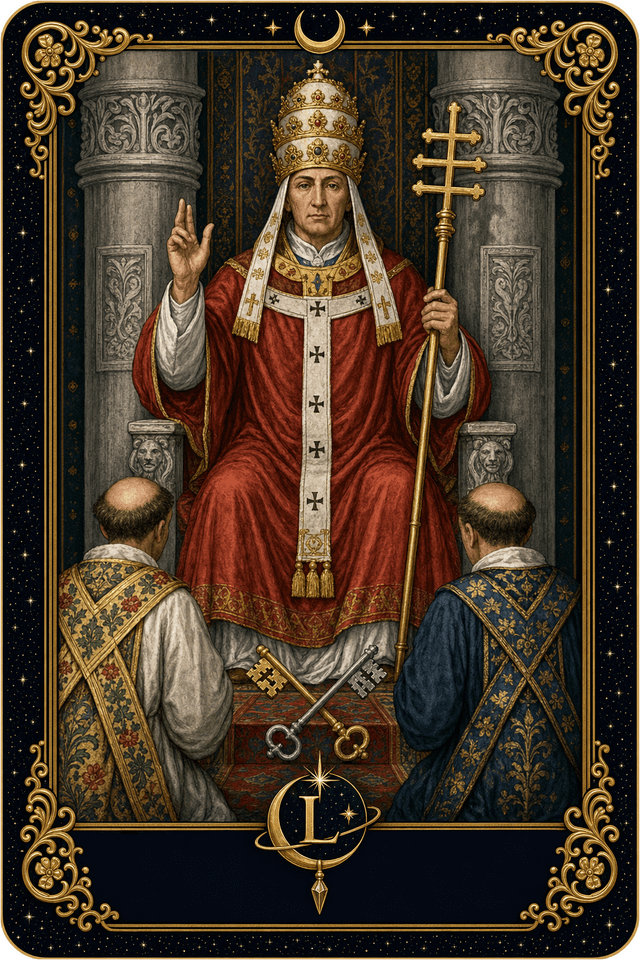
In the Rider-Waite-Smith image, The Hierophant sits on a throne between two grey pillars, wearing a triple crown and red robes. In his left hand he holds a staff topped with a triple cross, and his right hand is raised in blessing with two fingers lifted. Readers take the three tiers of crown and cross as the three worlds he mediates between.
Two crossed keys lie at his feet, read as the keys to the seen and unseen worlds, or to outer and inner knowledge. Before him kneel two tonsured ministers, one robe embroidered with red roses and the other with white lilies, the same flowers that grow in The Magician's garden: desire and purity, both brought under teaching.
The Hierophant in astrology: Taurus, number five and Vav
In the Golden Dawn system The Hierophant corresponds to Taurus and to Vav, the sixth letter of the Hebrew alphabet, whose name means nail or hook: the peg that joins one thing to another. Taurus is a fixed Earth sign ruled by Venus, patient, loyal, attached to what is solid and proven. The card's element is Earth.
Its number is five. Readers take five as the human being, with the five senses through which spirit is received, and The Hierophant as the teacher who carries the sacred into ordinary life.
The spiritual meaning of The Hierophant
Spiritually, The Hierophant is the value of a lineage: the prayers, texts, rites and teachers that carry wisdom across centuries. He speaks of initiation, of formal entry into a path, and of the humility needed to learn from a master. In time he also points inward, to the teacher in your own heart who recognises truth when it is spoken.
The Hierophant with other cards
The Hierophant with The Lovers is a blessed union and a marriage. With the Two of Cups, it is an engagement. With the Four of Wands, a wedding or a family celebration. With the Ten of Pentacles, family tradition and inheritance. With The Hermit, study under a master or a spiritual retreat. With The Devil, a group or doctrine that binds instead of freeing.
Questions people ask
What does The Hierophant mean in tarot?
The Hierophant means tradition, teaching, shared values and formal commitment. It says the answer lies in what has been tested by time and in learning from those who came before.
Does The Hierophant mean marriage?
Yes, it is one of the strongest marriage cards in the deck. Readers link it with engagements, weddings and a commitment blessed by family or faith.
What does The Hierophant mean as feelings?
It shows respect and serious intentions. The person wants to commit properly and cares about doing things in the right order.
What does The Hierophant reversed mean?
Reversed, The Hierophant means breaking with convention, questioning dogma or feeling pressured by expectations. It asks you to sort through what you were taught and hold on to what still rings true.
What zodiac sign is The Hierophant?
The Hierophant corresponds to Taurus, a fixed Earth sign ruled by Venus. Its Hebrew letter in the Golden Dawn system is Vav.
Is The Hierophant a yes or no card?
The Hierophant is a yes, especially for marriage, study and anything done through proper channels. Reversed, the yes holds once you are sure the form fits you.