Upright
What is fair will be done. This card says the matter is decided on its merits, and that honesty is your best ground. Look at your own part without excuses. If you have acted well, you have nothing to fear from the outcome. The decision in front of you needs a clear head: weigh the facts, then cut cleanly.
Reversed
Someone has a thumb on the scales. Justice reversed shows an unfair outcome, a truth being dodged, or someone refusing to answer for what they did. Sometimes that someone is you. The card also speaks of judging yourself too harshly. Put the facts back on the scale and carry your own share, no more.
In love
A relationship receives what has been put into it. The question here is fairness: is the giving balanced? Before you start again with someone new, be truthful with yourself about past patterns. A commitment made now is made with a clear head, and it holds.
In work
Agreements and formal decisions are in the foreground. Read every line and keep your dealings clean. You are assessed fairly, and both effort and neglect come to light. Decide on the facts. If you owe something, settle it. If you are owed, ask plainly.
Yes or no?
Wait. The outcome will be exactly what is fair, so weigh the facts before you act.
Justice upright meaning in depth
Justice is the card of consequences that arrive in proportion. Upright, it says the scales are true: the matter in front of you will be settled on what actually happened, not on who argues loudest or who is best liked. For someone who has acted cleanly that is a comfort. For someone who has not, it is a warning that the account is about to be read.
The card also calls for a decision made with the head. Justice holds a sword, and a sword cuts. Once the facts are weighed she does not linger. The card often appears when a choice has been put off for fear of seeming unkind, and its view is that a fair decision, made plainly, is a form of kindness even when someone is disappointed. Truth told without decoration, promises kept, debts named and paid: this is Justice upright in daily life.
Justice reversed meaning
Reversed, the scales tip. The most common reading is an outcome that is not fair: a decision taken on partial facts, a bias in whoever judges, a truth someone is working hard to keep off the table. Readers also take it as evasion closer to home, a refusal to own one's part in what went wrong. The card asks plainly whose hand is on the scale.
There is a quieter reversed meaning that matters as much. Justice reversed also describes someone who judges themselves without mercy, who takes the whole blame for a shared failure, or who keeps reopening an old fault long after it has been answered for. The remedy is the same either way. Return to the facts, give each part to its owner, and remember that a fair account includes the good you did as well as the harm.
Justice in love: single and in a relationship
In a relationship Justice looks at balance. Who gives, who receives, who apologises, who always bends? The card turns up when that ledger needs to be read aloud. It is not a cold card for love. It often marks a partnership built on respect, where two adults speak honestly and keep their word, and it is a classic sign of commitment made formal: an engagement, a marriage, a shared lease or a home bought together.
For a single person Justice asks for honesty about the past before the next step. What did you bring to your last relationship, and what did you allow? The person you meet now meets the result of that reckoning. Readers also take the card as a sign of a partner who is fair-minded, principled and straightforward, someone whose words and actions match.
Justice reversed in love and getting back with an ex
Reversed in love, Justice shows imbalance: one partner carrying the weight, blame handed out unevenly, a broken promise nobody has addressed.
Where an ex is concerned, upright Justice says a return is decided by what really happened between you. If the break came from a misunderstanding that can now be set right, the door opens on fair terms. Reversed, the old account is not settled, and coming back without settling it repeats the same ending.
Justice as feelings: how they feel about you
As feelings, Justice is measured rather than passionate. The person sees you clearly and is weighing the relationship: what it gives them, what it asks of them, whether it is fair to you both. From the outside that can feel cool, but it is serious. They are thinking about you with the whole mind, not only the heart, and if they choose you, they mean it. Reversed, the feelings are coloured by resentment, by a sense of being treated unfairly, or by guilt over something not yet admitted.
Justice as a person
As a person, Justice is principled, articulate and even-handed, someone who listens to both sides before speaking. They dislike drama and dishonesty, and they keep their promises. Readers link the card to people whose work is weighing and deciding: mediators, auditors, editors, anyone who sets standards for others. In character it describes a Libra, or anyone who values harmony but will not buy it with a lie. Reversed, the same person turns rigid, self-righteous or quietly partial.
Justice in career, work and money
At work Justice is the card of contracts, reviews and formal decisions. Applications are judged on merit, performance is assessed honestly, and any dispute is settled by the documents rather than by whoever shouts. It is a good card for anyone whose record is clean and a sobering one for anyone cutting corners, because it brings effort and neglect alike into the light.
With money, Justice is fair exchange. What comes to you now comes in proportion to honest work: a fair wage, a payment owed and finally received, an agreement in which both sides are treated well. This is the moment to settle debts, read the small print and ask for what you are owed without apology. Reversed, look out for unfair terms, an unequal split or an account that does not add up.
Justice as advice
As advice, Justice says: tell the truth, then decide. Gather the facts, including the ones that do not flatter you, weigh them without hurry, and act cleanly. Do not let fear of someone's reaction push you into a vague compromise that serves nobody. If you owe an apology, a payment or an answer, give it now. If someone owes you, ask plainly and keep a record.
Justice as an outcome, and in past, present and future
As the outcome of a spread, Justice says the matter ends exactly where the facts lead. You receive what your actions have earned, no more and no less, and for anyone who has acted well that is a good result.
In the past position, Justice points to a decision or consequence that still shapes your situation: an agreement signed, a ruling accepted, a choice that set things on their present course. In the present it shows the scales in motion. A decision is due, and what you do now counts. In the future it promises a time of accounting, when what is hidden comes to light and loose ends are tied fairly.
Is Justice a yes or no card?
Justice answers wait. It is neither a promise nor a refusal, because the card will not decide ahead of the facts. The outcome will be exactly what is fair, so the real question becomes whether your side of the scale is sound. Weigh what you know, put right what you can, and ask again once that is done. Reversed, the wait is longer: something unfair or hidden has to come out before any answer can be trusted.
Justice card symbolism
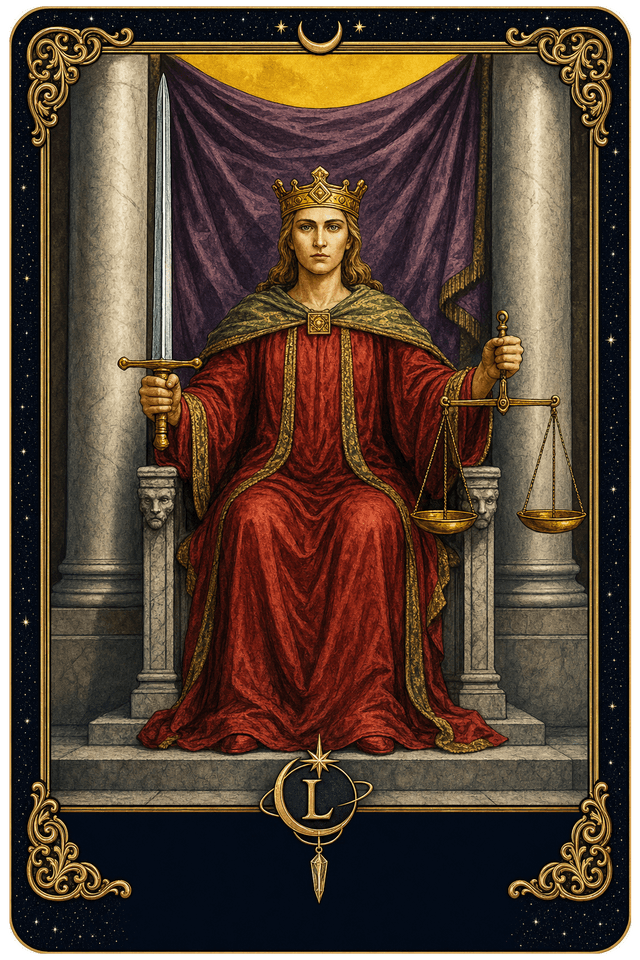
In the Rider-Waite-Smith image drawn by Pamela Colman Smith, Justice sits on a stone seat between two grey pillars, with a violet veil hung between them. She wears a red robe, a green mantle and a crown set with a small square. The sword in her right hand is double-edged and points straight up, a sign that judgement cuts both ways and leans to neither side. The scales in her left hand hang level.
Unlike the familiar statue outside a courthouse, she is not blindfolded. Readers take this as the heart of the card: true justice looks at the facts with open eyes. A white foot shows beneath the hem of her robe, read as a step about to be taken, a decision moving into action. The pillars and the veil recall The High Priestess.
Justice astrology, number, element and Hebrew letter
In the Golden Dawn system that the Rider-Waite deck follows, Justice belongs to Libra, the sign of the scales, ruled by Venus. Its element is Air, the element of thought and judgement, which suits the sword. Its Hebrew letter is Lamed, the ox goad that drives the ox forward, and readers take it as the push that turns a weighed decision into a step taken.
The card is numbered 11 in the Waite deck. Older decks, the Tarot de Marseille among them, place Justice at 8 and Strength at 11. The Golden Dawn exchanged the two so the zodiac signs run in order, and Waite kept the change. Eleven reduces to two, which links Justice with The High Priestess: she knows the inner truth, and Justice applies it in the world.
Justice spiritual meaning
Spiritually, Justice is the law of cause and effect, the harvest of what has been sown, what many call karma. The card invites you to live so that your account can be read without fear, with what you say, what you do and what you believe pointing the same way. It also lifts a burden. You do not have to punish anyone yourself, because the scales are held higher than any human hand.
Justice card combinations
With The Lovers, Justice speaks of a committed choice made with open eyes, often a marriage or formal partnership. With The Emperor it points to authority, rules and an official ruling. With the Ace of Swords a truth comes out and a clear decision follows. With Judgement a long matter reaches its final verdict.
With The Tower, a hidden imbalance is exposed all at once. With the Two of Swords, a decision long avoided can wait no longer. With the Five of Swords, beware of winning by unfair means, because Justice beside it says the gain will be answered for.
Questions people ask
What does the Justice tarot card mean?
Justice means fairness, truth and cause and effect. The matter is decided on its merits, and each person receives what their actions have earned.
Is Justice a yes or no card?
Justice answers wait. The outcome will be exactly what is fair, so weigh the facts and put right what you can before you act.
What does Justice mean in love?
In love, Justice asks whether the giving is balanced and points to an honest, committed partnership, often made formal. Reversed, it shows imbalance or a truth that has not been told.
How does someone feel about you when Justice appears?
They see you clearly and are weighing the relationship seriously. Their feelings are steady rather than stormy, and any decision they make about you is a considered one.
What does Justice reversed mean?
Reversed, Justice shows an unfair outcome, a truth being dodged or someone avoiding accountability. It also describes judging yourself far too harshly.
What zodiac sign is the Justice card?
Justice corresponds to Libra, the sign of the scales. In the Golden Dawn system its element is Air and its Hebrew letter is Lamed.