Uprightbondage
Uprighttemptation
Uprightobsession
Uprightattachment
Reversedbreaking free
Reversedfacing the shadow
Reversedrelease
Upright
You are tied to something that is not good for you, and you know it. The Devil names the attachment: a desire, a habit, a person, a fear about money, a story about your own powerlessness. It feels like a prison. The whole message of the card is that the chain is loose. See the bond for what it is, without shame, and stop feeding it.
Reversed
The chains are coming off. The Devil reversed is a person waking up to what has held them and beginning to pull free. It is not finished. The old pull is still strong and it calls you back. Face the shadow honestly, and take one concrete step out today.
In love
A powerful attraction with a hook in it. The passion is real, and so is the danger of obsession, jealousy, control or dependence. Ask whether you stay from love or from fear. Single, beware of the person you cannot stop thinking about for the wrong reasons.
In work
Something has a hold on you: a job you keep only for the pay, an ambition that eats everything else, an agreement with strings attached. Look hard at what binds you and at what you get from staying. Refuse shortcuts and deals that ask you to bend your principles.
Yes or no?
No. This path binds you, and what tempts you here costs more than it gives.
The Devil upright meaning in depth
The Devil is the card of the thing that has a hold on you. It names attachment in every form: a desire you cannot put down, a habit that runs your days, a relationship kept for the wrong reasons, a fear about money that makes every choice for you. Upright, it does not accuse. It describes, plainly, the places where you have handed your freedom to something smaller than yourself.
The heart of the card is in its chains. They hang loose around the necks of the two figures, loose enough to lift off. Readers take this as the whole message: the bondage is real, but it is partly chosen and kept in place by belief. The Devil feeds on the story that you have no choice. Once you see the bond clearly, without shame and without excuses, it begins to lose its grip.
The Devil reversed meaning
Reversed, the chains begin to come off. The card shows release: someone waking up to what has controlled them, naming it and starting to pull free. Readers count this among the more hopeful reversals in the deck, because the hardest part, seeing the bond, has already happened.
The freedom is not yet complete. The old pull is still strong and calls you back, especially in tired or lonely moments. The reversal also shows a shadow faced at last, a truth about yourself you had refused to look at. Keep going. Each concrete step away from the old attachment weakens it, and each return strengthens it.
The Devil in love: single and in a relationship
In a relationship the Devil shows a powerful attraction with a hook in it. Passion and physical chemistry run high, often thrillingly, and so does the risk of jealousy, control, possessiveness or dependence. The card asks whether you stay out of love or out of fear: fear of being alone, fear of the other person, fear of starting again. A bond like this can be transformed, but only once both people see what drives it.
For a single person the Devil warns against the one you cannot stop thinking about for the wrong reasons: the unavailable person, the one who keeps you on a string, the attraction that feels like a compulsion. It also describes a strong sensual pull towards someone new. Enjoy desire, but keep your eyes open and your self-respect whole.
The Devil reversed in love and getting back with an ex
Reversed in love, the card shows a person breaking free of a harmful bond, ending a pattern of control or dependence, or seeing a partner clearly after a long spell of obsession. As for an ex, the upright Devil shows a pull to return that comes from attachment more than love, and the same chains wait on the other side of the door. Reversed, it says you are freeing yourself from that tie, and staying free is the gain.
The Devil as feelings: how they feel about you
As feelings, the Devil shows intense desire, obsession and attachment. The person is strongly drawn to you, often physically, and thinks about you more than they would like. The feeling can be possessive or jealous, and it is not always loving: it can be about wanting, controlling or needing rather than caring. Reversed, it shows someone trying to free themselves from their feelings for you, or realising the attachment does them no good.
The Devil as a person
As a person, the Devil is magnetic, ambitious and persuasive, someone with a strong pull on others and a strong appetite for pleasure, money or power. They can be charming and generous, but they bind people to them, and the price of their favour rises over time. Readers link the card to the shadow side of Capricorn: ambition that has forgotten why it began. Reversed, it describes someone shaking off a controlling influence, or turning away from their own worst habits.
The Devil in career, work and money
At work the Devil shows something with a hold on you: a job kept only for the salary, an employer who rules by fear, an ambition that eats every other part of life, or an agreement with strings you did not read. Look hard at what binds you and at what you gain by staying. Refuse shortcuts and arrangements that ask you to bend your principles, because the card says they cost more than they pay.
With money, the Devil is materialism and fear: spending to fill an emptiness, debt that keeps growing, or clinging so hard to wealth that it rules every choice. Readers take it as a call to look honestly at your relationship with money. Reversed, it shows a debt being cleared, a financial trap escaped, or a new freedom from the need to have more.
The Devil as advice
As advice, the Devil says: look at what owns you. Name the habit, the person or the fear, without shame and without excuses. Ask what you get from it and what it takes from you. Then stop feeding it, one decision at a time. The chain is loose. Lift it.
The Devil as an outcome, and in past, present and future
As an outcome, the Devil says the path leads to a deeper attachment, a situation that binds you more tightly. It is the result of choices made from desire or fear, and seeing those choices clearly now is what changes it.
In the past position, it shows an old bond, habit or influence whose hold still shapes you. In the present, the attachment is active and you are inside it. In the future, it marks a temptation on its way, and naming it in advance takes away much of its power.
Is The Devil a yes or no card?
The Devil answers no. The path in question binds you, and what tempts you here costs more than it gives. Even when the offer looks attractive, the card says the price is hidden in the terms. Reversed, the no still stands for the temptation itself, and the card supports the step you take away from it.
The Devil card symbolism
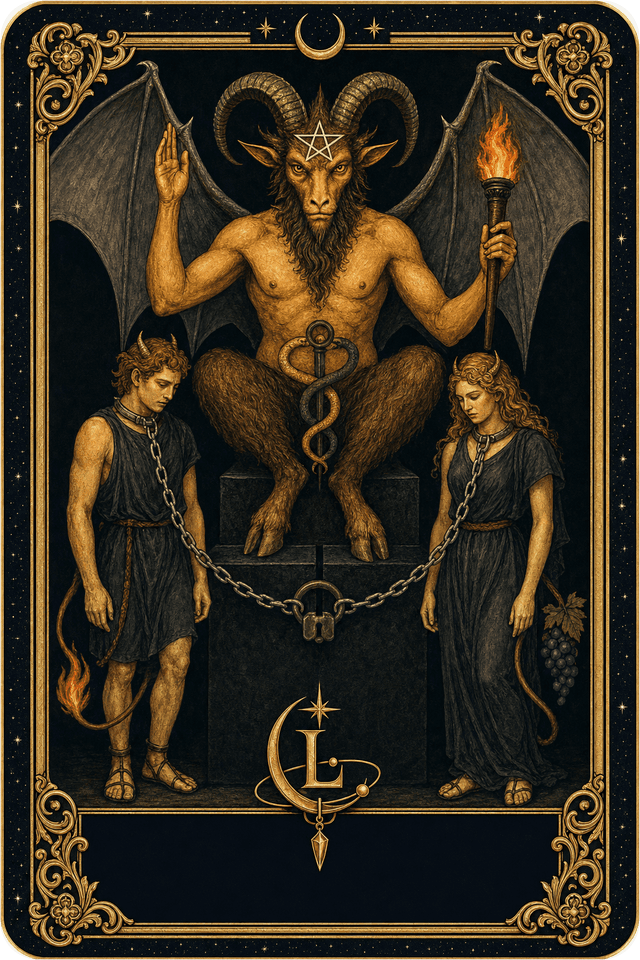
In the Rider-Waite-Smith image drawn by Pamela Colman Smith, a horned figure with bat wings and the legs of a goat squats on a black block. An inverted pentagram marks his brow, his right hand is raised, and his left holds a lit torch pointing towards the ground. Chained to the block by the neck stand a naked man and woman, each with small horns and a tail, hers ending in grapes and his in a flame.
Readers see the card as a dark mirror of The Lovers. There an angel blesses the couple. Here the Devil presides over them, and they belong to him. Yet the chains are loose, the figures are not struggling, and their tails show they have begun to take on his nature by their own consent. The torch pointing down is light spent on the lower appetites, and the black block is read as the half truth on which bondage rests.
The Devil astrology, number, element and Hebrew letter
In the Golden Dawn system the Devil belongs to Capricorn, the cardinal Earth sign ruled by Saturn and symbolised by the goat. Its element is Earth, the realm of the body, matter and possessions, which is where the card does its binding. Its Hebrew letter is Ayin, which means eye, and readers take it both as the eye that sees only the surface of things and as the clear sight that breaks the spell.
The card is numbered 15. Fifteen reduces to six, which links the Devil with The Lovers, the card it mirrors. Six is a choice made in love. Fifteen is the same choice made in fear or appetite.
The Devil spiritual meaning
Spiritually, the Devil is the shadow: the parts of yourself you would rather not see, and the false gods of comfort, status and craving that ask to be served. The card does not threaten. It reveals, so that the soul can reclaim the power it has given away. Many paths teach that freedom begins with honesty about what holds you, and this card is that honesty set down in a picture.
The Devil card combinations
With The Lovers, a relationship driven by obsession, or a choice made from desire rather than love. With The Tower, a bond breaks suddenly and for good. With the Eight of Swords, a trap that lives mostly in the mind. With the Four of Pentacles, greed or fear around money.
With Strength, the inner power to master an appetite. With The Star, freedom after a long attachment and the return of hope. With the Seven of Swords, deception, or a deal that is not what it seems.
Questions people ask
What does The Devil mean in tarot?
The Devil means bondage, temptation, obsession and attachment. It names what has a hold on you and shows that the chain is looser than it feels.
Is The Devil a yes or no card?
The Devil answers no. This path binds you, and what tempts you here costs more than it gives.
What does The Devil mean in love?
It shows a powerful attraction with a hook in it: real passion, and with it the risk of jealousy, control or dependence. The question it asks is whether you stay from love or from fear.
How does someone feel about you when The Devil appears?
They feel intense desire and attachment, often physical and sometimes possessive. Reversed, they are trying to free themselves from those feelings.
What does The Devil reversed mean?
Reversed, The Devil shows breaking free, facing the shadow and release. The old pull is still there, so every step away counts.
Is The Devil always a bad card?
No. It warns of attachment, but its chains are loose, and readers take it as the chance to see a bond clearly and take back your freedom.