Upright
Something in your life is over. Death says this plainly and without cruelty. A relationship, a role or a way of living has run its course, and holding on only prolongs the pain. Let it go, and grieve it properly. What clears now makes room, and the sun on the horizon of this card is the new chapter already on its way.
Reversed
You are refusing an ending that is due. Death reversed shows a situation kept going past its time, a change resisted out of fear, a slow fading in place of a clean close. You are caught between what was and what will be. Loosen your grip. The new cannot begin until this is finished.
In love
A chapter closes. Sometimes it is the relationship itself. More often it is the form the relationship has had, and it must change deeply in order to continue. On your own, you are finally finished with an old love, and that ending frees your heart for someone new.
In work
A job, a role or a way of working comes to an end. Let it finish. A complete change of direction is under way, and it will prove right. Close what is finished, clear the desk, and put your effort into what comes next instead of into saving what has ended.
Yes or no?
No. This matter has reached its end, and something else must begin in its place.
Death upright meaning in depth
Death is the most feared card in the deck and one of the most misunderstood. Upright, it means an ending that is complete and will not be undone: a chapter closed, a role finished, a version of yourself left behind. The card does not deal in half measures. Where other cards speak of change that can be negotiated, Death speaks of change already decided, and the only choice left is how you meet it.
The ending is never the whole message. The skeleton rides towards a rising sun, and readers take the card as transformation, the clearing that makes renewal possible. What falls away now was already finished in spirit. Grieving it is right. Holding on to it is what turns a clean ending into a slow one. Once the space is clear, the new arrives on its own.
Does the Death card mean physical death?
No. In tarot practice the Death card is read as the end of a cycle, not as a prediction that someone will die. It names transformation in the questioner's life: a relationship that changes form, a job that ends, a belief that gives way. Readers who meet it in a spread speak of closing doors and turning pages, and that is how the card is read throughout the Rider-Waite tradition.
Death reversed meaning
Reversed, Death shows an ending resisted. A situation is kept on life support after its time, a change is refused out of fear, and the person stands in a doorway, unwilling to go back and afraid to go forward. The result is stagnation. Nothing grows, because the ground is still taken up by what has died.
The reversed card also shows a transformation happening slowly and inwardly, a shedding that others do not yet see. Readers take that as gentler, but the counsel is the same. Loosen your grip on what is over. The longer the old form is held, the more it costs, and the new chapter cannot begin until this one has been allowed to close.
Death in love and getting back with an ex
In a relationship, Death rarely means the end of love by itself. More often it marks the end of a stage: the first enchantment gives way to something deeper, an old pattern of jealousy or distance dies, a couple moves house or country and becomes different people together. Sometimes it is the relationship itself that ends, and the card is honest about that. Either way, what continues has to be new.
For a single person, Death says an old love is finally over inside you. The ex who still filled your thoughts no longer holds the key, and that release clears room for someone new. It is a strong card for a fresh start, because it removes what stood in the way.
Reversed in love, the card shows a relationship that has ended in all but name, kept going from habit, fear of being alone or reluctance to grieve. As for an ex, Death upright is one of the clearest signs that a chapter is closed and that going back would not restore what was lost. Reversed, it shows someone still holding on, and the counsel is to let it end so both people can move on.
Death as feelings: how they feel about you
As feelings, Death shows someone going through a deep change in how they feel. An old way of relating to you is dying in them, which means either that they are moving on or that their feelings are turning into something more serious. In both cases they will not feel as they did before. Reversed, it shows someone who senses the change and resists it, clinging to the way things were or afraid of what they now feel.
Death as a person
As a person, Death is intense, direct and transforming, someone who arrives at a turning point in your life and changes its course. They have often been through deep losses themselves and do not flinch from hard truths. Readers link the card to Scorpio and to people who can stay beside others through grief and change. Reversed, the same person resists change, holds on to the past and keeps others tied to it.
Death in career, work and money
At work, Death marks the end of a job, a role or a way of working. A position finishes, a company restructures, or you outgrow the work and know it. The card says the change is right even when it is uncomfortable. Close what is finished properly, then put your energy into the next direction rather than into rescuing what has gone.
With money, Death is the end of one source of income and the start of another, or the moment to cut a loss and stop paying for something that no longer serves you. Clearing old debts and obligations belongs here too. Reversed, it warns of money poured into a situation that is already over.
Death as advice
As advice, Death says: let it end. Name what is finished, say goodbye properly and stop investing in it. Grieve, because grief is the honest answer to an ending, but do not build a home in the grief. Clear the space, and trust that what comes next needs the room.
Death as an outcome, and in past, present and future
As an outcome, Death says the matter closes completely and something different takes its place. It is not the next scene of the same story. It is the end of that story and the start of another.
In the past position, it shows an ending that still shapes you, a loss or change that cleared the way for where you stand now. In the present, the transformation is under way, and resisting it only adds to the pain. In the future, a chapter is drawing to a close, and preparing for it makes the passage cleaner.
Is Death a yes or no card?
Death answers no. The matter in question has reached its end, and something else must begin in its place. This is a no to the old situation carrying on as it was, not a no to your life moving forward. Even when the question is about leaving or changing something, the card's no speaks to what is ending: it will not return to its former shape. Reversed, the answer is still no, with the added note that the delay comes from holding on.
Death card symbolism
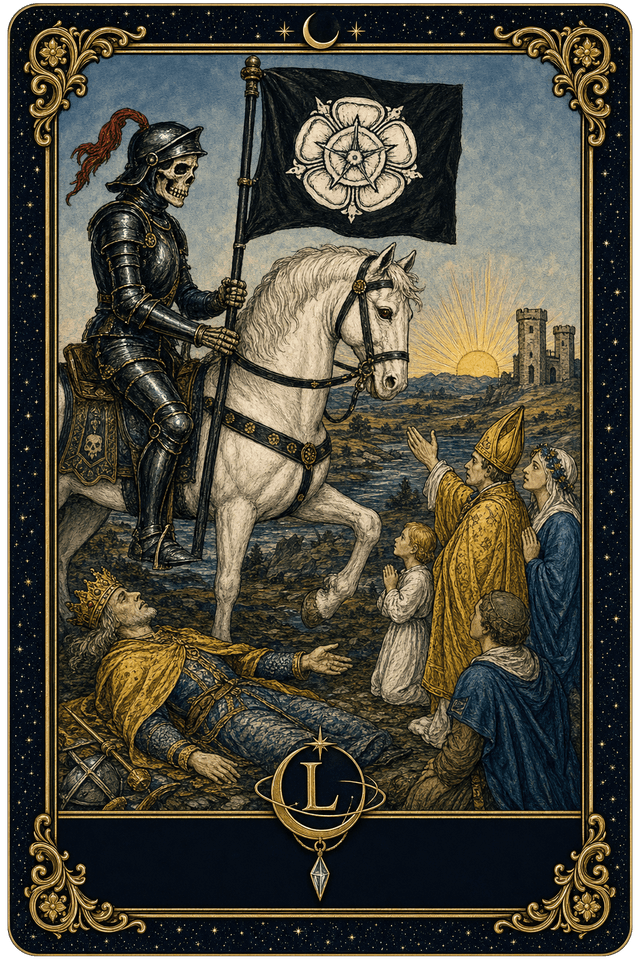
In the Rider-Waite-Smith image drawn by Pamela Colman Smith, a skeleton in black armour rides a white horse and carries a black banner bearing a white rose with five petals. Before him a king lies fallen with his crown on the ground, a bishop in a mitre pleads with joined hands, a young woman turns her face away and a child offers him flowers. Behind them a boat moves on a river, and far off the sun rises between two towers.
Readers take the scene as the great leveller: king, priest, maiden and child all meet the same rider, and only the child, who resists nothing, is at ease. The white horse is purity, and the rose is the life that continues through every change. The river carries away what has ended. The two towers return in The Moon, and the rising sun between them says the night is not the end.
Death astrology, number, element and Hebrew letter
In the Golden Dawn system Death belongs to Scorpio, the fixed Water sign of depth, intimacy and rebirth, traditionally ruled by Mars. Its element is Water. Its Hebrew letter is Nun, which means fish, and readers take the fish as life moving unseen below the surface, the hidden current of change.
The card is numbered 13, a number that carries old fears in the West, which suits a card so often misread. Thirteen reduces to four and links Death with The Emperor: the structure built in the fourth card is the structure Death takes down so that another can stand. In the Tarot de Marseille the card traditionally carries no name at all.
Death spiritual meaning
Spiritually, Death is the dying before death that many paths speak of, the release of the false self so the true one can live. Every ending in a life rehearses it, and the card asks you to meet it with trust rather than terror. The rose on the banner is the soul, and it survives every form it passes through.
Death card combinations
With The Tower, the ending is sudden and leaves no room for doubt. With The Star or The Sun, renewal follows quickly and brightly. With the Ten of Swords, a painful chapter is truly over. With the Six of Swords, the ending brings a move towards calmer waters.
With The Lovers, a relationship transforms, or a choice closes one path for good. With the Eight of Cups, you walk away from what no longer fulfils you. With Judgement, an old life ends and a new calling begins.
Questions people ask
What does the Death card mean in tarot?
The Death card means an ending, transformation and renewal. A chapter closes completely so that another can open.
Does the Death card mean someone will die?
No. Readers take it as the end of a cycle or a deep change in life, never as a prediction of anyone's physical death.
Is the Death card a yes or no?
Death answers no. The matter has reached its end, and something else must begin in its place.
What does the Death card mean in love?
It marks the end of a stage, sometimes of the relationship itself, and a deep change if the bond is to continue. For a single person it frees the heart from an old love.
What does Death reversed mean?
Reversed, Death shows an ending resisted, a situation held past its time and stagnation. The new cannot begin until the old is released.
What zodiac sign is the Death card?
Death corresponds to Scorpio. In the Golden Dawn system its element is Water and its Hebrew letter is Nun.