
How Tarot Reading Works: The Craft Behind the Cards
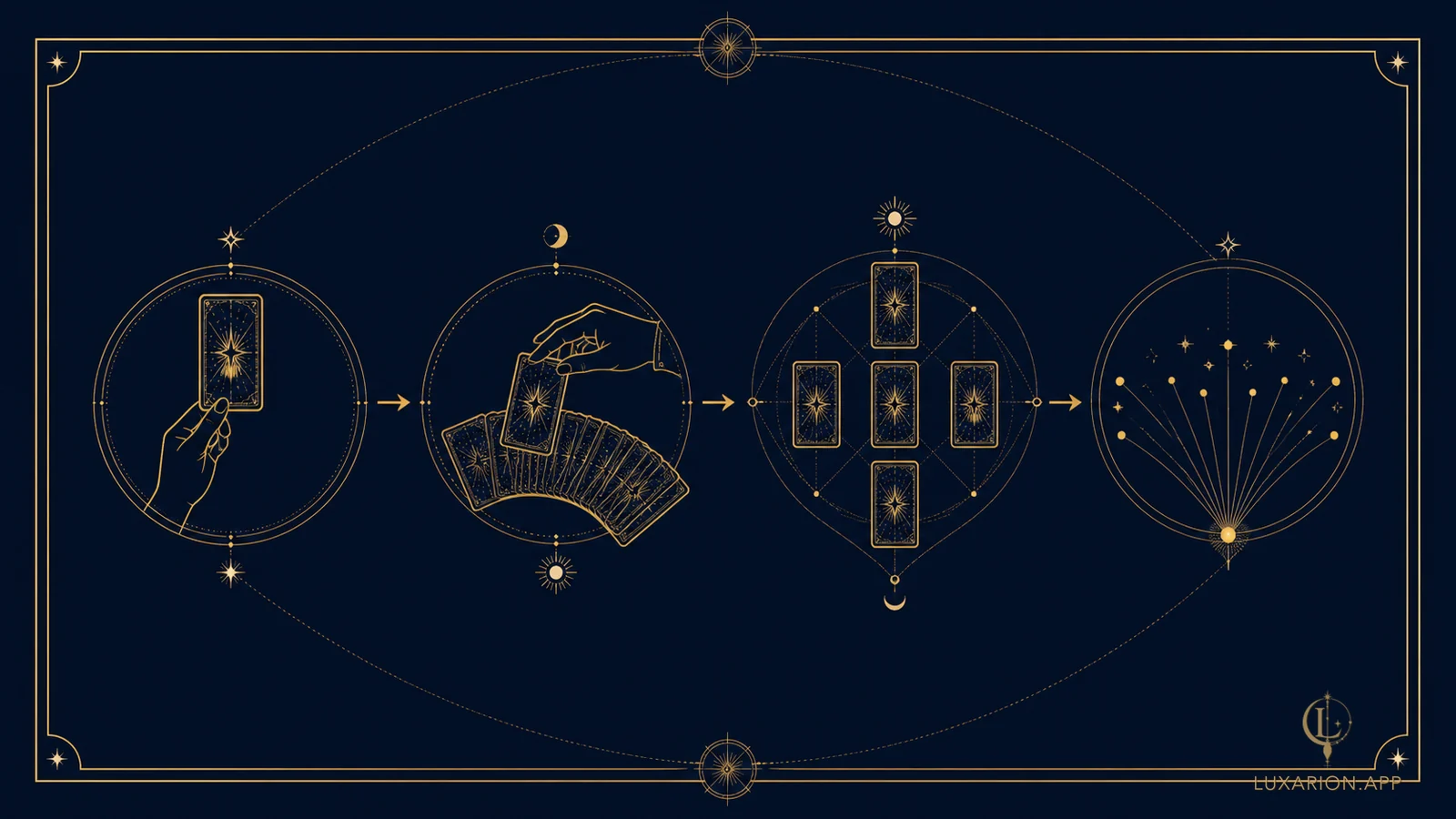
A reading is four moves: a question is set, cards are drawn, they land in positions, and the arrangement becomes sentences. Here is each one.
A tarot reading is four moves. A question is set. Cards are drawn. They land in positions. And a reader turns the arrangement into sentences.
That is the whole architecture, and stating it plainly is useful, because everything difficult — everything that separates a party trick from a reading someone remembers for years — lives inside those four moves rather than around them. The candles and the cloth are hospitality. The craft is in the sequence.
What follows is each move from inside the work: how questions are actually built, what the draw is for, how positions create meaning, and how a reader gets from seventy-eight images to a sentence you can act on. Then the parts nobody teaches beginners — reading the whole before the parts, the relationships between cards, reversals, and what to do when a card refuses to land.
What the seventy-eight are, in shape
Before the moves, a map — because you cannot read an arrangement without knowing what kind of thing each card is.
The deck divides in two. The twenty-two Major Arcana are not twenty-two scattered images but an ordered arc, and reading them in order saves memorising a great deal. It opens with the Fool — setting out with no baggage and no experience, the picture of every beginning taken before the beginner knows what they are doing. Then the instruments of action: the Magician gathering what is at hand, the High Priestess knowing what is not said, the Empress bearing fruit, the Emperor ordering.
Then what obstructs: the Lovers forcing a choice, the Chariot demanding two contrary forces be held, the Hermit withdrawing in order to see, the Wheel turning what is not owned. Then what overturns: the Hanged Man suspended deliberately, Death ending a condition, the Tower bringing down what was built without foundation. In this sequence those are not curses — they are stations on the arc that every life passes through, and when one of them turns up in a spread it shows which station is arriving. Then what repairs: the Star bringing water back after the demolition, the Moon walking in ambiguity, the Sun making plain, the World closing so the Fool can begin again.
Once you see the arc you understand why no card reads as absolutely good or bad. The Tower after the Sun is not the Tower before the Star. Position in the arc does to meaning what a sentence does to a word.
The fifty-six Minor Arcana divide into four suits, each taking on a material of life. Cups — water and feeling. Wands — fire and action. Swords — air and mind. Pentacles — earth and matter. Knowing the four saves learning fifty-six, and it is read before any individual card, as we will see.
Move one: the question does half the work
Every teacher says it and every beginner ignores it. The reading is only ever as good as the question, and most disappointing readings were decided before a card was turned.
Consider two versions of the same concern. Will he come back? can be read — the cards answer it — but asked bare, it leaves most of what the spread shows unasked. Will he come back, and what does this bond hold for me either way? gives seventy-eight images room to speak: whether he returns, on what terms, in what season, and what is yours to do meanwhile.
The difference is not politeness. It is structural. A question with two possible answers gets one of two answers; a question with an open shape gets the whole spread. The lineages that trained readers formally always began here, exactly as the horary astrologers and the dream interpreters did — the classical interpreters spent their first minutes on questions rather than symbols, a discipline we set out in how the old interpreters actually worked.
Four tests for a workable question, all of which you can apply yourself before you sit down.
Is it clear whose matter it is? A question can be about your own road, about another person — what they feel, what they intend, where they are heading — or about the bond between you. The cards reach all three; name which one you are asking, because the spread is laid and read differently for each.
Is it open? If it can be answered yes or no, widen it. "Should I take the job" becomes "what does this job hold for me, and where does it lead if I take it".
Is it live? A question you have already decided produces a reading you will argue with. If the decision is made, say so — "I have decided; show me what it opens and how to walk it" is a completely legitimate and often excellent session.
Is it one question? A session holds one matter and a branch of it. Three questions produce three thin readings instead of one good one, and a practised reader will send you back to choose.
Move two: the draw, and why it must be uncontrolled
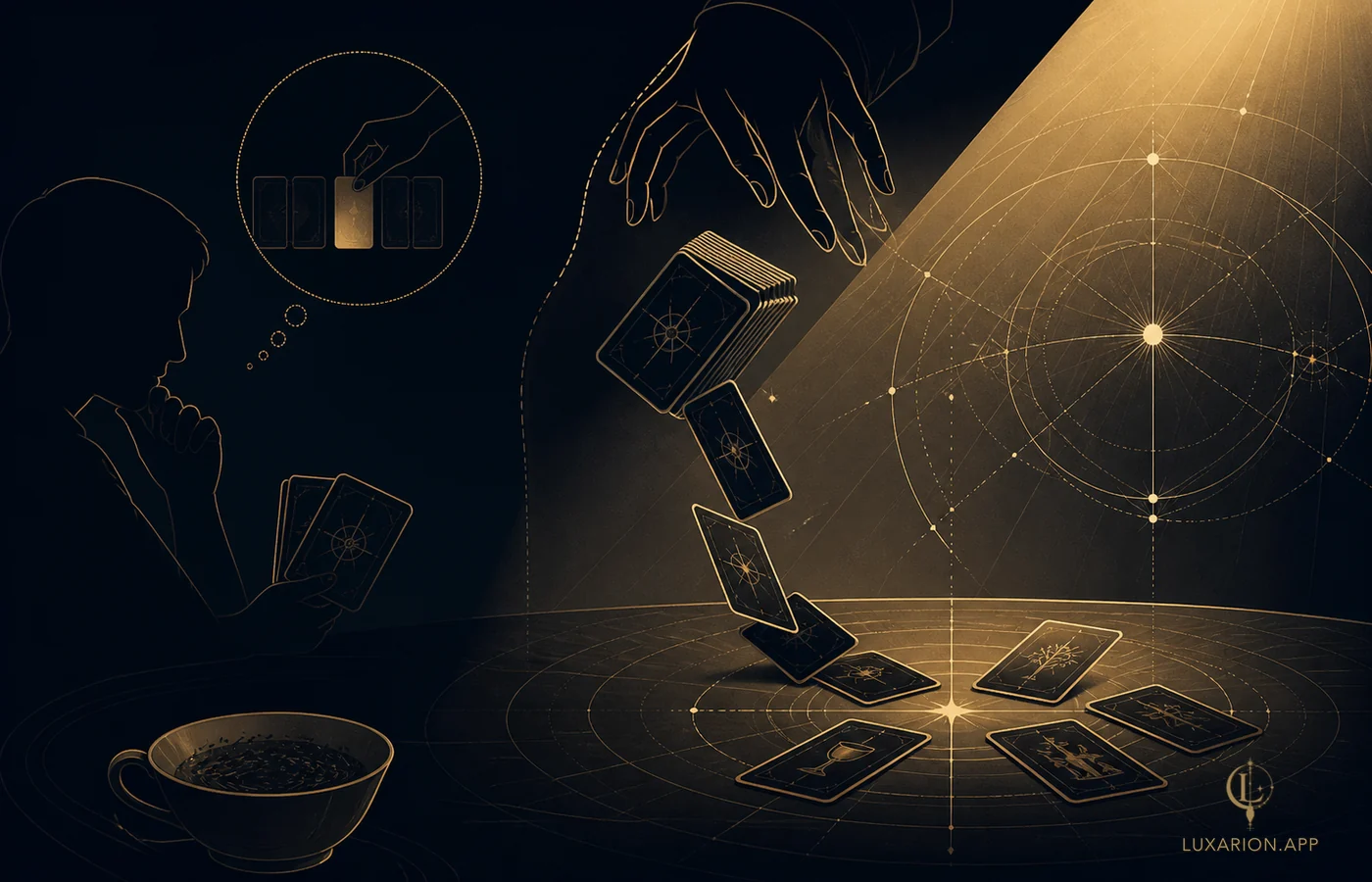
People stumble here more than anywhere: if the cards fall by chance, how can the result mean anything?
The craft's answer is more precise than expected, and it inverts the objection. The absence of control is a condition, not a defect.
Consider the alternative. If you chose the cards, you would choose the ones you already associate with your situation — and the reading would hand back only what you brought to it. The draw is kept out of the asker's hands so that what falls comes from beyond their wishes, and that is what lets a spread show what the asker could never have placed there. The same principle governs the whole residue-reading family, where the pattern in a cup is produced by a process nobody arranges.
This is an old idea in the wisdom literature rather than a novelty of card reading: a person cannot see their own matter except through an intermediary, and an intermediary they select hands back only what they chose. The traditions that cast lots and drew tokens in consultation were not abandoning judgement; they were keeping the answer out of reach of preference, so that what came could be read as given.
And note what is actually being read. Not the fall of one card in isolation, but that card in a specific position, beside a specific neighbour, against a question you defined, for a person in a particular situation. Four constraints, and one fall no one arranged — which is why the answer belongs to this person and this hour.
Practically: shuffle until it feels finished rather than counting, cut if your tradition cuts, and lay the cards face down before turning any. The reader who turns cards one at a time while talking is improvising; the reader who lays the whole spread first is reading it.
Move three: positions make the meaning
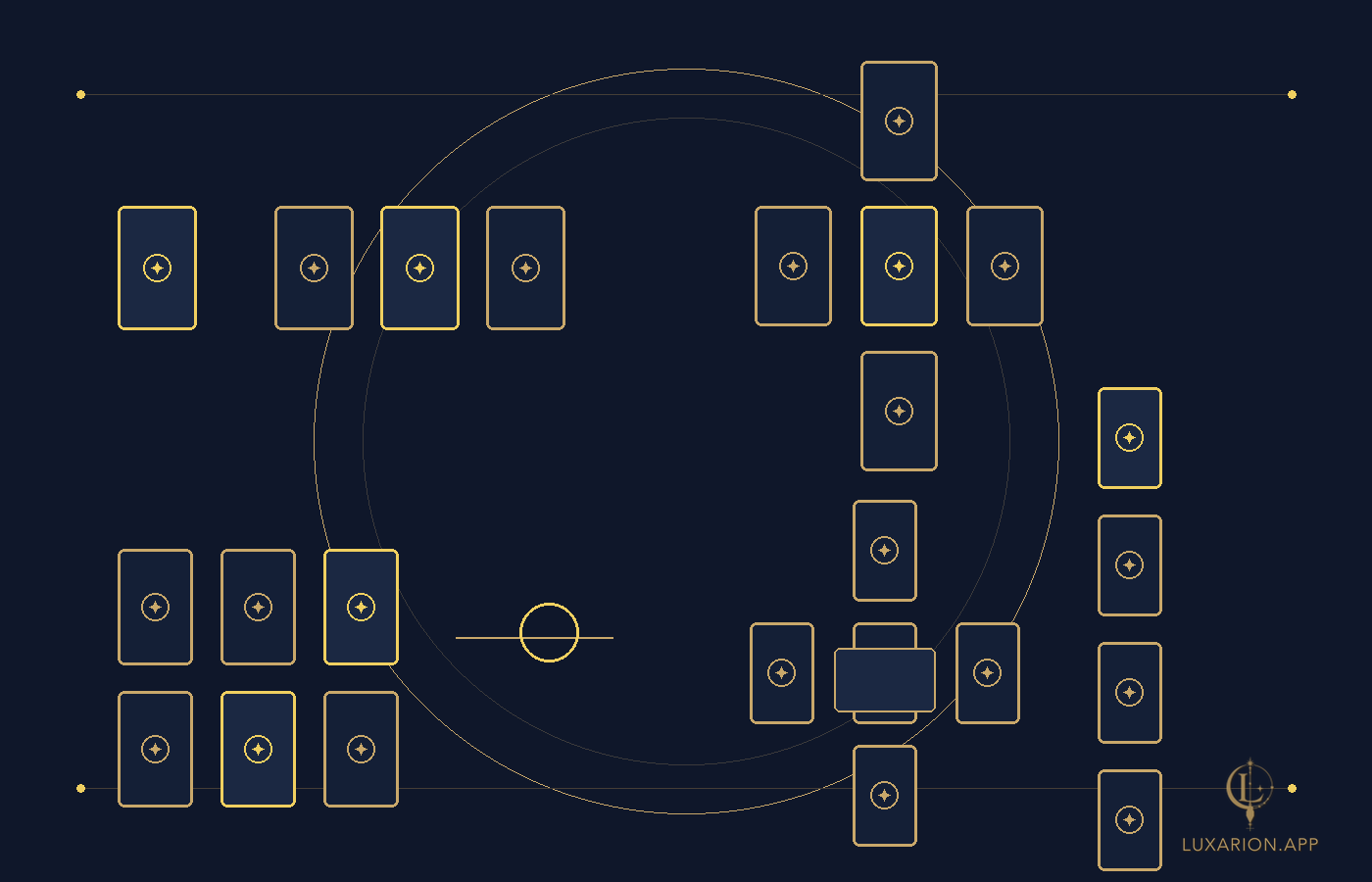
This is the move outsiders miss entirely. A card does not carry a fixed sentence. It carries a range, and the position selects within that range.
The Three of Swords in a "what is behind this" position is a grief already carried. The same card in "what would help" is a truth that will hurt to say and needs saying. Same image, same deck, opposite instruction — decided by where it fell.
Which is why choosing the spread is the reader's first real judgement, made before anything is turned, and why it should be sized to the question rather than to a taste for ceremony.
The three-card. The most useful and most underrated. Three positions, read variously by question: past, present, direction; or situation, obstacle, opening; or what you see, what you do not see, what to do. Most practical matters are settled in three.
The five-card. Adds what helps you and what stands against you. The best shape for two-branch decisions.
The Celtic cross. Ten positions, the most famous of the large spreads and the most exhausting for a beginner. The advice from practitioners is unanimous: do not start here. Ten positions invite detail before the first meaning has settled.
The relationship spread. Six positions in two facing rows: what you carry, what the other carries, what is between you. It reads both people — what the other person holds, what they want, where they are heading with you — and the bond itself, which is what most askers most need to see.
The single card. Deeper than it looks and irreplaceable in daily practice; we treat it in one card a day.
The year spread. Twelve positions, one per month, drawn once annually and returned to through the year. Each position shows what its month brings and where it leads, and the spread is read again as each month arrives.
Move four: from arrangement to sentences
Here is what a practised reader actually does once the cards are down, and it is not what beginners assume.
They read the whole before any card. Before naming a single image, a reader takes in the shape of the spread. This step is skipped by almost every beginner and it is where the most reliable information is.
Which suit dominates? A spread heavy in cups is an emotional matter whatever costume it arrived in. Heavy in wands, it is in motion and the question is how rather than whether. Heavy in swords, it is being processed in the head more than in the world, and the reading will usually call the querent down from thinking into doing. Heavy in pentacles, the answer is in practical detail rather than in meaning.
How many Major Arcana are present? A spread thick with majors is read as a matter larger than the querent's daily choices — a season rather than a decision. A spread of all minors is read as ordinary life, workable, in your hands.
Which way do the figures face? In a well-illustrated deck the figures look somewhere, and a reader notes whether they face toward the outcome position or away from it, whether two adjacent figures look at each other or apart. This is a real technique and it costs nothing.
Then they read relationships, not cards. Adjacency matters. A repeated number across two suits is read as emphasis on that stage. A court card beside a situation card is often the person through whom the situation reaches you. Cards that mirror each other structurally — two figures bound, two figures walking away — are read as a pattern rather than two facts.
Then they place it. A good reader names what the cards show and asks where in your life it sits — which job, which person, which house — so that the reading lands on the right door. The cards have already spoken; your answer tells the reader which room they are describing. A reader who talks for thirty minutes without once placing the reading in your life is performing.
Then they land it in one sentence. The whole session compresses to something you can carry out of the room. If it does not compress, the reading has not finished.
The part nobody teaches: what to do when a card will not land
It happens to everyone, including practitioners. A card is turned, and nothing comes.
Three moves, in order of usefulness.
Describe the image out loud, in full sentences, as if to someone who cannot see it. Not what it means — what is in the picture. Who is present, what they are doing, what the weather is, where the light is. The meaning very often arrives mid-description, and this works better than any amount of silent concentration.
Read it against its neighbour instead of alone. A card that says nothing by itself will frequently say something specific in relation to the card beside it. Meaning in a spread is relational, and a stuck card is often a card being asked to work alone.
Say that it is not landing. Out loud. "I do not have this one yet" is a mark of competence, not a failure. A forced card bends the reading; a card left open for a minute usually opens — often when the next card is turned and shows what it was pointing at.
What not to do: reach for a book mid-reading to fill the gap. A borrowed meaning inserted to relieve the discomfort of not knowing will sit there looking authoritative and quietly bend everything that follows it.
Reversals: the question everyone asks
Whether to read cards that fall upside down is the most common technical question, and it carries a widespread exaggeration.
A reversal is not the opposite of the meaning. That is the first thing to correct. The schools genuinely differ: some read it as a weakening of the quality, some as internal rather than external, some as delayed rather than prevented, and some do not work with reversals at all and read each card across its full range regardless of orientation.
All of these are working methods, and what unites them is that a reversal is an adjustment of degree rather than a reversal of direction. A reversed Sun is not darkness; it is a clarity that has not arrived yet, or a joy not yet declared.
The practical rule for a beginner is firm: do not work with reversals at first. The upright range of a card is wide enough to occupy a year, and introducing reversals before that range has settled doubles the meanings while halving the precision.
Learning it: what actually builds skill
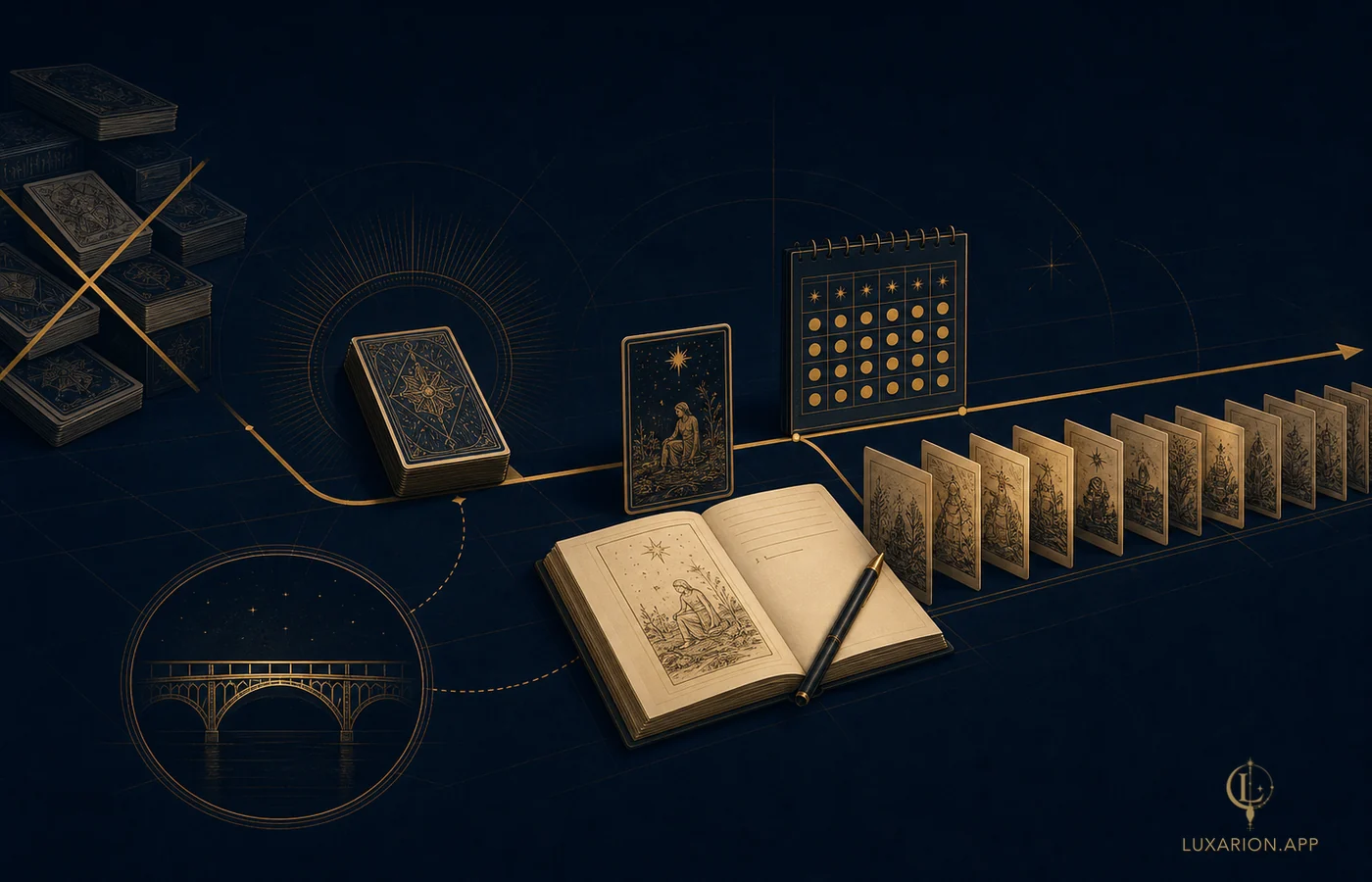
The gap between knowing the cards and reading them is bridged by volume and by record, not by more books.
One deck, for a long time. Collecting is the most common beginner's error. Someone who has worked a year with a single deck is far further along than someone who spent that year with five, because a card's range only settles once you have seen the same image dozens of times against different questions.
A deck with illustrated minors. If all fifty-six of those cards carry a scene, the images help you. If they do not, you are thrown back on memorisation. The Marseille pattern is beautiful and deep, but it is a second deck.
A daily card, recorded. Draw one, write the image in the morning without fixing its meaning, and one line in the evening on what the day brought. At the end of a month, read the record end to end. What that card has actually meant for you across thirty days is your own entry for it, and it will teach you more than any printed list of keywords — the same principle we set out for dream symbols in your own dream alphabet.
Read for real questions, including your own. Practice spreads about nothing teach very little. A reading needs a live situation to be tested against.
What is being built is the reader's sight: the capacity to see at a glance what a spread is showing, opened by practice rather than by lists. Michael Polanyi described the same structure in every developed craft as tacit knowledge — it knows more than it can say, and it is assembled by doing the thing thousands of times — which is why this craft, like every expertise worth the name, is transmitted by apprenticeship rather than by memorising a list of meanings.
Getting your own deck
A practical matter people ask about constantly, and the customs around it are worth setting straight.
An old custom says a deck should be a gift. No serious lineage requires it — buying your own is entirely fine. The real idea underneath the custom is different and is true: a deck is a tool worked with, and a working deck becomes its owner's over time.
Rules about care — the cloth, the box, letting no one else handle a working deck — vary by tradition and none are obligatory, but they share one sense: a deck kept for the work stays with the work. Someone who handles their deck carelessly tends to read carelessly, and the lineages that keep these customs keep them for that reason.
One genuinely practical note: cards wear. A deck read daily for two years will have soft corners, and soft corners are readable through the backs. Practitioners replace working decks for this reason, and it is worth knowing before you become attached to a particular copy.
The ethics, which are technique
Every serious lineage carries the same rules of conduct, and they are not decoration — they are the conditions under which the method works at all.
Timing in seasons. The cards carry timing as seasons and turns of the year, and a good reader gives it that way. A reader who fixes a calendar date has stopped reading the spread and started guessing.
No reading turned to harm. A spread can look at another person — what they feel, what they intend, where they are heading with you — and it is always read for the asker's good. The craft never uses what it sees to work against anyone.
The body goes to a physician. A reading can show the season a person is in and what is coming toward them; it does not diagnose, and a practitioner sends a question of illness to a doctor plainly.
Where readings are equally available, offer the better one. Not concealment of the difficult — refusal to select the frightening reading when the spread does not require it.
Grief is heard first. In the first weeks of a loss a reader listens before laying a card, and reads when the person can carry what the cards show. This restraint is a skill in itself, and we open it in when the reading says no.
Do not re-ask until the answer changes. Re-shuffling the same question in the same week is one of the oldest recorded errors. Act on the smallest piece of what you got, and return when the situation has actually moved.
What a good session looks like from the chair
Knowing the shape settles more nerves than any explanation, and the sequence is broadly the same across serious practice.
Questions first, before a single card is turned — what brought you, how long this has been going on, what you have already tried. Then the question gets sharpened with you until it is one that can be answered; this is the highest-yield minute of the whole session and it happens before the deck is touched. Then the spread is chosen and laid whole. Then the reading, with pauses — a good reader stops after each section to place it in your life, and what has not yet arrived is named as what is coming rather than forced onto the present.
And at the end, one step. Not a list — one specific small thing that can be done before next week. That last point is the oldest quality marker in every reading tradition: a reading that ends in news alone is unfinished; one that ends in what is coming and what to do about it is complete.
If you want a question read properly — asked before it is answered, given a season rather than a date, and sent home knowing what is moving and what to do about it — that is what our readers do. You can book a tarot reading. And if you want to know first what a reading reaches, it is set out in is tarot accurate.
The library teaches the craft. A reading applies it to you.
Get your personal reading