

Sixteen Figures, Countless Questions: The Dot Alphabet of Geomancy
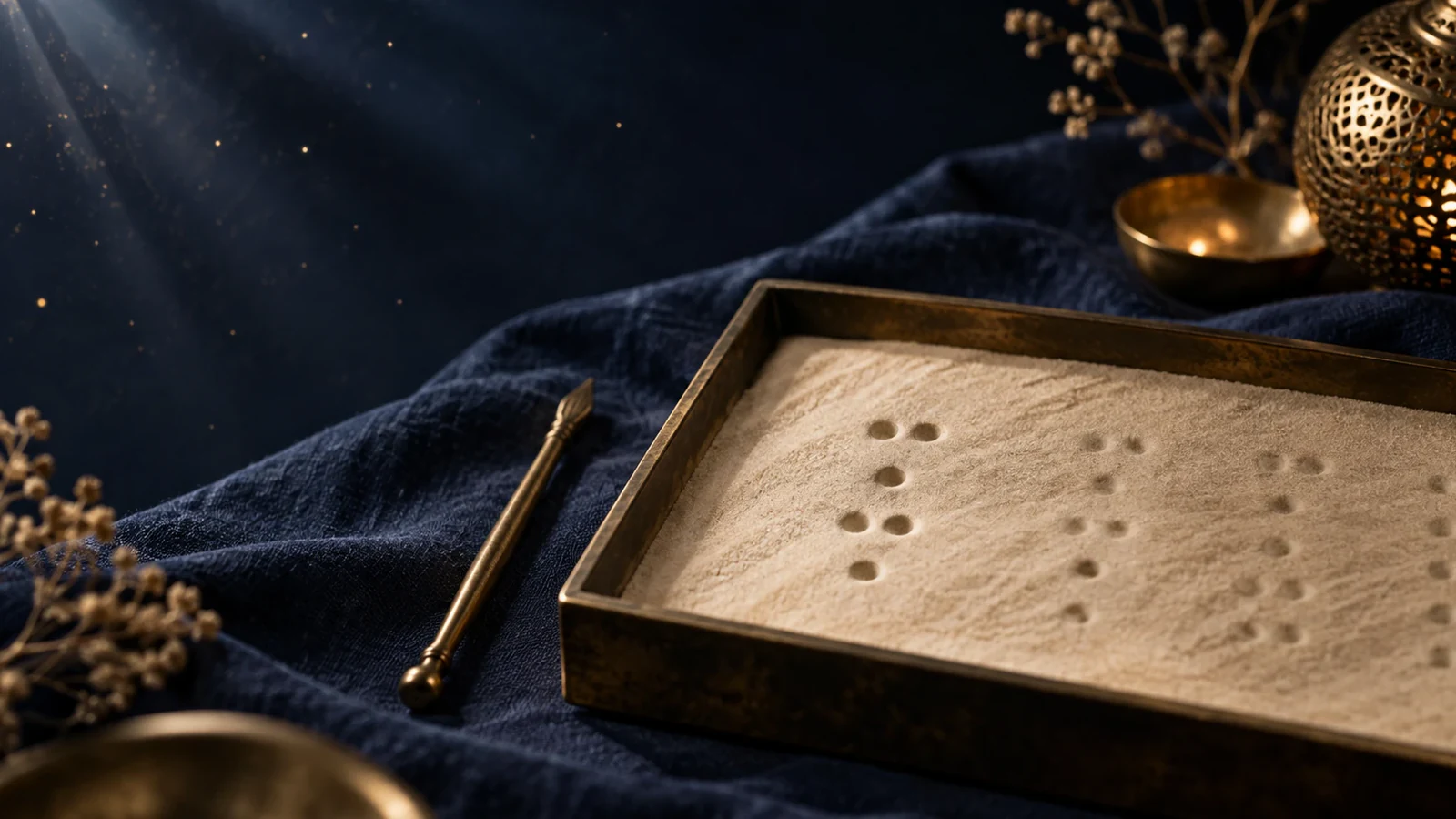
Four rows of one or two points make sixteen figures. The alphabet of the sand is small and exact, and its Judge answers the question you bring.
One point, then a pair. Another pair, then a single point. The arrangement is spare, and it holds a large question: how a finite language meets the endlessly changing circumstances of a life.
The sixteen geomantic figures are finite. The situations brought to them are not, and that is the first fascination of the science of the sand. The second is how clearly their structure can be described.
The geomancy of the sixteen figures is the system the Arabic tradition calls ʿilm al-raml, the science of the sand. ʿIlm is the tradition's own word for knowledge that is learned and taught. Sixteen lines of marks are struck without counting. Each line is read as odd or even and becomes a single point or a double one, and four of those, stacked, make a figure. One point, a pair, a pair, a point: that figure is Carcer · ʿUqla, the knot.
Why there are sixteen
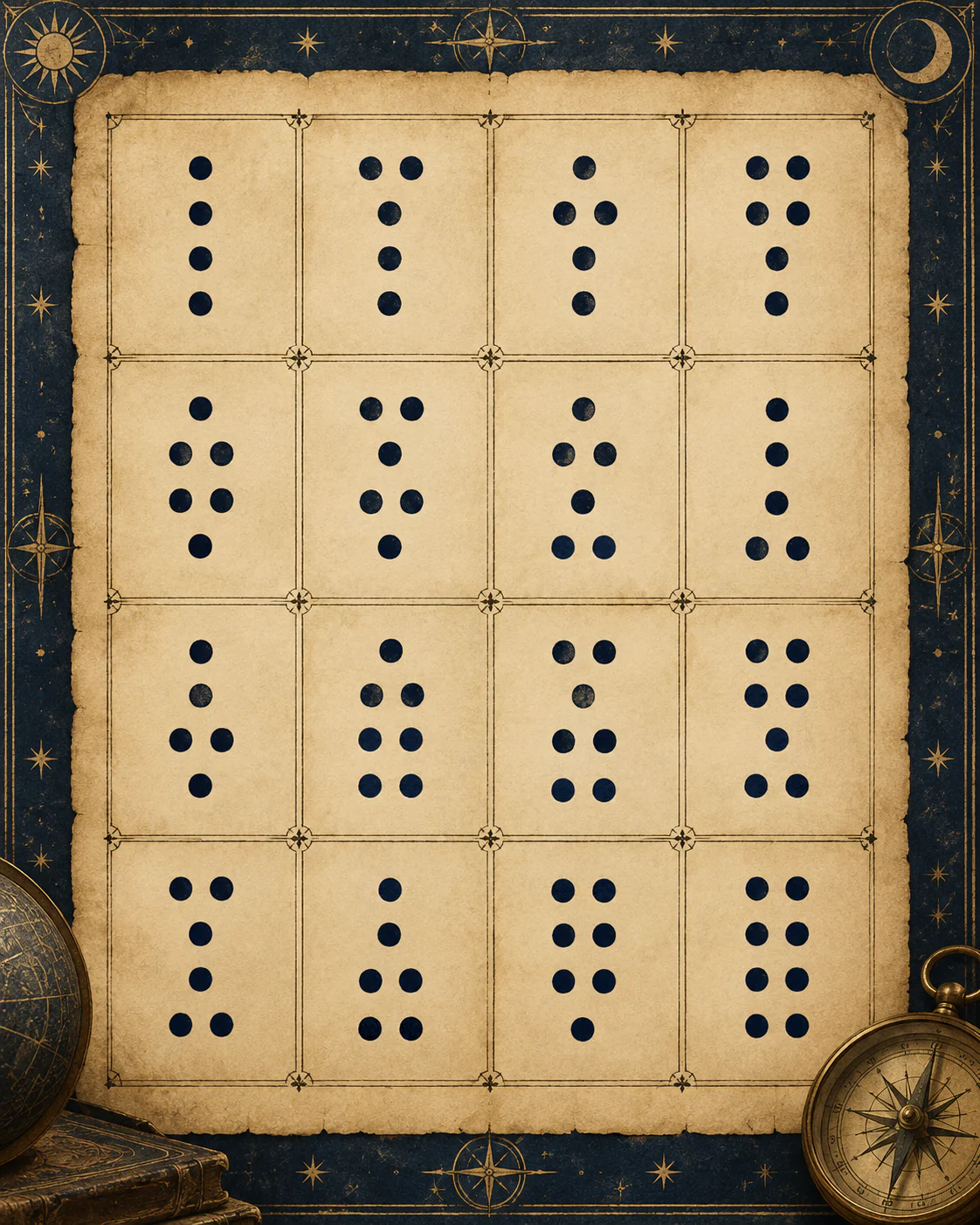
A figure has four rows, read from the top, and each row holds a single point or a pair. Four places with two states each give 2 × 2 × 2 × 2 figures: sixteen, and no more. The number follows from the notation itself, the same notation of single and double points that İlyas Çelebi describes in his entry "Remil" in the TDV İslâm Ansiklopedisi.
Order makes the difference
Put a single point on top and pairs in the three rows beneath it, and the figure is Laetitia · Laḥyān: joy, a rise, a flame going up. Put the single point at the bottom, under three pairs, and it is Tristitia · Nakīs: sorrow, a fall, a stake driven down. Both hold seven points. Counting them together erases exactly what makes them two figures.
A lock with four positions, each taking two settings, has sixteen combinations, and knowing that number tells you nothing about which one opens this door. The count gives the alphabet. The question decides which figure answers.
The sixteen figures
Each figure appears here as the Al-Raml ritual shows it in English: its Latin name beside its Arabic one, its four rows (● is a single point, ● ● a pair), its nature and its reading.
| Figure | The four rows | Nature | Reading |
|---|---|---|---|
| Via · al-Ṭarīq | ● ● ● ● | Mixed | The road: journey, passage, movement, what passes and does not stay. |
| Populus · al-Jamāʿa | ● ● ● ● ● ● ● ● | Mixed | The gathering: the many, company, an assembly that gives back what is brought to it. |
| Fortuna Major · al-Nuṣra al-Dākhila | ● ● ● ● ● ● | Fortunate | Help from within: inner strength, a fortress, a good end after effort. |
| Fortuna Minor · al-Nuṣra al-Khārija | ● ● ● ● ● ● | Fortunate | Help from outside: swift success, borrowed light, luck that must be held once given. |
| Acquisitio · Qabḍ al-Dākhil | ● ● ● ● ● ● | Fortunate | Taking in: gain, what arrives, a vessel that fills. |
| Amissio · Qabḍ al-Khārij | ● ● ● ● ● ● | Unfortunate | Letting go: loss, what leaves, a vessel that empties. |
| Laetitia · Laḥyān | ● ● ● ● ● ● ● | Fortunate | Joy: a rise, good news, vigour, a flame going up. |
| Tristitia · Nakīs | ● ● ● ● ● ● ● | Unfortunate | Sorrow: a fall, weight, roots, endurance, a stake driven down. |
| Puer · Jawdala | ● ● ● ● ● | Fortunate | The youth: boldness, haste, a spark, strength without patience. |
| Puella · Naqī al-Khadd | ● ● ● ● ● | Fortunate | The maiden: grace, harmony, a welcome, beauty. |
| Albus · Bayāḍ | ● ● ● ● ● ● ● | Fortunate | White: clarity, peace, counsel, a still cup. |
| Rubeus · Ḥumra | ● ● ● ● ● ● ● | Unfortunate | Red: passion, disturbance, an overturned cup, a call for caution. |
| Carcer · ʿUqla | ● ● ● ● ● ● | Unfortunate | The knot: confinement, a bound thing, a ring, patience. |
| Conjunctio · Ijtimāʿ | ● ● ● ● ● ● | Fortunate | Meeting: union, a crossroads, the recovery of what was lost. |
| Caput Draconis · al-ʿAtaba al-Dākhila | ● ● ● ● ● | Fortunate | The threshold entering: a beginning, an open door. |
| Cauda Draconis · al-ʿAtaba al-Khārija | ● ● ● ● ● | Unfortunate | The threshold leaving: an ending, a door closing. |
A fortunate figure inclines the matter towards good wherever it falls, an unfortunate one weighs it down or holds it back, and a mixed figure takes the character of the figures it falls among.
The figures speak in pairs
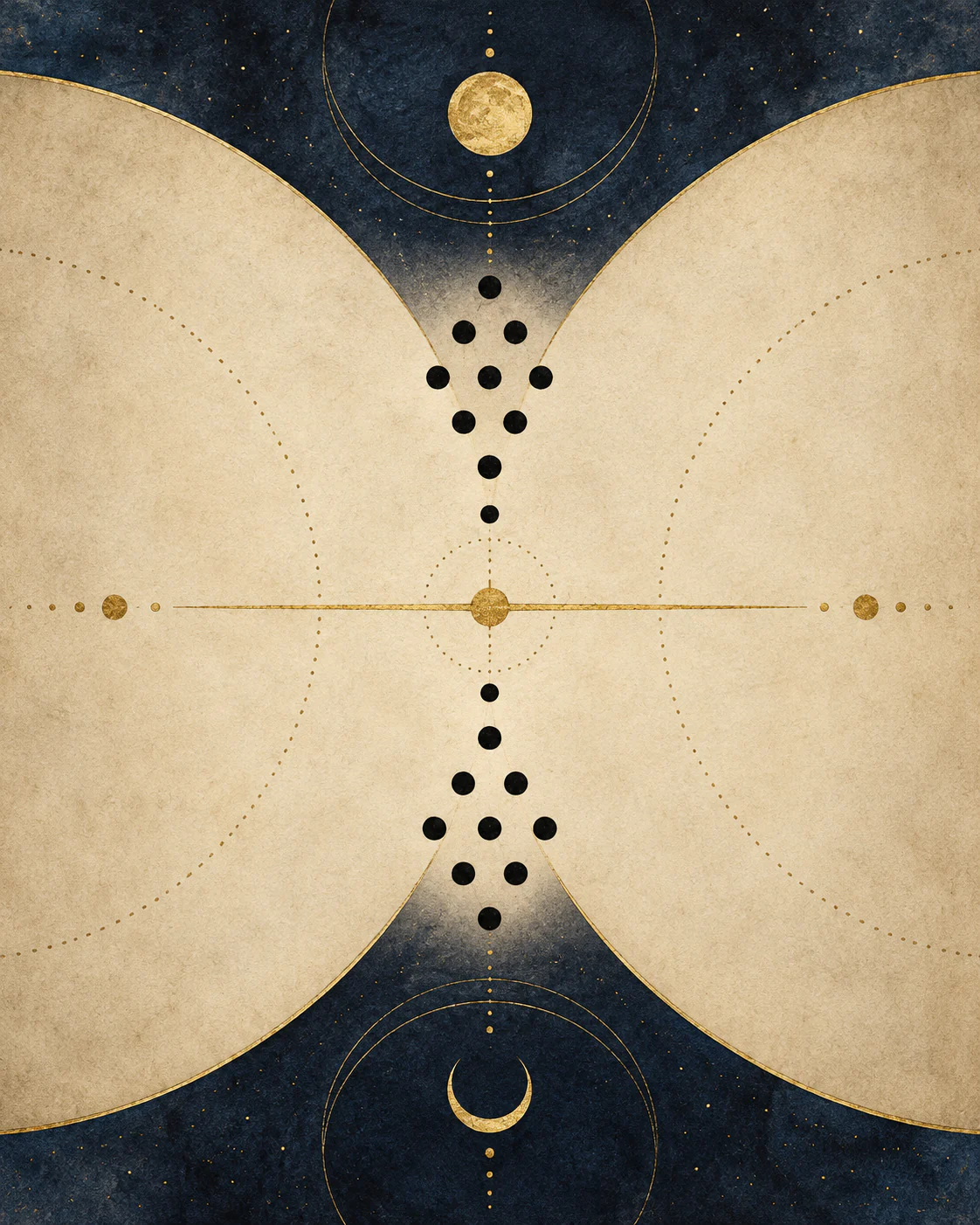
Via · al-Ṭarīq and Populus · al-Jamāʿa are the two extremes: four single points, and four pairs. Via is the road: passage, movement, what passes and does not stay. Populus is the gathering, an assembly that gives back what is brought to it, and so it takes its colour from the figures beside it. Both are mixed by nature, and movement and company enter the chart through its two plainest patterns.
Acquisitio · Qabḍ al-Dākhil and Amissio · Qabḍ al-Khārij reverse each other row for row. Acquisitio is taking in: gain, what arrives, a vessel that fills. Amissio is letting go: loss, what leaves, a vessel that empties. Amissio is an unfortunate figure, and where losing is the wish (a burden, a debt, a sorrow) it answers well, which is why a figure is always read against the question.
Caput Draconis · al-ʿAtaba al-Dākhila and Cauda Draconis · al-ʿAtaba al-Khārija are the two thresholds. The first is the threshold entering: a beginning, an open door. The second is the threshold leaving: an ending, a door closing. Each is the other turned upside down, and between them they ask which door a matter stands at.
The figures are the alphabet; the chart is its grammar. The sixteen lines struck in the sand give the four Mothers. The four Daughters come from the Mothers' rows, the four Nieces from pairing, then two Witnesses, and from the Witnesses the Judge, the figure that answers the question. The figures stand in houses, and a house gives a figure its subject. How the sand is read walks through the chart step by step.
The sand in brass and ink
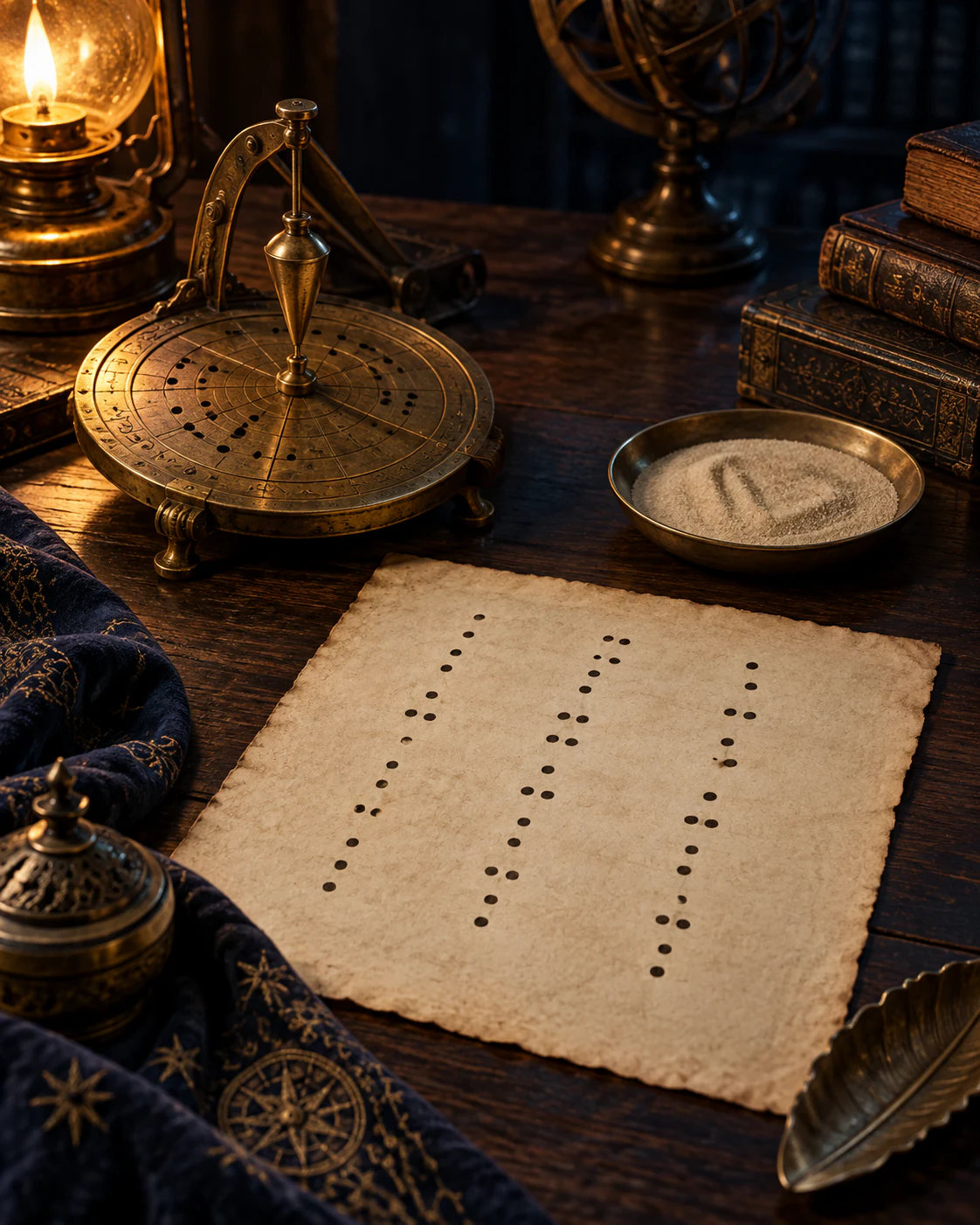
The British Museum holds a brass geomantic instrument, registration number 1888,0526.1, dated 639 AH, which is 1241–42. It is signed by Muhammad ibn Khutlukh al-Mawsili, a craftsman of Mosul by his name. Its dials show the figures mechanically, wheel, window and pattern moving together.
The instrument answers anyone who imagines divination as shapeless or improvised. A craftsman put skill, brass and design into making the relations between the figures something the hand could turn. In brass, the alphabet has a body. Judging the figures remains the reader's work, as it was when the brass was new.
The figures on the page
In the British Library, Harley MS 4166 is a composite volume whose parts were copied in the fourteenth and fifteenth centuries. Its first two parts hold geomantic works, with figures and shields drawn in brown ink in the margins and in tables; other parts of the volume turn to other subjects.
In Paris, the Bibliothèque nationale de France holds Arabe 2631, an eighteenth-century Arabic manuscript whose title gives the science of the sand to the prophet Idris, as the tradition does. It opens with a table of the sixteen figures, each drawn in its four lines of points.
Brass from the thirteenth century, European copies from the fourteenth and fifteenth, an Arabic treatise from the eighteenth: the same sixteen figures run through them all.
The question before the figure
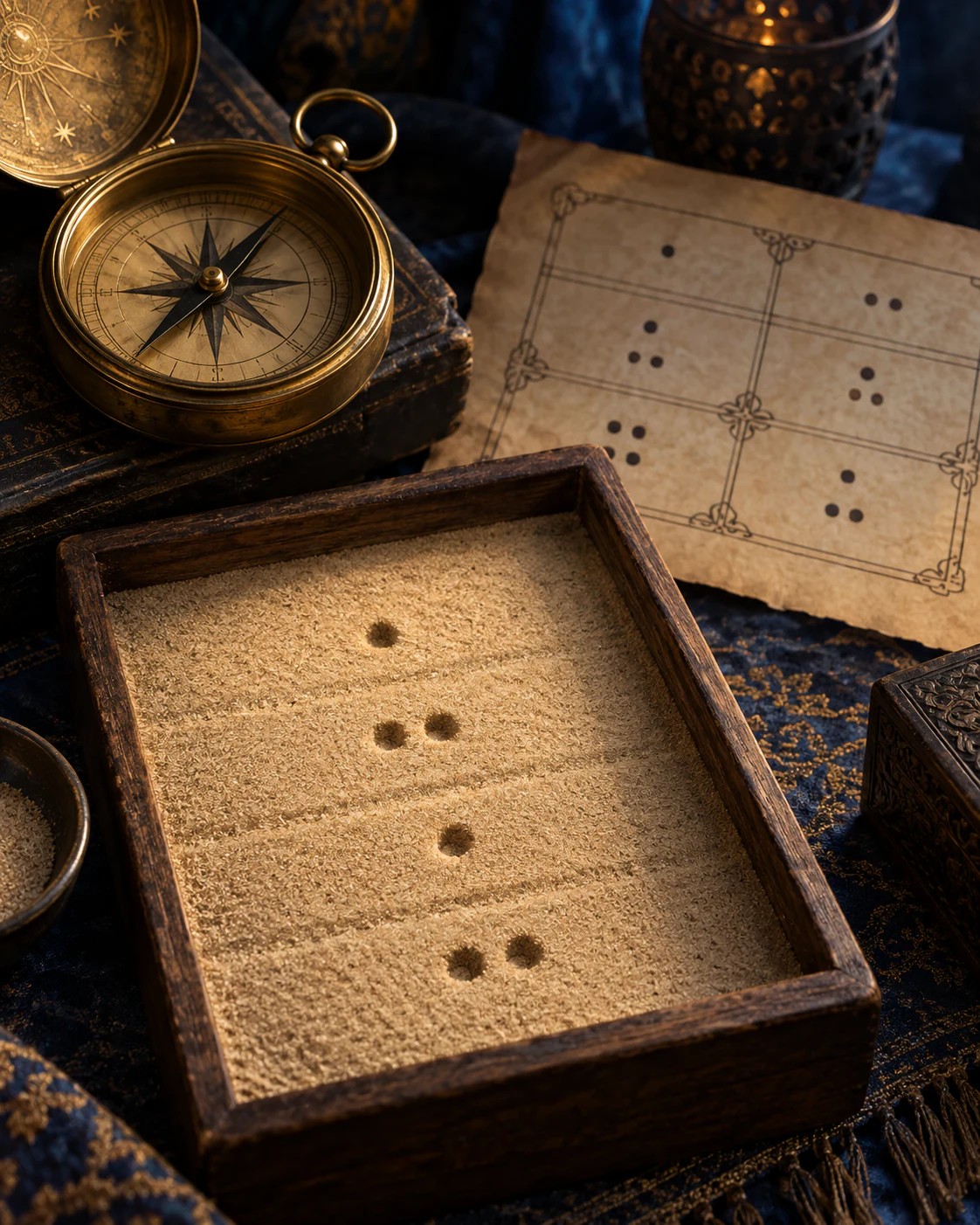
Every reading of the sand passes through four layers, in order. First the pattern: what is actually in the sand, before any interpretation. Then the placement and the question: where the figure falls in the chart, and what was asked. Then the tradition's reading: what this figure says in this place, for this question. Last, the decision: what remains with the person living the situation, who acts on the answer.
Kept in order, the layers stop a reading from leaping from a mark to a verdict, and they keep the answer tied to the question that was actually asked.
When the same figure returns across readings, the matter is pressing, and a familiar question comes back to be met afresh: an old hesitation, a commitment that keeps coming round, a choice approached from a new position. What has changed around the figure is read with it: your readiness, your relationships, the words in which you ask.
A question that changes when it becomes specific
Imagine someone deciding whether to move to another city; the example is invented. They ask the sand, "Will it work?" That sentence bundles work, money, friendship, belonging and the fear of disappointing someone into one outcome.
The Judge answers the question it is given, and this one is five questions at once. An encouraging figure gets taken as permission to ignore the costs; a hard one, as a ban on any change at all. One answer has been asked to cover several questions.
The sharper question is "What kind of belonging am I ready to build in the new city?", and the figure that answers it speaks to the relationships and commitments inside the move.
The practical unknowns are settled in the world: a job offer is checked, a rent is looked up. The sand is asked what no document can settle, the belonging and the leaving of an old life, and each answer stands beside the others.
Question design is a craft of its own. How to ask a pendulum sets it out for another instrument, and the same care serves the sand.
Questions about the sixteen figures
Are there sixteen figures because there are sixteen planets or elements?
No. The count comes from the notation: four rows, two states each, sixteen figures. Planets and elements are a further layer of correspondence, and each line of the tradition assigns its own.
Can the same figure appear twice?
Yes. There are sixteen kinds of figure and a chart holds many figures, so the same one often appears twice. A repeat never makes a seventeenth.
Does the arithmetic make the answer certain?
The Judge answers the question as it stands on the day it is asked. The path it shows moves with decision, prayer and God's decree, which is where the sand meets destiny and choice.
Why is the science of the sand given to Idris?
The tradition names the prophet Idris as the first to strike the sand, and the Paris manuscript Arabe 2631 carries that attribution in its title.
Where do the names and readings in the table come from?
They are the names and readings of Luxarion's Al-Raml ritual in English. The natures follow the European line of the tradition, through which the figures reached English, and the Arabic name stands beside each Latin one.
Does Luxarion read the sand?
Yes. Al-Raml is Luxarion's ritual of the sand. Each dawn one chart is struck for everyone, and one question of the day stands over it. Readers read the Judge and give their judgement before the practitioner's judgement opens at noon. And anyone can strike sixteen lines of their own, for a question of their own, and receive a chart that belongs to them alone.
Give the whole question room
Sixteen figures are enough for every question a life can bring, because the question and the figure's place in the chart do the rest. What gives a reading its weight is the care taken with the question, and the faithfulness with which the tradition's meanings are handed on.
At dawn the sand is struck again. Al-Raml sets the day's question over one chart for everyone, and keeps a place for your own sixteen lines and the question only you can ask.
One point, then a pair. The rest of the figure comes from your own hand.
The library teaches the craft. A reading applies it to you.
Get your personal reading