
Is Tarot Accurate? What the Question Is Really Asking
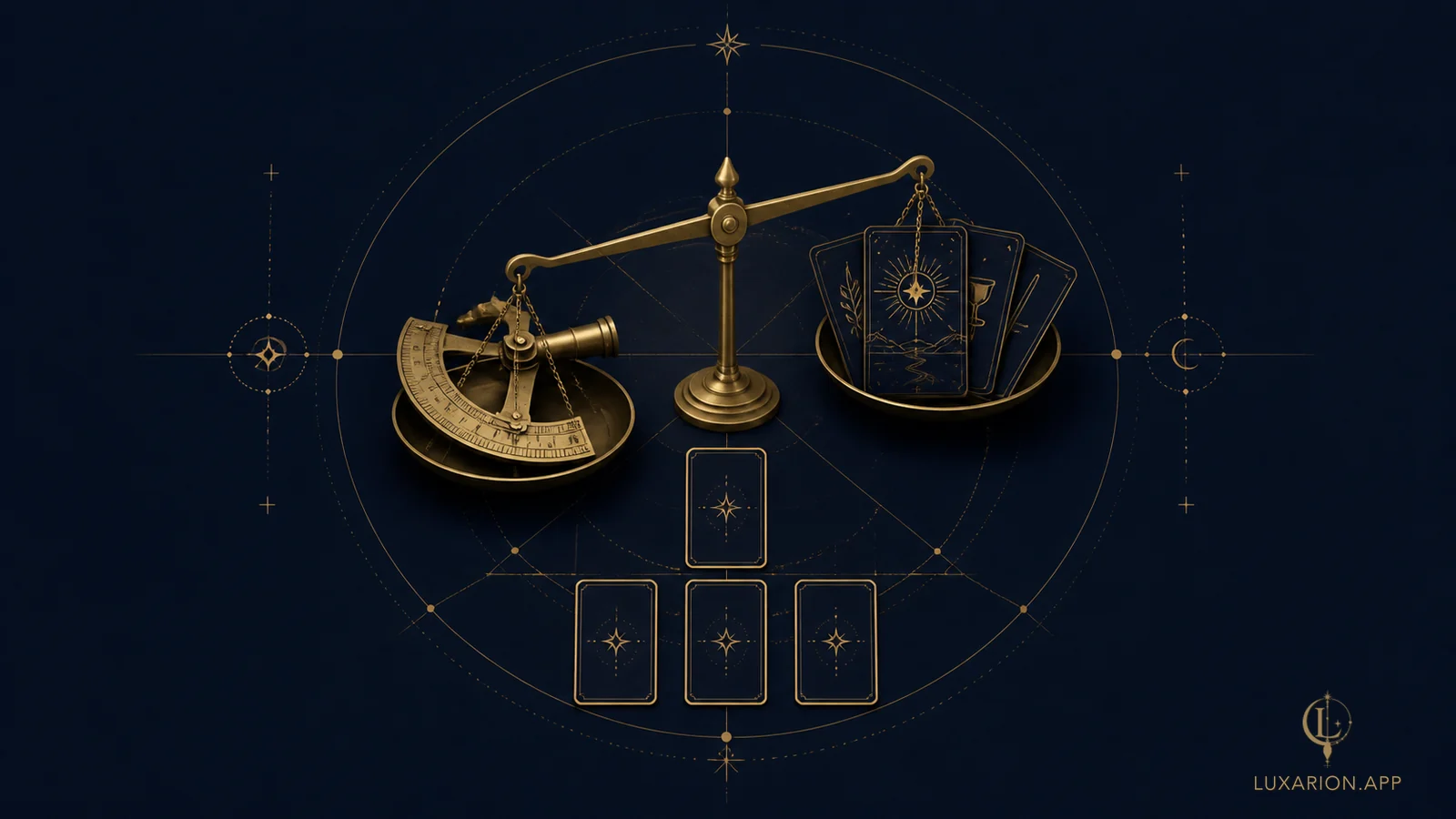
«Accurate» is borrowed from instruments. A spread answers a situation — what is at work in it, and where it is heading.
It is the first question almost everyone asks, and it deserves a real answer rather than a defensive one.
Accurate is a word borrowed from instruments. A thermometer is accurate when its reading matches the temperature. So the question, asked in that form, is really asking: what is a tarot reading supposed to match?
And here the tradition has been unusually precise, for a very long time. The answer the serious lineages give is your situation — what is at work in it and where it is heading — named more clearly than you had managed to name it yourself, and placed inside a frame old enough to show you what shape it is and which way it is moving.
It is also testable in the way that matters: as the weeks unfold, you know whether a reading named your situation and the road it was on. What follows is what the craft reaches, where it draws its lines, why the images carry the weight they do, and how to tell a good reading from a poor one.
What the tradition declines — and why that is mastery
Start with the restraint, because it is the most misunderstood thing about tarot and the most reliable mark of a real practitioner.
Serious readers, across centuries and across schools, keep a short set of lines. They give timing as a season rather than a calendar date, because that is how a spread carries it. They read what another person feels and intends and where they are heading, and they do not promise what a free person will choose. They do not diagnose; the body goes to a physician. And they do not use a reading to harm anyone. Ask a practised reader for a lottery number and you will be turned down — politely, and by someone entirely confident in their craft.
This is not a hedge or a disclaimer. It is the same restraint every serious discipline develops as it matures. A good doctor gives you a prognosis with a range rather than a date. A good lawyer tells you what is likely rather than what is certain. The classical dream interpreters said I do not know when they did not know, and treated that sentence as a mark of competence rather than a failure of it — a principle we set out in how the old interpreters actually worked.
The pinned calendar date is not the deep end of the craft. It is what people do instead of the craft. The lines are where the skill lives, and a reader who keeps them is telling you something reassuring about everything else they say.
We have set out the full ethical frame in when the reading says no — including the harder discipline of declining a reading altogether when the moment is wrong.
What a reading actually reaches
Four things, and the first is the one the question was really about.
What is in motion. The craft does not decline this, and it never did. A spread shows the energies at work in a situation now — the pressure you have been feeling and could not source, the influence of someone who is not in the room, the thing already moving toward you. And from that it shows direction: which way this is tending if nothing changes, where it is likely to turn, which of two roads is the stronger, and, where the spread supports it, the season in which the turn is due. Readers call this the shape of the thing. It is the difference between walking into a month blind and walking into it knowing what it is made of.
Articulation. A spread is a structure, and a situation laid across it stops being a tangle. People arrive with a tangle and leave with a sentence — the forces named, the direction clear. That transformation is one of the most common things a reading produces, and anyone who has had a good one recognises it immediately.
Reframing. The deck's images are centuries of compressed human situation. Laying your problem across them forces it into shapes you had not tried. The Tower's demolition. The Hanged Man's deliberate suspension. The Star's slow return. These are not moods; they are structures, and putting your situation into a different structure genuinely changes what you can see about it. The Tower in particular is the most misread card in the deck, and we make its case in The Tower is a Mercy.
Permission. The space of a reading lets people say aloud what they cannot say at a kitchen table. I have already decided to leave; I just have not said it. When the cards have named it first, the sentence comes easily.
The last three come with the first, and none of them replaces it. People come to see what is moving and where it leads, and they leave with it named — which is why the craft has survived in continuous practice for six hundred years while a great many other systems have not.
The two readings of the same spread
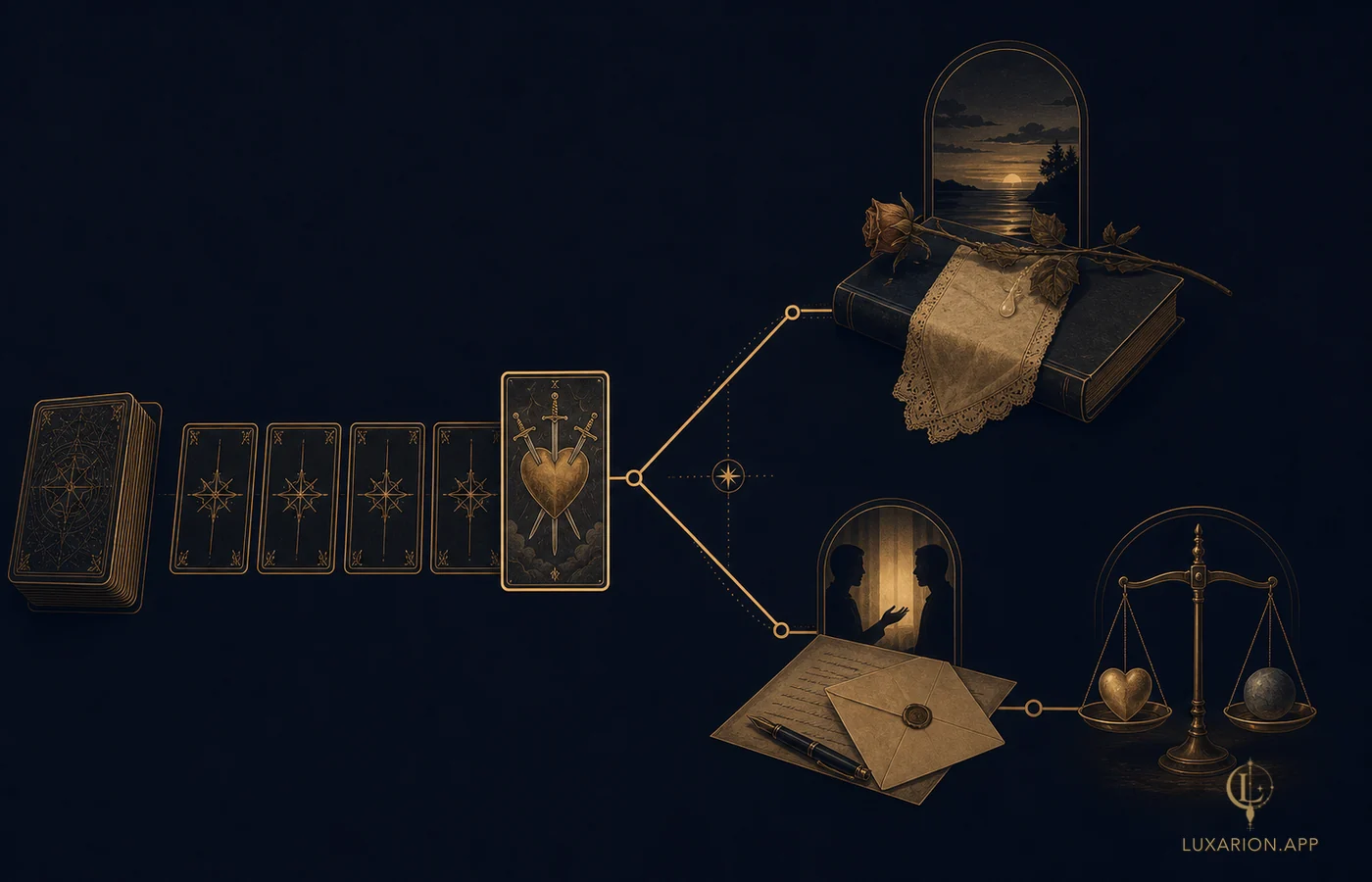
Something worth understanding, because it is where most confusion about accuracy comes from: the cards do not carry one fixed meaning each. They carry a range, and the reader's work is to select within it.
Take the Three of Swords — an image of a pierced heart. In one reading it is a grief that has already happened and is being carried. In another it is a truth that will hurt to say and needs saying. In a third it is a decision made with the head against the heart's preference. All three are within the card's range. Which one applies is decided by the question, the position, the surrounding cards, and the person sitting there.
This is exactly the same structure that governs every serious interpretive tradition. A dream image means different things to different dreamers. A line in a palm reads differently at twenty-five and at fifty. The image supplies the range; the life supplies the selection.
And it explains something that puzzles newcomers: why two competent readers can give you genuinely different readings of the same spread and both be doing the craft correctly. They are not contradicting each other. They are selecting differently within an overlapping range, usually because each entered the range by a different door — one through the position, one through the neighbouring card — and a well-read spread carries both readings to the same place.
What would be a failure is a reader who selects without reference to you at all — who reads the card's dictionary entry aloud and stops. That is the tarot equivalent of reading a dream from a symbol list, and every tradition that has thought about it has warned against it in almost identical language.
Where the deck came from
Knowing the provenance helps, because the images are not arbitrary and their weight comes from how they accumulated.
The cards begin as playing cards in fifteenth-century Italy, with a fifth suit of trumps added for a trick-taking game. Those trumps — the images that became the Major Arcana — were drawn from the visual vocabulary everyone in that world already shared: the wheel of Fortune, the virtues, Death, the Devil, the Star, the Moon, the Sun. They were not invented as a symbol system. They were the common images of a whole civilisation, and that is precisely why they carry so much.
The Tarot de Marseille standardised the pattern in France and remains the working deck of a large part of European practice. In the eighteenth century Antoine Court de Gébelin and then Etteilla developed the divinatory use in a systematic form, and Etteilla in particular was the first to build a full working method around it.
The nineteenth-century Golden Dawn added a rigorous correspondence framework, and out of that came the deck most people now picture: A. E. Waite directing and Pamela Colman Smith illustrating the Rider–Waite deck of 1909. Smith's decisive innovation was to give every one of the fifty-six Minor Arcana a full narrative scene rather than a bare count of cups or coins — which is why that deck reads so fluently and why it has dominated ever since. It is a genuinely great piece of visual design, and its influence is hard to overstate.
So when you sit down to a reading, the images in front of you are the distilled result of six centuries of people looking at these pictures and finding their own situations in them. That accumulation is the deck's actual authority.
Why the images work as well as they do
There is a real question underneath the popular one: why does the spread that falls fit the situation it is laid for?
The first answer is the tradition's own. The cards are drawn by a hand that does not choose them, so that what falls comes from beyond the asker's wishes — and what falls is what the moment gives. Every lineage of lots and drawn signs has read the fall this way: not as noise, but as the answer arriving.
The second is the deck's range. It is built to cover the whole arc of a life rather than a list of topics — beginnings, forces, reversals, waiting, loss, recovery, completion — so whatever the moment gives, the deck has an image able to carry it. And the images survived six hundred years of practice because they carried weight; the ones that did not fell out of the pattern.
Carl Jung stood beside this from inside serious intellectual work. He took divinatory systems seriously — as working instruments rather than curiosities — and wrote about synchronicity to describe meaningful coincidence that is not causal; his account of archetypes and the collective unconscious was his attempt to say why a fixed set of images keeps proving adequate to an unlimited set of lives.
What the tradition and Jung share: the fit between the cards and a life is not a coincidence to be explained away. It is the thing the craft is built on.
The reader is half of it
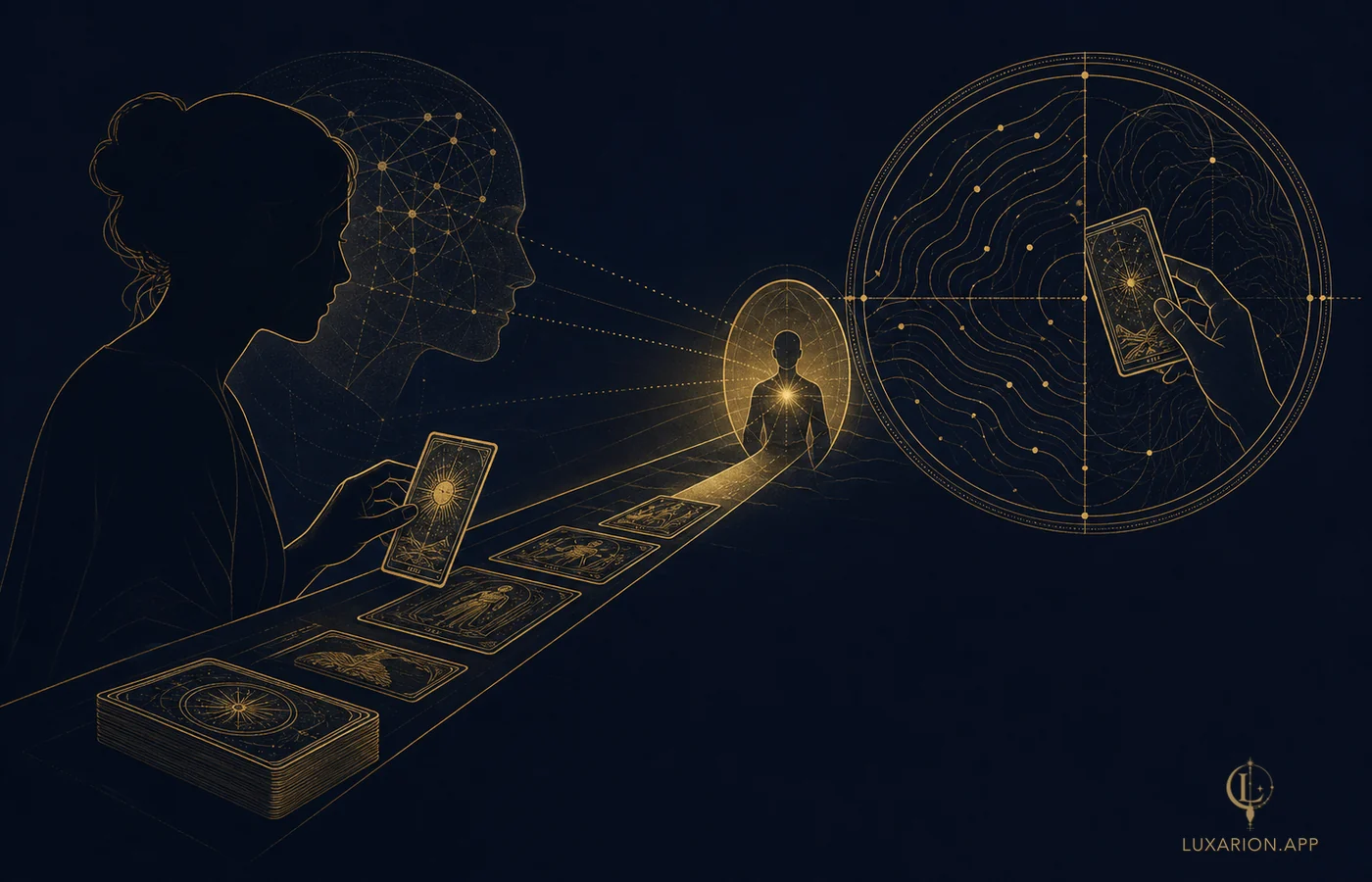
The deck alone is not the reading. The reader is at least half of what happens, and the difference between a practised reader and a beginner with the same cards is enormous.
What is the skill, exactly? It is the reader's sight — the capacity to see at a glance what a spread is showing and which card is carrying the matter — opened by doing the thing thousands of times. Michael Polanyi called the same structure in every craft tacit knowledge: it knows more than it can say. It is the structure of any developed expertise, and it is why the craft is transmitted by apprenticeship rather than by memorising meanings.
It is also why the same spread, read by two people, produces two different sessions — and why choosing a reader matters more than choosing a deck. We open the question of what that perception actually is in The Quiet Sense.
Three misuses, and what to do instead
The craft has three characteristic misuses. Each has a reframe that a reading can genuinely work with.
Asking only whether someone is thinking of you. "Is she thinking about me." The cards can read her — what she feels, what she intends, where she is heading — and a good reader will. But asked bare, the question keeps you waiting rather than moving. Instead: "What is she carrying toward me, where is this bond heading, and what is mine to do?" That is a question with an answer you can use.
Asking repeatedly until the answer changes. Re-shuffling the same question in the same week is one of the oldest recorded errors, and practitioners have warned about it for centuries. The cards are not a slot machine and the practice does not reward it. Instead: take the reading you got, act on the smallest piece of it, and come back when the situation has actually moved. A reading responds to changed circumstances; it does not respond to being asked twice.
Asking for permission you have already given yourself. Very common, and the reader will usually spot it in the first two minutes — the question is phrased as uncertainty but the decision is plainly made. Instead: say it. "I have decided; show me what it opens and how to walk it." That is a genuinely useful session and a completely legitimate reason to sit down. The cards have been giving people permission to say the already-decided thing out loud for six hundred years, and there is no shame in using them that way.
Notice what these three have in common: each turns the reading into something that happens to you rather than something you participate in. The craft assumes a participant. That assumption is why the questions get asked, and why the reading fails without them.
How to judge a reading
Here is the practical part. Judge a reading by whether it named what was moving and where it was heading — and whether it left you able to act. Six markers, all of which you can assess yourself.
Did it address your actual question? Or did it deliver material that would fit anyone? A reading that never touches the thing you came about has failed regardless of how impressive it sounded.
Did the reader place it in your life? A good reader names what the cards show and asks where it sits — which job, which person — so the reading lands on the right door. A reader who talks for thirty minutes without once placing it is performing rather than reading.
Did it give you direction and season? "This is heading toward a parting by the end of the summer unless the conversation happens, and here is what turns it" is a practitioner speaking. A calendar date pinned to a single event is not.
Did it keep its lines? A reading that pronounces on your body or pins a calendar date has left the craft. The good ones have edges.
Did it leave you with something to do? This is the oldest quality marker in every reading tradition. A reading that ends in news alone is unfinished; one that ends in what is coming and what to do about it is complete.
Did it hold up as the weeks passed? Did the naming still fit once the emotion of the session had faded, and did what it said was moving begin to move? That is the test that matters, and a reading worth the name passes it.
What to bring, and what to ask
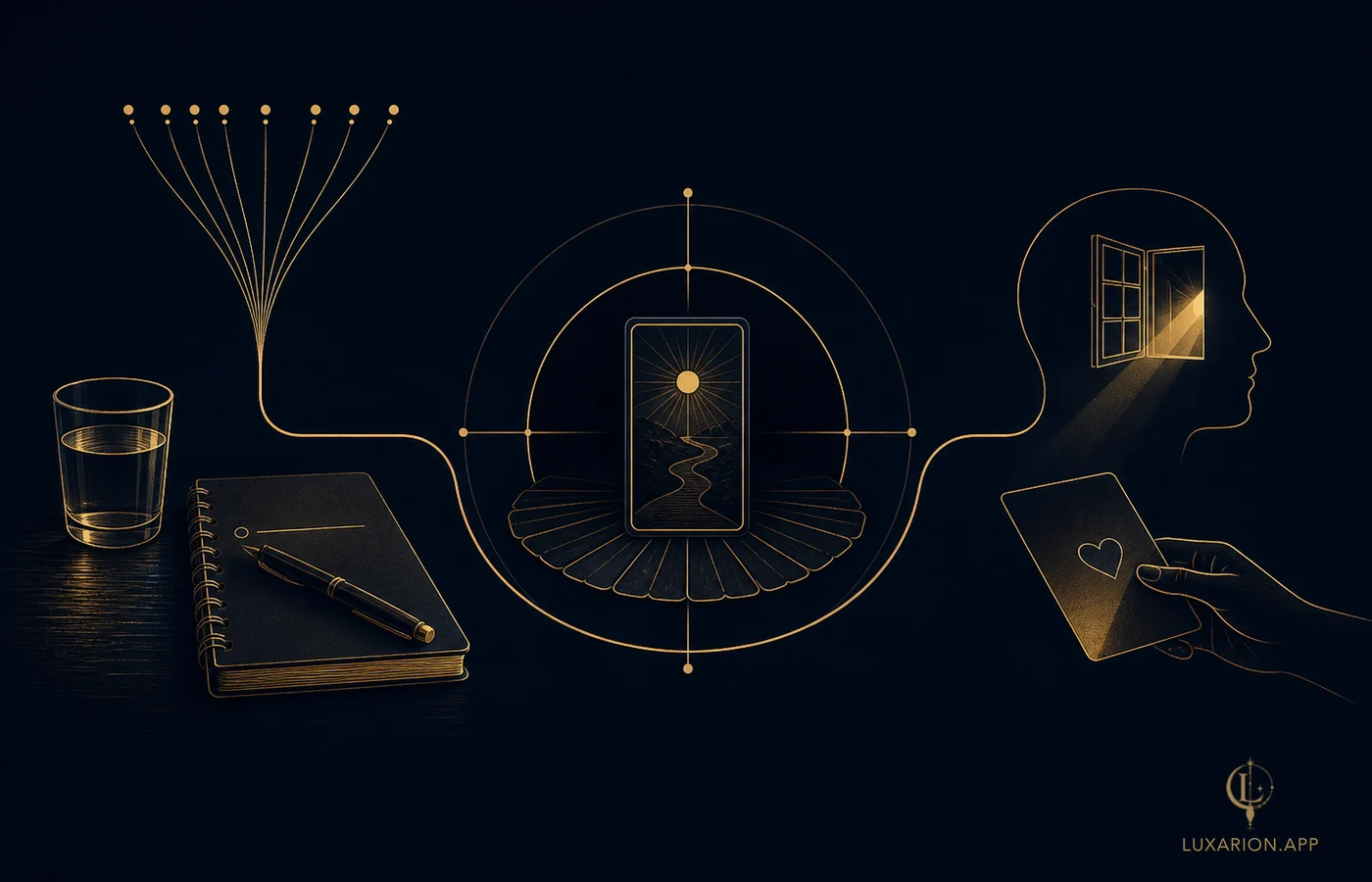
Readings improve dramatically with a little preparation, and almost nobody does it.
Bring one real question. Not five, and not a vague desire to see what comes up. The single most common cause of a disappointing reading is an unspecific question, and the fix costs you two minutes beforehand.
Name whose matter it is. "Should I take this offer" is a question about your road. "Does he love me" is a question about him, and the cards can read him. Say which you are asking, and add the bond — "what does he feel, and where is this heading" — and a reading answers it fully.
Say the question plainly. Hiding it to test the reader makes the cards answer a question you did not ask. You are not running an experiment; the cards answer what they are asked, and the clearer the question, the clearer the answer.
Write down the one sentence you leave with. Sessions blur within days. The sentence is what you actually paid for, and a week later it is the only thing you will want.
If you want to learn the mechanics yourself first, the practical ground is laid out in how to read tarot, and the smallest sustainable practice is in one card a day.
How a good session actually runs
Knowing what to expect settles more nerves than any amount of theory, and the sequence is broadly the same across serious lineages.
Questions first. Before a single card is turned, the reader asks about you: what brought you, how long you have been in this, what you have already tried. This is not preamble and it is not small talk. It tells the reader which matter the spread is being laid for.
Then the question gets sharpened. A practised reader will rewrite your question with you until it is one that can actually be answered. "Will I be happy" becomes "what is this path bringing me, and where does it lead". This is the single highest-yield moment of the whole session, and it happens before any card appears.
Then the spread is chosen. Sized to the question rather than to a desire for ceremony. A small question drowns in a large spread; a large one gets truncated in a single card.
Then the reading, with pauses. A good reader stops after each section to place it in your life, and what has not yet arrived is named as what is coming rather than forced onto the present.
And at the end, one step. Not a list — one specific small thing that can be done before next week. A session that ends without it has ended incomplete.
Getting your own deck
A practical question people ask constantly: should you buy your own deck, and which one?
An old custom says a deck should be a gift. No serious lineage requires it — buying your own is entirely fine. The real idea underneath the custom is different and is true: a deck is a tool worked with, and a working deck becomes its owner's over time.
Which one? For a beginner the advice is nearly unanimous: get a deck with fully illustrated Minor Arcana. If all fifty-six of those cards carry a scene, the cards help you; if they do not, you are thrown back on memorisation. The Marseille pattern is beautiful and deep, but it is a second deck, not a first.
And stay with one deck for a long while. Collecting is the most common beginner's error. Someone who has worked a year with a single deck is far further along than someone who has spent that year with five — because a card's range only settles once you have seen the same image dozens of times against different questions.
Rules about care — the cloth, the box, letting no one else handle a working deck — vary by tradition and none are obligatory, but they share one sense: a deck kept for the work stays with the work.
A better question than accuracy
The reason "is tarot accurate" sits awkwardly is that it imports a standard from measurement into a practice that does not measure. A thermometer matches a number. A reading answers a situation — and a situation has forces in it, a direction, a weather, and more than one road out. Those are exactly what a spread is built to show, and none of them is the kind of thing a number would capture. The question is not wrong; it is aimed slightly past the target.
The question the craft answers is: what is at work in my situation, where is it heading, and what should I do? And that has a real answer, arrived at by six centuries of people doing it and keeping what worked. The traditions were careful about the boundaries precisely because they took the practice seriously — you draw firm lines around something you intend to keep using.
So the answer to the question in the title is this. If you mean "will it hand me a dated calendar of next month" — no serious reader will give you that, and the reason is craft rather than modesty: a spread speaks in seasons, and a date pretends to a precision the instrument does not have. If you mean "will it show me what is really at work here, which way it is heading, and what is likely to arrive if I do nothing" — then yes. That is what a spread is for, it is what six hundred years of readers have kept it for, and a good reading does it well enough that people recognise their own situation the moment it is named.
If you have a question you have been circling for a while and want it read properly — by someone who will ask before they answer, name what is moving and where it leads, and send you home able to act on it — that is what our readers do. You can book a tarot reading, and bring the one real question with you.
The library teaches the craft. A reading applies it to you.
Get your personal reading