

Palm Reading: A Complete Guide to the Lines, Mounts and Hands
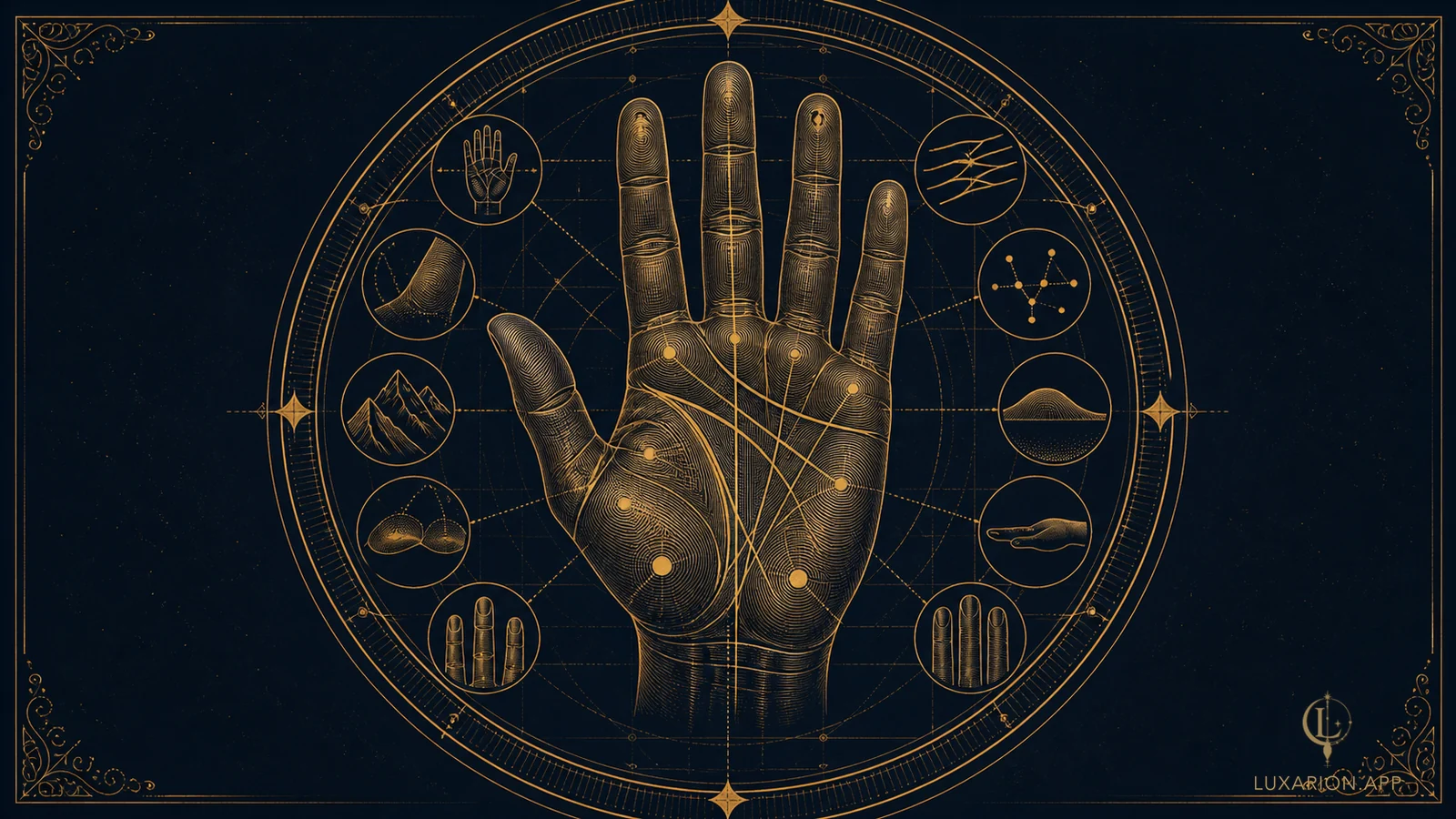
The full vocabulary of the hand — lines, mounts, shapes and fingers — as the lineages actually taught it, and how to read your own hand this week.
Hold your hand open under a good light and look at it as if you had not seen it before. There is more information there than almost anywhere else on the body: creases that formed before you were born, ridges unique to you among every person who has ever lived, calluses laid down by whatever you have done ten thousand times, and a set of marks that have quietly changed since you were twenty.
Palmistry is the craft of reading that record. It is old, it is continuous, and it is taught in more or less the same shape across a remarkable spread of the world — Indian hasta samudrika, Greek chiromancy, the Arabic and Persian material, the Romani lineages of Europe, and the modern European revival that gave us most of the English vocabulary.
The premise underneath all of it is humbler and more interesting than the stage version suggests: the hand is a diary. It records how you have gripped, worked, hesitated and held on — and, like a diary, it keeps being written. We make that argument at length in Hands Change. This article is the vocabulary that goes with it, set out completely enough that you can read a hand yourself.
Where the craft comes from
Palmistry is not one tradition. It is four or five that converged, and knowing which is which explains most of the apparent contradictions in the modern books.
The oldest continuous body of teaching is the Indian, where hand reading sits inside samudrika shastra — the broader science of bodily marks, of which the hand is one chapter among many. This is where the mounts, the elemental hand types and much of the finger lore originate, and it is the most systematised of the sources.
The Greek material gives us the word itself and the planetary naming of the mounts. Aristotle is credited in the later tradition with an interest in the hand's markings, and the Hellenistic world folded palmistry into the same framework that governed astrology and medicine — the body as a small-scale map of a larger order, an idea that survives in the medieval zodiac man diagrams.
The Islamic world transmitted, tested and argued about all of it. Ibn Khaldun discusses the divinatory arts at length in the Muqaddimah, and al-Biruni catalogued the Indian sciences with unusual accuracy for a scholar writing across a cultural boundary. The Persian and Arabic manuals refined the vocabulary and, importantly, hardened the ethics — much of the restraint that a good reader still practises comes from this layer.
The Romani lineages carried the practical craft across Europe for centuries, and it is largely through them that hand reading survived as a living skill rather than a manuscript tradition. The nineteenth-century European revival then systematised it into the form most books still use, which is why an English palmistry book and an Indian one agree on the mounts and disagree on almost everything else.
One consequence worth stating: where the sources disagree, they usually disagree because they are answering different questions, not because one is wrong. The Indian material is more interested in character and destiny, the European revival in temperament, the Romani practice in the person actually sitting there. A good reader knows which register they are working in.
Before any line: which hand, and in what order
Most beginners go straight to the life line. Every serious lineage does three things first, and skipping them is why amateur readings feel arbitrary.
Both hands, not one. The near-universal teaching is that the non-dominant hand carries what you were given — inheritance, disposition, the starting conditions — and the dominant hand carries what you have done with it. The difference between them is the reading. A wide divergence is read as a life substantially self-made; a close match as a life running along its given grain. Nothing in palmistry is more informative than this comparison, and nothing is more often skipped.
The whole hand before any part. Shape, size, texture, flexibility, colour, how it is held. A reader who has looked properly already knows a great deal before touching a line. A hand held rigidly open and a hand that curls when relaxed are different hands, whatever the creases say.
Ask before you read. This is the ethical spine and it is also the technical one. The same line means different things at twenty-five and at fifty, in a labourer's hand and a violinist's. The classical manuals across every one of these traditions insist that the reader ask about the person first. A reading offered without knowing who is sitting there is a guess in the costume of knowledge — the same principle that governs dream interpretation, which we set out in how the old interpreters actually worked.
The four major lines
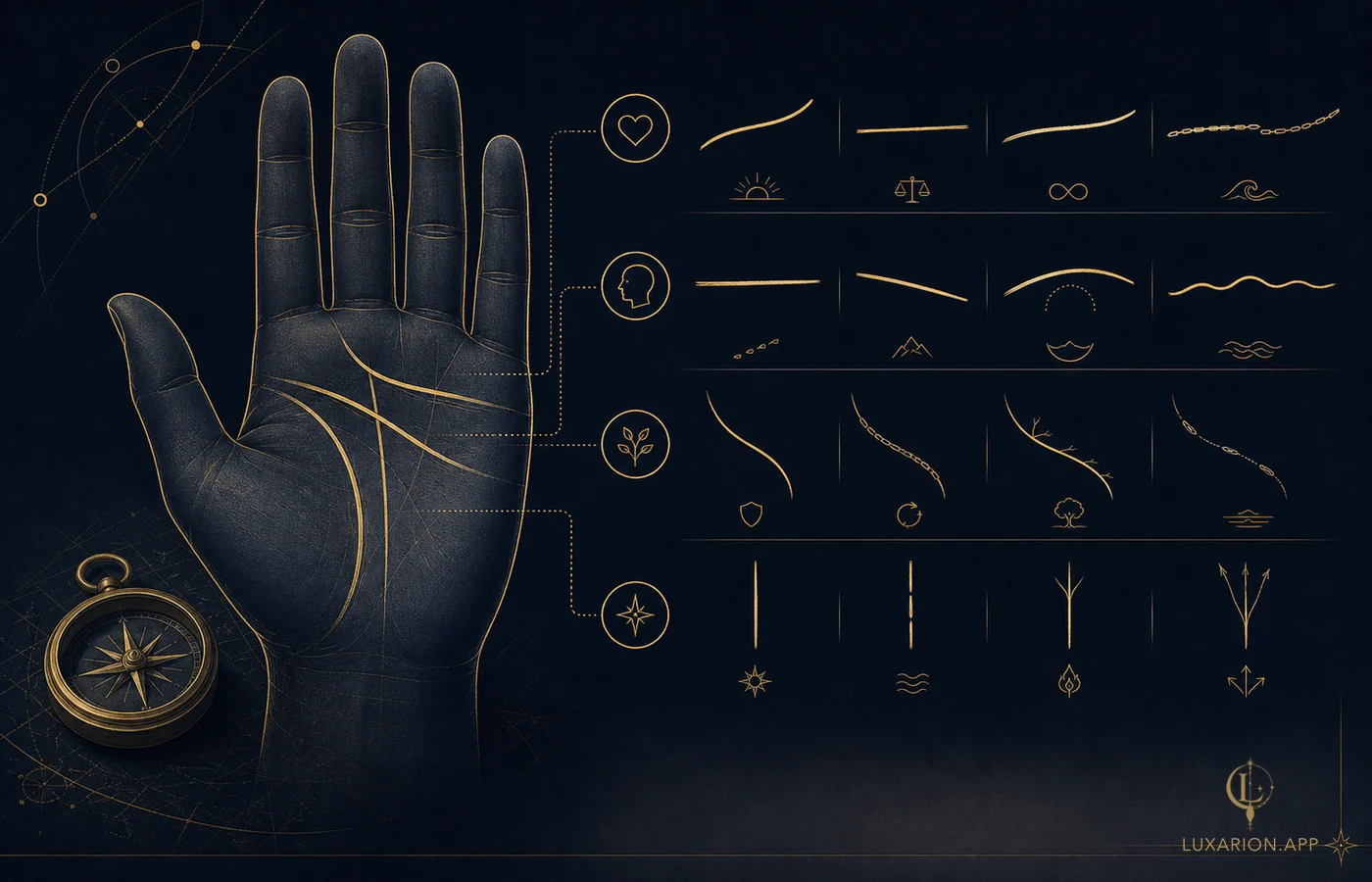
These are the creases everyone knows, and each is more specific than its reputation.
The heart line. The uppermost of the long horizontal creases, running below the fingers. Read for how feeling moves in you rather than for whom you will love. A long curve rising toward the index finger was read as affection that leads — warmth offered first. A straighter, shorter line ending under the middle finger was read as feeling that follows thought. A line that runs the full width of the palm is read as constancy; one that breaks and restarts, as feeling that renews itself rather than persisting unchanged. Chains and islands along it are traditionally read as periods rather than verdicts.
The head line. Beneath the heart line, and read for style of mind rather than intelligence — a distinction the good manuals are firm about. A long straight line was read as sequential, practical thinking. A line that slopes down toward the wrist, into the region the tradition calls the mount of the Moon, was the classical mark of imagination outrunning caution — the maker's line rather than the accountant's. Where the head line begins joined to the life line and separates late, the reading is caution and a slow start; where it begins clearly separate, independence early.
The life line. The curve around the base of the thumb, and here the tradition needs defending from its own reputation. It was never a measure of lifespan. That is a stage-hall invention, and the classical sources do not support it. What the lineages actually read is vitality and scope: the depth and sweep of the line as the width of the arena your energy claims. A wide, generous curve was read as a life lived outward; a line hugging the thumb, as one lived close to home. Breaks are read as changes of course, and very often as relocations — which, in a craft that developed among travelling and trading peoples, is exactly what you would expect it to notice.
The fate line. Rising vertically toward the middle finger, and the most variable of the four — many hands do not have one at all, which is itself a reading rather than an absence. It is read for the sense of a directing thread: work, vocation, the feeling that a life has a spine to it. A fate line beginning at the wrist is read as a direction set early; one beginning halfway up the palm as a course found later. No fate line is read as a life shaped by choice and circumstance rather than by a single long arc — and in modern practice that is extremely common and carries no bad news at all.
The minor lines
The secondary markings carry the specifics, and this is where a reading stops being generic.
The sun line (or line of Apollo), rising toward the ring finger, read for recognition, satisfaction in what you make, and the sense that your work is seen. Often absent in young hands and appearing later — one of the clearest examples of a line that arrives.
The mercury line (or health line), running toward the little finger, read traditionally for constitution and, in the older material, for aptitude in speech and trade. The manuals are unanimous that its absence is favourable rather than otherwise.
The relationship lines, the short horizontal marks on the edge of the palm below the little finger. Read for significant attachments rather than for a countable number of marriages — the counting version is a modern simplification the older sources do not make.
The girdle of Venus, an arc above the heart line, read for sensitivity and responsiveness of feeling; in the older material, for a nature that registers things strongly.
The line of intuition, a curve on the percussion edge, comparatively rare and read for the quality we treat at length in The Quiet Sense — receptiveness to what has not yet been said aloud.
Travel lines and the rascettes, the horizontal creases at the wrist, read in the older material for movement and for the general fortune of the life — the most decorative of the readings and the one modern practitioners lean on least.
The mounts
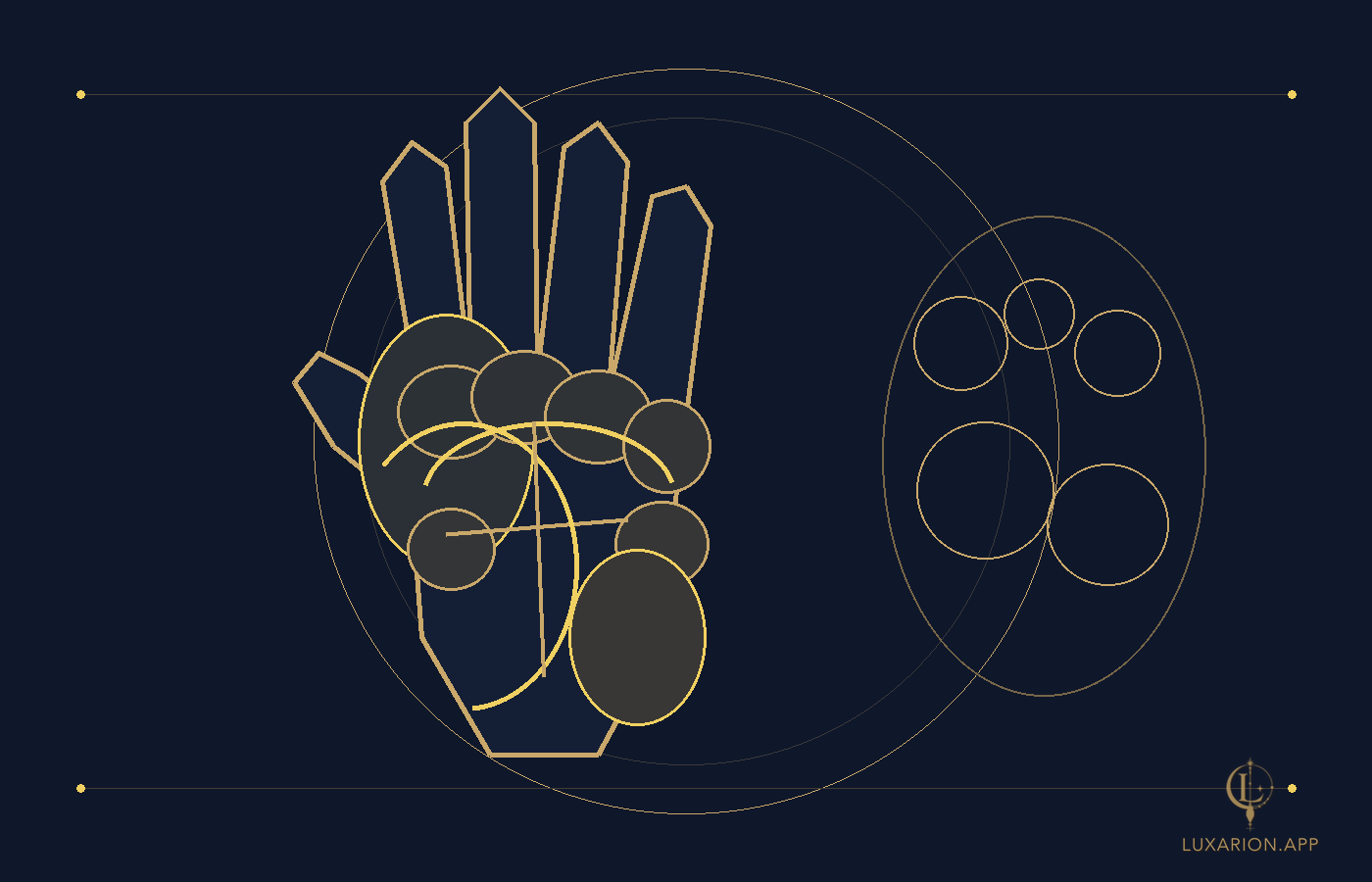
The mounts are the fleshy pads of the palm, and they are the most reliably useful part of hand reading precisely because they are physical: they change with use, they differ visibly between people, and you can assess them by touch as well as sight.
They take their names from the planets, which is the Greek inheritance, and each is read for the quality that classical astrology assigned to its planet.
Venus, the large mount at the base of the thumb, ringed by the life line. Read for vitality, warmth, appetite and physical affection. A full mount is read as generous and embodied; a flat one as a nature that lives more in the head.
Jupiter, below the index finger. Read for ambition, leadership and self-regard in the neutral sense — the willingness to take up space.
Saturn, below the middle finger. Read for seriousness, endurance, solitude and the capacity for long work. Prominence here is read as gravity rather than gloom.
Apollo, below the ring finger and named for the Sun. Read for creativity, taste and the desire to make things well.
Mercury, below the little finger. Read for speech, quickness, commerce and adaptability.
Mars, in two parts — the lower mount inside the life line read for physical courage, the upper mount on the percussion edge read for endurance under pressure. The tradition distinguishes the courage to start from the courage to continue, which is a genuinely useful distinction.
Luna, the mount of the Moon at the base of the percussion edge. Read for imagination, memory, restlessness and the pull toward water and travel.
The practical method is comparative, not absolute: you are asking which mounts are full relative to the others in this hand, not measuring against an ideal. A hand where Saturn and Luna dominate is a different person from one where Jupiter and Mars do, and that comparison can be made in seconds once you know what you are looking at.
Hand shapes: the elemental classification
Before the lines, most modern readers classify the hand itself, using a scheme borrowed from the four classical elements. It is quick, it is surprisingly stable, and it sets the frame everything else is read inside.
Earth hands — square palm, short fingers, firm skin. Read as practical, grounded, physically capable, more comfortable doing than discussing.
Air hands — square palm, long fingers, often fine dry skin, usually well-marked with many fine lines. Read as analytical, verbal, curious, sometimes restless.
Fire hands — long palm, short fingers, warm and firm. Read as energetic, impulsive, drawn to action and to leading.
Water hands — long palm, long fingers, soft skin, often a fine web of lines. Read as sensitive, responsive, emotionally receptive.
Two notes the good manuals add. First, most hands are mixed, and the mix is the reading. Second, the classification describes how a person operates, not what they are worth — a distinction the older sources are careful about and the popular versions often are not.
Fingers, thumb and nails
The fingers carry a surprising amount, and they are the fastest read on the hand.
Length is judged against the palm: fingers longer than the palm are read as detail-minded, shorter as decisive and impatient with process.
Set — the line along which the fingers join the palm. A low-set little finger is traditionally read as a difficult early start, a reading the manuals apply gently.
Spacing when the hand is held open naturally. Wide gaps are read as openness and a tolerance for risk; closely held fingers as caution and privacy.
Knots at the joints are read as a mind that examines things before accepting them; smooth fingers as one that moves quickly and trusts first impressions.
The thumb deserves its own paragraph, because much of the tradition treats it as the single most informative digit. Its length is read for willpower, its flexibility for adaptability — a thumb that bends back easily is read as generous and pliable, a stiff one as steady and unyielding. The two phalanges are read as will and logic, and which is longer tells you which leads in that person.
The nails are read for constitution and temperament: broad nails as candour, narrow as reserve, and their condition as a straightforward indicator of general health — one of the places where the tradition is doing plain observation rather than symbolism.
What the hand genuinely records
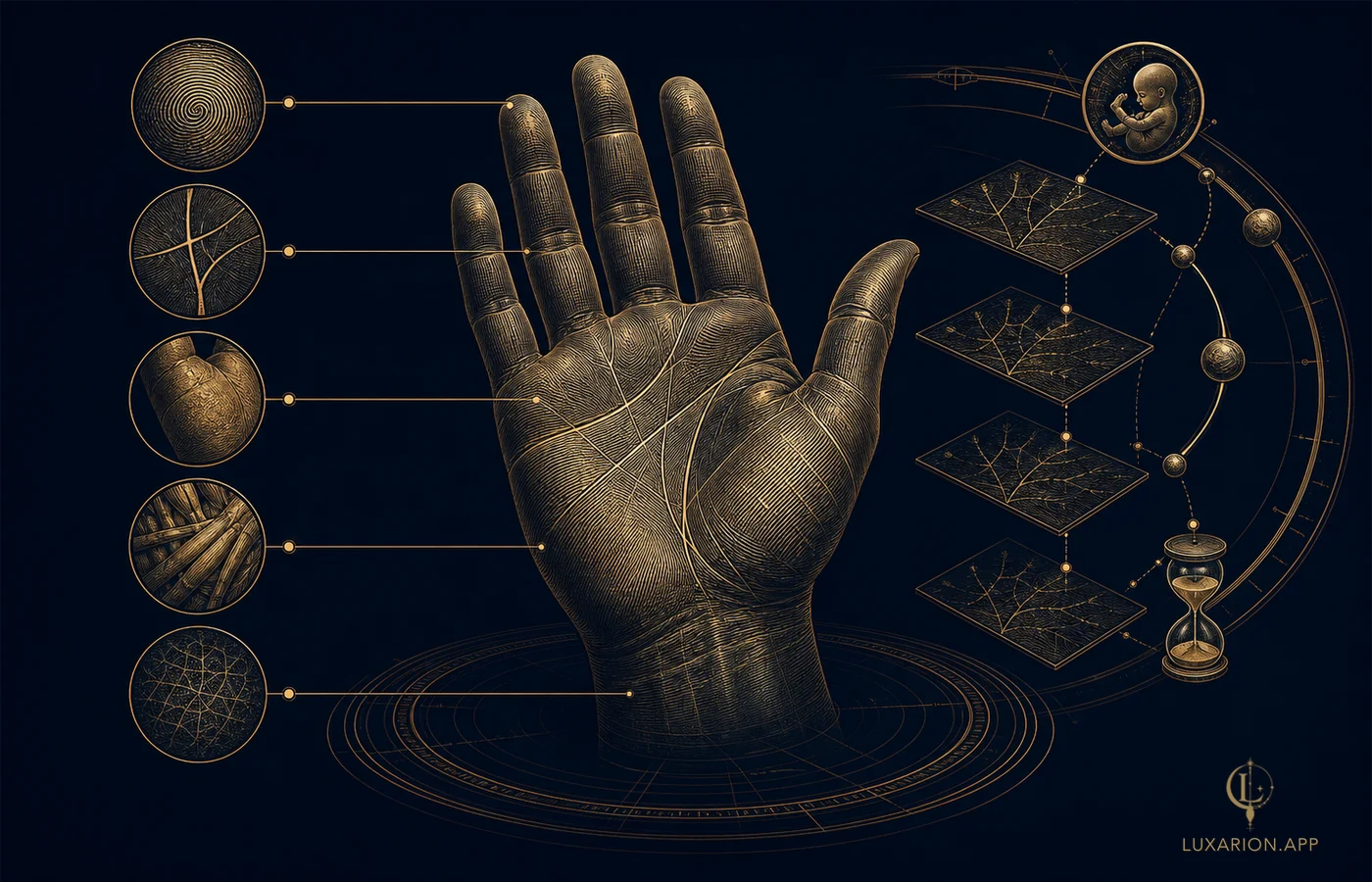
Here is the part that makes the craft's central premise more interesting than either its defenders or its detractors usually allow.
The hand really does carry a physical record, and some of it is remarkably precise. The ridge patterns — the field known as dermatoglyphics — form in the womb and never change; your fingerprints are yours alone and will be at ninety what they were at nine. The major creases also form before birth, which is why the tradition treats them as the given rather than the acquired.
But the surface of the hand is a working record. Calluses map what you do repeatedly. Muscle at the base of the thumb builds with grip. The fine secondary lines — the ones that make an anxious hand look like a spiderweb and a placid one look almost bare — genuinely do come and go with periods of a life. Anyone who has photographed their own palm a decade apart has seen this.
Which is exactly the claim the lineages were making. The hand is not a fixed verdict issued at birth; it is a surface that is still being written. That is why the tradition reads both hands and reads the difference, and why a reader will tell you that a line has changed rather than that it was always going to say this.
There is a further point worth making about how this kind of knowledge accumulates. A skilled reader is doing something close to what Michael Polanyi called tacit knowledge — a trained perception that takes in far more than it can articulate, built by seeing thousands of hands. The reader who tells you they noticed your hand was tense is not performing; they noticed, because noticing is what the training is. This is the same structure as any developed expertise, and it is why hand reading rewards apprenticeship rather than memorisation.
The etiquette of a reading
Every serious lineage carries rules of conduct, and with hand reading they do real work. They are also the fastest way to tell a practised reader from an unpractised one.
No dates on the hard things. The classical manuals are markedly reserved about specific events and specific timings. A reader who names a year is working outside the tradition, not deep inside it.
Never a lifespan. Restated because it is the single most common misuse of the craft. The life line is read for vitality and scope. A reader who reads it as a clock is doing something the sources do not authorise.
Where readings are equally available, offer the better one. Not concealment of the difficult, but a refusal to select the frightening reading when the hand does not require it.
Not over fresh grief or fear. Someone in the first weeks of a loss or a rupture is heard rather than read. This restraint is a skill in its own right, and we open it in when the reading says no.
No readings about a third party. Your hand is a record of your life. It does not carry news about someone else's intentions, health or future, and every serious tradition draws that line firmly.
Nothing medical. The older material does read the nails and skin for constitution, and a careful reader may say your hands look tired. Naming a diagnosis is outside the craft entirely and belongs with a doctor.
Reading your own hand: a practical sequence
You can do this properly in about half an hour, and doing it yourself will teach you more than reading three more articles.
1. Photograph both palms in daylight. Flat, relaxed, no flash. Do this today and again in a year; the comparison is the single most persuasive thing in the whole subject.
2. Classify the shape. Palm length against finger length, skin texture, line density. Earth, air, fire, water, or the mix. Thirty seconds.
3. Compare the two hands. Look for where they differ — a line present in one and not the other, a mount fuller on one side. The difference is your given nature against your made one, and it is the reading most people never get.
4. Read the mounts by touch. Press each pad. Which are full, which flat, relative to each other in your own hand.
5. Take the four major lines in order. Heart, head, life, fate. Note length, depth, curve, breaks. Write what you see before you interpret it — the same discipline that governs dream records.
6. Then, and only then, interpret. Against your own life, not against a list. The question is never "what does a forked head line mean" but "what does this hand, on this person, at this age, look like it has been doing".
Write it down. A page you can compare against in a year is worth more than any single reading, because the whole claim of the craft is that hands change — and you will only ever prove that to yourself with a record.
What a session actually gives you
A good reading is not a list of pronouncements. It is a structured conversation with your own hand as the subject, and what people take from it is usually not what they expected to take.
The reader will look at both hands and ask about you before saying anything substantial. They will work from the whole to the parts. They will give ranges rather than verdicts, decline the questions the craft cannot answer, and — if they are good — leave you with something to do rather than something to wait for. That last point is the oldest mark of quality in every reading tradition: an interpretation that ends in news is incomplete; one that ends in a next step is finished.
People most often come with a specific question — about work, about a relationship, about a decision that has been sitting unmade. The hand is a good surface for those conversations precisely because it is concrete. It is difficult to stay abstract about your own life while someone is pointing at the place where you grip.
If you would like your hands read properly — both of them, with the questions asked in the right order, and without a single date attached to anything — that is what our readers do. You can book a palm reading, and bring the photographs if you have taken them. And if you want the argument underneath the whole craft first, it is set out in Hands Change.
The library teaches the craft. A reading applies it to you.
Get your personal reading