

Mercury Is Not Your Enemy: What the Old Books Actually Say
The classical sources treat a retrograde planet as one weak factor among dozens. The three-week ambient catastrophe is not in them.
Three times a year the same explanation goes round: the trains are late, the email reached the wrong person, and Mercury is retrograde.
The interesting thing is where that explanation comes from, because it is not the handbooks the tradition was built on. Go back to those and the claim narrows sharply — not because the old writers were sceptical, but because they were specific. What they assign to a retrograde planet is technical, and it is a good deal more useful than an ambient three-week catastrophe.
Two things are worth having straight. The first is the geometry. The second is what the sources say.
The loop, and what is actually moving
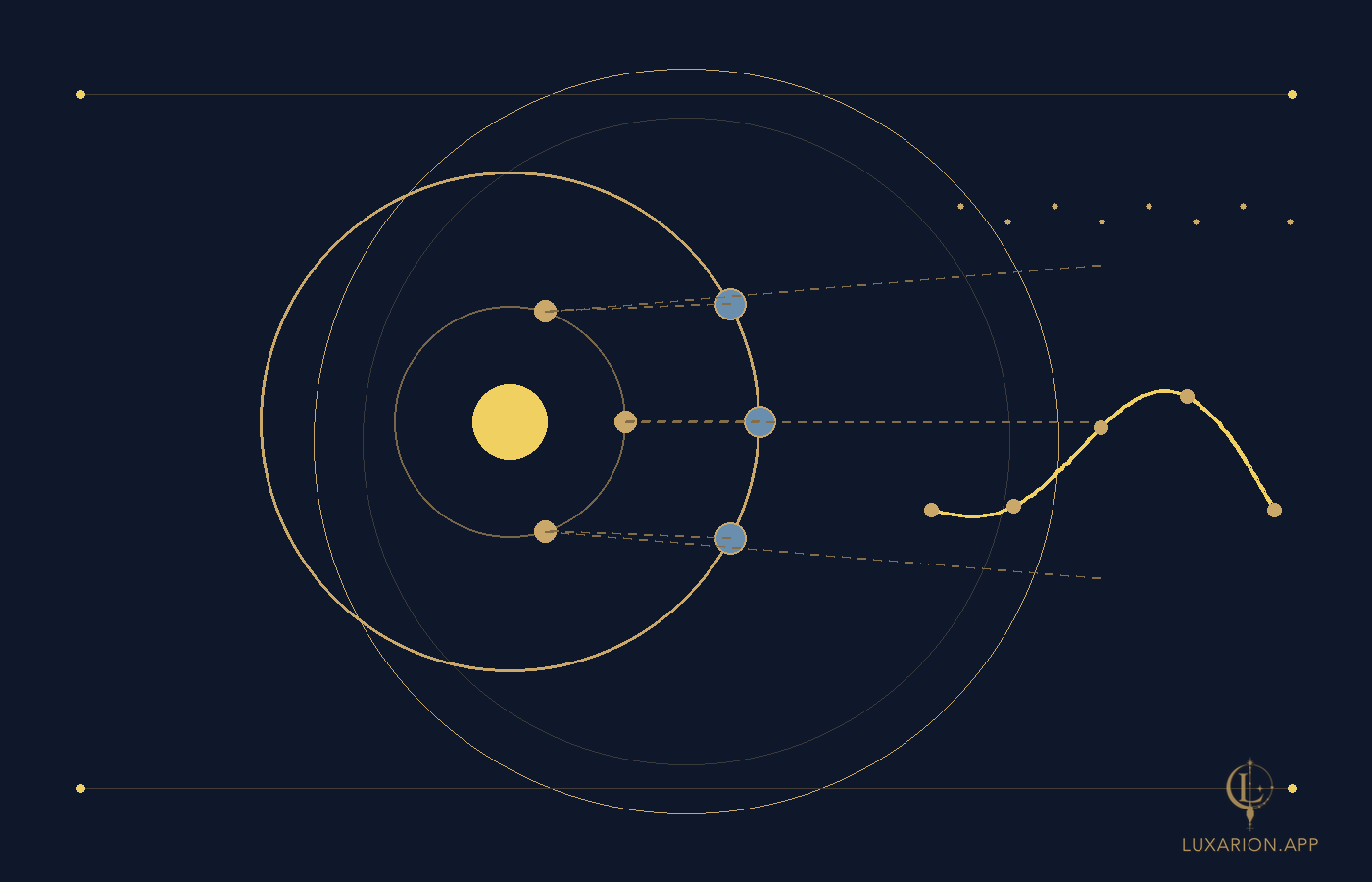
Retrograde motion is real in the sense that you can photograph it, and unreal in the sense that nothing changes direction.
Mercury goes round the Sun in 88 days to our 365. Because it is an inner planet, it periodically overtakes us on the inside lane, and while it does, its position as seen from here slides backward against the fixed stars for a few weeks before resuming. It is the same effect as a slower car appearing to roll backward as you pass it: the apparent motion belongs to the observer's platform, not to the object.
The ancients knew this and said so. The technical vocabulary of the classical astronomers separates the apparent motion from the true one, and they built their planetary models specifically to account for the loop. The meaning begins where the optics end. Any practitioner who tells you the planet physically reverses is telling you something the tradition never claimed.
One weak factor among dozens

Now the part that surprises people who go looking.
In the classical handbooks a retrograde planet is a planet in a condition — one entry on a long list of things that strengthen or weaken what a planet signifies, alongside its sign, its house, its aspects, whether it rises before or after the Sun, and a dozen more. Retrogradation weakens, and it turns a matter back on itself: in a horary question the retrograde significator of someone absent was read as their return, and of an agreement as its reopening.
Its one sharp use is in electional astrology, the branch concerned with choosing a moment to begin something. There the caution is genuinely traditional and genuinely narrow: William Lilly, whose Christian Astrology of 1647 is the most detailed English handbook of the period, weighs a retrograde Mercury when timing agreements and messages, because Mercury had ruled merchants, contracts and correspondence since it carried Hermes' name. That is advice about picking a date; what your own week holds is read from your own chart, where the retrograde is weighed with everything else.
What the sources do not contain is the broader modern version — everything going wrong for everyone at once, three times a year. That version is much younger than the handbooks, and it arrived from somewhere other than them.
The arithmetic that keeps the reading exact
Here is a number worth carrying, because it protects the real signal from the noise that has grown up around it.
Mercury's synodic period is about 116 days, so it turns retrograde roughly three times a year, for about 22 days each time. That is close to 69 days, or nineteen percent of the year.
Nineteen percent is a wide net. Anything that goes wrong in your life stands nearly a one-in-five chance of landing inside a retrograde window on the calendar alone. That is exactly why the classical writers refused to let a single factor stand on its own: a retrograde Mercury is read against the rest of the chart, and a factor that has not been weighed that way has not been read at all.
This is the tradition's own discipline: a factor blamed for everything has been read for nothing, and the practitioners who last weigh every factor inside its chart. We make the same argument about a birth chart's crowded fullness in why you are not your sun sign.
What the season is actually good for
Strip out the catastrophe and something small and usable is left.
The traditional signature of a retrograde is the prefix re-: review, revise, repair, reconcile, return. Practitioners treat these weeks the way a workshop treats its closed days — the time to re-read the contract rather than sign a new one, finish the draft rather than open another, have the postponed conversation rather than start a fresh dispute.
That is the planet's own signature at work. Mercury going back over its degrees turns the matters it rules back for a second look, and work that goes with that grain goes well. The lunar month offers a faster rhythm of the same kind, which we wrote about in living by the Moon.
Said well and said badly
Two sentences, and the difference between them is the whole subject.
"Mercury is retrograde" said well means: this is a good stretch to double-check what I send and re-say what was misheard. It makes you more careful and more forgiving at once — with yourself, and with the people whose messages also landed sideways.
"Mercury is retrograde" said badly means: nothing is my fault for three weeks. That version adds a planet to your list of enemies and takes a decision off your desk.
The sky is for reading, not for blaming. Mercury, patron of translators and messengers, would rather be read than blamed.
Common questions
How often is Mercury retrograde? About three times a year, roughly 22 days each, which is close to a fifth of the year in total.
Should I avoid signing contracts? The traditional caution is about elections — deliberately choosing a start date — and it is one factor among many, not a prohibition. If a date is fixed by the world rather than by you, the reading moves to what that moment shows: a retrograde Mercury there says read every clause twice and keep copies.
Does it affect technology? The association is with messages, commerce and paperwork, which is Mercury's classical territory. Devices are a modern extension; they sit at the edge of that territory because they carry the messages, and the same weighing applies to them.
Do other planets go retrograde? All of them except the Sun and Moon, and the outer ones for far longer — Saturn spends over a third of each year retrograde. Nobody panics about that, which is itself informative.
Is the shadow period real? The pre- and post-retrograde periods, when Mercury covers the same degrees, are a genuine part of modern practice but are a recent refinement rather than a classical doctrine. They also roughly double the share of the year that is spoken for, which is worth noticing before adopting them.
Where to go from here
For the sky as it stands today rather than as it stood at your birth, the daily horoscope is free for every sign. And if the natal placement turns out to be the interesting part — a Mercury that was retrograde at birth is read as a way of thinking rather than a fault — a natal chart reading takes it up with the house and aspects around it.
If you want to know where Mercury actually sits in your own chart rather than in the sky today, the birth chart calculator gives the placement free, including whether it was retrograde at your birth — which the tradition reads as a manner of thinking rather than a defect.
And if the underlying question is how to hold any of this without handing your judgement over to it, that is the subject of the quiet sense.
The library teaches the craft. A reading applies it to you.
Get your personal reading