
Hands Change: What Palmistry Reads in a Living Hand
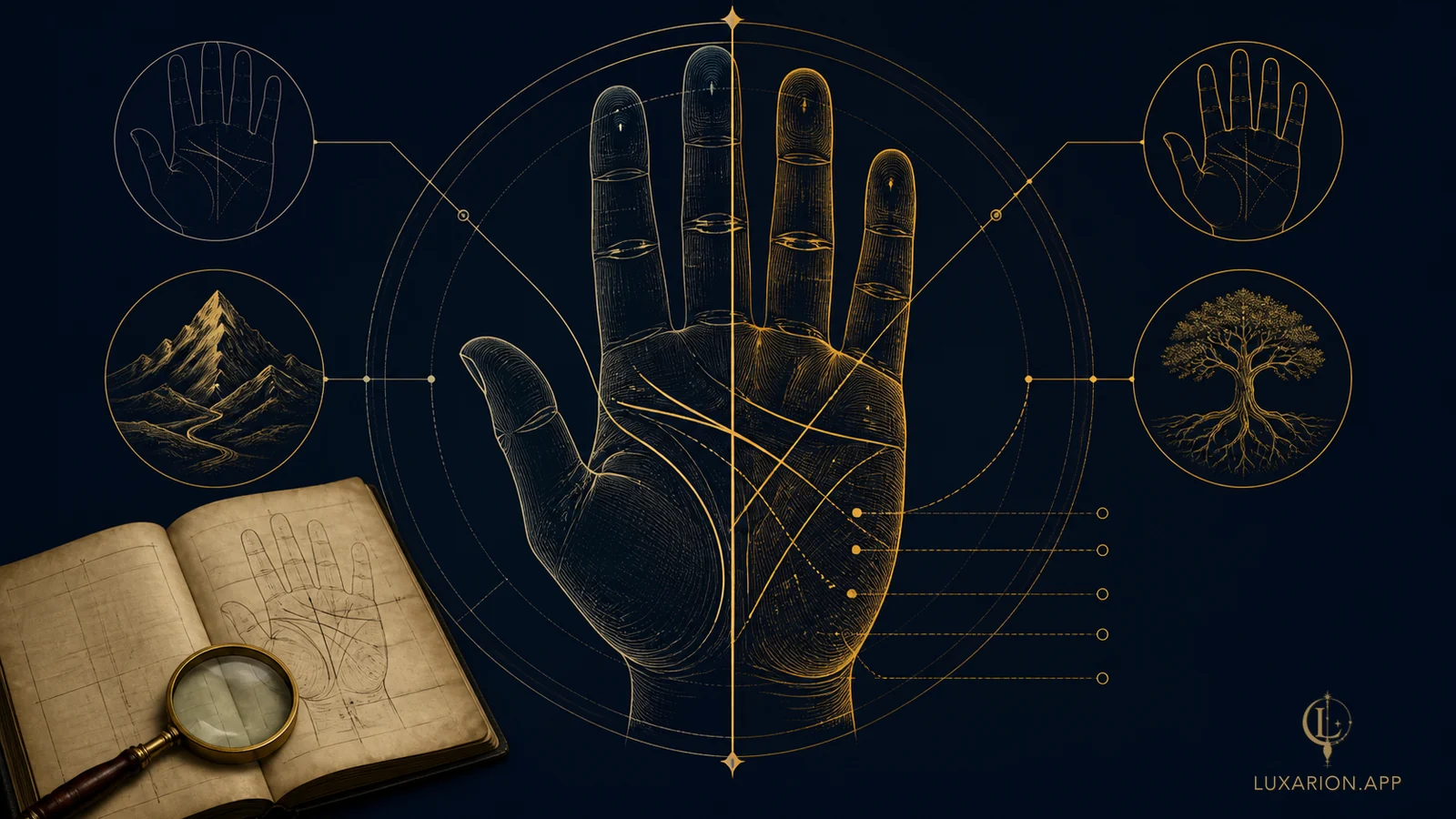
Palmistry from inside the craft: two branches, two hands, why the life line is not a lifespan, and how a changing hand shows the road ahead.
Every palmist with real years at the table has watched someone stare at their own hand as if it were a verdict. It is one of the most common moments in the work, and the craft's oldest answer to it is the exact opposite of what the person is bracing for.
The palm carries your life as it is being lived — where you began, what you have made of it, and where the road is turning — and a hand read closely shows where it is going.
That is not a modern softening or a kindness invented to make a reading easier to hear. It is the teaching the whole tradition is built on, older than the boardwalk booth that gave palmistry its popular reputation — and it is written plainly in the hand itself, as this article sets out.
A very old, very travelled art
Palm reading is among the oldest divinatory arts with a continuous history, and the route it travelled explains a great deal about the shape it has today.
Its likely origins lie in ancient India, from where it moved along the trade routes of the Silk Road into China, Tibet, Persia, Mesopotamia and Egypt before flowering in Greece. The Greeks took to it enough to forge for it: a treatise on the subject circulated for centuries under Aristotle's name — one of the works now grouped as Pseudo-Aristotle — complete with a legend that it had been found on an altar of Hermes. False attribution was then, as now, the sincerest form of prestige.
Medieval Europe read palms in Latin and folded the craft into the wider study of physiognomy, the reading of a person from their form. The nineteenth century turned it into a salon phenomenon: the Irish celebrity palmist Cheiro read for Mark Twain and Oscar Wilde, and the fashion for it moved through drawing rooms across Europe and America.
Four thousand years of fashion cycles is a long time for anything to survive. Crafts that do not touch something people keep needing do not last four decades, let alone forty centuries. That endurance is the first thing worth taking seriously about palmistry — before any question of lines.
Two branches, not one
What the popular reputation flattens into "reading the lines", the tradition splits carefully in two. Knowing the split is the difference between a reading that holds together and one that contradicts itself halfway through.
Chirognomy reads the hand's form — the shape of the palm, the length and set of the fingers, the give of the flesh, the thumb's angle. It treats form as temperament: the broad practical square, the long-fingered analyst, the tapering dreamer, the firm hand and the soft one. It is closer to a description of how a person is built than to a description of what is happening to them.
Chiromancy reads the lines. Their depth, their breaks and branches, their crossings, the fine tributaries that come and go.
The distinction matters because the two speak on completely different timescales. Form is slow. A hand's shape is close to constitution; it is the same hand at thirty that it was at twenty-five. Lines are fast. They are closer to weather than to climate — responsive, mobile, sometimes noticeably different from one year to the next.
A reader who conflates the two will tell you your character is in danger by next spring, which is incoherent in the terms of both branches. Form does not change by spring. Lines do not describe character. Keeping them apart is one of the clearest marks of someone who has actually been taught.
We have set out the working vocabulary of both branches — the four major lines, the mounts, the elemental hand shapes, the reading order — in the palm reading guide. This article is about what sits underneath that vocabulary.
The fact in the title
Here is the observation the whole craft rests on, and it is one where the tradition and the anatomy agree.
The major flexion creases of the hand are laid down before birth. But their depth, their branching and their fine tributaries shift over months and years of use, because the palm is living skin over working connective tissue, and it records what it is asked to do. Meanwhile your fingerprints — the true fixed signature, the subject of dermatoglyphics — never change at all.
Read those facts side by side and the craft's whole posture makes sense. The hand carries what is given and what moves, and the reading lives in how the two meet: the given lines as the nature and road a person was born with, the moving lines as the road being walked now.
Anyone can see the moving part without any special training. Compare the palm of someone who does manual work with someone who does not; compare the callus pattern of a guitarist, a rower, a surgeon. Look at your own hand in a photograph from ten years ago. The hand is not a stone tablet. It is a surface that moves with the life lived in it.
This is why the craft's oldest instruction to students is to look at hands constantly, and why a practitioner who has read for twenty years is looking at something a beginner cannot yet see. The information is in the variation, and variation only becomes legible against thousands of comparisons.
What changes a hand, and how fast
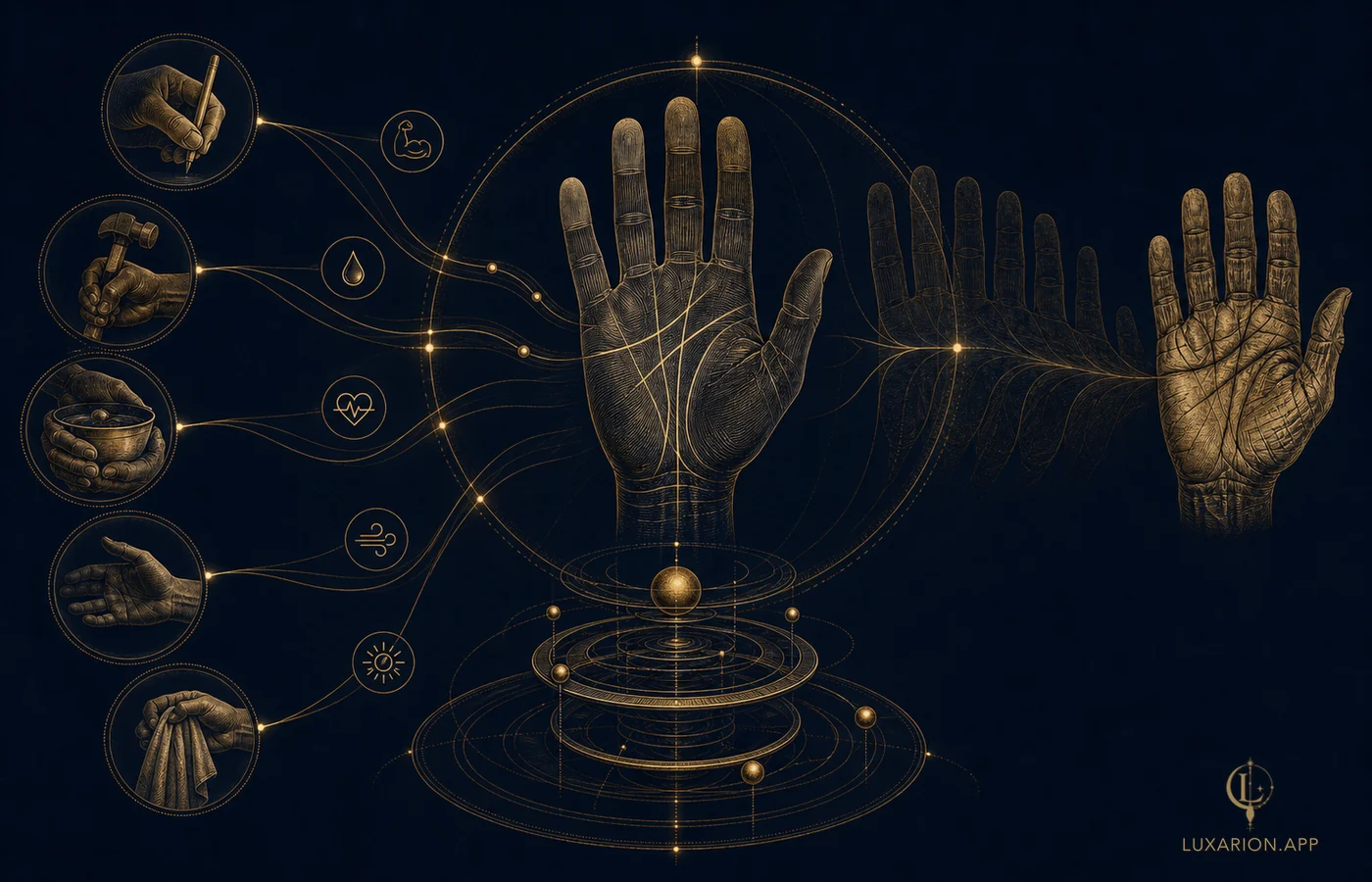
If lines move, the obvious next question is what moves them, and here the tradition and ordinary observation line up closely enough to be useful.
Use is the biggest factor. What a hand does daily for a year shows in that hand. This is why occupation reads so clearly and why a change of occupation is one of the more visible things in a palm.
Weight and condition matter. The flesh of the palm is the medium the lines sit in, and it changes with health, hydration, age and the season. Practitioners learn to discount the temporary and read the persistent, which is a skill and not a rule.
Tension shows. A hand held closed for months of a difficult period does not carry the same fine detail as the same hand held open. This is one of the more striking things to observe in yourself across a hard year.
Age deepens. Everything gets more legible with time, which is why the tradition considers a hand read at fifty to be a fuller document than the same hand at twenty — and why it treats a young hand with particular care, since so little of it has been written yet.
The timescales matter. Nothing here happens in a week. The craft speaks in seasons and years because that is the rate at which its subject actually changes, and a reader promising a visible difference by next month has stopped describing hands.
The two-hand rule
Traditional practice encodes the changing hand in a rule that beginners often treat as a formality and practitioners treat as the centre of the reading.
The passive hand — for most people, the non-dominant one, which is why handedness is the first thing a reader establishes — is read as what you arrived with. Inheritance, disposition, the starting conditions. The dominant hand is read as what you are doing with it: the hand that grips, works, gestures and revises.
And then comes the part that makes the rule worth having. The reading is in the gap between them.
Two hands that closely match are read as a life largely consistent with its starting conditions — not a criticism, and often a description of someone who found early what suited them. Two hands that diverge sharply are read as a life that has been substantially rebuilt, and the direction of the divergence is the interesting part: what got deeper, what faded, what appeared on the working hand that was never on the other one.
This is the heart of a reading: the distance between what you were given and what you have made of it, laid out in two hands on the table for both of you to see.
It is also the reason serious readers ask to see your hands again a year later. They are reading how the road has moved, and where it now leads.
The myth that will not die
Say it plainly, because practitioners of twenty and thirty years say it constantly and it never seems to reach the people who need it: the life line does not measure lifespan.
It never did. It is not what the line is for in any of the branches, in any of the periods, in any of the regions the craft passed through. The tradition reads it for vitality, for constitution, for the quality and continuity of your physical engagement with your own life. A break in it is read as a change of circumstance or of energy — a move, an illness recovered from, a period of a different pace — and a short line is read as intensity, not as a countdown.
The idea that it counts your years is a boardwalk invention, and it is the single most destructive thing attached to this craft, because it is the reason people arrive at a table frightened of their own hand. Every serious reader spends part of their working life undoing it.
Related and equally worth stating: the tradition does not diagnose illness and does not date a death. Those are not modern caveats added for safety. They are the craft's own boundaries, and a reader who crosses them has left the craft, not advanced within it.
What a hand carries
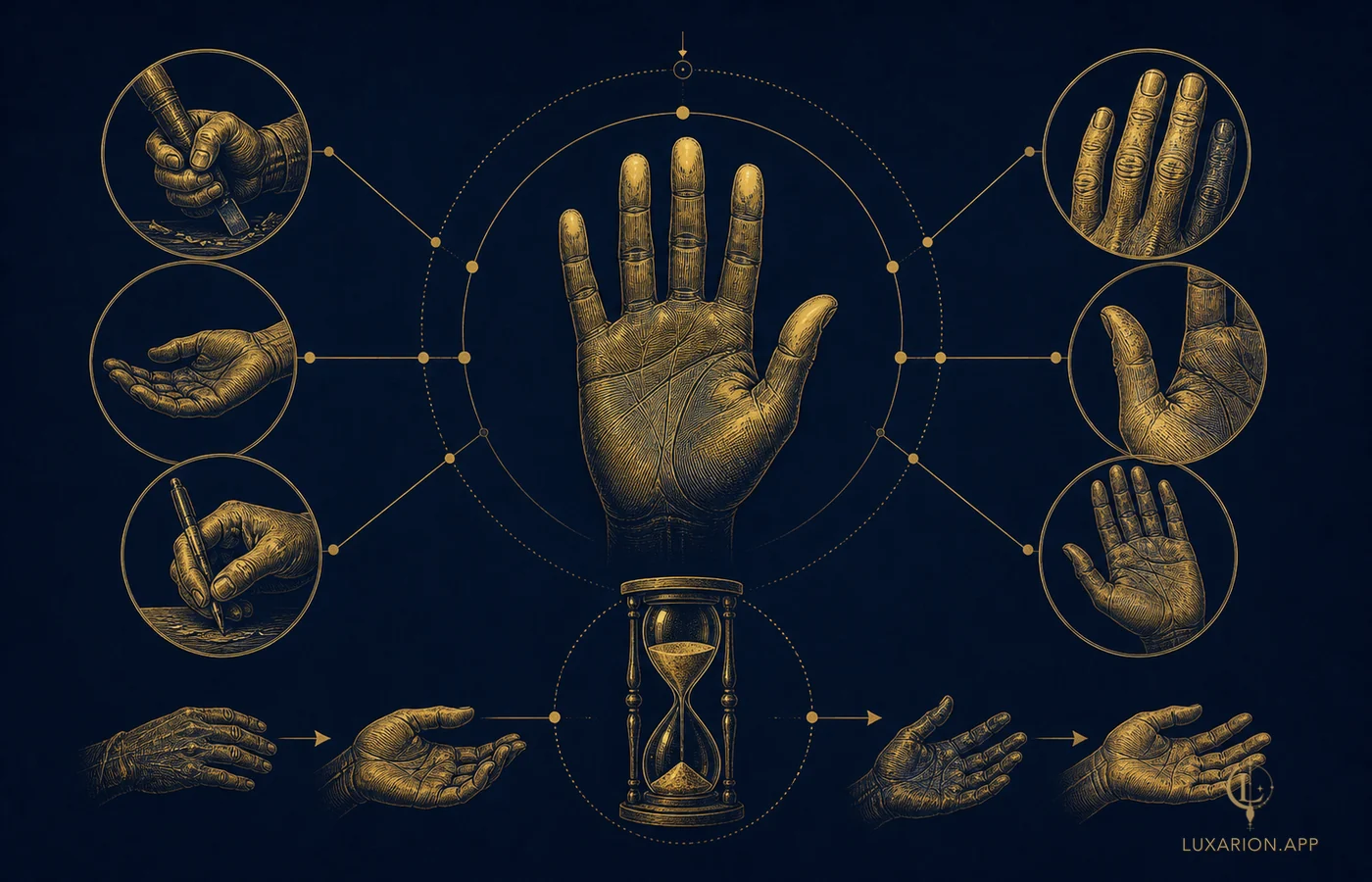
Here is what a practised reader sees in a hand.
Work. Hands carry occupation more legibly than almost anything else about a person. Grip, wear, the set of the fingers, where the skin has thickened.
Habit. How you hold tension. Whether the hand rests open or closed. Whether the thumb sits close to the palm or well away from it — the traditional reading of reserve and openness, and one that anyone can watch changing in themselves across a difficult season.
Time. The lines that have deepened and the ones that have gone faint — the road walked and the direction it is taking — which is why the same hand read five years apart gives a different reading, correctly and not inconsistently.
Bearing. A hand is offered, and how it is offered is information. The hand held out flat and the hand held half-curled are two different sentences, and both are readable before a single line is discussed. This is continuous with what body language and gesture record more generally, and practitioners have always attended to it.
The road ahead. The phase you are moving into, the change the lines are building toward, the attachment the heart line is carrying, and the strength you will meet it with. A hand is read forward as well as back.
None of this requires the practitioner to guess. It is present, visible and shared with the person whose hand it is — which is precisely why the tradition insists a reading be conducted with the hand in view of both parties rather than pronounced over it.
The questions a hand answers
People arrive at a palm reading with questions about what is coming, and a hand answers them in its own terms.
What people ask is almost always about the future: will this work out, when will it change, is this the right person. The hand answers in the language it carries — the phase you are in, the turning the lines are building toward, the attachment the heart line holds — and it answers best when the reader has first seen where you have been.
That is why a good reading moves between past and future in the same breath. What the last five years did to your hands shows the direction you are travelling, and the direction shows what is coming.
Readers see this constantly: a person told accurately where their hands have been hears, in the same sentence, where they are going.
This is why the most experienced practitioners read the road rather than a single event. A hand carries a direction, and a direction shows what lies ahead.
Why the reputation is what it is
It is worth being honest about where the craft's popular image came from, because the reputation and the practice are not the same thing and never were.
What most people picture is a specific nineteenth- and twentieth-century phenomenon: the fairground booth, the short reading given fast to a stranger for a small fee, the fixed script. That version optimised for spectacle, because spectacle was what it was selling. It produced the lifespan myth and the scripted fairground reading — neither of which comes from the older tradition.
The craft itself was always slower and deeper than that. It was taught hand to hand, over years, in the same way most traditional practices are transmitted. Its practitioners built up their eye by looking at thousands of palms, and its most valued readers were the ones who saw the most.
The gap between the two is roughly the gap between a street caricaturist and a portrait painter. Both are drawing faces. Only one of them is claiming to have looked at yours.
What a good reading actually sounds like
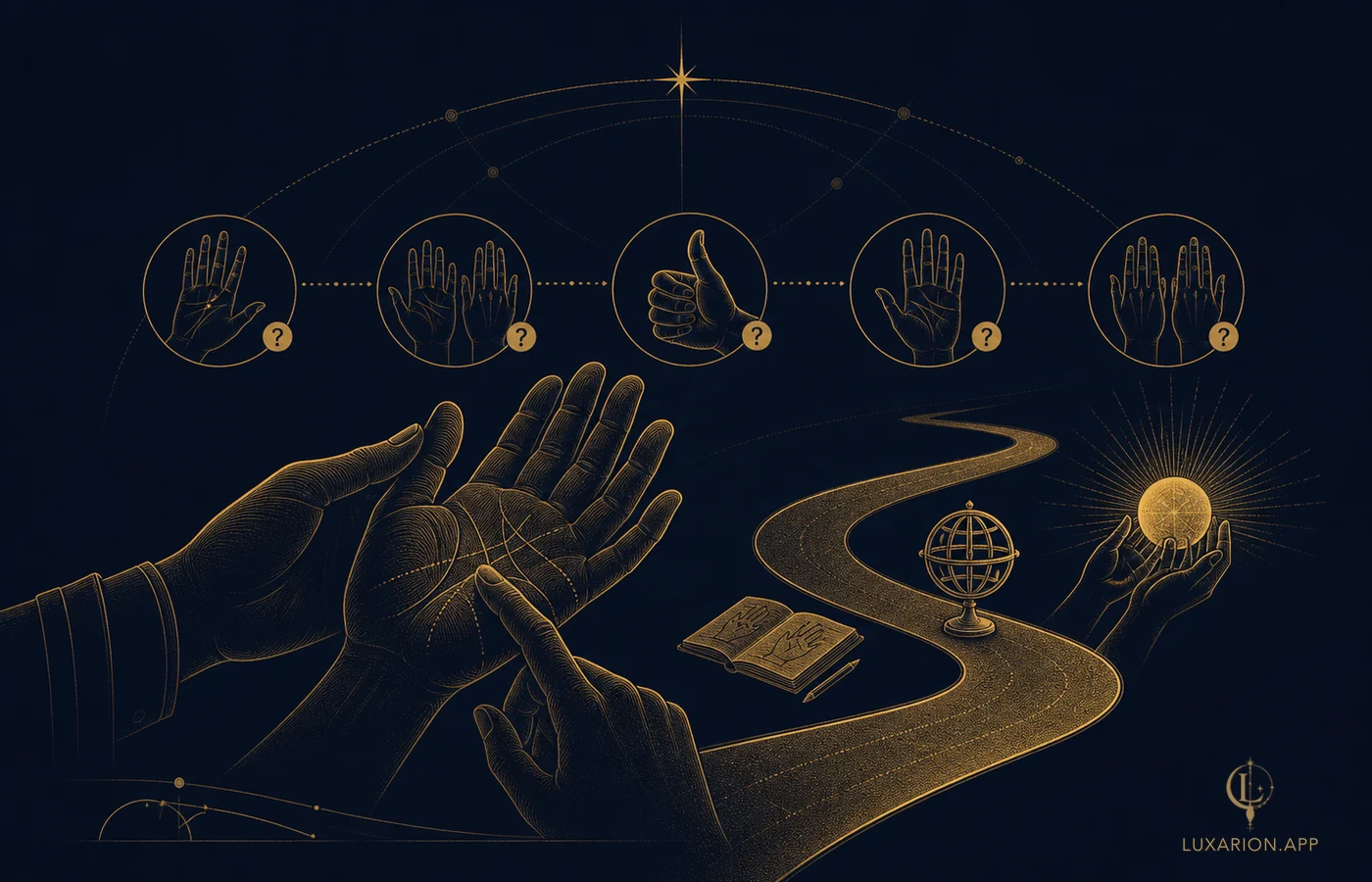
If you have never had one from a practitioner, it is worth knowing how different it is from the version in the popular imagination.
It is mostly questions. A reader who knows the craft will ask what you do with your hands, whether something changed in the last few years, whether you have always held your thumb like that. Not because they are fishing — because the hand raises specific questions and the answers narrow the reading.
It moves between the two hands constantly. Passive, dominant, back again. Any reading that only looks at one hand has skipped the mechanism that makes palmistry palmistry.
It speaks in phases and seasons. "This has deepened", "this is recent", "a change is building here, and it is close" are the natural sentences of the craft.
And it hands things back. The most common closing move in a good reading is to put the observation into your hands: here is what the two hands say about the distance you have travelled, here is the turning ahead, and here is what to do as you meet it. The choice you make with it is yours.
If you would like a reading conducted that way, that is what our palm reading is — the craft rather than the caricature, with both hands on the table.
Reading a hand across time
The most distinctive thing palmistry can do, and the thing almost nobody does with it, is longitudinal.
Photograph both palms. Flat light, no flash, both hands in the same frame, and write the date. Do it once. Then do it again in a year.
What that gives you is unavailable any other way: a record of your own hands at two points, read by the only person with full access to what happened in between. The changes are usually small and always specific — a line that thickened, a branch that appeared, a chain that smoothed out. Set against your own memory of that year, they become legible in a way no single reading can be.
This is the practice underneath the phrase in the title. A hand is read across the years because a life is: one reading shows the road at one hour, and two readings a year apart show which way it is going.
It is also how you watch a reading come true. You look, you write the date, and a year later the hand shows the road the reading saw. The tradition has been recommending exactly that for a very long time.
The etiquette
The craft's manners are old and consistent across the regions it travelled through, and they exist for reasons that become obvious the first time you sit at a table.
You read the hand that is offered. You do not read a child's hand for a verdict on their future. What is said over a hand stays between the two people looking at it.
And there is a rule specific to this craft: you never leave someone frightened of their own body. A hand is not a card that can be put back in the deck; the person takes it with them. Anything said about it needs to be something they can live alongside, and a practitioner who forgets that has done real harm with a small sentence.
This is also why the tradition does not chase drama. A reading that leaves someone watching their own palm anxiously has failed on the craft's own terms, regardless of how impressive it sounded at the time.
What the hand reads, and the lines the craft keeps
Knowing exactly what the craft reads is the thing that distinguishes four thousand years of practice from the version sold in a booth.
It does not diagnose, and it does not date a death. It does not read a fate that cannot move — the two-hand mechanism shows a road that moves with the life walking it.
What it reads is larger than the booth ever promised. The hand carries an accumulated record of a life and an indication of its shape ahead: the phase you are moving through, the transition the lines say is due, the strain gathering in one area of the life and the opening in another, and — where the two hands diverge — which of the roads in front of you the hand is already leaning toward. It reads the road and its turnings. And because a road can be walked deliberately, the reading is worth having before the turn rather than after it.
That is the tradition's teaching about the future, and it is a true one: not that the road is fixed, but that it is legible, and that a legible road can be walked deliberately. The specific marks a reader watches for a coming change — a branching line, a doubled line, a break that has begun to bridge — are set out in the complete guide.
It is also why the craft names a hard road with care. A road named is a road you can still choose about, while a doom pronounced closes the very thing the reading was for.
A hand still moving
Come back to the person staring at their hand as if it were a verdict.
What the tradition wants to say to them is that a verdict is issued once, by someone else, and never moves — and the striking thing about the palm is that it moves. The lines deepen and fade with the life lived in them; the road they show turns as the person walking it turns.
That is the observable life of hands, and it is what four thousand years of practitioners built their craft around: two hands, one showing where you began and one showing what you have done since, the whole reading living in the distance between them, and the road ahead written in where that distance is heading.
Which means the most accurate thing anyone can say about your palm is also the least frightening. It is not finished. It has never once been finished. The next page is legible from here — the phase you are entering, the crossing the lines have been building toward — and it is still yours to write, today, with whatever you did with your hands this morning.
The same craft applied to one subject in particular — what a hand records about how a person loves — is worked through in love in the hand.
If you would like both hands read that way — the road you have walked and the road ahead — that is what our readers do. You can book a palm reading.
The library teaches the craft. A reading applies it to you.
Get your personal reading