

Your Saturn Return Is Not One Date. It Is Usually Three

Saturn crosses its own birth degree up to three times before it settles. That is why the return feels like a season rather than a birthday.
Nearly everyone arrives at this subject with the same question: when is mine? And nearly every answer says "around twenty-nine" and moves on to what it means.
The reason the answer stays vague is that the full version is harder to say in one line. A Saturn return is not a date. It is usually three dates spread across about nine months, and where they fall depends on the minute you were born.
That is not a technicality. It is why people describe the return as a season they lived through rather than a day something happened, and why someone can tell you it "started last spring" and still be in it a year later. This article is the timing: what is actually returning, why there are three crossings, how to find your own, and what the window brings once you have it.
What is actually returning
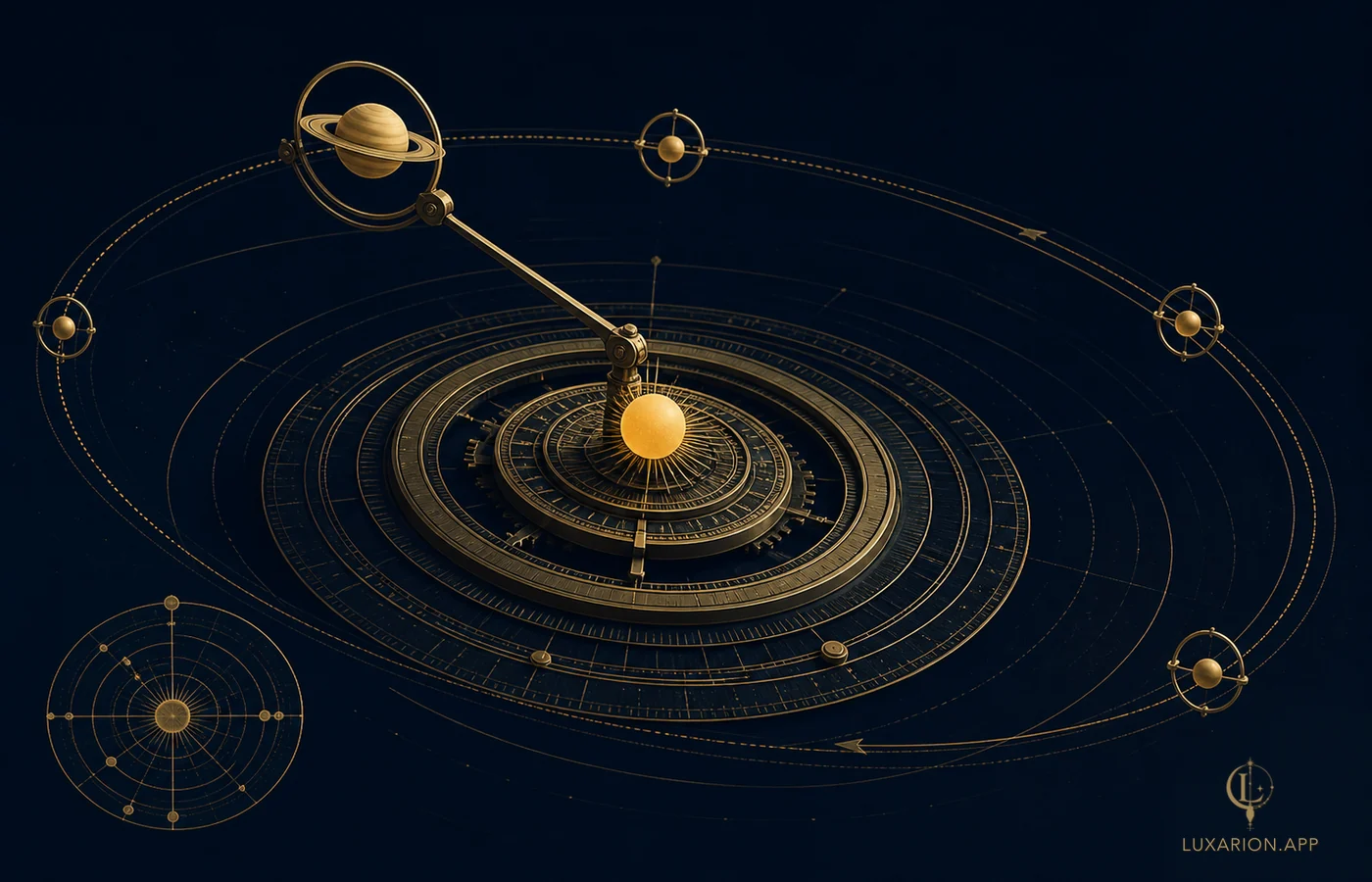
Saturn takes 29.4475 years to go once around the Sun. That single number generates the whole phenomenon.
At the moment you were born, Saturn stood at some precise degree of the zodiac — say the eleventh degree of Scorpio. It then set off on its orbit, and roughly twenty-nine and a half years later it arrived back at that same degree. That arrival is the return. There is nothing symbolic about the mechanism: it is a slow planet completing a lap.
The arithmetic gives the standard ages directly. First return at about 29½, second at about 59, third at about 88½ for those who reach it. The reason people quote "twenty-seven to thirty-one" as a range is not that the orbit is imprecise — it is measured to four decimal places — but that the crossings spread out, which is the next section.
Two things follow that are worth holding onto. Your Saturn return is yours: it depends on where Saturn was at your birth, not on your birthday, so two people born four months apart in the same year can have returns nearly a year apart. And it is computable exactly, which means "around twenty-nine" is an estimate you never have to settle for.
Why there are three crossings, not one
Here is the part that explains the whole texture of the experience, and it is astronomy rather than interpretation.
Saturn does not appear to move steadily from Earth. Roughly once a year — every 378 days, its synodic cycle — Earth overtakes Saturn on the inside track, and for several months Saturn appears to stop, travel backwards against the stars, stop again, and resume. This is apparent retrograde motion: nothing reverses, we simply pass it, the way a slower car seems to drift backwards when you overtake.
Now put that together with a planet arriving at a particular degree. If Saturn reaches your birth degree shortly before one of these retrograde periods, the sequence is:
- First crossing — Saturn moves forward over the degree.
- Second crossing — Saturn turns retrograde and passes back over it.
- Third crossing — Saturn turns direct again and crosses a final time.
The three passes typically span somewhere around nine months to a year. If Saturn happens to reach the degree well clear of a retrograde, you get a single clean crossing instead — which is why some people describe a short sharp return and others describe a year and a half of it.
This is the single most useful thing to know about the timing, because it reframes the question. "When is my Saturn return" has a first answer, a middle, and a last — and practitioners generally treat the final crossing as the one that settles things, not the first.
Working out your own window
You need two things: where Saturn was when you were born, and where it is now.
Start with your natal Saturn. It comes out of a birth chart — sign and degree. Saturn is slow, so unlike the rising sign it does not need your birth time to the minute; the date and place will place it accurately enough for this purpose, and a birth time only refines which house it sits in. Luxarion's free birth chart calculator returns it with the rest of the placements.
Then add about twenty-nine and a half years to your birth date. That lands you inside the window. Anyone born in the first half of a year will usually find the first crossing arriving in the second half of their twenty-ninth year.
Then look for the retrograde. If Saturn's retrograde period that year covers your natal degree, you are in a three-pass return and the whole thing will run the better part of a year. If not, it is one crossing.
A worked shape, to make it concrete rather than abstract. Someone born with Saturn at 11° Scorpio in early 1996 has Saturn returning to 11° Scorpio in the second half of 2025. If Saturn's retrograde that year sweeps back across 11°, they get a crossing in mid-2025, a second a few months later, and a third in early 2026 — one return, three dates, roughly nine months from first to last.
Where it lands is the part nobody mentions
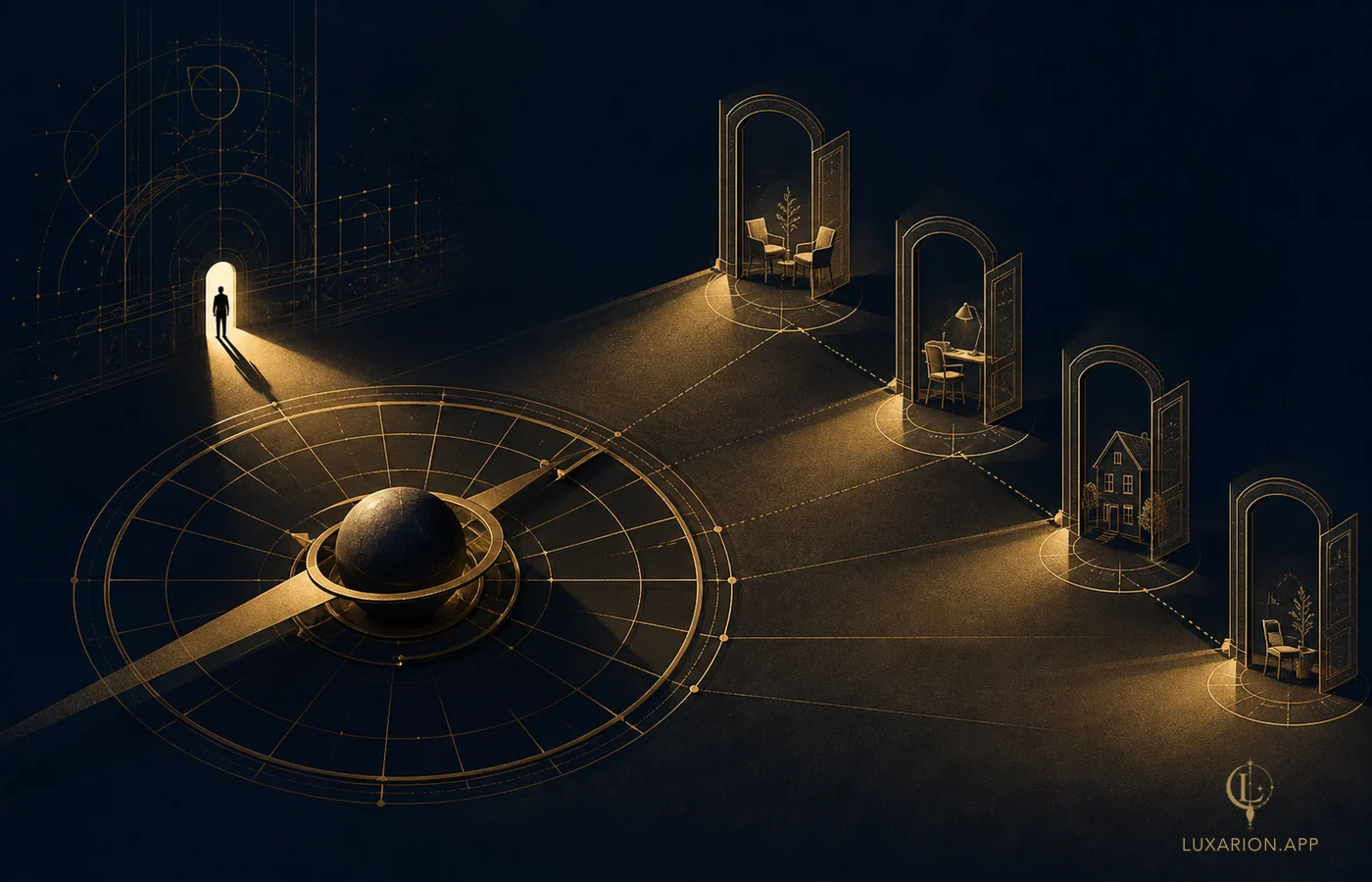
Almost every article about the Saturn return describes it as a single generic experience: the late-twenties reckoning, the job you quit, the relationship that ends. That description is doing something the tradition does not do — it is reading the transit without reading the chart.
In practice the same transit is read very differently depending on which house your natal Saturn occupies, because the houses are the departments of a life. A Saturn return in the house of work is a reckoning about vocation. The same return in the house of home is one about where and how you live. Same planet, same age, different subject.
The sign matters too, but less than people assume, because everyone born within roughly two and a half years of you shares it. The house is the part that is closer to being yours, and it is the reason a generic Saturn-return description can feel both accurate and beside the point at once: it is describing the transit and not the chart.
Getting the house right is the one place the birth time earns its keep here. Without it you still know your Saturn's sign and degree, and therefore your dates; you just do not know which department of life it falls on.
The second and third returns
The second return arrives at about fifty-nine, and it is read quite differently — not as an initiation into adult responsibility but as an audit of what was built with it. The third, near eighty-eight, is rarer in the literature simply because fewer charts are read at that age.
Worth noting for anyone in their late fifties who arrived here looking for the twenty-nine-year-old's article: the second return is the same mechanism, same three-crossing structure, and the same dependence on which house it falls in. What changes is what a person has to audit.
What Saturn brings
Everything above is measurement — orbital period, retrograde geometry, degrees. This section is the reading: what Saturn signifies, and what its return brings.
Saturn has a consistent character, older than astrology's modern vocabulary. The planet carries the name of Kronos in Greek and Saturn in Latin — a figure of time, harvest and limit, whose festival, Saturnalia, inverted the ordinary order for a few days each winter. Ptolemy treats Saturn as the slowest and heaviest of the visible planets, and it is the principle of structure: what endures, what costs, what will not be hurried.
Read that way, a Saturn return is not a punishment and not a crisis. It is the moment the structure you have been building gets tested against what you actually want it to hold. Commitments made lightly at twenty-two tend to come up for renewal. So do the ones made seriously. And it is read for events as well: what ends, what is built, what is delayed and then granted, according to the house the return falls in and the condition of Saturn in your chart.
Plenty of people meet the same reckoning without ever having heard of Saturn; the transit does not wait to be believed in. What the chart adds is the timetable and the subject: when the three crossings fall, which house they test, and what the condition of your Saturn says about how the test resolves.
What to do with the window once you have it
The most common mistake is to treat the dates as a countdown to something that will happen to you. The more useful move is the opposite.
Write down what you would not sign up for again. Practitioners will tell you the return rarely introduces a new problem; it brings an old arrangement to a decision point. Knowing in advance which arrangements those are is most of the work.
Expect the first crossing to raise the question and the last to answer it. If you are in a three-pass return, the middle months are famously unresolved. That is the shape of the transit, not a sign you are handling it badly.
Do not make the deadline the point. A decision forced to fit inside a date is a worse decision. The window is a season to act in, not an expiry.
And the dates matter: decisions taken with the season — opened by its first crossing and settled by its last — hold better than the same decisions forced against it.
Common questions
What age exactly? First return between about twenty-eight and thirty-one, centred on twenty-nine and a half. The spread comes from the three crossings, not from imprecision in the orbit.
Do I need my birth time? Not for the dates. Saturn moves slowly enough that date and place fix its sign and degree. The birth time tells you which house it falls in, which is what makes the reading specific rather than generic.
Why does mine seem to have started early? Because the first crossing can arrive a year before the last. If Saturn reached your degree just before a retrograde, the opening pass can land at twenty-eight.
Is a Saturn return always difficult? No. Saturn tests, and what it finds sound it rewards: people who spent their twenties building something arrive at the return and find it holds, and a Saturn well placed in the chart brings standing, property and lasting commitments in its season. The reckoning is hardest where the structure was borrowed.
What is the difference between my Saturn return and my Saturn sign? The sign is where Saturn stood at birth, fixed for life. The return is an event: Saturn arriving back at that spot. Everyone with your Saturn sign shares it; almost nobody shares your exact dates.
Can I see it in my chart myself? Yes — find Saturn's sign and degree in your birth chart, then look up when Saturn next occupies that degree. That is the whole calculation.
Getting your dates
Start with the chart, because everything here depends on one number: the degree Saturn occupied when you were born. Luxarion's birth chart calculator is free and returns it along with the sign and, if you have a birth time, the house it falls in — which is what turns a generic Saturn-return description into one about your life rather than everyone's.
If you would rather have the window read than calculated, a natal chart reading works from the same figures and takes the house and the aspects into account. And if you want to know what else in the chart shapes a return, the piece on what a birth chart actually contains is the natural next step.
The library teaches the craft. A reading applies it to you.
Get your personal reading