

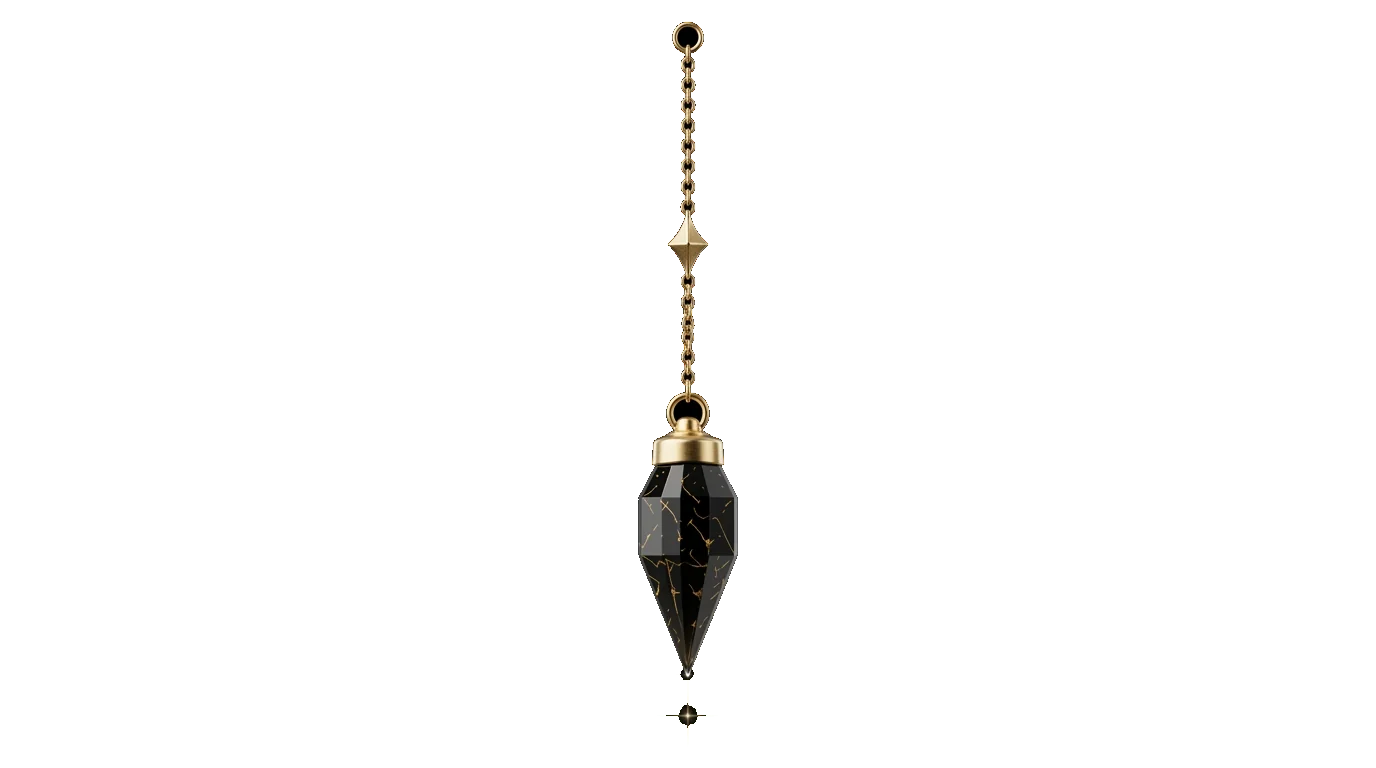
How to Ask a Pendulum a Question That It Can Actually Answer
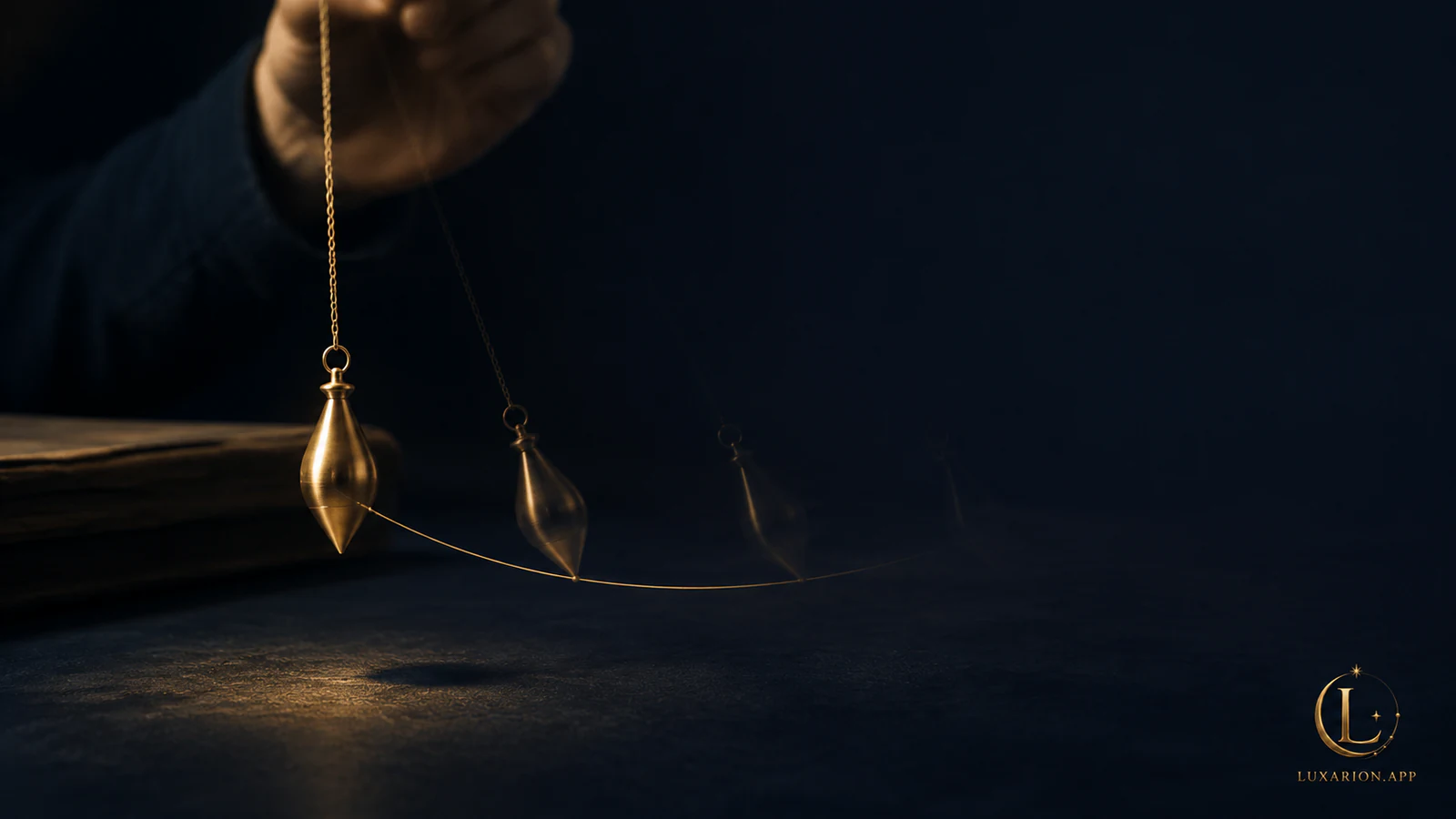
The weight begins to swing and the question is answering. How to set your own yes and no, build a question one swing can carry, and read the stall.
There is a moment, usually about ninety seconds into a first session, that decides whether someone keeps a pendulum or puts it in a drawer. The weight has begun to move. It is describing a small, unmistakable circle. And the person holding it thinks: I am doing that.
Almost everything written about pendulums either argues that thought away or makes it the whole explanation. Practitioners do neither. The hand is the route the answer travels, and a practice that knows its route is steadier, more useful and considerably harder to fool than one that pretends the thought never arrives.
This article is the working method: what the object is, where the movement comes from, how to set your own answers, how to build a question that a single swing can carry, and — the part that separates a practised hand from a beginner — how to read the answer that is neither yes nor no.
The object, before anything else
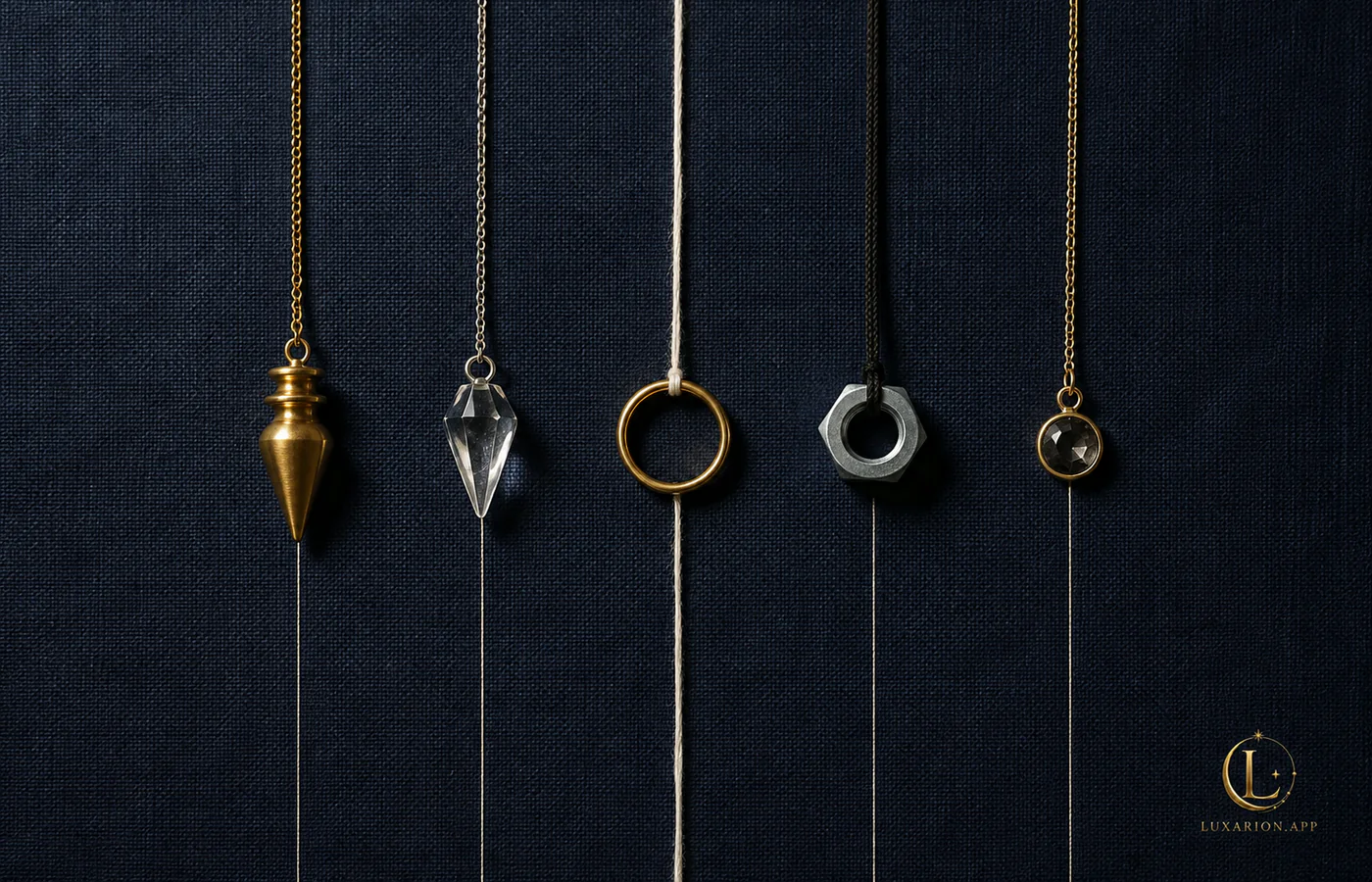
Physically, a pendulum is a weight on a line held from a fixed point, and nothing about its making needs to be expensive. What makes it an instrument of discernment is the one holding it and the question put to it — which is why a plain weight in a practised hand answers better than a costly crystal in a hurried one.
The physics is the ordinary pendulum of a school laboratory: a suspended mass swings at a period set almost entirely by the length of its line. Shorten the line and the swing quickens; lengthen it and the swing slows and grows. This matters for one practical reason. A very short line gives a twitchy, ambiguous movement that is hard to read. A very long one takes so long to build that you lose the thread of the question. Somewhere between eight and fifteen centimetres of free line is where most people find the instrument becomes legible, and finding your own number is the first thing to do.
The material is a genuine choice. A brass cone, a faceted crystal, a ring on a thread, a heavy pendant you already wear — all of them can serve, and practitioners who work with stones choose the stone for its own properties as well as for its weight. What also differs is how it feels to hold, and that is not a trivial consideration: an object you like handling is an object you will actually use, and consistency of use is what makes a pendulum reliable. Practitioners who have kept one for years almost always keep the same one, and the reason they give is that the two have become attuned: the hand has learned the instrument, and the instrument has taken the hand.
Weight matters more than material. Too light and it drifts on the air of a room; too heavy and small movements never get started. Twenty to forty grams is a broad, forgiving range.
Where the movement comes from
Here is the answer to the question that sent you looking, from both sides of it.
The physical route is the hand. The swing is carried by minute, involuntary movements of your own hand, which science calls the ideomotor response. Michel-Eugene Chevreul, the chemist, described it carefully in 1833 after working with a pendulum himself; Michael Faraday demonstrated the same mechanism twenty years later in the parlours of Victorian London. Muscles act on something held in attention, below the level at which you notice yourself acting.
Read that as a deflation and you will put the pendulum in the drawer. Read it accurately and it says something the traditions always knew: what moves the weight moves before you can put it into words. That is the same channel by which a skilled surgeon's hands know a complication before the mind names it, and by which you flinch from a car you have not consciously seen.
The pendulum lengthens that movement into a swing you cannot miss, and makes legible what could not yet be said.
And that is not the whole of it. A still mind and a clear question open the channel wider than the asker's own knowledge: what answers is not only what the hand already held, and practitioners who have kept records for years find answers there that no one at the table knew. The ideomotor account describes the route the answer travels; it does not reach where the answer comes from, and no measurement of hand tremor could. What follows from the practitioner's reading is the instruction that makes the instrument work: a calm state, a clean question, and no wish pressing on the weight.
This is also why the technique that follows is not decoration. If the instrument reports at that level, then everything depends on the state you are in when you ask. A question you have not made honest will get an honest answer to a question you did not mean. That is the entire discipline.
Setting your own yes and no
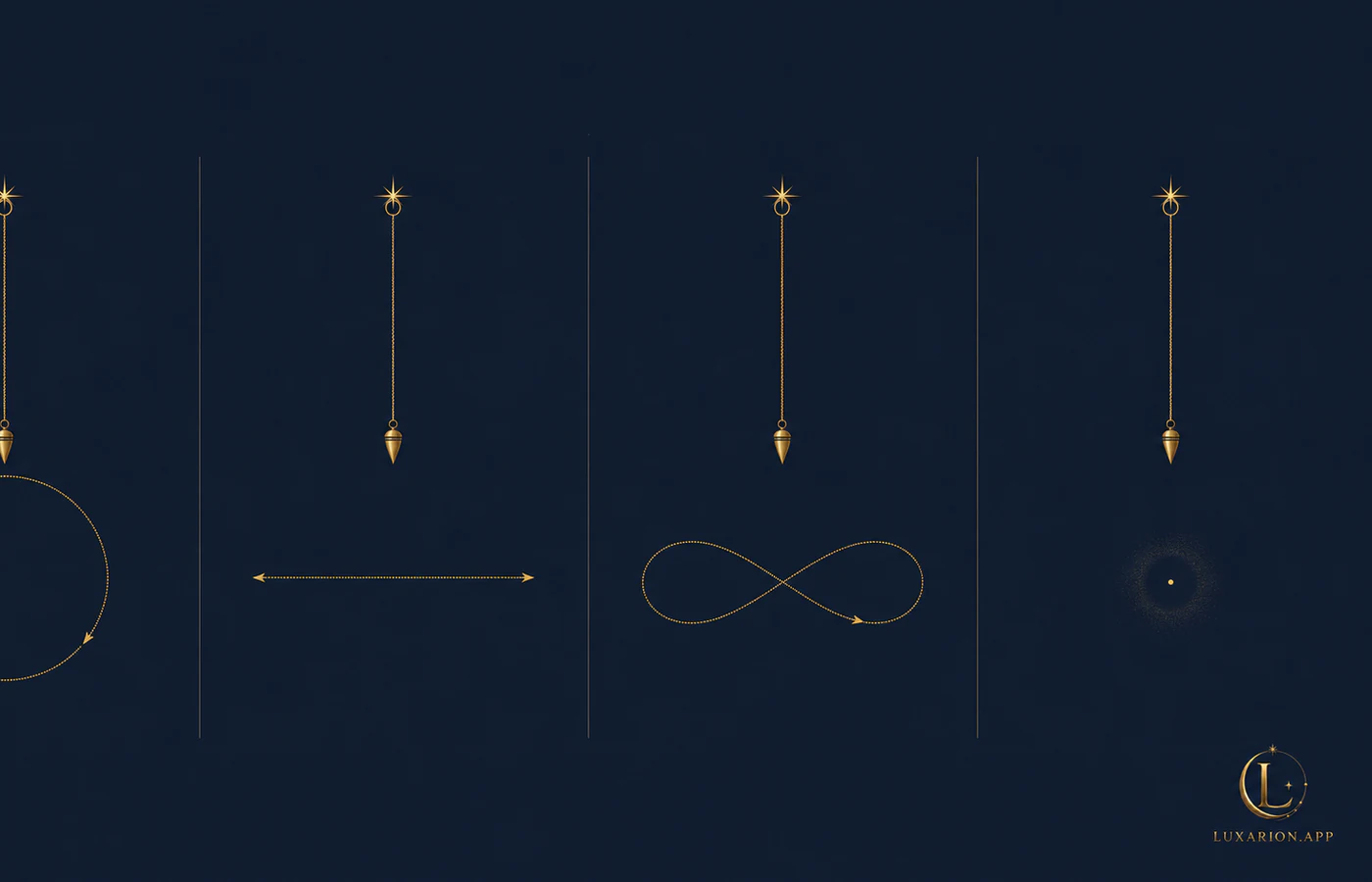
Nobody else's directions apply to you. Clockwise means yes for one person and nothing at all for the next. The first session is spent finding out what your own hand does, and it is worth doing slowly, once, properly.
Sit with both feet on the floor and your forearm supported — the edge of a table, your own knee. An unsupported arm tires within a minute and tremor starts reporting fatigue instead of anything else. Hold the line between thumb and forefinger, let the weight hang still, and wait until it is genuinely still. Rushing this single step is the commonest fault of beginners.
Then, three calibrations, in this order:
- Show me yes. Say it aloud or hold it clearly, and wait — for up to a minute if necessary. Something will begin: a line, a circle, a diagonal. Note it exactly, including the direction of rotation.
- Show me no. Still the weight with your free hand first, always. Wait again. It should be a distinctly different movement — most people get a straight line against a circle, or two perpendicular lines.
- Show me that I should not ask this. This third calibration is the one nearly every guide omits, and the one that makes the instrument trustworthy. Set a signal for no answer available. A stall, a jitter, a small chaotic wobble, a slow drift with no shape.
Now verify, because a calibration you have not tested is a guess. Ask three questions whose answers are already certain and unambiguous — your own name, the city you are in, whether it is currently daylight. All three must come back correctly. If they do not, your line is the wrong length, your arm is unsupported, or you are tired. Adjust and repeat. This costs two minutes and it is the difference between a practice and a party trick.
Repeat the whole calibration at the start of every session for the first month. After that most people find their signals have set and a single verification question is enough.
The fourth answer, and why it matters most
A pendulum that can only say yes or no is an instrument that must answer everything, and an instrument that must answer everything is an instrument that will answer badly.
The stall — the wobble, the drift, the refusal to commit — is not a malfunction. In practice it appears reliably in four situations, and learning to recognise which one you are in is most of the craft.
The question has two questions inside it. "Should I take the job in Lyon?" contains a question about the work, a question about the city, and a question about leaving. Your hand cannot answer three things with one swing, so it answers nothing. Split it and the swing returns immediately.
The question is not framed for one swing. "Does he still think about me?" asks about another person's heart in a form a single swing cannot hold: thinking of someone is a matter of degree, and a yes or a no to it tells you little. Ask what one swing can carry — "Is he still open to hearing from me this month?" — and the swing returns. For the heart itself, a love reading reads the bond at a depth one swing cannot reach.
You already know. A stall arrives surprisingly often on questions where the asker's mind is entirely made up and is seeking permission rather than information. The wobble is worth sitting with for a moment before rephrasing.
The situation is not yet decided. Some questions have no answer at the time they are asked because the material has not arrived. A stall here is accurate reporting, not failure.
A reader who has never set up a fourth answer will get a yes or a no in all four of those cases, and it will mean nothing. This is the single largest source of pendulum answers that turn out to be worthless, and it is entirely preventable.
Building a question the swing can carry
The constraint is severe and it is the whole design problem: you have one bit of information to work with. Everything about a good pendulum question follows from spending that bit well.
One clause. If the sentence contains "and", "or", or a comma joining two ideas, it is two questions. Split it.
Bounded in time. "Will I move house?" has no answer, because the honest answer is "eventually, probably". "Will I move house before next spring?" has one.
Closest to what you can act on. "Should I send the message today?" and "Will she reply this week?" can both be asked, and the first is the one you can act on. A question about what others will do needs its own time bound and is read as what is approaching; a question about your own action is read as the strongest path.
Free of the answer you want. Compare "This is the right flat, isn't it?" with "Is this flat the right one for me to take?" The first is a request for agreement dressed as a question, and it will get agreement.
Asked once. Asking the same question repeatedly until the swing changes is the most common way people ruin their own practice. The second answer is not more accurate; it is the first answer plus your dissatisfaction with it. Ask once. If you want another angle, change the question rather than repeating it.
A working example of the whole progression. Someone starts with: Should I leave my job? Too large — it contains money, meaning, timing and courage. Second attempt: Should I leave my job this year? Better, still compound. Third: Is it right for me to hand in notice before December? That is a question a single swing can carry, and if it comes back yes, the follow-up is not another pendulum question but a calendar.
A session, from start to finish

Ten minutes, and it is worth keeping the shape even when you are practised, because the shape is what stops a session drifting into asking twenty things badly.
Sit somewhere you will not be interrupted, with the phone face down. Write the question on paper before you pick up the pendulum — this alone eliminates about half of all badly formed questions, because a vague sentence looks vague in your own handwriting in a way it does not sound vague in your head.
Calibrate: yes, no, stall, and one verification question you know the answer to.
Still the weight. Read your written question aloud, once. Then stop talking and stop deciding, and let your hand go quiet. The waiting is the part beginners skip; a swing that takes forty seconds to arrive is not a slow answer, it is an answer that had to get past your preferences to reach you.
Read what happens. Write it down — the movement, the time it took, and one line about how the answer landed in you. That last note is worth more over six months than the answers themselves.
Then stop. One question per session is not a limitation; it is what keeps each question serious. A session of fifteen questions is a session in which no question was really asked.
One evening, written down
An example of what a page of the record actually looks like, because "keep a notebook" is advice everyone gives and nobody demonstrates.
Tuesday, 21:40. Line at eleven centimetres, arm on the table. Yes clockwise, no side to side, stall a small figure of eight. Verification: is it Tuesday — clockwise, three seconds. Good.
Question, written first: is it right for me to say yes to the freelance contract before the end of the month?
Nothing for about twenty seconds. Then the figure of eight, clearly. Stall.
Re-read the question and found two in it: whether to take the work at all, and whether to commit this month. Split them. Second question: is it right for me to take this contract? Clockwise almost at once. Third question, next evening: is it right to commit before the end of the month? Side to side, slowly.
That is a complete and genuinely useful result: yes to the work, no to the deadline the client had set. Neither answer would have arrived from the first question, which was the one that felt most natural to ask.
Where the practice comes from
Suspending a weight to settle a question is old, widespread, and considerably more respectable than its current reputation suggests.
The broad family is dowsing — the forked rod for water, the swinging weight for everything else — attested across Europe from at least the sixteenth century in the search for ore and springs, and practised without interruption since. Beneath it sits a much older idea, the casting of lots, which appears in nearly every literate tradition on earth as a way of putting a decision beyond the reach of the person making it. The I Ching is a binary oracle of exactly this kind, three thousand years old, built entirely on repeated yes-and-no throws.
What these share is not a theory. It is a shape: a person with a decision, a device that will not argue, and a rule agreed in advance about what the device's behaviour will be taken to mean. The agreement in advance is the technical heart of the whole family, which is why the calibration step above is not preliminary to the practice — it is the practice.
The pendulum's twentieth-century revival gave it a French vocabulary and a French lineage; readers of that tradition will know the word for it and the drop-shaped brass weight that still carries a Savoyard priest's name.
When the answer is one you did not want

This is the situation the instrument exists for, and it deserves better than the advice to "trust the pendulum".
Notice, first, what happened in your chest when the swing settled. Relief and disappointment are both information, and they arrive faster than thought. A no that produces relief has told you something the yes would have hidden. Practitioners will tell you this is often the most valuable second in the whole session.
Then do not re-ask. Write down the answer and the reaction, put the pendulum away, and come back tomorrow. If the question still matters in the morning, ask a different question — usually the one underneath the first, which the reaction has just revealed.
And know the instrument's measure. A pendulum answers in one bit, and some questions deserve more. Grief, the heart of another person, money you cannot afford to lose, a decision you will not be able to reverse — these want a full reading that can see the whole situation, what is moving in it and where it is heading. Questions about the body belong with a physician. Knowing which instrument a question needs is itself a skill.
Common questions
Does the material matter? Not to the mechanism. It matters to your comfort and consistency, which matter a great deal. Choose something you like holding and then stop changing it.
Can I use one for someone else? Practitioners do, and it asks more of the one holding it: the question must be clean, the person held clearly in mind, and your own wishes for them set aside. It is where beginners produce their most confident and least reliable answers, so learn the instrument on your own questions first.
Why did I get different answers on different days? Most often the line length changed, the arm was unsupported, or the question was phrased differently and you did not notice. Keep a written record and the pattern usually shows itself within a fortnight.
Do I need to cleanse it? Practitioners clear an instrument before first use and after heavy questions — with running water, smoke or moonlight, as the material allows — and many say the name of God over it before they begin. The pause itself also works: a small rite before a session marks the boundary between ordinary attention and the deliberate kind.
Should I ask about medical or legal matters? Matters of the body belong with a physician, and the house does not pronounce on them. A legal matter has too many parts for one swing: split out what you can act on, and put the whole of it to a full reading, and to a lawyer where the stakes call for one.
How long until I trust it? Most people need about three weeks of one question a day, with written records. The trust comes from the record, not from the sensation.
What if nothing moves at all? Check the line length first, then the arm support, then whether you are asking something you genuinely want an answer to. Stillness with a real question is rare; stillness with a question you are not invested in is ordinary.
Asking one properly
If you have a question already shaped — one clause, bounded in time, about something you can act on — you can put it to Luxarion's pendulum now. It returns a yes or a no and a sentence about why: the reading that makes an answer usable rather than merely received.
If the question turned out to have three questions inside it — and most of the good ones do — then the swing was never the right instrument. A spiritual reading is built for exactly that case: a reading that sees the whole situation, what is at work in it, what is approaching and the strongest path through it. For a decision you have already circled for weeks, the piece on deciding when you cannot know takes up the same problem from a much older direction, and the article on intuition is the natural companion to everything above about what your hands know before you do.
Whatever you use, keep the record. The answers carry their own weight on the evening they come, and the notebook after three months shows you something more: how often the swing was right before you were.
The library teaches the craft. A reading applies it to you.
Get your personal reading