


The Quiet Sense: What Intuition Is, and When to Trust It

The inner sight the traditions call firāsa, what the modern study of expertise sees of it, and the old test for when the quiet sense speaks true.
You have felt it: the certainty that arrives before the reasons do. A name you should not trust. A room you want to leave. A decision your body has already made while your mind is still assembling arguments.
Every reading tradition works with this faculty, and every one teaches its discipline — because the quiet sense is real, it can be trained, and it can be clouded.
This article is about that discipline: what intuition is in the traditions that have always worked with it, when it speaks true and when it is clouded, what the modern study of expertise has found about one of the routes it travels, and what to do when you carry a strong sense and cannot yet see where it leads.
The inner sight, and one of its routes
The traditions that read have always named this faculty. In the Islamic tradition it is firāsa, the perceptiveness of the heart — "beware the firāsa of the believer, for he sees with the light of God" runs the saying the classical writers quote — and beyond it kashf, the uncovering of what is hidden. The Sufis distinguish ilhām, the inspiration that settles the heart, from waswasa, the whisper that agitates it. Christian discernment speaks of the promptings of the spirit, and the reading crafts of the reader's gift. Each treats the quiet sense as a true perception of what is there.
Modern research has studied one route this sense travels. Gary Klein spent his career studying firefighters and nurses — people who make life-and-death calls in seconds — and found recognition: thousands of stored patterns firing faster than conscious thought, matching the present moment against something already lived. His model of recognition-primed decision making describes the expert who does not compare options but recognises a situation, and the right response arrives with it.
The firefighter who orders everyone out of a building "for no reason" seconds before the floor collapses has read the heat, the sound, the wrongness. The sense is quiet because the work happened below the waterline of attention — what Michael Polanyi meant by tacit knowledge: we know more than we can tell.
That route is why the faculty grows with practice — one card, one cup, one dream, one conversation at a time; the research on expertise says the expert sees the pattern where the novice sees the parts. It is not the whole of the quiet sense. The traditions know the sight that arrives about a matter the person has no pattern for at all, and the recognition account describes one road the signal travels without claiming it is the only one.
The modern test for learned recognition
For the part of the quiet sense that is learned recognition, the laboratories supply a test worth keeping at the front of the mind.
Klein spent years in a famous and productive disagreement with Daniel Kahneman — the psychologist who catalogued the mind's systematic errors and the heuristics behind them. In 2009 the two published a joint paper agreeing on exactly when intuition can be trusted, and their answer is a two-part test.
First, the environment must be regular enough that valid patterns exist to be learned. Chess qualifies. Firefighting qualifies. Predicting the stock market does not — not because the people are less able, but because the regularities they would need are not there to be learned.
Second, the person must have had the chance to learn those patterns through prolonged practice with clear feedback. Hours alone are not enough; you need to find out, reliably and reasonably soon, whether you were right.
Where both conditions hold, trust the learned hunch. Where either fails, the confident feeling is not expertise but a bias wearing expertise's clothes — and the confidence itself tells you nothing, because certainty feels identical in both cases.
That last point is the whole difficulty, and the traditions name it too: the heart's certainty and the self's certainty feel alike from inside. Both the laboratory and the lineages apply their test from outside the feeling.
Two systems, and why the fast one is not the enemy
A great deal of popular writing has flattened this subject into a fight between a fast, error-prone mind and a slow, sensible one. It is worth correcting, because the flattened version leads people to the wrong conclusion.
The two-system picture — a fast, automatic mode and a slow, deliberate one — is a useful sketch and both of the researchers above worked within it. But the fast mode is not a defect. It is where nearly all competence lives. A surgeon who had to reason consciously through every movement would be a danger; a reader who had to look up every card would produce nothing usable.
What the research actually says is narrower and more interesting: the fast system is superb in environments it has been trained on and confidently wrong in environments it has not, and it does not signal the difference. The problem is not speed. The problem is that speed feels the same in both cases.
This matters for how you treat your own hunches. The instruction is not to distrust the fast response — that would discard the thing you have spent years building. It is to know which rooms your fast response has actually lived in.
Practitioners in every craft describe the same maturation: early on you are told to slow down and check everything, and later you are told to stop second-guessing what you have genuinely learned. Both instructions are correct, at different points, and telling them apart is a large part of what a teacher is for.
What the traditions knew first
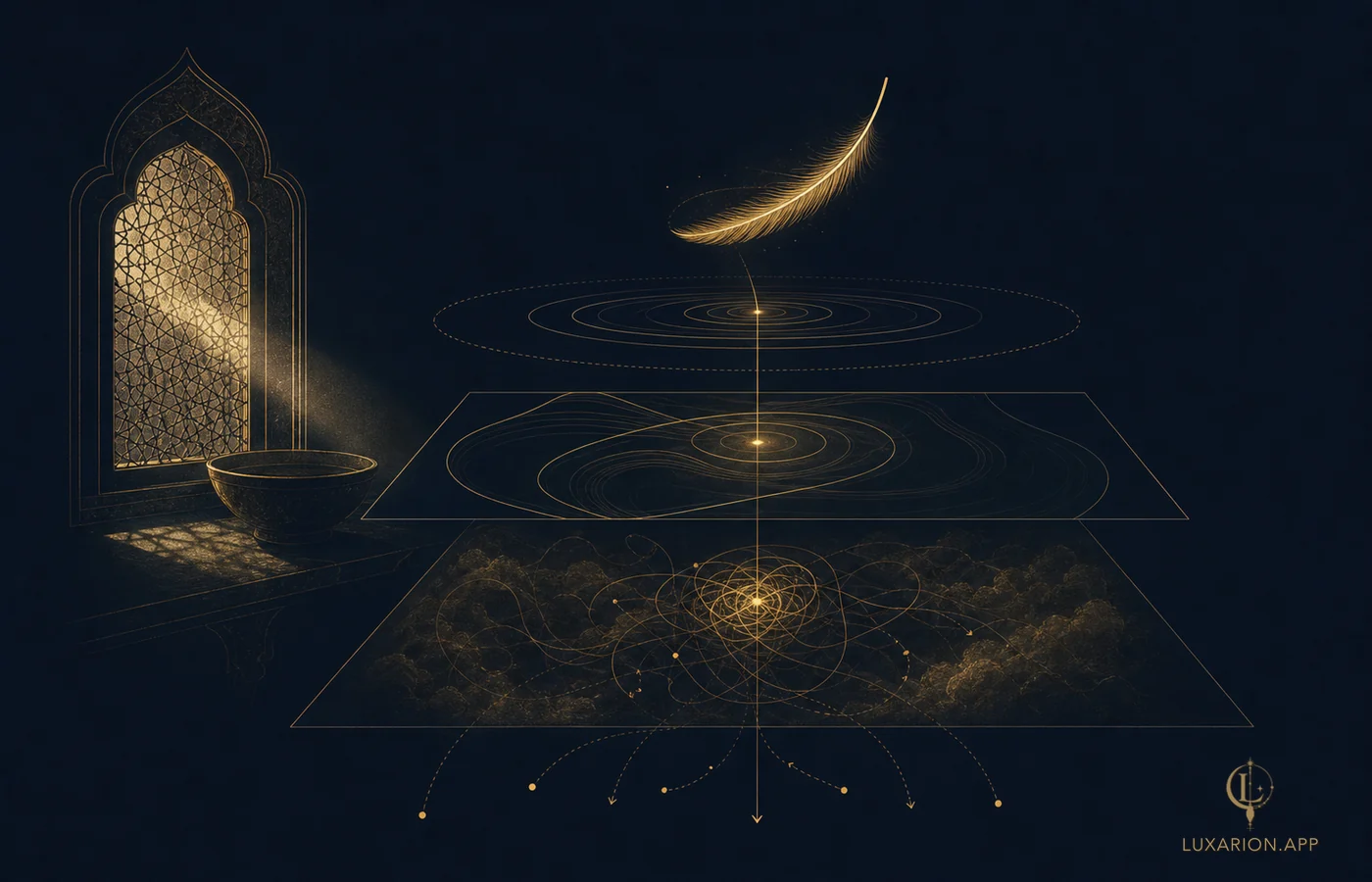
The contemplative crafts taught this discipline long before the laboratories, as the discipline of the heart.
Every serious lineage distinguishes the true prompting from the anxious one, and the test is remarkably consistent across traditions: the trustworthy sense is calm. It arrives quietly and does not need to shout you into agreement. The fearful certainty, the one that demands you act now, is the one the traditions teach you to distrust — the agitation the Sufis call waswasa — because anxiety is very good at producing the feeling of knowing.
In the Islamic tradition the faculty of reading a situation truly is firāsa, and the classical writers — al-Ghazālī among them — tie it directly to the state of the one perceiving: a polished heart reflects what is there, and a clouded heart perceives clouds. Ibn ʿArabī treats the same faculty as something disciplined rather than spontaneous.
Istikhāra is worth naming here because it is the clearest procedural form of the same teaching: you do not act on the first impulse, you place the question before God, you wait, and you watch how things settle. The waiting is not deference. It is how the answer shows itself.
Christian discernment traditions built the same test into a method — Ignatius distinguishing consolation from desolation, the Quaker practice of waiting in silence until a sense is settled rather than merely strong. Different vocabularies, one finding: the quality that makes a prompting trustworthy is not its intensity.
Where the two accounts meet
Put the traditions and the modern study side by side and the overlap in practice is close.
Both require a trained perceiver. Klein's condition is prolonged practice with feedback; the traditions require years of apprenticeship and a disciplined inner state. Neither treats the untrained hunch as authoritative.
Both distrust urgency. The psychology says that fluency and confidence are unreliable signals. The traditions say the same in one sentence: what is true does not need to hurry you.
Both make the state of the perceiver part of the question. Klein asks whether valid patterns exist to be learned. The traditions ask whether the heart is settled enough to see — which is why a reader declines to read in agitation, over fresh grief, or on a matter that belongs with a physician.
Both put checking after feeling. Neither says "trust yourself". Both say: notice the prompting, then test it.
Where they part is on the source. The laboratory sees stored pattern; the traditions see pattern too, and beyond it a light given to the heart and the sight that arrives with no pattern behind it. The practical discipline is shared, and it is the useful part.
The three questions that do the work
In practice you rarely have time for a literature review. What you need is a short test you can actually run, and the two traditions between them supply one.
One: is this a domain where I have seen enough? Not "am I intelligent" — have I seen hundreds of these? Your intuition about a person's mood in a room you know well is a different object from your intuition about a market, a diagnosis or a stranger's motives.
Two: is it calm? Does the sense sit still while you look at it, or does it escalate when questioned? A well-founded recognition tolerates being examined. Anxiety does not; it argues.
Three: what would change my mind? If nothing could, you are not perceiving, you are committed. A real recognition can usually name the thing that would overturn it.
Three questions, under a minute. They do not tell you the hunch is right. They tell you whether it is the kind of hunch worth weighing — which is the only question you can actually answer from the inside.
How the reading crafts use it
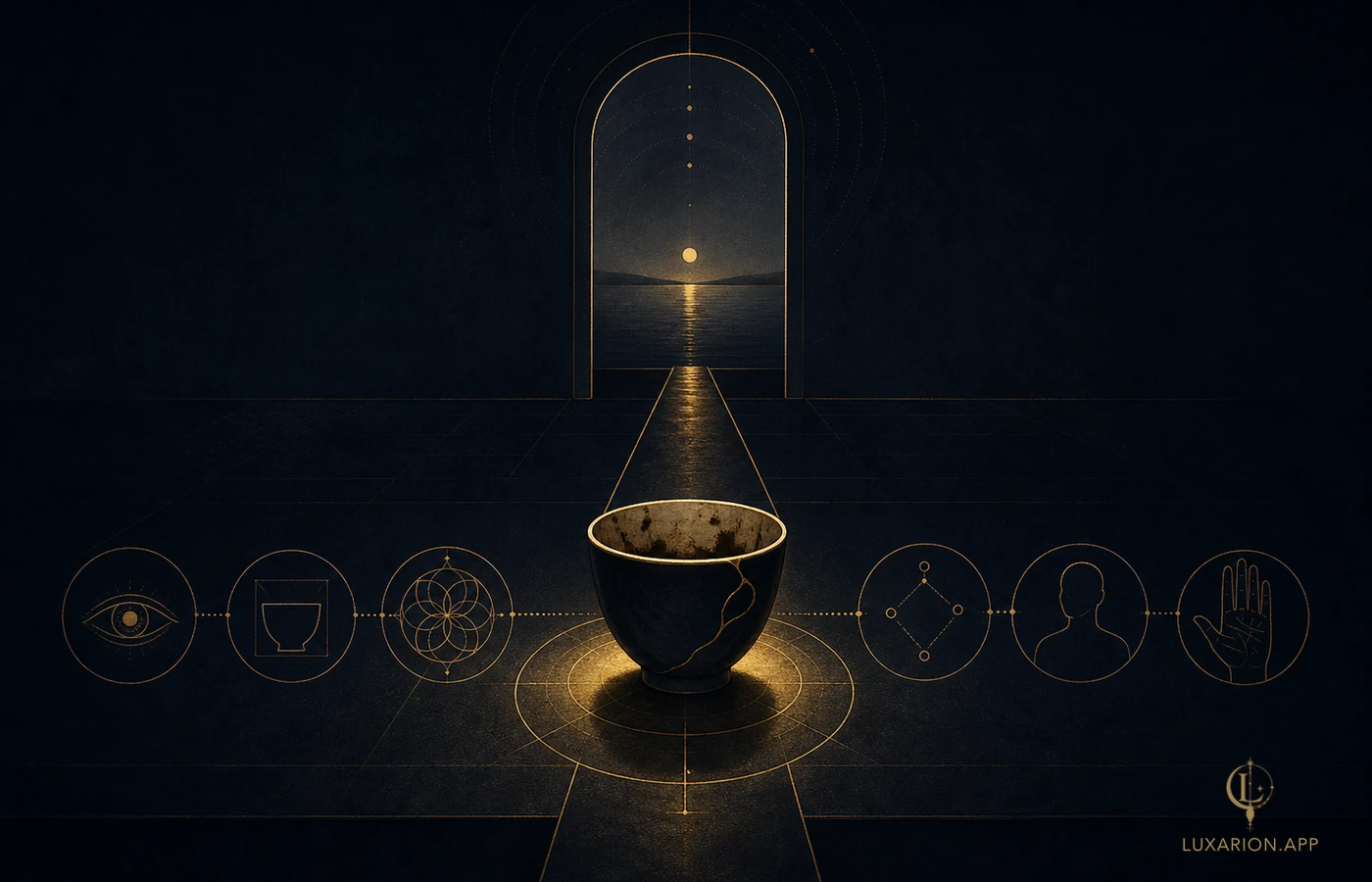
This is where the traditions become concrete, because a reading is a controlled setting for exactly this faculty.
A card, a cup, a palm is not a blank. Each carries its own meaning — the card its tradition, the cup its shapes and regions, the palm its lines — and the reader's sight meets it: the object shows, and the quiet sense sees what it shows for this person and what it says is coming.
The order in which a reader works is itself an intuition-discipline. Structure before symbol; description before interpretation; the whole before the parts. Every one of those rules exists to slow the first impression down long enough to check it, and we set out how that works in how to read tarot and in the cup remembers.
And the craft's ethics guard the sight. Read in a settled state. Do not pronounce on the body or date a death. Decline when the heart is clouded or the person is in the first shock of grief. Each of those protects the perception itself — the same care the traditions have always taken with the heart that sees.
What a strong feeling is often about
One of the more useful things a long practice teaches is that a strong sense frequently has a subject other than the one it announces.
The feeling arrives attached to something — a person, a decision, a plan — and the attachment is not always accurate. Readers see this constantly: someone arrives certain that their unease is about a job offer and leaves having named that it is about a conversation they have been avoiding for a year. The unease was real and well-founded. Its stated object was wrong.
There is a reason for this. The heart registers that something in the field needs attention faster than the mind can name what; emotional signals arrive before their object. Attaching them to a specific cause is a second step, done quickly and often carelessly, and it is the step where most of the error enters.
Which produces a practical move worth knowing. When a sense is strong, ask what else it could be about before deciding what it is about. Name three candidates rather than one. Most people, given the exercise, notice that the second or third candidate is more uncomfortable than the first — and that discomfort is usually informative.
This is also why talking a hunch through with someone is not weakness. A second person cannot feel your sense, but they are considerably better placed than you are to notice what it has been attached to.
When the sense is clouded
It is worth being specific about what clouds the sense, because "trust your intuition" is unhelpful advice precisely when it matters.
Novelty. The first time in a new situation, your pattern library is matching against the wrong shelf. The feeling of recognition is often strongest here, because the mind is reaching for the nearest familiar thing.
Fatigue and fear. Both narrow perception and both increase confidence. The traditions' insistence on a settled state before reading is exactly this discipline: a clouded heart perceives clouds.
Wanting an outcome. The strongest hunches most people report are about things they badly want or badly fear. That is where the self's desire — what the traditions call hawā, and the psychologists confirmation bias — does its work, and where a reading needs a second pair of eyes.
After the fact. Hindsight rewrites memory: once you know how it turned out, you remember having known. Everyone does this. It is the main reason people over-rate their own intuition, and the only reliable defence is writing things down before the outcome.
That last point produces the most useful practice in this entire article, and it costs nothing.
The domains most people are good at
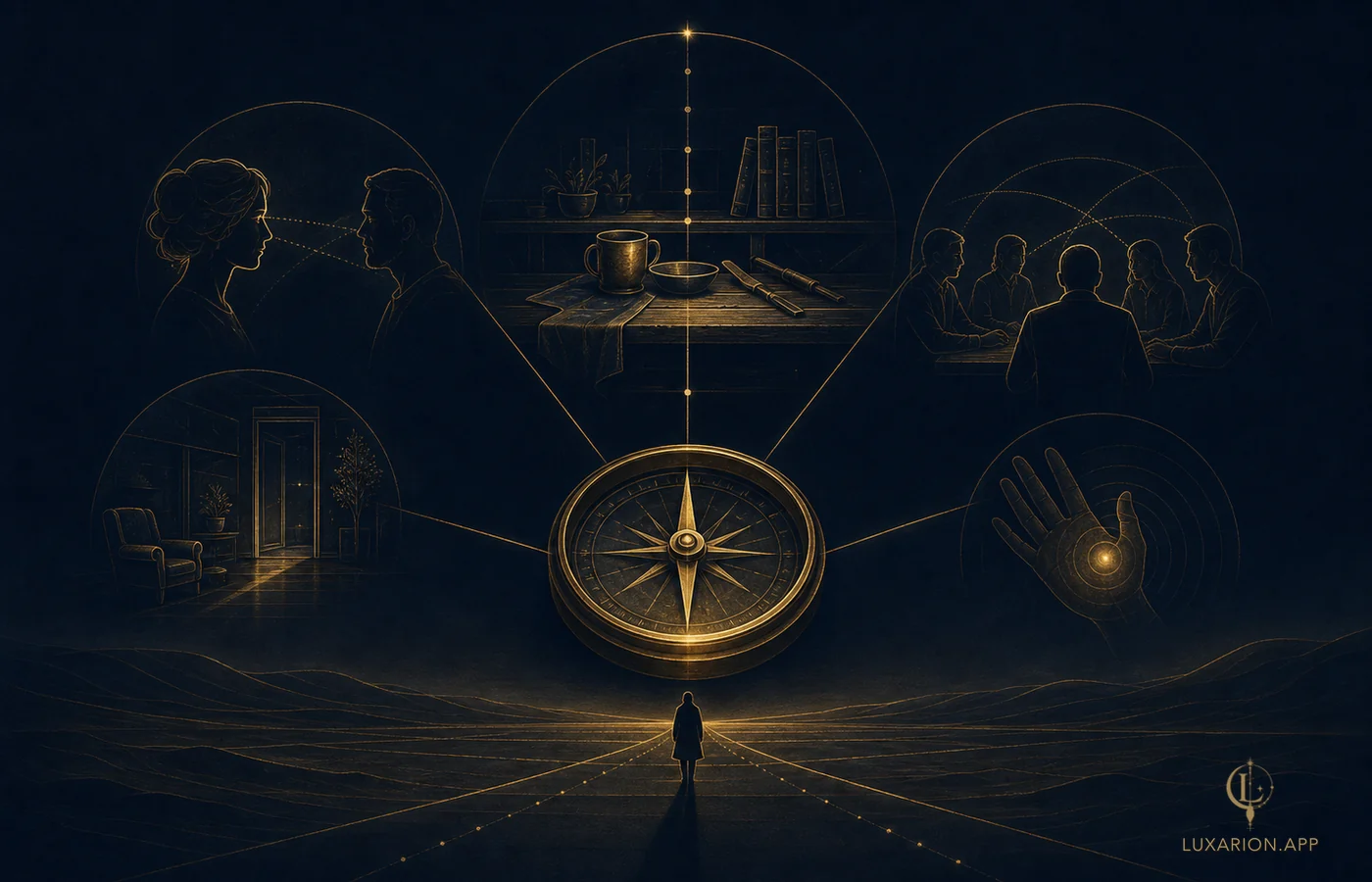
Since the two-part test turns on where you have seen enough, it is worth naming the domains where most adults genuinely qualify — because people routinely underrate these and overrate the flashier ones.
Faces and moods. You have seen tens of thousands of instances with immediate feedback since infancy. Almost everyone's intuition here is well-founded, and it is the reason "something was off with him" so often turns out to be right.
Your own field. Whatever you have done for a decade with real consequences — teaching, nursing, code, a trade, a kitchen — you have a trained sense in, and it is usually better than your ability to justify it.
Rooms and groups. Whether a meeting is going to go badly, whether two people have already discussed something before you arrived. Regular environment, fast feedback, enormous sample.
Your own body. Not diagnosis — that is a different and much harder problem — but the sense that something has changed. You are the only person with a lifetime of baseline.
Set against that, the domains where an untrained hunch is least reliable are also predictable: anything involving many independent actors, anything on a long time horizon, anything about a stranger's intentions, and anything you badly want to come out a particular way. Those are exactly the matters the reading crafts bring their own instruments to — the card, the cup, the chart — and a reader whose sight has been trained.
The point of the list is not to rank people. It is that the same person is well-calibrated in one domain and poorly calibrated in another, at the same moment, with the feeling in both cases identical.
The practice: write it before you know
If you want to find out how good your quiet sense actually is, there is one method, and anyone can keep it.
When you have a strong sense about something, write it down. One line. Date it. Then leave it.
Come back in three months and read what you wrote — not what you remember thinking. Almost everyone who does this for the first time discovers that they were right more often than they expected, and that their sense was sharpest in the matters closest to them. That discovery is worth more than any amount of theorising, and it is available to anyone with a notebook.
Do it long enough and something better happens: you learn where your intuition is reliable. Most people find they have two or three genuinely strong domains — usually areas where they have had a decade of contact and honest feedback — and several where their confidence is not earned. Knowing which is which is the practical form of this whole subject.
This is also, not coincidentally, the discipline behind one card a day, and behind the traditional instruction to record a dream before interpreting it. The traditions arrived at the same method for the same reason: memory is not a witness you can call.
Training the faculty
The quiet sense grows the way the traditions have always said it grows — with practice, a settled heart and honest attention to what proved true — and a few things measurably help.
Increase your sample. Whatever domain you want a good sense in, you need many instances of it, close together, with outcomes you actually learn.
Slow the first impression by a beat. Not to discard it — to look at it. Attentional practice, meditation, dhikr and prayer all train the same thing: the gap between noticing a reaction and acting on it, where the heart settles and the sight clears.
Learn to describe before you interpret. "This is heavy, this is near the handle" before "this means a journey". The habit generalises far outside the reading crafts and it is the single fastest way to improve accuracy.
Attend to the body, and tell its signals apart. The bodily signal that arrives with a hunch is real and worth noticing — a great deal of perception runs through the body. The traditions teach you to tell the tightening of fear from the settled weight of knowing; the first agitates, the second stays still when you look at it.
Keep a record. Everything above depends on feedback, and without a written record you do not have feedback. You have a story.
What the quiet sense is for
There is a temptation, once you know the sense can be trained, to lean on it alone for everything. The traditions teach a better way: the quiet sense works with its instruments.
It is very good at people and at rooms. Reading a mood, sensing that someone is not saying the thing they came to say, knowing that a conversation is about to turn — these are regular environments in which most adults have had thousands of instances and immediate feedback. Trust that.
For matters beyond your own field and your own life — the course of a relationship, a season ahead, what another person carries toward you — the quiet sense is at its best joined to a reading: the cards, the cup or the chart give it the shape of what is coming, and a trained reader's sight reads that shape.
And on its own it is at its best as the first sight. The hunch that says something is wrong here is doing its proper job when it makes you look closely; practitioners describe this identically across crafts — the sense opens the reading.
That is what a reader brings to a reading: a sight trained over years, meeting the card, the cup or the life in front of it, to see what is there and what is coming. If you would like that sight turned on your own question, that is what our spiritual reading is.
Where this leaves the quiet sense
Two things are true at once, and holding both is the whole discipline.
A third belongs with them. Recognition explains the firefighter and the nurse, and a part of what happens at a reading table. It does not explain the case every practitioner eventually meets: the certainty about a matter the person had no stored pattern for, no exposure to, no way of having learned. The contemplative traditions have a vocabulary for that sight and have always worked with it. The recognition account describes one route the signal can travel and is silent about the others.
The quiet sense is real. It is not decoration, it is not a figure of speech, and the people who work with it professionally — in fire crews, in hospitals, at reading tables — are not fooling themselves about its existence. Thousands of hours of pattern-matching produce a faculty that genuinely outruns conscious reasoning, and dismissing it wholesale means discarding the most reliable thing an experienced person has.
And it has its discipline. It speaks true from a settled heart and a trained eye. Clouded by fear or by wanting, the feeling persists unchanged while the sight dims, which is the trap.
The traditions and the laboratories, from opposite directions, reached the same practical instruction, and it is worth carrying in one sentence: listen to the quiet one, ask what it is made of, and write it down before you find out.
One form the quiet sense takes has a tradition of its own behind it — the number that keeps arriving until you notice it. That is set out in why you keep seeing 11:11.
That is not a compromise between two views. It is what both of them actually say.
The library teaches the craft. A reading applies it to you.
Get your personal reading