
What Is Synastry? Chart Comparison Beyond Sun Signs
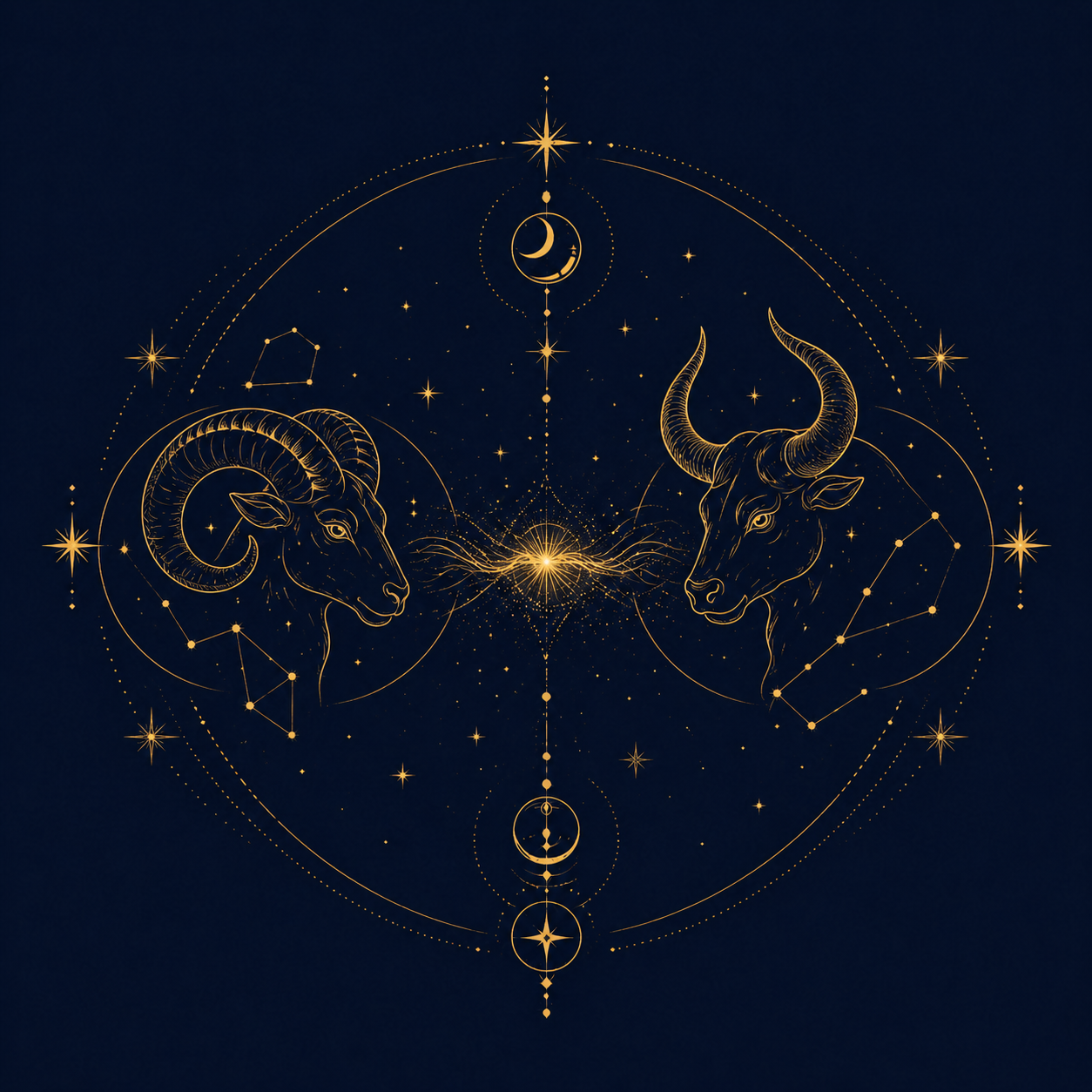
The craft's answer to 'are we compatible?' was never a score out of twelve. Synastry lays two whole charts side by side and reads their conversation — here is how the instrument actually works.
Sun-sign matching — Aries clashes with Cancer, Taurus belongs with Virgo — is astrology's most popular product and its least defensible one. The largest data check ever run on the idea, across roughly ten million marriages, found no effect whatsoever; we told that story in Compatibility Is a Verb. But here is what the headlines skip: the classical craft agreed. Serious astrologers never matched by Sun sign. Their instrument was synastry — from the Greek for "stars together" — and it works on an entirely different principle.
Two charts, laid transparent
Synastry begins with two complete birth charts — each computed from date, time, and place, each already a portrait of one person's engine, tide, and doorway. Then the transparency is laid: where do your planets fall against the other person's chart? Your Moon in their seventh house; their Saturn sitting on your Mercury; your Venus trine their Sun. Every such contact is read as a channel in the relationship — a place where the two systems touch, feed, or grind.
The aspects: how planets converse
The geometry between two planets — the aspect — sets the tone of each channel. Conjunctions merge; trines and sextiles flow, sometimes so easily the couple never develops muscles there; squares and oppositions grind, which the old craft did not read as doom but as the relationship's gymnasium. A Venus–Saturn square between two charts is the classic example: affection meets structure, which can feel like coldness — or become the very thing that makes love last, once both people know the channel exists. That is the point of the map: friction located is friction workable.
What the reading actually weighs
A working synastrist reads clusters, not single contacts: whether the Moons can rest with each other (the deep habitability question), what Saturn touches (where the bond will be tested and where it can build), where Mars lands (heat, and quarrels), and which houses receive the other person's planets — the same planet in your third house is a conversation partner, in your tenth a colleague, in your eighth something much less casual. No single contact decides anything. The chart conversation, like the human one, is read whole.
An honest instrument, honestly used
Synastry does not output a percentage, and any tool that does has left the craft. What it outputs is a map: here are this bond's easy channels, here are its grinding ones, here is what each of you is asked to practice. That is also why the ethics matter — both people's birth details, both people's consent, as with every third-party reading. A Luxarion compatibility reading computes both charts precisely and reads their conversation in your language — a map instead of a score, which is the only thing the craft ever honestly had to sell.
The library teaches the craft. A reading applies it to you.
Get your personal reading